Introduction
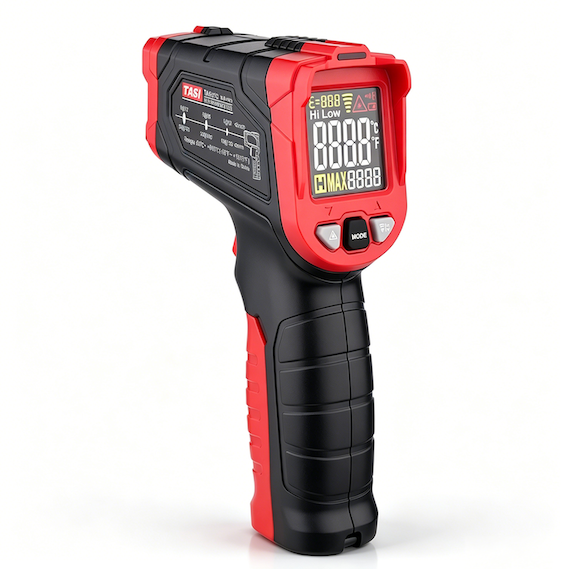
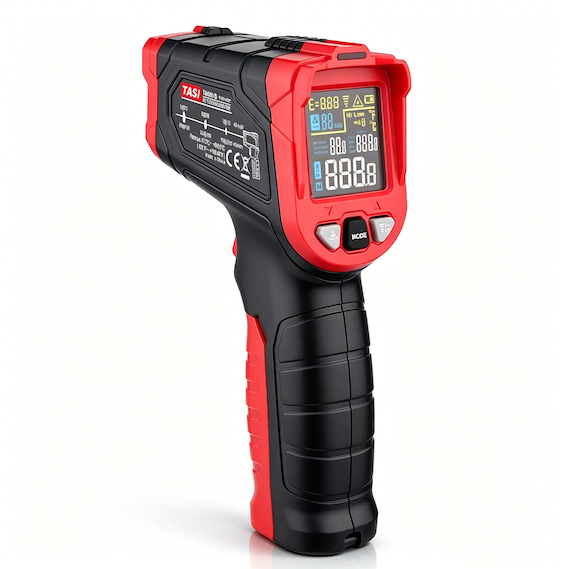
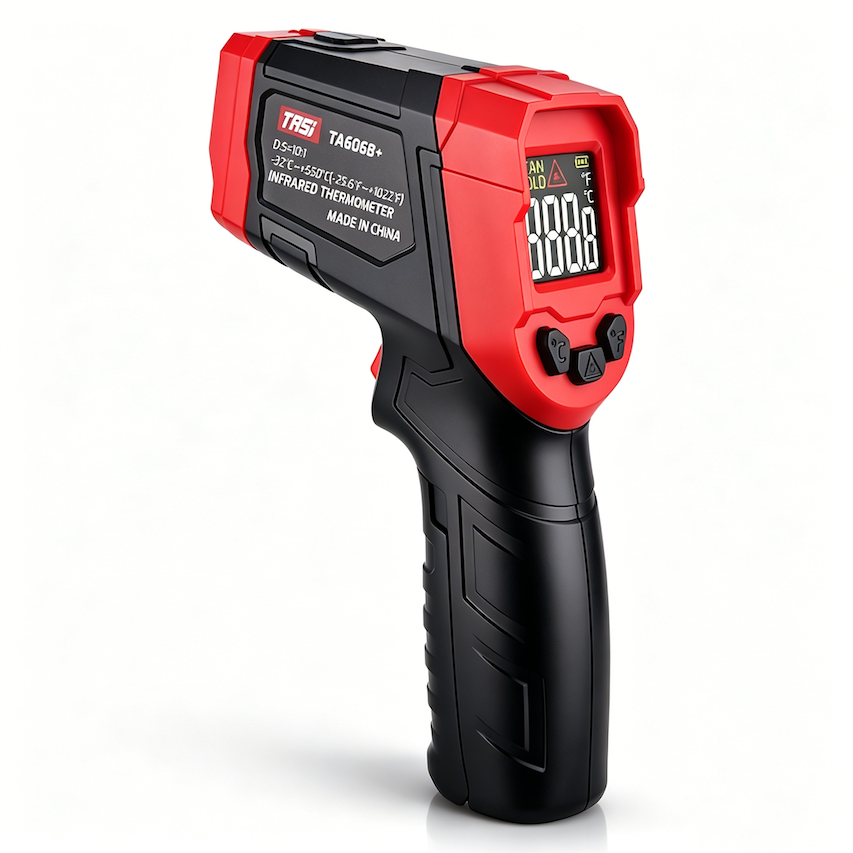
An infrared thermometer can measure surface temperature quickly without making physical contact with the target. The key component that makes this possible is not the laser, but the infrared detector inside the instrument.
In many handheld infrared thermometers, this detector is a thermopile sensor. It receives infrared radiation emitted by the target surface and converts the absorbed radiant energy into a very small electrical voltage. The instrument then applies temperature compensation, signal amplification, analog-to-digital conversion, and temperature calculation algorithms to produce the final displayed temperature.
Understanding how a thermopile works also helps explain why infrared temperature measurements are affected by emissivity, measuring distance, target size, reflected background temperature, and ambient temperature.
Key Points
● A thermopile does not directly “read temperature”; it first detects infrared radiant energy emitted by the target.
● The optical system focuses infrared radiation onto the thermopile's sensing area.
● The thermopile uses the thermoelectric effect to convert the temperature difference between its sensing junctions and reference junctions into a small voltage.
● Because sensor output also depends on the sensor's own temperature, infrared thermometers normally require ambient or reference-junction temperature compensation.
● The instrument calculates the target surface temperature using the thermopile signal, emissivity setting, sensor temperature, calibration data, and internal algorithms.
● Contaminated optics, an undersized target, low-emissivity surfaces, and strong reflected background radiation can all affect the infrared energy reaching the thermopile.
What Is a Thermopile Sensor?
A thermopile is an infrared detector that converts thermal radiation into an electrical signal. It typically consists of multiple miniature thermocouples connected in series, with each thermocouple formed from two materials having different thermoelectric properties.
When the sensing area absorbs infrared radiation, its temperature rises slightly. A temperature difference between the sensing junctions and reference junctions then generates a thermoelectric voltage.
The voltage produced by a single thermocouple is very small, so multiple thermocouples are connected in series. Their voltages add together, producing an output signal that can be more effectively detected and processed by the instrument electronics.
In simplified terms, a thermopile:
● Receives infrared radiation;
● Converts radiant energy into a small temperature rise;
● Converts the temperature difference into an electrical voltage;
● Sends this voltage to the instrument electronics for further processing.
The thermopile therefore performs the fundamental conversion from infrared radiant energy to an electrical signal.
Why Can a Thermopile Detect a Target Object?
Any object above absolute zero emits electromagnetic radiation, part of which lies in the infrared spectrum.
As the temperature of an object changes, both the intensity and spectral distribution of its infrared radiation change. Infrared thermometers use this relationship between thermal radiation and temperature to perform non-contact measurements.
When the instrument is aimed at a target surface, part of the infrared radiation emitted from the measurement area enters the optical system and is directed onto the thermopile sensor.
The thermopile does not need to touch the target, nor does the target need to transmit an active signal. The sensor simply detects naturally emitted infrared radiation.
This is the fundamental reason an infrared thermometer can measure surface temperature rapidly from a distance.
How Does Infrared Radiation Reach the Thermopile?
Only a portion of the infrared radiation emitted by the target reaches the detector. An infrared thermometer uses a specifically designed optical system to collect radiation from a defined field of view and focus it onto the thermopile sensing area.
The optical path typically includes:
● An infrared lens or optical window;
● An aperture and internal optical path;
● The thermopile sensing area.
The optical system determines the size of the area being measured at a given distance. It is therefore directly related to the instrument's D:S (Distance-to-Spot Ratio).
As the measuring distance increases, the infrared radiation reaching the thermopile generally comes from a larger target area. If the target is smaller than the measurement spot, the detector may also receive infrared radiation from the surrounding background.
The displayed result may then represent a combination of radiation from the intended target and its surroundings rather than the true temperature of the target surface alone.
How Does a Thermopile Convert Infrared Radiation into Voltage?
The operating principle of a thermopile is based on the thermoelectric effect.
The sensor generally contains two thermally distinct regions:
● Sensing junctions that absorb infrared radiation and increase slightly in temperature;
● Reference junctions thermally connected to the sensor substrate or internal structure.
When infrared radiation reaches the absorber, the sensing junctions warm slightly while the reference junctions remain relatively stable.
This creates a temperature difference between the two junction groups.
Because a thermocouple made from two dissimilar materials generates a thermoelectric voltage when a temperature difference exists, each thermocouple produces a very small voltage.
By connecting many thermocouples in series, these voltages are added together to form the thermopile output signal.
When the infrared radiation from the target changes, the temperature difference within the thermopile also changes, resulting in a corresponding change in output voltage.
Under defined operating conditions, the thermopile output therefore corresponds to the amount of infrared radiation absorbed by the detector.
Why Is the Thermopile Signal Alone Not Enough to Determine Target Temperature?
A thermopile detects the temperature difference produced by absorbed radiation. It does not directly output a signal equivalent to “50°C” or “200°C.”
Its output also depends on the temperature of the sensor itself.
For example, if the target remains unchanged but the internal temperature of the infrared thermometer changes from 20°C to 40°C, the thermal conditions of both the sensing and reference junctions also change. If the instrument used only the thermopile voltage without considering sensor temperature, significant measurement errors could result.
For this reason, infrared thermometers normally include an additional temperature-sensing element near the thermopile to measure the sensor or internal reference temperature.
Depending on the design, this may be referred to as:
● Ambient temperature;
● Sensor temperature;
● Reference-junction temperature;
● Cold-junction temperature.
Terminology varies by sensor and instrument design, but the purpose is essentially the same: to compensate the thermopile output for its own operating temperature.
How Does an Infrared Thermometer Calculate Temperature from the Thermopile Signal?
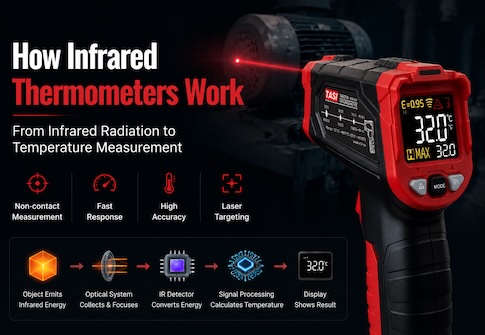
From incoming infrared radiation to the final displayed temperature, the measurement process generally follows these stages:
● The target emits infrared radiation;
● The optical system collects radiation from the specified field of view;
● Infrared energy reaches the thermopile absorber;
● The sensing junctions undergo a small temperature rise;
● A temperature difference develops between sensing and reference junctions;
● The thermopile generates a small voltage signal;
● The analog front end amplifies and filters the signal;
● An analog-to-digital converter converts the signal into digital data;
● The instrument simultaneously measures the sensor or internal reference temperature;
● The microprocessor applies the thermopile signal, sensor temperature, emissivity, and calibration parameters to the temperature calculation;
● The calculated target surface temperature is displayed.
The temperature shown by an infrared thermometer is therefore not a direct output from the thermopile. It is the result of the complete optical, sensing, electronic, calibration, and computational system.
Why Does a Thermopile Require Ambient Temperature Compensation?
A thermopile fundamentally responds to a temperature difference.
If the temperature of the instrument changes, the temperature of the reference junctions may also change even when the target temperature remains constant. This affects thermopile output.
This is why an infrared thermometer moved directly from a cold outdoor environment into a warm room, or from a hot environment into a cooler one, may require time to reach thermal stability.
If significant internal temperature gradients still exist, the thermopile, reference temperature sensor, optics, and electronics may not yet be in a stable thermal condition, and the measurement may drift.
Modern infrared thermometers use compensation algorithms to reduce these effects. However, allowing the instrument to stabilize after a major environmental temperature change remains important for reliable measurement.
Why Does Emissivity Affect Thermopile Measurements?
The thermopile can only detect infrared radiation that actually reaches the sensor. It cannot automatically distinguish how much radiation was emitted by the target itself and how much was reflected from the surrounding environment.
The ability of a material or surface to emit infrared radiation is described by its emissivity ε.
Many painted surfaces, plastics, rubber materials, and non-metallic surfaces have relatively high emissivity. Polished aluminum, copper, stainless steel, and other shiny metallic surfaces can have much lower emissivity.
A low-emissivity surface emits less of its own infrared radiation and may reflect a greater proportion of surrounding thermal radiation.
The thermopile signal may therefore contain:
● Infrared radiation emitted by the target itself;
● Infrared radiation from surrounding heat sources reflected by the target into the instrument.
If the emissivity setting does not correspond to the actual target surface, the calculated temperature can contain significant error.
Emissivity is therefore not a property of the thermopile itself. It is an important target-surface parameter used by the infrared thermometer's measurement algorithm to interpret the detected radiation correctly.
What Determines Thermopile Response Time?
A thermopile must absorb radiation, undergo a small temperature rise, establish a temperature difference, and generate an electrical signal. Its response speed therefore depends strongly on the thermal mass and thermal structure of the detector.
A sensing structure with low mass and low thermal capacity can respond more quickly to changes in infrared radiation.
Modern micromachined thermopiles typically use very small sensing structures to achieve fast response.
However, the response time of a complete infrared thermometer is not determined by the thermopile alone. Other factors include:
● Optical system design;
● Signal amplification and filtering;
● Analog-to-digital conversion speed;
● Digital filtering algorithms;
● Display update rate.
The response time stated in an infrared thermometer specification therefore normally describes the dynamic performance of the complete measurement system rather than only the thermopile sensor.
What Factors Affect the Infrared Signal Reaching the Thermopile?
Even if the thermopile itself is operating correctly, any change in the infrared radiation reaching it can influence the final measurement.
Common factors include:
● Target too small. If the target is smaller than the measurement spot, background radiation contributes to the result.
● Excessive measuring distance. Increasing distance enlarges the measurement spot and increases the likelihood of including surrounding areas.
● Low target emissivity. Shiny metals and other low-emissivity surfaces are more strongly affected by reflected infrared radiation.
● Hot objects in the background. Furnaces, heaters, direct sunlight, or other heat sources can be reflected from the target surface into the sensor.
● Contaminated optical window. Dust, oil, moisture, or condensation can reduce or alter the infrared energy reaching the thermopile.
● Steam, smoke, or particles in the measurement path. Part of the infrared radiation may be absorbed or scattered.
● Rapid changes in instrument temperature. Readings may drift before the thermopile and reference-temperature system reach thermal stability.
● Unsuitable measurement angle. On some surfaces, a large viewing angle can alter the effective emission and reflection conditions.
Infrared temperature measurement is therefore more than simply aiming the instrument at a target. The result depends on the entire path by which infrared radiation travels from the target to the detector.
What Is the Relationship Between the Thermopile and the Laser on an Infrared Thermometer?
They are essentially separate functional systems.
The laser on an infrared thermometer is primarily an aiming aid. It helps the user identify the approximate direction of measurement but normally does not participate in temperature detection.
The actual temperature measurement is performed by:
● The infrared optical system;
● The thermopile sensor;
● Temperature compensation circuitry;
● Signal processing and calculation electronics.
A very small laser spot therefore does not mean that the instrument measures only that small area.
The actual measurement area is determined by the optical field of view and the instrument's D:S.
The laser position also does not necessarily represent the entire optical measurement field. Target size should therefore be selected according to the specified D:S and measurement distance rather than according to the laser spot alone.
What Is the Difference Between a Thermopile and a Thermocouple?
Although a thermopile usually contains multiple thermocouples, a thermopile used in an infrared thermometer serves a different purpose from a conventional contact thermocouple probe.
A contact thermocouple must physically touch the target. Heat transfer brings the measuring junction toward the target temperature, and the thermoelectric voltage is then used to determine the contact temperature.
A thermopile does not need to contact the target.
Instead, its miniature thermocouples detect the small temperature difference produced when infrared radiation heats the sensing structure, allowing the instrument to infer the target surface temperature indirectly.
In practical terms:
● A contact thermocouple measures the temperature reached by the probe through thermal contact with the target;
● An infrared thermopile measures the thermal effect produced by the target's infrared radiation.
Both rely on thermoelectric principles, but their construction, measurement method, and applications are different.
Why Are Thermopiles Well Suited to Handheld Infrared Thermometers?
Thermopile sensors offer several practical advantages for infrared temperature measurement:
● They respond directly to infrared radiation without requiring the instrument to transmit measurement energy toward the target;
● They enable fully non-contact temperature measurement;
● Their compact construction is suitable for handheld instruments;
● With appropriate optics and signal processing, they can support a wide measurement range;
● Their relatively low power consumption is suitable for battery-operated instruments;
● They integrate effectively with reference temperature sensors, microprocessors, and digital compensation algorithms.
For these reasons, thermopiles are widely used in handheld infrared thermometers and other non-contact infrared temperature measurement equipment.
FAQ
Does a thermopile sensor measure temperature directly?
No. A thermopile first detects the thermal effect of infrared radiation on its sensing area and generates a corresponding voltage. The infrared thermometer then calculates the target temperature using sensor temperature, emissivity, calibration parameters, and other compensation data.
Does a thermopile need to touch the target?
No. It detects infrared radiation emitted by the target, allowing completely non-contact temperature measurement.
Is the laser on an infrared thermometer emitted by the thermopile?
No. The laser is normally an independent aiming system. Infrared radiation enters through the instrument optics and reaches the thermopile. The laser is generally not involved in the actual temperature measurement.
Why does an infrared thermometer also need to measure its internal temperature?
Because thermopile output depends on the temperature difference between the sensing and reference junctions. The instrument must know the sensor or reference temperature to calculate the target temperature correctly.
Can a thermopile accurately measure every material?
A thermopile can detect infrared radiation from different materials, but overall measurement accuracy also depends on emissivity, surface reflectivity, measuring distance, target size, and thermal background. Extra care is required with shiny, low-emissivity metals.
Can a dirty lens affect the thermopile measurement?
Yes. Contamination may not directly damage the thermopile, but it can block, absorb, or alter the infrared radiation reaching the sensor and therefore affect the measured result.
Conclusion
The thermopile sensor is a key component that enables non-contact temperature measurement in many infrared thermometers. It absorbs infrared radiation emitted by the target, produces a very small temperature rise at its sensing junctions, and uses multiple thermocouples connected in series to convert this temperature difference into a measurable voltage.
The thermopile itself, however, does not directly provide the target temperature. A complete infrared thermometer also relies on an optical system to define the measurement field, a reference temperature sensor for compensation, and electronic circuitry and algorithms that incorporate emissivity, calibration parameters, and other measurement data.
Infrared thermometer accuracy therefore depends not only on thermopile performance but also on target emissivity, measurement distance, target size, reflected background radiation, optical cleanliness, and ambient temperature stability.
Understanding how a thermopile converts infrared radiation into an electrical signal provides a solid basis for understanding both the advantages of non-contact temperature measurement and the measurement conditions that must be controlled in practical applications.