Introduction
When reviewing the specifications of an infrared thermometer, you will often see terms such as “Spectral Response” or “Spectral Range,” for example 8–14 μm. This specification does not indicate how many degrees Celsius the instrument can measure. Instead, it defines which wavelengths of infrared radiation the thermometer can detect and use.
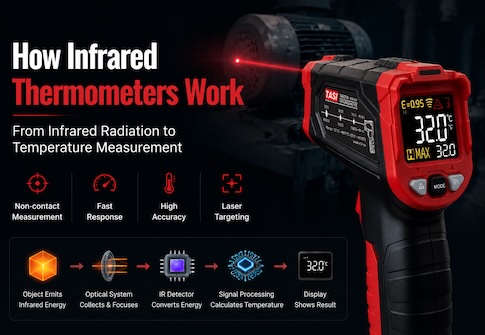
Any object with a temperature above absolute zero emits electromagnetic radiation. The distribution of this radiation across different wavelengths depends on the object's temperature, material, and surface condition. An infrared thermometer detects radiation within a selected wavelength band and converts the measured radiant energy into a surface temperature, taking factors such as emissivity into account.
The spectral response range therefore determines not only what infrared radiation the detector can “see,” but also which temperatures, materials, and measurement environments the instrument is best suited for.
Key Points
● The spectral response range defines the infrared wavelength interval detected and used by an infrared thermometer for temperature measurement.
● General-purpose handheld infrared thermometers commonly operate in the 8–14 μm long-wave infrared band.
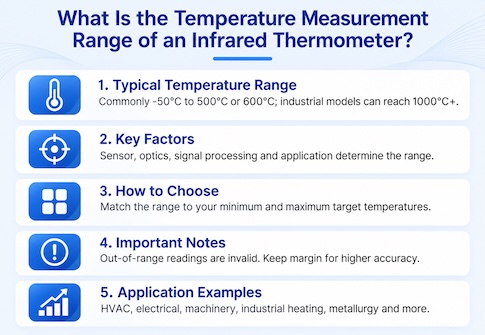
● Spectral response range and temperature measurement range are different specifications and should not be confused.
● A material's emissivity, reflectivity, and transmissivity may vary with wavelength, so the optimum measurement band depends partly on the target material.
● High-temperature metals, glass, plastic films, and other specialized targets may require wavelength bands other than 8–14 μm.
● The wavelength of the visible laser aiming system is unrelated to the infrared spectral response used for temperature measurement.
What Is the Spectral Response Range of an Infrared Thermometer?
The spectral response range can be understood as the range of infrared wavelengths that an infrared thermometer detects and uses to determine temperature.
For example, if an instrument is specified as:
Spectral Response: 8–14 μm
this means that its optical system, spectral filtering, and infrared detector are designed primarily to receive radiation with wavelengths between approximately 8 μm and 14 μm. The measured radiant energy within this band is then used to calculate the target surface temperature.
The symbol μm stands for micrometre. One micrometre equals 0.001 mm.
An infrared thermometer does not detect the entire infrared spectrum. Its optical components, filters, and detector define a specific effective wavelength range so that the instrument responds primarily to infrared energy within its intended measurement band.
Why Do Many Infrared Thermometers Use 8–14 μm?
For objects near ambient temperature and for many targets at temperatures up to several hundred degrees Celsius, long-wave infrared radiation provides favorable conditions for non-contact temperature measurement.
The 8–14 μm region is therefore widely used in general-purpose infrared thermometers intended for industrial maintenance, HVAC inspection, electrical inspection, building diagnostics, and routine surface temperature measurements.
This wavelength region also falls within a commonly used atmospheric infrared transmission window. Over typical short measurement distances, atmospheric transmission within this band is generally suitable for infrared thermometry.
However, 8–14 μm is common rather than universal. Not every infrared thermometer is designed to operate within this wavelength range.
How Does Spectral Response Affect Infrared Temperature Measurement?
Infrared thermometry is based on thermal radiation, and the radiative properties of materials vary with wavelength. Two objects at the same actual temperature may therefore behave differently when observed in different infrared bands.
One of the most important factors is emissivity.
For many materials, emissivity is not constant across the entire infrared spectrum. A particular material may exhibit relatively high and stable emissivity in the long-wave infrared region but significantly stronger reflectivity at shorter wavelengths.
The spectral response range can therefore affect:
● How effectively the instrument detects infrared radiation emitted by the target;
● The suitability of the instrument for different surface materials;
● The influence of emissivity settings on the measurement result;
● The effect of gases, water vapor, or other media along the optical path;
● The strength of the usable detector signal at different target temperatures.
This is why infrared thermometer selection should not be based solely on temperature range and stated accuracy. The spectral characteristics of the target may also be important.
Why Can Different Targets Require Different Wavelength Bands?
General-purpose infrared thermometers are typically used on painted surfaces, plastics, rubber, wood, paper, building materials, food products, and many other non-metallic surfaces. For a large proportion of these applications, the 8–14 μm band is suitable.
Some specialized targets, however, have very different spectral properties.
● High-temperature metals: Metals, especially polished or shiny surfaces, generally have low emissivity and high reflectivity. Professional high-temperature infrared thermometers may use shorter wavelengths to improve measurement performance under specific high-temperature conditions.
● Glass: The transmissivity, absorptivity, and reflectivity of glass vary significantly with wavelength. Measuring glass surface temperature therefore requires an instrument whose operating wavelength is suitable for the type of glass and the application.
● Plastic films: Some thin plastic films are highly transmissive in certain infrared regions. Dedicated film-temperature measurement systems often operate at wavelength bands where the material has stronger absorption.
● Flames and hot gases: Gases exhibit characteristic absorption and emission bands. Industrial measurements involving flames or hot gases may therefore require narrow-band or application-specific spectral designs.
There is consequently no single “best” spectral range for every material and temperature condition.
Is a Wider Spectral Response Range Always Better?
No.
An infrared thermometer does not automatically become more accurate simply because it detects a wider range of wavelengths. In radiation thermometry, selecting a wavelength band that matches the target temperature, material properties, and measurement environment is more important than maximizing bandwidth.
If part of the spectrum is strongly affected by target transmission, reflected background radiation, atmospheric absorption, or other unwanted infrared sources, a wider response range may introduce additional measurement uncertainty.
Professional infrared thermometers therefore use optical filters, detector technologies, and optical systems specifically designed to restrict the operating wavelength range.
The important question is whether the spectral band is appropriate for the application, not whether it is as wide as possible.
What Is the Difference Between Spectral Response Range and Temperature Range?
These two specifications are often confused.
The spectral response range describes which infrared wavelengths the instrument detects, for example:
● 8–14 μm
The temperature measurement range describes the target temperatures the instrument is designed to measure, for example:
● -50°C to 550°C
The first is an optical and detector-related specification. The second defines the instrument's temperature measurement capability.
The two are related through the overall instrument design, but they cannot be converted directly into one another. One 8–14 μm infrared thermometer may measure temperatures up to several hundred degrees Celsius, while another instrument operating in a similar spectral band may have a different temperature range and accuracy specification.
Both parameters should therefore be evaluated separately when selecting an infrared thermometer.
What Is the Difference Between Spectral Response and Laser Wavelength?
The laser on an infrared thermometer is primarily an aiming aid. It normally emits visible light and does not perform the temperature measurement itself.
For example, an infrared thermometer may specify:
● Infrared spectral response: 8–14 μm;
● Laser wavelength: approximately 630–670 nm.
These belong to two different optical systems. The visible red laser spot on the target is not the infrared radiation detected for temperature measurement and does not represent the instrument's infrared measurement wavelength.
Even if the laser aiming function is switched off, the infrared thermometer can continue measuring temperature as long as the infrared detection system is operating normally.
How Is Spectral Response Related to Emissivity?
Emissivity varies with wavelength. The same material may exhibit different radiative behavior at different infrared wavelengths, so its effective emissivity can also vary depending on the spectral response of the measuring instrument.
This means that two infrared thermometers operating in different spectral bands may not necessarily use exactly the same effective emissivity value for the same material.
For routine industrial measurements, using a single adjustable emissivity value is generally sufficient. However, for low-emissivity surfaces, high-temperature metals, glass, thin films, or high-accuracy process measurements, the relationship between target emissivity and instrument wavelength becomes more important.
In these applications, simply entering a commonly quoted emissivity value may not be sufficient. The spectral characteristics of both the target and the infrared thermometer should be considered.
Can the Environment Affect Infrared Radiation at Different Wavelengths?
Yes.
Infrared radiation must travel through the atmosphere between the target and the detector. If the measurement path contains significant amounts of water vapor, steam, smoke, dust, or certain gases, part of the infrared radiation may be absorbed, scattered, or supplemented by radiation emitted by the intervening medium.
These effects are wavelength-dependent, which is another reason why spectral response is an important part of infrared thermometer design.
For typical handheld measurements over short distances in normal air, atmospheric effects are usually limited. For long-distance measurements or applications involving heavy steam, smoke, high humidity, or process gases, the spectral band and optical path should be evaluated more carefully.
Should Spectral Response Be a Major Selection Criterion?
For routine industrial maintenance and general surface temperature measurements, users of established general-purpose infrared thermometers normally do not need to select an instrument based on spectral response alone. The 8–14 μm band is widely suitable for these applications.
However, spectral response deserves greater attention in applications involving:
● High-temperature or extremely high-temperature metals;
● Shiny, polished, or low-emissivity metallic surfaces;
● Glass surfaces and glass-processing operations;
● Plastic film production;
● Flames, combustion processes, or hot gases;
● Long-distance infrared temperature measurement;
● Industrial process control requiring low measurement uncertainty.
In such applications, spectral response should be considered together with temperature range, emissivity, distance-to-spot ratio (D:S), response time, measurement accuracy, and target material properties.
FAQ
What does a spectral response of 8–14 μm mean?
It means that the infrared thermometer primarily detects infrared radiation with wavelengths between approximately 8 μm and 14 μm and uses the detected energy within this band to calculate the target surface temperature.
Can an 8–14 μm infrared thermometer measure every material?
No. It is suitable for many common non-metallic materials and general industrial surfaces, but shiny metals, glass, transparent or semi-transparent films, and other specialized targets may require different measurement techniques or dedicated spectral bands.
Is a wider spectral range better?
Not necessarily. Selecting the correct wavelength band for the target material, temperature, and environment is more important than simply increasing bandwidth.
Does the spectral response determine the maximum temperature range?
Not by itself. The spectral band influences instrument design and suitability, but the maximum measurable temperature also depends on the detector, optics, electronics, signal processing, and calibration.
Is the red laser part of the 8–14 μm infrared measurement band?
No. The red laser is visible light used for aiming. The 8–14 μm band is invisible infrared radiation used by the temperature measurement system.
Conclusion
The spectral response range defines the infrared wavelengths an infrared thermometer can detect and use for temperature calculation. It is an important specification for understanding how infrared thermometry works.
General-purpose handheld infrared thermometers commonly operate in the 8–14 μm spectral range, which is suitable for a wide variety of routine surface temperature measurements. However, different materials, target temperatures, and environments have different spectral characteristics. High-temperature metals, glass, plastic films, and other specialized applications may require dedicated wavelength bands.
For this reason, spectral response should not be evaluated in isolation. Infrared thermometer selection should consider the target material, temperature range, emissivity, D:S ratio, and measurement environment together. General-purpose long-wave infrared thermometers are suitable for most routine applications, while specialized materials and industrial processes may require closer matching between the instrument's spectral response and the target's infrared characteristics.