Introduction
When using an infrared thermometer, the instrument does not measure an infinitely small point. Instead, it detects infrared radiation emitted from a defined area of the target surface. The size of this area is determined by the thermometer's Field of View (FOV).
As the measurement distance increases, the area covered by the instrument generally becomes larger. Therefore, even if the laser aiming point remains on the target, surrounding surfaces may contribute infrared radiation if the target is too small to fully cover the actual measurement area.
Understanding FOV helps determine how much of the target is actually being measured and provides an essential basis for understanding measurement distance, spot size, and D:S ratio.
Key Points
● FOV defines the spatial area from which the infrared thermometer's optical system receives infrared radiation.
● An infrared thermometer measures an area, not the laser point itself.
● The measurement spot generally becomes larger as the measurement distance increases.
● The target should fully cover the thermometer's actual measurement area.
● FOV and D:S ratio are closely related, but they describe optical performance in different ways.
● If the target is too small or the measurement distance is too great, background temperatures may influence the reading.
What Is the FOV of an Infrared Thermometer?
FOV stands for Field of View.
For an infrared thermometer, it describes the spatial range from which the optical system can receive infrared radiation. The optical system can be visualized as a viewing cone that expands outward: the farther the target is from the instrument, the larger the area generally covered.
For example, when measuring a heated metal plate, the detector does not receive radiation only from the exact location of the laser point. It receives infrared energy from a larger surface area within the measurement field.
FOV therefore answers an important practical question:
● At the current measurement distance, how large is the area actually being measured?
This area is commonly referred to as the measurement spot or spot size.
Why Does FOV Affect Infrared Temperature Measurements?
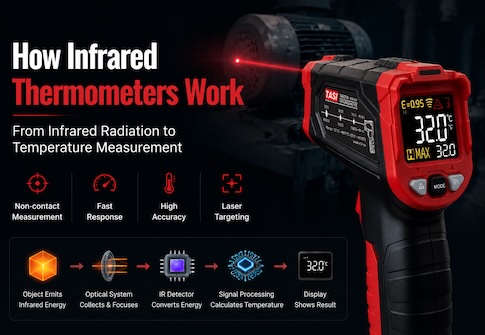
An infrared thermometer calculates temperature from the infrared radiation reaching its detector. If the entire field of view is filled by the intended target, the detected radiation mainly originates from that target.
However, if the measurement spot extends beyond the edges of the target, the detector may receive radiation from both the target and surrounding surfaces.
For example, when measuring a narrow hot pipe from too far away, the measurement spot may become larger than the pipe diameter. The detector may then receive infrared radiation from:
● The pipe surface;
● The wall behind the pipe;
● Nearby equipment or surrounding surfaces.
The displayed temperature may therefore no longer represent the actual surface temperature of the pipe.
This effect becomes particularly significant when the temperature difference between the target and the background is large.
How Does Measurement Distance Relate to FOV?
For most infrared thermometers, the measurement area becomes larger as the distance from the target increases.
A simple way to understand this is:
● Shorter distance → smaller measurement spot;
● Longer distance → larger measurement spot.
If the manufacturer specifies the full field-of-view angle θ, the spot diameter can be approximated geometrically as:
Spot diameter ≈ 2 × measurement distance × tan(θ ÷ 2)
where θ is the full field-of-view angle.
In practical use, however, portable infrared thermometers are more commonly specified by their D:S ratio, which provides a more convenient way to describe the relationship between measurement distance and spot diameter.
What Is the Difference Between FOV and D:S Ratio?
FOV and D:S ratio both describe the measurement area of an infrared thermometer, but they express optical performance differently.
FOV describes the optical viewing range primarily as an angle, while D:S expresses the relationship between measurement distance and spot diameter.
In the D:S ratio:
● D means Distance;
● S means Spot Size.
For example, if an infrared thermometer has a D:S ratio of 12:1, it theoretically means:
● At approximately 120 mm, the spot diameter is about 10 mm;
● At approximately 600 mm, the spot diameter is about 50 mm;
● At approximately 1200 mm, the spot diameter is about 100 mm.
A higher D:S ratio generally allows a smaller target to be measured from the same distance.
In practical terms, FOV describes the optical field concept, while D:S provides users with a more direct method for evaluating measurement distance and target size.
Is FOV the Same as the Laser Spot?
No.
This is one of the most common misunderstandings when using an infrared thermometer.
The laser is mainly an aiming aid. It helps indicate approximately where the instrument is pointed. The laser itself does not measure temperature and does not represent the entire area detected by the infrared sensor.
Even if the visible laser point is only a few millimeters in diameter, the actual infrared measurement spot may already be several tens of millimeters or larger.
Therefore:
● The laser indicates the aiming position;
● FOV determines the optical detection area;
● The measurement spot represents the actual target area contributing to the temperature reading.
A laser point on the target does not mean that only that point is being measured.
How Much Larger Should the Target Be Than the Measurement Spot?
For reliable measurements, the target should not merely match the theoretical spot diameter.
A better practice is to ensure that the target is clearly larger than the measurement area so that the entire infrared field of view remains within the target surface. This also provides margin for aiming error, hand movement, and the actual optical response profile.
For example, if the calculated spot diameter at a given distance is 50 mm, a target exactly 50 mm in diameter is not necessarily an ideal measurement condition.
In practice:
● Reduce the measurement distance whenever possible;
● Select a larger and more uniform target area;
● Avoid positioning the measurement spot near target edges;
● Prevent background surfaces from entering the actual measurement field.
For small targets, moving closer is generally more reliable than relying solely on the laser aiming point.
Is a Smaller FOV Always Better?
Not necessarily.
A smaller FOV generally produces a smaller measurement spot at the same distance, making it suitable for:
● Small targets;
● Long-distance measurements;
● Localized measurements on pipes, electrical components, and similar objects;
● Applications requiring higher spatial resolution.
However, selecting an infrared thermometer also requires consideration of temperature range, accuracy, response time, emissivity settings, spectral response, and the specific application.
For large targets or routine short-distance measurements, very high optical resolution may provide little practical benefit.
FOV or D:S ratio should therefore be selected according to the actual target size and measurement distance, rather than assuming that a higher optical specification is always better.
When Is FOV Particularly Important?
When measuring large walls, floors, or large equipment surfaces, FOV is usually less problematic as long as the target fully fills the measurement area.
FOV becomes especially important when measuring:
● Small pipes or wires;
● Electrical terminals, connection points, and connectors;
● Localized components on PCBs;
● Bearings and small mechanical components;
● High-temperature equipment from a distance;
● Targets measured from behind safety barriers;
● Targets surrounded by surfaces at significantly different temperatures.
In these situations, if the target does not fully cover the measurement field, the reading may deviate from the true target surface temperature even when the instrument is correctly aimed.
How Can FOV-Related Measurement Errors Be Reduced?
First, check the infrared thermometer's D:S ratio or the optical diagram provided by the manufacturer and estimate the spot size at the intended measurement distance.
The target should then be large enough to clearly exceed the measurement spot.
Recommended practices include:
● Measure from the shortest practical distance;
● Use a higher D:S ratio for small targets;
● Do not confuse laser spot size with infrared measurement spot size;
● Aim at the central area of the target rather than near its edges;
● Prevent backgrounds, openings, or objects at different temperatures from entering the field of view;
● Confirm that the target is sufficiently large before performing long-distance measurements;
● For higher-accuracy applications, consult the optical diagram or spot-size specifications for the specific instrument model.
FAQ
Does a larger FOV mean a wider temperature measurement range?
No. A larger FOV generally means that a larger physical area is covered at the same distance. Temperature measurement range describes the minimum and maximum temperatures the instrument can measure and is a separate specification.
Are FOV and D:S ratio the same parameter?
Not exactly. FOV usually describes the optical field as an angle, while D:S expresses optical resolution as the ratio between distance and spot size. Both describe how the measurement area changes with distance.
Is an infrared thermometer more accurate when it is closer to the target?
Not necessarily in terms of the instrument's specified accuracy. However, a shorter distance generally produces a smaller spot, making it easier for the target to completely fill the field of view and reducing background interference.
Why can the reading still be incorrect when the laser is on the target?
Because the laser is only an aiming reference. If the infrared measurement spot is larger than the target, the detector may also receive radiation from surrounding surfaces.
What applications benefit from a high D:S ratio?
High D:S ratios are generally useful for small targets, long-distance measurements, or applications where surrounding surfaces must be excluded from the measurement area, such as elevated pipes, electrical components, mechanical parts, and high-temperature equipment.
Conclusion
The FOV of an infrared thermometer describes the spatial area from which its optical system receives infrared radiation and therefore determines the size of the effective measurement area at different distances.
The key principle is simple: an infrared thermometer measures an area, not the laser point.
As the measurement distance increases, the measurement spot generally becomes larger. If the target does not fully cover the field of view, infrared radiation from surrounding surfaces may enter the detector and affect the temperature reading.
For reliable measurements, FOV, D:S ratio, measurement distance, and target size should therefore be considered together. For small targets, reduce the measurement distance or select an instrument with a higher D:S ratio, and always ensure that the target fully covers the actual measurement area.