Introduction
Infrared thermometers detect infrared radiation emitted from a target surface, allowing them to measure not only solids but also many types of liquids without physical contact. However, one important limitation must be understood: an infrared thermometer generally measures the surface temperature of a liquid, not its internal or bulk temperature.
For water, oils, and certain industrial fluids, an infrared thermometer can provide a fast surface-temperature reading when the liquid surface emits infrared radiation effectively and the measurement conditions are suitable. If the application requires the temperature inside the liquid, the average bulk temperature, or high-accuracy process measurement, a thermocouple, RTD, or another suitable contact temperature sensor may be more appropriate.
Key Takeaways
● Infrared thermometers can measure many liquids, but they primarily measure surface temperature.
● Water and other high-emissivity liquids are generally suitable for infrared measurement, although steam, foam, and surface movement can affect readings.
● Oils, chemicals, and molten materials may have different emissivity values, so the emissivity setting should be matched to the actual material.
● An infrared thermometer does not directly measure temperature deep inside a liquid.
● During heating, cooling, or thermal stratification, surface temperature may differ significantly from internal temperature.
● The target area should fully cover the thermometer's measurement spot, while steam, container edges, and strong reflected radiation should be minimized.
Can an Infrared Thermometer Measure Liquids Directly?
Yes. Under suitable conditions, an infrared thermometer can be aimed directly at an exposed liquid surface for non-contact temperature measurement.
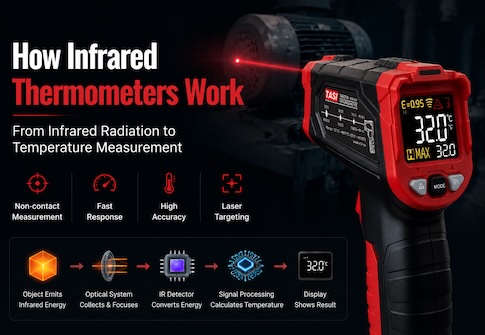
The instrument does not send a signal into the liquid and then determine its internal temperature. Instead, it detects infrared radiation emitted by the liquid surface and calculates temperature based on the received radiation, the selected emissivity, and the instrument's measurement algorithm.
In this respect, measuring a liquid with an infrared thermometer is fundamentally similar to measuring a solid surface: the instrument detects radiant temperature information from the surface within its field of view.
Typical examples include:
● Water surface temperature;
● Hot or cold water surface temperature;
● Cooking oil or industrial oil surface temperature;
● Coolant surface temperature;
● Certain chemical liquid surface temperatures;
● Liquid raw materials or process-bath surface temperatures.
However, different liquids do not have identical infrared radiation characteristics. The same instrument setting therefore cannot be assumed to provide equal accuracy for every liquid.
Why Does an Infrared Thermometer Measure the Surface Temperature of a Liquid?
An infrared thermometer detects infrared radiation entering its optical system from the direction of the target. With typical handheld infrared thermometers, the reading mainly represents the temperature of the outermost visible surface.
For example, when an infrared thermometer is aimed at a cup of hot water, the displayed value represents the temperature near the water surface rather than the temperature at the center or bottom of the cup.
If the liquid has been thoroughly mixed and its temperature is relatively uniform, the surface temperature may be close to the internal temperature. However, during rapid heating or cooling, or when thermal stratification is present, the difference can become significant.
For example:
● Liquid near the bottom of a heated vessel may be hotter than the surface;
● A hot liquid left undisturbed may develop temperature differences between upper and lower layers;
● During cooling, the surface may cool faster than the interior;
● Stirring generally produces a more uniform liquid temperature and makes the surface reading more representative.
For this reason, an infrared surface-temperature reading should not automatically be interpreted as the internal liquid temperature.
Which Liquids Are Suitable for Infrared Temperature Measurement?
Many liquids with relatively high and stable emissivity are suitable for infrared surface-temperature measurement.
Water is a common example. Within the spectral range used by many infrared thermometers, water surfaces generally have high emissivity. When distance, environmental conditions, and instrument settings are appropriate, stable surface-temperature measurements can usually be obtained.
Many oils and other liquids can also be measured, although their emissivity may vary depending on the liquid type, surface condition, and temperature.
For an unknown liquid, particularly when measurement accuracy is important, its infrared emission characteristics should be understood and the thermometer's emissivity should be set accordingly.
When Can Liquid Temperature Measurements Become Inaccurate?
Heavy steam above the liquid
When measuring hot water, boiling water, or high-temperature process fluids, steam or vapor may be present between the thermometer and the liquid surface. This can absorb, scatter, or emit infrared radiation and affect the signal reaching the detector.
Foam on the surface
Foam has different surface properties from the liquid underneath. If the thermometer is aimed at foam, the reading may mainly represent the foam surface rather than the actual liquid below it.
Rapidly moving liquid surfaces
Flowing, stirred, or vibrating liquids continuously change the measurement area and can cause unstable readings. Taking several measurements and observing the stabilized value can help.
Incorrect emissivity setting
Different liquids can have different emissivity values. If the actual emissivity differs substantially from the instrument setting, systematic measurement error may result. For adjustable-emissivity infrared thermometers, the setting should be selected according to the liquid being measured.
Measurement spot larger than the liquid surface
Infrared thermometers have a specified distance-to-spot ratio (D:S). As measuring distance increases, the measurement spot generally becomes larger. If the spot extends beyond the liquid surface, the container edge, table, or surrounding objects may enter the field of view and affect the reading.
Measuring the container instead of the liquid
If a liquid is inside a glass bottle, plastic bottle, or other closed container, aiming an infrared thermometer at the outside wall does not mean the internal liquid temperature is being measured. The instrument will normally measure the temperature of the container's outer surface.
Can Liquid Temperature Be Measured Through Glass?
With most handheld infrared thermometers, ordinary glass should not be treated as transparent to the infrared wavelengths used by the instrument.
Although glass is transparent to visible light, it is not necessarily transparent in the long-wave infrared range commonly used by handheld infrared thermometers. When the instrument is aimed at a glass container, it will generally detect infrared radiation and reflected energy associated mainly with the glass surface.
As a result, the displayed temperature will usually be closer to the glass surface temperature than to the temperature of the liquid behind it.
For liquids inside glass bottles, cups, or viewing windows, it is generally preferable to measure an exposed liquid surface or use an appropriate contact temperature probe.
How to Measure Liquid Temperature Correctly with an Infrared Thermometer
For more reliable liquid surface-temperature measurements:
● Aim directly at the exposed liquid surface whenever possible rather than measuring through ordinary glass or transparent plastic;
● Set emissivity appropriately for the liquid, particularly when using an adjustable-emissivity infrared thermometer;
● Maintain a suitable measuring distance so that the liquid surface completely covers the measurement spot;
● Avoid the edges of the container to prevent the container wall from entering the field of view;
● When measuring high-temperature liquids, minimize steam or vapor between the instrument and the surface;
● If foam is present, determine whether the required measurement is the foam surface or the actual liquid surface underneath;
● During rapid heating or cooling, remember that surface temperature may not represent internal temperature;
● Where safe and appropriate, mixing the liquid before measurement can improve temperature uniformity;
● Measure several points across the surface when necessary to check whether the liquid temperature is uniform.
Can an Infrared Thermometer Measure Boiling Water?
Yes, an infrared thermometer can measure the surface temperature of boiling water, although the measurement conditions are more challenging.
As water approaches boiling, vigorous surface movement and steam can interfere with the optical path. Temperatures may also vary slightly across different areas of the surface and within the vapor above it, causing the displayed value to fluctuate.
Infrared measurement is suitable for a rapid indication of water-surface temperature. However, when accurate internal liquid temperature is required, particularly for laboratory work, calibration, or process control, an appropriate contact temperature probe is generally more suitable.
It is also important to remember that the boiling point of water is not always exactly 100°C. It varies with atmospheric pressure and altitude.
Can an Infrared Thermometer Measure Oil Temperature?
In many applications, yes, provided the measurement conditions are suitable.
Different oils may have different surface emissivity characteristics, while flow conditions, surface appearance, temperature, smoke, or vapor can also affect the infrared measurement.
For industrial inspections, infrared thermometers are useful for quickly checking the surface temperature of lubricating oil, hydraulic oil, heat-transfer oil, and other fluids without physical contact.
However, when the purpose is to accurately monitor the temperature inside a tank, pipeline, or vessel, an appropriately positioned contact temperature sensor should be used rather than relying solely on an infrared surface reading.
Does Liquid Surface Temperature Represent Internal Temperature?
Not necessarily.
Surface temperature is most representative of the overall liquid temperature when the liquid is thermally uniform and heat transfer between the surface and the interior is relatively stable.
The surface and internal temperatures may differ significantly when:
● The liquid is heating rapidly;
● The liquid is cooling rapidly;
● A localized heat source is applied to the bottom or side of the container;
● The liquid has not been sufficiently mixed;
● Thermal stratification is present;
● Strong evaporation is occurring;
● The ambient temperature differs substantially from the liquid temperature.
If the application requires the temperature at the center, bottom, a specific depth, or the average bulk temperature, a contact probe capable of being immersed in the liquid should be used.
When Should a Contact Thermometer Be Used?
Infrared and contact temperature measurements are not simply interchangeable methods. Each is suited to different measurement requirements.
Infrared thermometers are particularly useful for fast, safe, non-contact checks of liquid surface temperature, including routine inspections, temperature screening, moving liquids, and targets that are difficult or undesirable to contact directly.
A contact thermometer is generally more appropriate when:
● Internal liquid temperature is required;
● Temperature at different depths must be measured;
● Long-term continuous monitoring is needed;
● Significant differences exist between surface and internal temperatures;
● Higher measurement accuracy is required;
● The liquid emissivity is uncertain or changes significantly;
● Steam, smoke, or other infrared interference is present.
In critical industrial or laboratory applications, infrared measurement can also be used as a rapid screening method, followed by contact measurement when verification is required.
FAQ
Can an infrared thermometer measure water temperature?
Yes, but it normally measures the water surface temperature. If the water is thermally uniform, the surface temperature may be close to the internal temperature. During heating, cooling, or thermal stratification, however, the difference may be significant.
Can an infrared thermometer measure hot water in a cup?
Yes, if it is aimed directly at the exposed water surface. If the thermometer is aimed at the cup wall, the reading will mainly represent the cup surface temperature.
Can an infrared thermometer measure liquid through a glass bottle?
Generally, no. Ordinary glass is not transparent to many of the infrared wavelengths used by handheld infrared thermometers. The instrument will usually measure the glass surface rather than the liquid behind it.
Can an infrared thermometer measure cooking oil temperature?
Usually yes for surface-temperature measurement. However, emissivity and surface condition vary among oils. When higher accuracy is required, the emissivity setting should be appropriate and the result may need to be verified using a contact measurement.
Can an infrared thermometer measure boiling liquids?
Yes, but steam, bubbles, and surface movement may cause unstable readings. When accurate internal liquid temperature is required, a contact probe is generally recommended.
Why does an infrared thermometer give a different reading from a temperature probe?
The most common reason is that the two instruments measure different locations. An infrared thermometer mainly measures the liquid surface, while an immersed probe measures temperature inside the liquid. Emissivity, steam, measuring distance, and thermal stratification can also contribute to the difference.
Conclusion
An infrared thermometer can measure liquid temperature, but it primarily measures the liquid surface temperature. For water, oil, and many industrial liquids, infrared measurement provides a fast and convenient non-contact method when emissivity is appropriate, the target fully covers the measurement spot, and environmental interference is limited.
However, surface temperature is not always equal to internal liquid temperature. Heating or cooling conditions, thermal stratification, emissivity, steam, foam, measuring distance, and the container can all affect the result.
For rapid surface-temperature checks, an infrared thermometer is highly practical. When accurate internal temperature, temperature at a specific depth, or bulk liquid temperature is required, an appropriate contact temperature sensor should be selected.