Introduction
Infrared thermometers measure surface temperature without physical contact by detecting infrared radiation emitted by the target. From a purely technical perspective, an infrared thermometer can therefore detect the surface temperature of human skin.
However, being able to measure skin temperature does not mean that a standard industrial infrared thermometer is suitable for measuring body temperature.
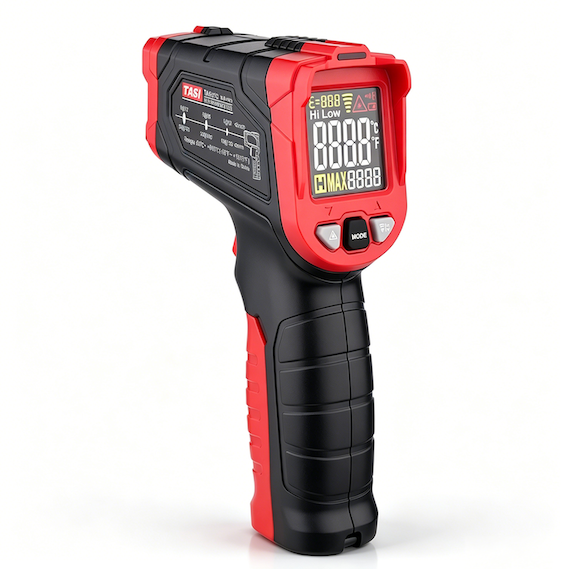
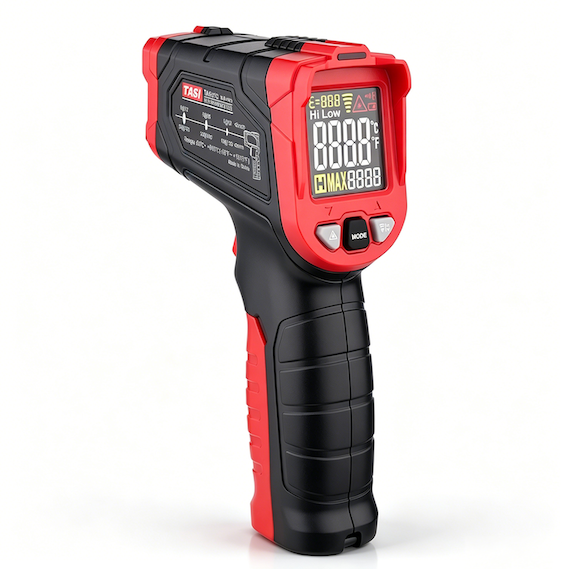
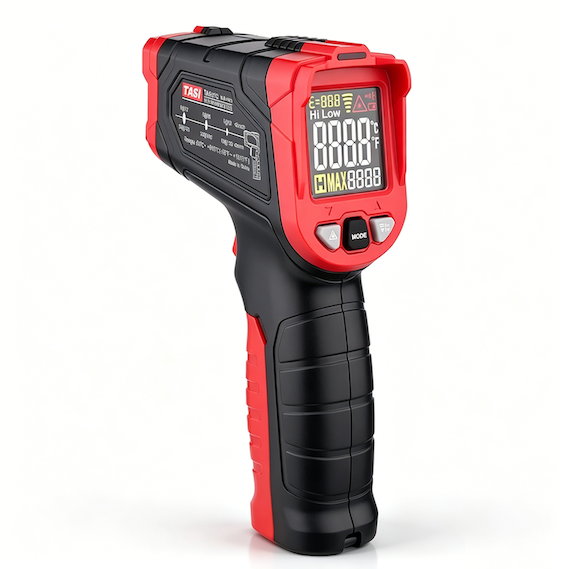
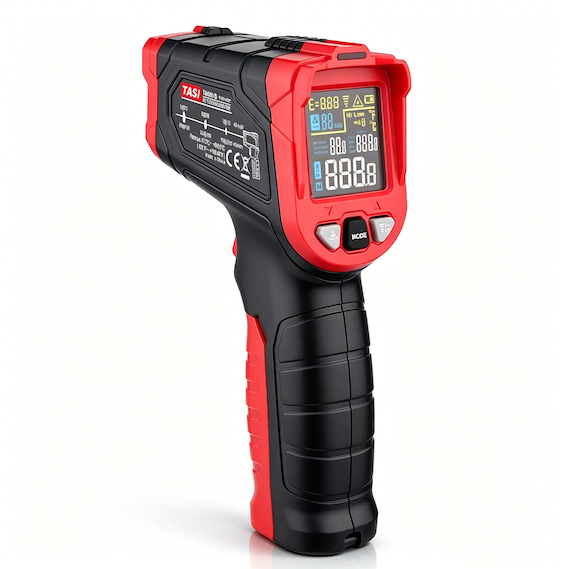
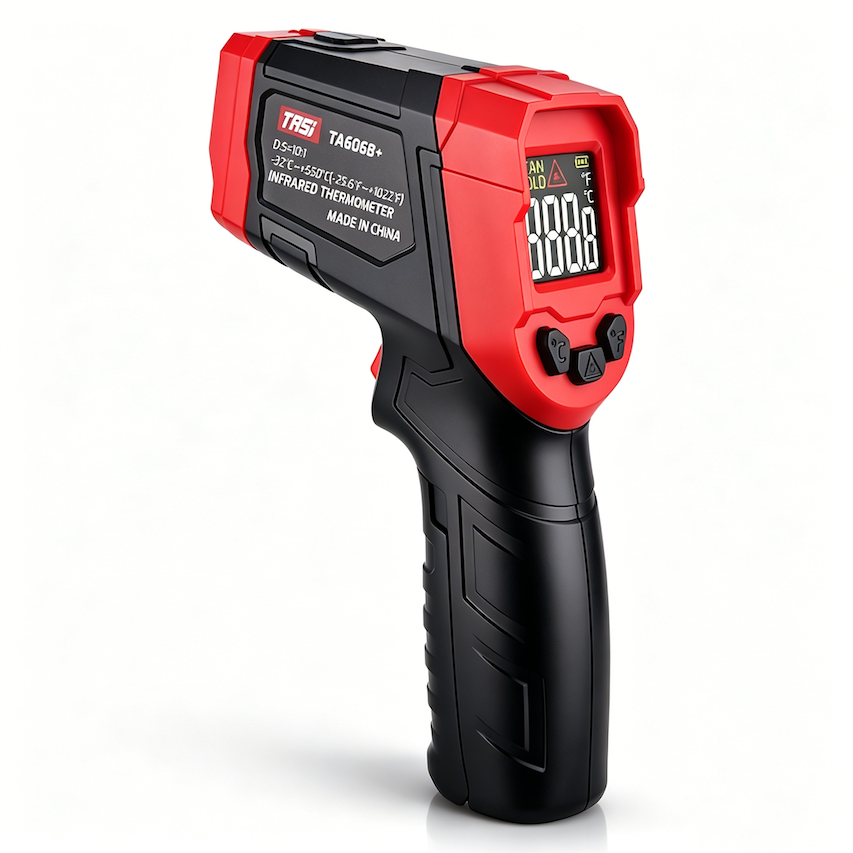
Industrial infrared thermometers are primarily designed for surfaces such as machinery, pipes, electrical components, HVAC equipment, and materials. Infrared body thermometers, by contrast, are specifically designed and calibrated for human temperature measurement.
Although both types of instruments rely on infrared sensing, they differ significantly in measurement purpose, accuracy requirements, calibration, and signal processing.
If the objective is to assess body temperature or perform health screening, a device specifically intended for human temperature measurement should be used instead of a standard industrial infrared thermometer.
Key Points
● Standard industrial infrared thermometers can measure skin surface temperature.
● Skin surface temperature is not the same as internal body temperature.
● Industrial infrared thermometers and infrared body thermometers differ in measurement range, accuracy, calibration, and temperature compensation.
● Readings from an industrial infrared thermometer should not be used directly to determine whether a person has a fever or to assess health status.
● For body temperature measurement, use a thermometer specifically designed and specified for human use.
Why Can an Infrared Thermometer Detect Human Temperature?
Any object with a temperature above absolute zero emits infrared radiation, including the human body.
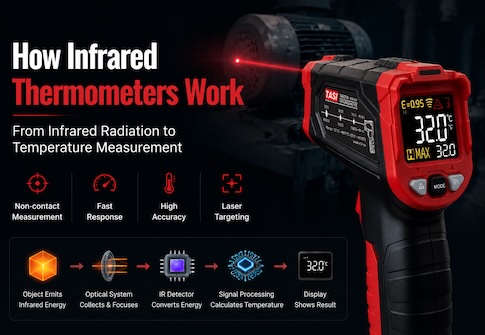
The infrared sensor inside the thermometer detects infrared energy emitted by the skin. The optical system, detector, and electronic circuitry then process this signal and convert it into a temperature reading.
As a result, when an industrial infrared thermometer is pointed at the forehead, arm, or another exposed area of skin, it will usually display a temperature value.
However, this value represents the infrared surface temperature of the measured skin area. It should not automatically be interpreted as core or clinical body temperature.
Why Is Skin Temperature Different from Body Temperature?
Body temperature generally refers to a temperature that reflects the body's internal thermal condition. Skin, however, forms the interface between the body and the surrounding environment, so its temperature can change considerably.
For example, forehead temperature may vary under different conditions.
● After entering a warm indoor environment from cold weather, forehead temperature may temporarily be lower.
● Exposure to direct sunlight may increase skin temperature.
● Perspiration can cool the skin through evaporation.
● Air conditioning, fans, or moving air can change skin temperature.
● Measurements taken on the forehead, hand, or arm may produce different values.
There is therefore no universal fixed conversion between skin surface temperature and internal body temperature that applies to every person, environment, and measurement location.
For this reason, an industrial thermometer reading of approximately 36°C should not automatically be treated as equivalent to actual body temperature.
What Is the Difference Between an Industrial Infrared Thermometer and an Infrared Body Thermometer?
Although both devices use non-contact infrared sensing, they are designed for different applications.
Different measurement targets
Industrial infrared thermometers are typically used for surfaces such as:
● Motors and bearings;
● Electrical cabinets and connection points;
● HVAC equipment;
● Pipes and heating systems;
● Machinery;
● Metal, plastic, wood, and other materials.
Infrared body thermometers are specifically designed for measuring designated areas of the human body, such as the forehead.
Different measurement ranges
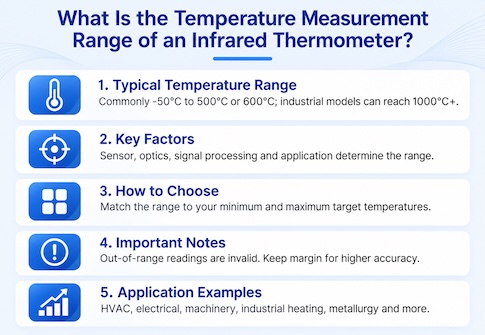
Industrial infrared thermometers often need to cover a very wide temperature range. Some models are designed to measure surfaces at several hundred degrees Celsius or more.
Human body temperature, by comparison, falls within a relatively narrow range. Body thermometers can therefore be optimized specifically for this limited temperature interval.
A wide industrial measurement range and a narrow range optimized for human body temperature represent two different design objectives.
Different accuracy requirements
Industrial temperature measurement often focuses on surface temperature, thermal trends, hot spots, and temperature differences between components.
Human body temperature measurement operates within a narrow temperature range where relatively small measurement deviations can affect interpretation.
A display resolution of 0.1°C on an industrial infrared thermometer does not mean that the instrument provides the same accuracy as a body thermometer. Display resolution and measurement accuracy are not the same specification.
Different calibration and algorithms
Infrared body thermometers are generally designed specifically for human use. Their calibration and internal processing may take account of skin temperature, ambient conditions, and other relevant factors to provide a result suitable for body temperature assessment.
Industrial infrared thermometers normally follow a surface-temperature measurement model. Their displayed result primarily represents the target surface temperature and may not include compensation specifically developed for human body temperature measurement.
Why Does an Industrial Infrared Thermometer Often Read 34°C or 35°C on the Forehead?
This does not necessarily indicate a faulty instrument.
When an industrial infrared thermometer is used on the forehead, it measures skin surface temperature. The forehead continuously exchanges heat with the surrounding air, so its surface temperature can be lower than internal body temperature.
The reading may be reduced further under conditions such as:
● Low ambient temperature;
● Recently entering indoors from a cold environment;
● Perspiration on the forehead;
● Direct airflow from an air conditioner or fan;
● Incorrect measuring distance;
● An unsuitable measurement spot size;
● An instrument not optimized for the human temperature range.
For this reason, a forehead reading of 34°C, 35°C, or another value lower than typical body temperature cannot reliably be converted into actual body temperature simply by adding 1°C or 2°C.
Can You Add a Few Degrees to an Industrial Infrared Thermometer Reading to Estimate Body Temperature?
This is not recommended.
Some sources suggest adding 1°C or 2°C to an industrial infrared thermometer forehead reading. A fixed correction of this kind is not reliable.
The difference between skin temperature and internal body temperature is affected by ambient temperature, blood circulation, measurement location, perspiration, measuring distance, and individual physiological differences.
Two people with the same internal body temperature can have different forehead surface temperatures. Similarly, the same person's forehead temperature can change under different environmental conditions.
A fixed offset should therefore not be used to convert an industrial infrared thermometer reading into body temperature.
Does Setting the Emissivity to 0.98 Make an Industrial Thermometer Suitable for Body Temperature Measurement?
No.
Human skin has relatively high infrared emissivity within commonly used infrared measurement wavelengths, and a value close to 0.98 is often used as a reference when measuring skin surface temperature.
However, emissivity is only one factor affecting infrared temperature measurement.
Setting an industrial infrared thermometer to an emissivity of 0.98 may help improve the estimation of skin surface temperature, but it does not convert the instrument into an infrared body thermometer.
Human temperature measurement also depends on factors such as:
● Measurement location;
● Ambient temperature;
● Instrument accuracy;
● Measurement distance;
● Distance-to-spot ratio;
● Detector response characteristics;
● Ambient temperature compensation;
● Calibration and algorithms designed for human temperature measurement.
Adjusting emissivity alone cannot eliminate the fundamental differences between an industrial infrared thermometer and a body thermometer.
Does the D:S Ratio Affect Measurements on the Human Body?
Yes.
The D:S ratio, or distance-to-spot ratio, determines the size of the area being measured at a given distance.
As the distance between the thermometer and target increases, the measurement spot generally becomes larger.
If an industrial infrared thermometer is used too far away from the skin, the measurement area may extend beyond the intended target and include hair, clothing, or the surrounding background, which can affect the reading.
Even when measuring skin surface temperature for non-clinical purposes, the recommended measuring distance and D:S specification should therefore be followed.
However, correct use of the D:S ratio only improves surface-temperature measurement conditions. It does not give an industrial infrared thermometer clinical body-temperature measurement capability.
Does the Laser Dot Indicate the Exact Area Being Measured?
Not necessarily.
Some industrial infrared thermometers include laser aiming, but the laser is normally provided only to help the user identify the approximate target location.
Temperature is measured from detected infrared radiation, not from the laser beam itself.
The instrument actually measures an area with a defined diameter rather than an infinitely small laser point.
The laser dot should therefore not be interpreted as representing the complete measurement area.
When using an industrial infrared thermometer with laser aiming, avoid directing the laser toward the eyes.
When Can an Infrared Thermometer Be Used for Human Temperature Measurement?
The key consideration is not whether the product is called an “infrared thermometer,” but whether it has been specifically designed and specified for measuring human body temperature.
If the manufacturer's documentation clearly identifies the instrument for human temperature measurement and it has been designed, calibrated, and validated accordingly, it can be used according to the manufacturer's instructions.
If the product documentation primarily lists applications such as:
● Industrial equipment inspection;
● Electrical maintenance;
● HVAC inspection;
● Automotive service;
● Food surface temperature measurement;
● Machinery troubleshooting;
then the instrument is generally an industrial infrared thermometer and should not be treated as a medical or clinical body thermometer.
For users, the manufacturer's stated intended use is more important than the temperature range alone when determining whether a device is suitable for body temperature measurement.
Can an Industrial Infrared Thermometer Be Used to Observe Skin Temperature Trends?
For general observation of skin surface temperature, an industrial infrared thermometer can provide useful comparative information when its limitations are understood.
For example, temperature changes at the same skin location can be compared when the ambient conditions, measurement position, distance, and instrument settings remain consistent.
However, these readings should still be treated as surface-temperature data, not as clinical body-temperature measurements or diagnostic information.
Where fever assessment, health screening, or other body-temperature applications are required, an instrument intended for human temperature measurement should be used.
Which Instrument Should Be Used for Measuring Human Body Temperature?
For body temperature measurement, choose equipment specifically designed for this purpose, such as an appropriate infrared forehead thermometer, ear thermometer, or other suitable clinical thermometer.
For industrial maintenance, electrical inspection, manufacturing processes, or machinery troubleshooting, use an industrial infrared thermometer.
The basic selection principle is:
● Human body temperature: use a thermometer designed for human temperature measurement.
● Object surface temperature: use an industrial infrared thermometer.
● General observation of skin surface temperature: an industrial infrared thermometer may provide surface-temperature data, provided the result is interpreted correctly.
Selecting an instrument suited to the intended measurement is more important than comparing only maximum temperature range or display resolution.
FAQ
Can a standard industrial infrared thermometer measure forehead temperature?
It can provide a forehead surface-temperature reading, but this value should not be treated directly as body temperature. For human temperature measurement, use an infrared body thermometer designed for that purpose.
If an infrared thermometer reads 35°C, does that mean the person's body temperature is too low?
Not necessarily. An industrial infrared thermometer measures skin surface temperature, which may be considerably lower than internal body temperature.
Can I simply add 1°C or 2°C to the reading?
No fixed correction is recommended. The difference between skin and internal body temperature varies with environmental conditions, measurement location, circulation, perspiration, and other factors.
If I set emissivity to 0.98, can the industrial thermometer be used as a body thermometer?
No. Emissivity is only one measurement parameter. Human body temperature measurement also requires appropriate calibration, compensation, measurement geometry, and instrument design.
Is an infrared body thermometer also an infrared thermometer?
Yes, both use infrared radiation for temperature measurement. However, an infrared body thermometer is specifically designed and calibrated for human use, while an industrial infrared thermometer is primarily intended for surface-temperature measurement.
Can an industrial infrared thermometer be used to determine whether someone has a fever?
It is not recommended. Industrial infrared thermometer readings from skin should not be used directly to determine fever status. Use equipment specifically intended for human body temperature measurement.
Does an infrared thermometer emit infrared radiation toward the body?
Normally, no. Infrared thermometers primarily receive infrared radiation naturally emitted by the target. Some industrial models use a visible laser for aiming, but the laser does not perform the temperature measurement.
Conclusion
An infrared thermometer can detect infrared radiation emitted by human skin, so a standard industrial infrared thermometer will normally display a temperature when aimed at the body.
However, it is essential to distinguish between skin surface temperature and body temperature.
Industrial infrared thermometers are designed primarily for surface-temperature measurements on equipment and materials. Infrared body thermometers are specifically optimized and calibrated for human temperature measurement. For this reason, an industrial infrared thermometer should not be used as a direct substitute for a body thermometer, nor should its readings be converted using an arbitrary fixed temperature offset.
Use industrial infrared thermometers for machinery, electrical systems, components, and other surfaces. For human body temperature measurement, choose an instrument clearly designed for that application.
Reliable temperature measurement begins with selecting the correct instrument for the target and intended use.