Introduction
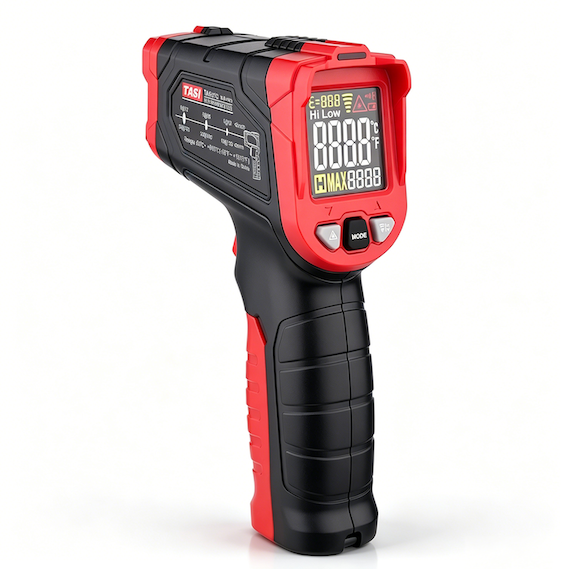
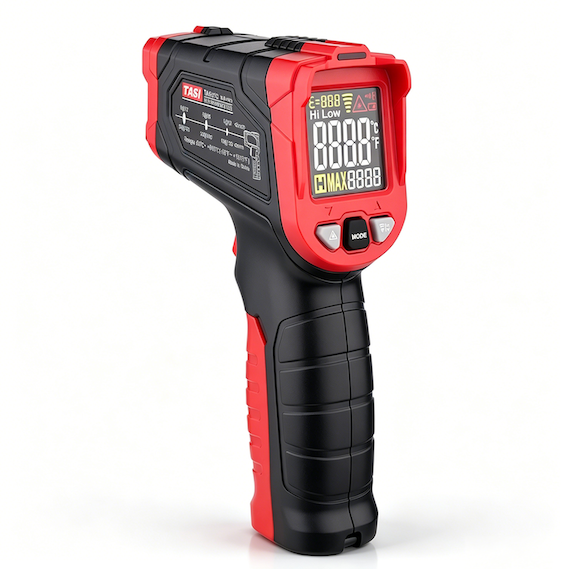
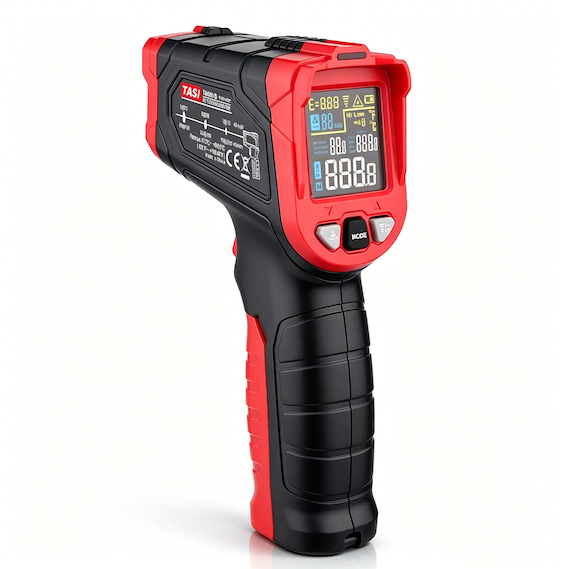
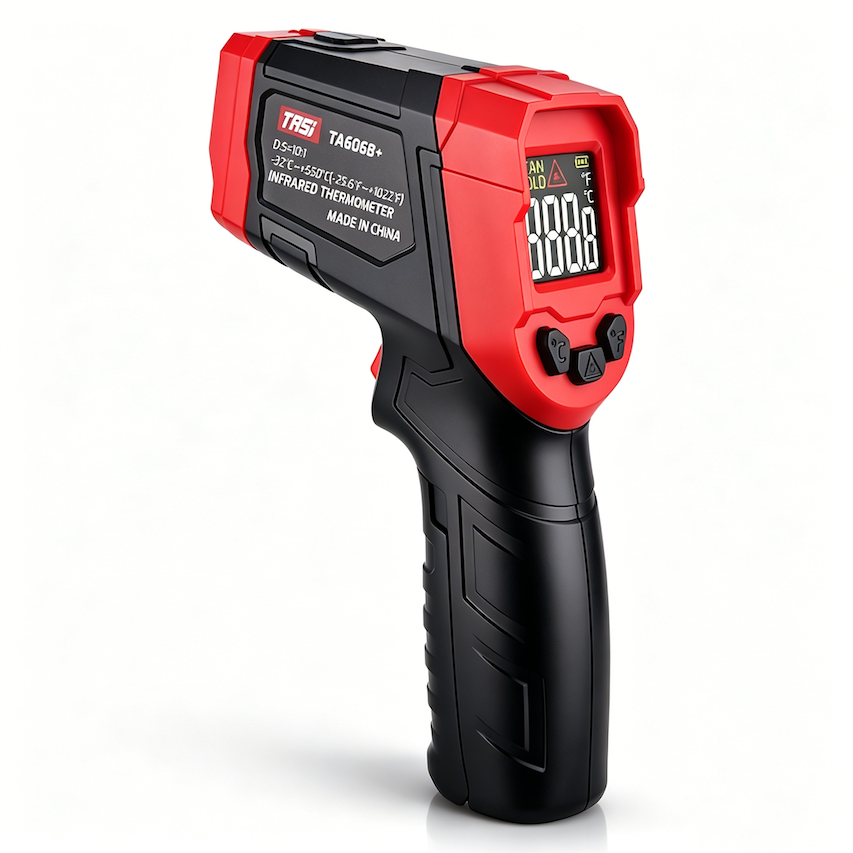
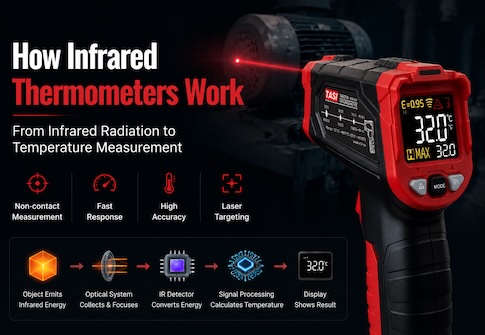
Infrared thermometers are non-contact temperature measurement instruments that use infrared radiation principles to detect the surface temperature of objects. They are widely used in industrial maintenance, electrical inspection, HVAC systems, automotive repair, manufacturing processes, and laboratory applications.
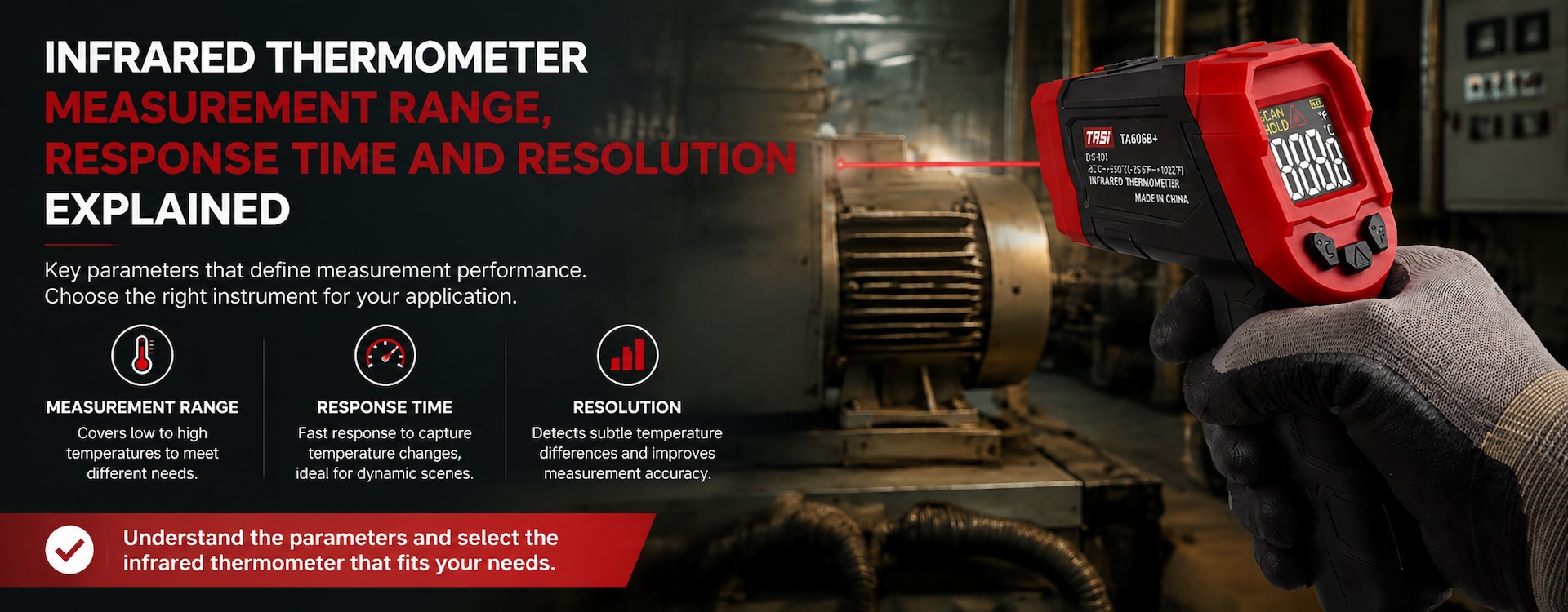
When selecting an infrared thermometer, many users focus mainly on the maximum temperature range while overlooking important specifications such as measurement range, response time, and resolution. These parameters directly determine whether the instrument can meet the requirements of a specific application.
For example, high-temperature equipment inspection requires an appropriate measurement range, while fast-moving production lines require a short response time. Applications involving small temperature differences require higher temperature resolution to identify subtle changes.
Key Points
● Understand the definition and practical importance of the measurement range of infrared thermometers;
● Learn how response time affects fast temperature detection;
● Understand the relationship between temperature resolution and measurement performance;
● Select the right infrared thermometer according to different application requirements.
What Is the Measurement Range of an Infrared Thermometer
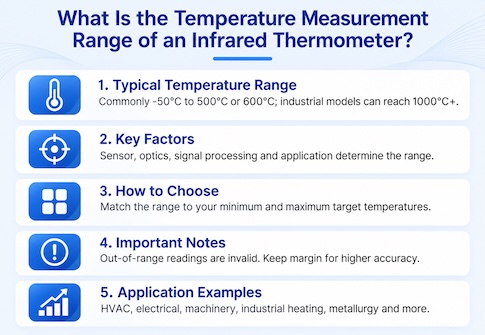
The measurement range refers to the minimum and maximum temperatures that an infrared thermometer can accurately measure. It is usually expressed in degrees Celsius (°C).
For example, an infrared thermometer with a measurement range of -50°C to 550°C can measure surface temperatures within this temperature range.
The measurement range is one of the most important specifications when selecting an infrared thermometer. The appropriate range should be determined according to the actual application environment.
● General equipment maintenance and electrical inspection usually require a medium temperature range;
● Industrial furnaces and high-temperature equipment require infrared thermometers with higher temperature capability;
● Cold chain, food processing, and HVAC applications require reliable low-temperature measurement performance.
A wider measurement range does not always mean better performance. If the target temperature is always near the lower or upper limit of the range, measurement stability may be affected. Therefore, selecting a suitable measurement range according to the actual temperature target is essential.
Factors Affecting the Measurement Range of Infrared Thermometers
The measurement range of an infrared thermometer is determined not only by the infrared sensor but also by several other factors.
● Infrared sensor performance: The sensitivity and detection capability of the sensor affect the measurable temperature range;
● Optical system design: The lens structure and signal processing capability influence measurement performance, especially for distant or high-temperature targets;
● Operating environment: Ambient temperature, humidity, dust, and surface conditions can affect measurement results;
● Emissivity setting: Different materials emit different amounts of infrared radiation, and incorrect emissivity settings may cause measurement errors.
Therefore, even when the target temperature is within the specified measurement range, correct parameter settings and proper measuring distance are still important for reliable results.
What Does Response Time Mean in an Infrared Thermometer
Response time refers to the time required for an infrared thermometer to detect a temperature change and display a stable reading. It is usually expressed in seconds (s) or milliseconds (ms).
A shorter response time means the instrument can react more quickly to temperature variations.
In static measurement environments, such as checking equipment housings or pipelines, response time has less impact. However, fast response is important in applications such as:
● Measuring temperatures on moving production lines;
● Detecting abnormal heat sources in electrical systems;
● Monitoring temperature changes during equipment operation;
● Performing rapid inspection and troubleshooting.
For continuous scanning or applications requiring quick identification of temperature changes, an infrared thermometer with a fast response time is recommended.
Relationship Between Response Time and Practical Applications
Different applications have different requirements for response time.
In industrial environments, equipment operating conditions may change rapidly. If response time is too slow, abnormal temperature increases may not be detected in time. Components such as motors, bearings, conveyor systems, and electrical terminals often require fast temperature feedback.
For building inspection and HVAC maintenance, temperature changes are usually slower, so standard response time performance is generally sufficient.
When selecting an infrared thermometer, response time should be considered together with the target object, temperature variation speed, and inspection purpose rather than simply choosing the fastest model.
What Is Resolution in an Infrared Thermometer
Infrared thermometer resolution generally includes display resolution and temperature resolution.
Display resolution refers to the smallest temperature increment shown on the screen. For example, a display resolution of 0.1°C means the instrument can display temperature values to one decimal place.
Temperature resolution, also known as temperature sensitivity, refers to the smallest temperature difference that the instrument can detect.
For example, a temperature resolution of 0.1°C means the thermometer can distinguish temperature differences of approximately 0.1°C.
For general temperature measurements, standard resolution is usually sufficient. However, applications such as equipment condition monitoring, research testing, and precision measurement require higher temperature resolution to identify smaller temperature variations.
How Resolution Affects Infrared Temperature Measurement
Higher temperature resolution allows an infrared thermometer to detect smaller temperature differences.
For example, during electrical maintenance, two similar connection points may have only a small temperature difference. A low-resolution instrument may not clearly show the abnormal temperature increase, while a higher-resolution device can help identify potential problems earlier.
The required resolution depends on the application:
● Routine equipment inspection mainly focuses on obvious temperature changes and can use standard-resolution instruments;
● Precision equipment testing and research applications require higher temperature resolution;
● Professional infrared inspection applications usually require higher thermal sensitivity.
How to Select the Right Infrared Thermometer
When selecting an infrared thermometer, measurement range, response time, resolution, and other technical specifications should be considered together.
● For industrial equipment inspection, choose a suitable temperature range, fast response time, and reliable performance;
● For electrical fault detection, select an instrument capable of quickly identifying abnormal temperature increases;
● For laboratory or precision testing, prioritize higher temperature resolution and measurement accuracy;
● For long-distance measurement, also consider the distance-to-spot ratio (D:S) to ensure accurate target measurement.
Proper matching of technical specifications helps avoid selecting a device that is either insufficient for the application or unnecessarily over-specified.
FAQ
Is a wider measurement range always better for an infrared thermometer?
No. The measurement range should match the actual application temperature. An excessively wide range does not necessarily provide better performance for specific measurement conditions.
What are the advantages of a fast response time?
A fast response time allows the instrument to capture temperature changes quickly, making it suitable for moving targets and real-time monitoring applications.
What is the difference between temperature resolution and measurement accuracy?
Temperature resolution describes the smallest temperature difference the instrument can detect, while measurement accuracy describes how close the measured value is to the actual temperature.
Which specifications are important for industrial inspection?
Industrial inspection usually requires consideration of measurement range, response time, resolution, emissivity adjustment, distance-to-spot ratio, and environmental adaptability.
Conclusion
The measurement range, response time, and resolution are three important technical specifications that determine the performance of an infrared thermometer.
The measurement range defines the temperature limits the instrument can measure, the response time determines how quickly temperature changes can be detected, and the resolution affects the ability to identify small temperature differences.
When selecting an infrared thermometer, these parameters should be evaluated according to the application environment, target object, and measurement purpose.
Choosing an infrared thermometer with the appropriate specifications can improve measurement efficiency and enhance the reliability of equipment maintenance, fault detection, and quality inspection.