Introduction
A common infrared thermometer fault is that the laser still operates normally when the trigger is pressed, but no valid temperature value appears on the display. The screen may remain blank, show dashes, or display an abnormal indication.
It is easy to assume that the instrument is operating correctly because the laser is visible. In practice, however, the laser aiming system and the infrared temperature measurement system are separate functional sections. A working laser only confirms that the laser circuit is receiving power; it does not confirm that the infrared detector, signal-processing circuitry, or temperature calculation functions are operating correctly.
When this occurs, the thermometer should be checked systematically, starting with the battery and optical system before considering environmental conditions, the trigger switch, or internal electronic faults.
Key Points
● The laser is used primarily for aiming and does not measure temperature.
● A working laser does not confirm that the infrared detector or measurement electronics are functioning correctly.
● Low battery power may allow the laser to operate while preventing stable temperature measurement.
● Heavy contamination, obstruction, or condensation on the infrared optical window can interfere with measurement.
● Ambient temperatures outside the instrument’s specified operating range may prevent normal operation.
● If replacing the battery and checking the optics and environment do not restore the reading, the detector, trigger switch, or internal electronics may require inspection.
Why Can the Laser Work While Temperature Measurement Does Not?
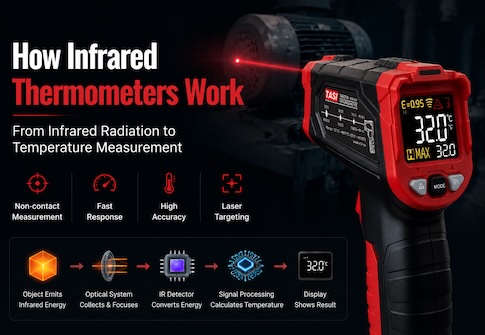
An infrared thermometer typically contains several functional sections, including a laser aiming module, infrared optics, an infrared detector, signal-processing electronics, a display, and power-management circuitry.
The laser helps the operator identify the approximate measurement direction or target area. It does not detect temperature. Temperature is determined by collecting infrared radiation emitted from the target surface through the optical system. The detector converts this radiation into an electrical signal, which is then processed and converted into a temperature value.
The operating sequence can be summarized as follows:
● The laser module assists with aiming.
● The infrared optics collect radiation from the target.
● The infrared detector senses the incoming infrared energy.
● The electronics amplify, compensate, and process the signal.
● The display shows the calculated temperature.
A failure in any temperature-measurement section can therefore result in no temperature reading even though the laser continues to operate.
Check the Battery First
When an infrared thermometer does not display a temperature value, the battery should be one of the first items checked.
Different internal circuits may have different voltage and current requirements. Under low-battery conditions, the remaining power may still be sufficient to operate the laser while the infrared detector, signal-processing circuitry, or display electronics can no longer operate reliably.
Typical symptoms may include:
● The laser still operates normally.
● The display becomes dim or incomplete.
● No temperature value appears.
● Temperature readings appear intermittently.
● The instrument restarts or shuts down unexpectedly.
If the battery has been in service for an extended period or the low-battery symbol appears, replace it with a new battery of the correct type before carrying out further troubleshooting. Do not assume the battery is satisfactory simply because the laser still works.
Inspect the Infrared Optical Window for Contamination, Obstruction, or Condensation
The laser window and the infrared measurement optics are normally separate components. A clear laser window therefore does not guarantee that the infrared optical path is unobstructed.
Check the infrared optical area for:
● Dust, oil, dirt, or other contamination.
● Protective film, tape, or foreign material covering the optical window.
● Condensation after moving the instrument from a cold environment into warmer, humid air.
● Visible scratches, cracks, or mechanical damage.
A small amount of dust is more likely to increase measurement error than to eliminate the reading completely. However, heavy contamination, severe condensation, obstruction, or optical damage can substantially reduce the infrared energy reaching the detector.
Clean optical components only in accordance with the manufacturer’s instructions. Avoid tools or chemicals that may scratch the optics or damage optical coatings.
Make Sure the Instrument Is Within Its Specified Ambient Operating Temperature
An infrared thermometer has its own specified ambient operating temperature range.
If the instrument has been stored for a long period in a hot vehicle, outdoors in very cold conditions, inside a cold room, or in another extreme environment, the detector and internal compensation circuitry may not operate normally.
Rapid movement between environments with large temperature differences can also cause the thermometer’s internal temperature to remain unstable and may lead to condensation on the optical components.
Allow the instrument to acclimatize to the normal operating environment before taking measurements.
This stabilization requirement applies to the thermometer itself, not only to the object being measured.
Check the Measurement Trigger or Button
Many handheld infrared thermometers activate infrared sampling only when the trigger or measurement button is pressed.
If the trigger switch is worn, mechanically damaged, or electrically intermittent, some functions may activate while the actual temperature acquisition process does not start correctly.
Check whether:
● The display changes when the trigger is pressed.
● Releasing and pressing the trigger again changes the instrument status.
● A reading appears only at a particular trigger position.
● The trigger feels loose, sticks, or operates inconsistently.
If readings are obtained only by repeatedly pressing the trigger or changing the pressure applied to it, the switch or its internal connection may require service.
The Infrared Detector or Internal Measurement Electronics May Be Faulty
If the battery, optical system, ambient conditions, and operating procedure are all normal but no temperature value appears, an internal measurement fault should be considered.
Possible causes include:
● Infrared detector failure.
● Poor connection between the detector and circuit board.
● Faults in signal amplification or conversion circuitry.
● Failure of the internal ambient-temperature compensation sensor.
● A main-control circuit that is unable to process the measurement signal.
● Internal damage caused by impact, moisture, or overheating.
These faults generally cannot be corrected through normal user adjustments. If the instrument has been dropped, exposed to water, subjected to severe humidity, or overheated, internal hardware damage becomes more likely.
For industrial inspection or other applications requiring reliable measurements, an instrument with this type of fault should not remain in service until it has been checked.
Target Surface Conditions Usually Do Not Cause a Complete Loss of Readings
Incorrect emissivity settings, excessive measurement distance, a target that is too small, or a highly reflective surface can all affect measurement accuracy.
These conditions usually result in:
● Readings that are noticeably too high or too low.
● Unstable measurements.
● Different readings at different viewing angles.
● Measurements influenced by reflected background radiation.
They normally do not cause the display to show no temperature at all.
If the thermometer cannot obtain a temperature reading from any target, repeatedly changing emissivity or measurement distance is unlikely to solve the problem. The power supply, instrument status, optical system, and internal measurement electronics should be checked first.
Recommended Troubleshooting Sequence
When the laser works but no temperature value is displayed, troubleshoot the instrument from the simplest possible causes to the more complex ones:
● Install a new battery of the correct type and restart the instrument.
● Confirm that the display can show characters and symbols normally.
● Inspect the infrared optical window for dirt, obstruction, condensation, or physical damage.
● Allow the thermometer to acclimatize to a normal operating environment.
● Test it on several ordinary indoor surfaces.
● Check the trigger or measurement button for intermittent operation.
● If the instrument provides a reset function, restore appropriate settings according to the operating instructions and test again.
● If no valid temperature reading can still be obtained, stop relying on the instrument for formal measurements and contact the manufacturer or a qualified service technician.
This approach eliminates common battery and environmental causes before concluding that an internal hardware fault is present.
When Should the Instrument Be Taken Out of Service?
Stop using the thermometer for formal measurements if:
● No temperature reading appears after installing a new battery.
● The instrument has experienced a severe drop or impact.
● The infrared optical window is cracked or visibly damaged.
● The instrument has been exposed to water or severe moisture.
● Temperature readings appear intermittently and cannot be repeated reliably.
● The display continuously shows abnormal characters or fault indications.
● Comparison with a known-good instrument confirms abnormal measurement behavior.
A visible laser spot is not evidence that the instrument is still capable of accurate temperature measurement. For industrial maintenance, electrical inspection, HVAC troubleshooting, and similar applications, measurement performance should be verified before returning the instrument to service.
FAQ
Does a working laser mean the infrared thermometer is not faulty?
No. The laser is only an aiming aid. It confirms that the laser circuit is operating, but it does not verify the infrared detector, signal-processing circuitry, or temperature calculation system.
Why can the laser still work when the battery is nearly depleted?
Different internal circuits require different operating voltages and currents. In some cases, the remaining battery capacity may still power the laser but may be insufficient for stable infrared detection and signal processing. Replacing the battery is therefore one of the first troubleshooting steps.
Can an incorrect emissivity setting cause the thermometer to show no temperature reading?
Normally, no. An incorrect emissivity setting primarily affects measurement accuracy, particularly on low-emissivity metallic surfaces. A temperature value will usually still be displayed.
Can excessive measurement distance cause the temperature reading to disappear?
Normally, no. Excessive distance increases the measurement spot size and may include surrounding areas in the measurement, reducing accuracy. It does not normally eliminate the reading completely.
Can a dirty optical window prevent a reading?
Light dust usually causes additional measurement error rather than a complete loss of the reading. Heavy contamination, obstruction, condensation, or optical damage can significantly reduce the infrared energy reaching the detector and may cause abnormal operation.
What should I do if replacing the battery does not restore the temperature reading?
Check the infrared optics, ambient operating temperature, and trigger switch. If the instrument still cannot measure several ordinary targets under normal conditions, the infrared detector or internal electronics may be faulty and should be inspected by the manufacturer or a qualified service technician.
Can the laser spot be used to confirm that the measurement area is correct?
Not completely. The laser is an aiming aid and does not necessarily represent the full infrared measurement spot. A correctly positioned laser does not confirm that the infrared optical system or detector is functioning properly.
Conclusion
When an infrared thermometer shows a working laser but no temperature reading, the key point is that the laser aiming function and infrared temperature measurement function are separate.
Start troubleshooting with the battery, then check the infrared optics, ambient operating conditions, trigger switch, and any history of impact or moisture exposure. If the thermometer still cannot produce a temperature value from several targets after these checks, the infrared detector or internal electronics may be faulty.
For applications where reliable temperature data is required, do not continue using the instrument solely because the laser still operates. Return it to service only after the temperature measurement function has been restored and its performance has been verified.