Introduction
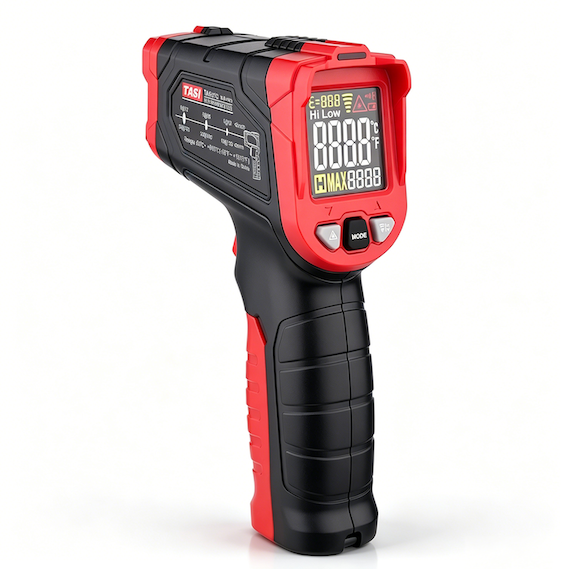
Infrared thermometers can determine an object’s surface temperature without physical contact by detecting infrared radiation emitted from its surface. However, the relationship between detected radiation and temperature is not identical for every material because different surfaces emit thermal radiation with different efficiencies.
To establish a defined and calculable relationship between thermal radiation and temperature, thermal radiation theory uses an ideal reference known as a blackbody.
A blackbody is the fundamental reference model for radiation thermometry. At a given temperature, its spectral radiation characteristics can be described precisely by physical laws. Infrared thermometers use these ideal radiation relationships as their theoretical basis and then account for factors such as the emissivity of real surfaces when converting infrared radiation into temperature.
Key Points
● A blackbody is an ideal thermal radiator with an emissivity of ε = 1.
● The intensity and spectral distribution of thermal radiation change with temperature.
● Planck’s law describes the spectral radiation emitted by a blackbody at different wavelengths and temperatures.
● Infrared thermometers detect radiation within a defined infrared spectral range and calculate temperature from the measured signal.
● Real objects are not ideal blackbodies, so emissivity and reflected ambient radiation must be considered.
● Blackbody radiation sources are widely used for calibration and performance verification of infrared thermometers.
What Is a Blackbody?
In thermal radiation theory, a blackbody is an idealized object that completely absorbs electromagnetic radiation incident on its surface, without reflecting or transmitting it.
At the same time, at a given temperature, a blackbody is also the most efficient possible thermal emitter.
Emissivity ε is commonly used to describe the radiation capability of a real surface relative to that of an ideal blackbody:
ε = radiation emitted by the actual surface ÷ radiation emitted by a blackbody at the same temperature
For an ideal blackbody:
ε = 1
For a real object:
0 < ε < 1
The term “blackbody” therefore does not simply mean an object that appears black to the human eye. It is a physical model describing thermal radiation behavior.
A surface that appears black in visible light does not necessarily have an infrared emissivity of 1. Conversely, a surface that is not visually black may still have a high infrared emissivity.
What Is Blackbody Radiation?
Any object with a temperature above absolute zero contains thermal motion at the atomic and molecular level and emits energy in the form of electromagnetic radiation.
The thermal radiation emitted by an ideal blackbody at a given temperature is referred to as blackbody radiation.
Blackbody radiation is distributed over a range of wavelengths rather than occurring at only one wavelength. As temperature changes, both the radiation intensity and the distribution of energy across the spectrum change.
In general:
● Higher temperatures produce greater total thermal radiation.
● Changes in temperature alter the spectral distribution of the emitted radiation.
● As temperature increases, the wavelength of peak emission shifts toward shorter wavelengths.
Because temperature and thermal radiation are related by defined physical laws, radiation can be measured and used to determine temperature.
Why Is Planck’s Law Fundamental to Infrared Temperature Measurement?
One of the most important laws describing blackbody radiation is Planck’s law.
It defines the spectral radiance of a blackbody at a given absolute temperature T and wavelength λ.
The fundamental relationship can be expressed as:
L(λ,T) = f(λ,T)
where:
● L represents spectral radiance;
● λ represents wavelength;
● T represents absolute temperature in kelvin.
Under ideal blackbody conditions, a measured radiation level within a defined spectral range can therefore be related to temperature.
This relationship is one of the fundamental principles behind modern radiation thermometry.
How Can an Infrared Thermometer Determine Temperature from Radiation?
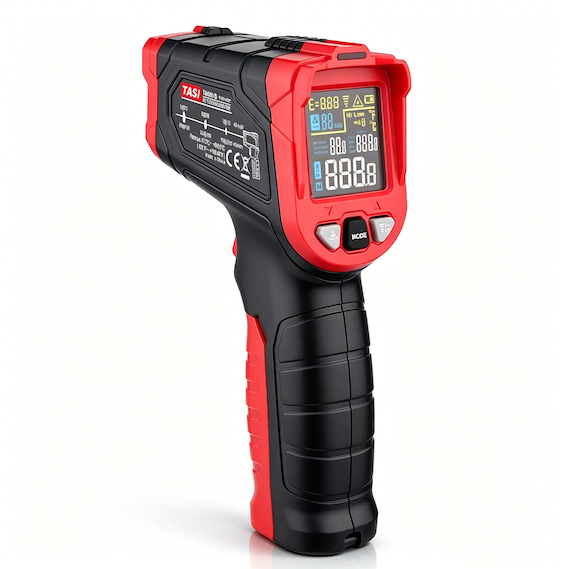
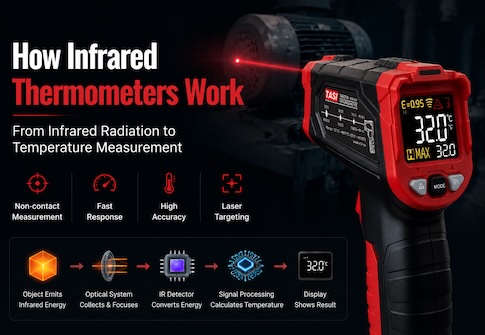
An infrared thermometer typically contains an optical system, an infrared detector, signal-processing electronics, and a temperature calculation algorithm.
During measurement, the process can be summarized as follows:
● The target surface emits infrared radiation.
● The optical system collects infrared energy from a defined field of view.
● The detector converts the incident radiation into an electrical signal.
● The instrument processes the signal using detector characteristics, spectral response, emissivity settings, and internal calibration data.
● The processed radiation signal is converted into a displayed surface temperature.
An infrared thermometer therefore does not directly “sense temperature.”
It detects infrared radiation and converts that radiation signal into a temperature value using a thermal radiation model.
Why Can Real Objects Not Be Treated Exactly Like Blackbodies?
Most real-world objects are not ideal blackbodies.
At the same temperature, a real surface normally emits less radiation than a blackbody. Emissivity ε is therefore used to correct for this difference.
Under simplified conditions:
Radiation from a real surface ≈ ε × blackbody radiation at the same temperature
For example, two surfaces may both be at 100°C but have very different emissivities. The infrared radiation detected from each surface may therefore differ significantly.
If the infrared thermometer uses an incorrect emissivity value, it may interpret a difference in radiation efficiency as a difference in temperature.
This is why emissivity is one of the most important parameters in infrared temperature measurement.
An Infrared Thermometer Receives More Than the Target’s Own Radiation
Actual infrared measurements are more complex than the simplified relationship ε × blackbody radiation.
For many opaque surfaces, the radiation reaching the instrument may include:
● Infrared radiation emitted directly by the target;
● Ambient thermal radiation reflected by the target surface;
● Radiation absorbed or emitted by water vapor, smoke, dust, or other media in the optical path.
Low-emissivity surfaces are particularly sensitive to reflected ambient radiation.
Polished aluminum, stainless steel, copper, and other reflective metals often have low and variable infrared emissivity. The signal reaching the thermometer may therefore contain significant reflected radiation from nearby machinery, walls, people, or hot objects.
As a result, the displayed temperature may change even when the target itself remains at a constant temperature.
What Is the Relationship Between Blackbody Radiation and Emissivity?
A blackbody provides the reference for defining emissivity.
For an ideal blackbody:
ε = 1
If a real surface emits approximately 80% of the radiation emitted by a blackbody at the same temperature under equivalent conditions, its emissivity can be approximated as:
ε ≈ 0.80
Emissivity therefore answers the question:
“How efficiently does this real surface emit thermal radiation compared with an ideal blackbody at the same temperature?”
For real materials, emissivity may depend on:
● Material type;
● Surface roughness;
● Oxidation;
● Coatings or contamination;
● Measurement wavelength;
● Surface temperature;
● Viewing angle.
A material should therefore not automatically be assumed to have one fixed emissivity under all conditions.
Why Do Room-Temperature Objects Emit Infrared Radiation?
Blackbody radiation is not limited to red-hot metals, furnaces, or other high-temperature objects.
Objects at room temperature also continuously emit thermal radiation. Most of this radiation lies in the infrared region and is invisible to the human eye.
For a blackbody near 300 K, which is close to normal room temperature, peak emission occurs at approximately 10 μm.
This is one of the reasons many infrared temperature measurement systems designed for low and moderate temperatures operate in the mid- or long-wave infrared region.
A table, wall, machine housing, or human body may not appear to emit visible light, but it is continuously emitting infrared thermal radiation.
Why Does Thermal Radiation Increase as Temperature Rises?
According to thermal radiation theory, radiated energy increases significantly with temperature.
For an ideal blackbody, total emitted radiant power is proportional to the fourth power of absolute temperature, as described by the Stefan–Boltzmann law:
E = σT⁴
where:
● E is the total radiant power per unit area;
● σ is the Stefan–Boltzmann constant;
● T is absolute temperature.
Temperature and thermal radiation therefore do not have a simple linear relationship.
In practice, an infrared thermometer generally does not measure all radiation across the complete spectrum. It measures radiation within a specific spectral response range and uses calibrated algorithms to determine temperature.
The instrument’s spectral range is therefore also an important measurement parameter.
Why Are Blackbodies Used to Calibrate Infrared Thermometers?
Because the relationship between temperature and radiation is well defined for a blackbody, practical blackbody radiation sources or blackbody calibrators are designed to approximate ideal blackbody behavior.
A typical blackbody calibration system is designed to provide:
● High and stable effective emissivity;
● Uniform and stable target temperature;
● A known reference temperature;
● Suitable cavity or surface geometry;
● Controlled measurement geometry.
During calibration, an infrared thermometer is aimed at a blackbody source with a known temperature and the two values are compared:
Blackbody reference temperature ↔ infrared thermometer indication
Measurements at several temperature points can be used to evaluate measurement error, repeatability, and calibration status.
Does the Blackbody Temperature Always Equal the Infrared Thermometer Reading?
Under ideal measurement conditions, if:
● The blackbody temperature is accurate and stable;
● Effective emissivity is close to 1;
● The thermometer emissivity setting is correct;
● Measurement distance and spot size are appropriate;
● The blackbody target fully fills the instrument’s field of view;
● Environmental and optical-path effects are controlled;
then the infrared thermometer reading should agree with the blackbody reference temperature within the specified measurement uncertainty or instrument accuracy.
In practical calibration, however, factors such as effective emissivity, temperature uniformity, measurement distance, spot size, reflected background radiation, spectral response, and reference temperature uncertainty must still be considered.
An actual blackbody calibrator is therefore an engineered reference source rather than a perfect physical blackbody.
Why Is Blackbody Theory Especially Important for Reflective Metals?
Polished metal is one of the clearest examples of the difference between a blackbody and a real surface.
Many shiny metals have relatively low infrared emissivity and therefore differ significantly from the ε = 1 ideal blackbody.
Low emissivity means:
● The object’s own thermal emission is relatively weak.
● Reflected ambient infrared radiation becomes more significant.
● Emissivity-setting errors can produce larger temperature errors.
● Changing the viewing angle or position of surrounding heat sources may alter the reading.
When measuring polished aluminum, copper, stainless steel, or similar surfaces, the displayed value should therefore not be interpreted without considering emissivity and reflected background radiation.
Where the process permits, a high-emissivity coating, suitable black tape, or another surface with known emissivity can provide a more stable measurement area.
Is a Black-Colored Object the Same as a Blackbody?
No.
This is one of the most common misunderstandings surrounding blackbody radiation.
“Black” normally describes an object’s appearance in the visible spectrum, while “blackbody” describes its absorption and emission behavior over the relevant electromagnetic spectrum.
Therefore:
● A surface that looks black may not have an infrared emissivity of 1.
● A surface that does not look black may still have high infrared emissivity.
● Infrared temperature measurement should be based on emissivity in the instrument’s measurement band, not on visible color alone.
A blackbody should therefore not be interpreted simply as a “black object.”
How Does Understanding Blackbody Radiation Improve Infrared Temperature Measurement?
Understanding blackbody radiation helps explain why infrared measurements are influenced by surface properties and the surrounding environment.
● Understanding emissivity: Real objects are not ideal blackbodies, so their radiation efficiency differs.
● Understanding reflection errors: Low-emissivity surfaces may reflect significant thermal radiation from their surroundings.
● Understanding spectral range: Radiation distribution changes with temperature, while an infrared thermometer detects only a defined wavelength range.
● Understanding calibration: Blackbody sources provide stable and repeatable thermal radiation references.
● Understanding surface color: Visible color and infrared emissivity are different physical properties.
Blackbody theory is therefore not only a theoretical concept. It is fundamental to understanding infrared thermometer accuracy, emissivity settings, and calibration.
FAQ
Is a blackbody a real special material?
An ideal blackbody is a theoretical model and cannot be perfectly reproduced across all wavelengths and conditions. However, specially designed cavities and high-emissivity surfaces can produce practical blackbody sources that closely approximate ideal behavior.
Does an infrared thermometer measure directly according to blackbody temperature?
Blackbody radiation provides the theoretical basis, but real targets are normally not blackbodies. The instrument must also account for emissivity, reflected radiation, spectral response, and calibration characteristics.
Will setting emissivity to 1 always produce an accurate result?
No. This setting is appropriate only when the target’s effective emissivity is close to 1 and other measurement conditions are suitable. If the actual emissivity is much lower, significant error may result.
Does a black surface always have higher emissivity than a white surface?
No. Visible color does not directly determine infrared emissivity. Surface behavior must be evaluated in the infrared wavelength range used by the instrument.
Why are blackbodies commonly used for infrared thermometer calibration?
Because a blackbody provides a stable and calculable relationship between radiation and temperature, allowing a known reference temperature to be compared with the instrument indication.
Does Planck’s law also apply to ordinary objects?
Planck’s law strictly describes ideal blackbody radiation. For real surfaces, the blackbody model must be combined with spectral emissivity, reflection, and, where relevant, transmission characteristics.
Conclusion
Blackbody radiation is one of the fundamental principles of infrared temperature measurement.
For an ideal blackbody, spectral radiation at a given temperature is defined by physical laws, while Planck’s law establishes the fundamental relationship between temperature, wavelength, and spectral radiance. Infrared thermometers use this relationship to determine surface temperature from detected infrared radiation.
Real objects are normally not ideal blackbodies, so practical measurements must also consider emissivity, reflected ambient radiation, spectral range, target size, and optical-path conditions.
In practical terms, a blackbody can be regarded as the theoretical reference standard of infrared thermometry. It provides the basis for emissivity, temperature calculation, calibration, and performance verification.