Introduction
Infrared thermometers use infrared radiation because temperature is closely related to an object's thermal radiation. Any object with a temperature above absolute zero emits electromagnetic radiation. Within the temperature ranges encountered in industrial maintenance, electrical inspection, HVAC, manufacturing, and everyday applications, a significant portion of this radiation lies in the infrared spectrum.
An infrared thermometer collects infrared radiation from the target surface through its optical system. An infrared detector converts the received radiation into an electrical signal, which is then processed together with emissivity settings, ambient compensation, and internal calibration data to calculate the target surface temperature.
In other words, infrared thermometry is essentially a method of measuring surface temperature without physical contact by detecting naturally emitted thermal radiation.
It is also important to distinguish the measuring system from the laser pointer found on many handheld infrared thermometers. The laser is generally used only for aiming and does not perform the temperature measurement.
Key Points
● Any object above absolute zero emits thermal radiation, and infrared radiation represents an important part of this energy within common temperature ranges.
● Infrared thermometers primarily detect infrared radiation emitted by the target itself; they do not normally measure temperature by transmitting infrared radiation toward the target.
● Infrared radiation changes with object temperature, making it suitable for non-contact temperature measurement.
● Infrared thermometry provides rapid surface-temperature measurement without touching the target, making it useful for hot, moving, electrically energized, or inaccessible objects.
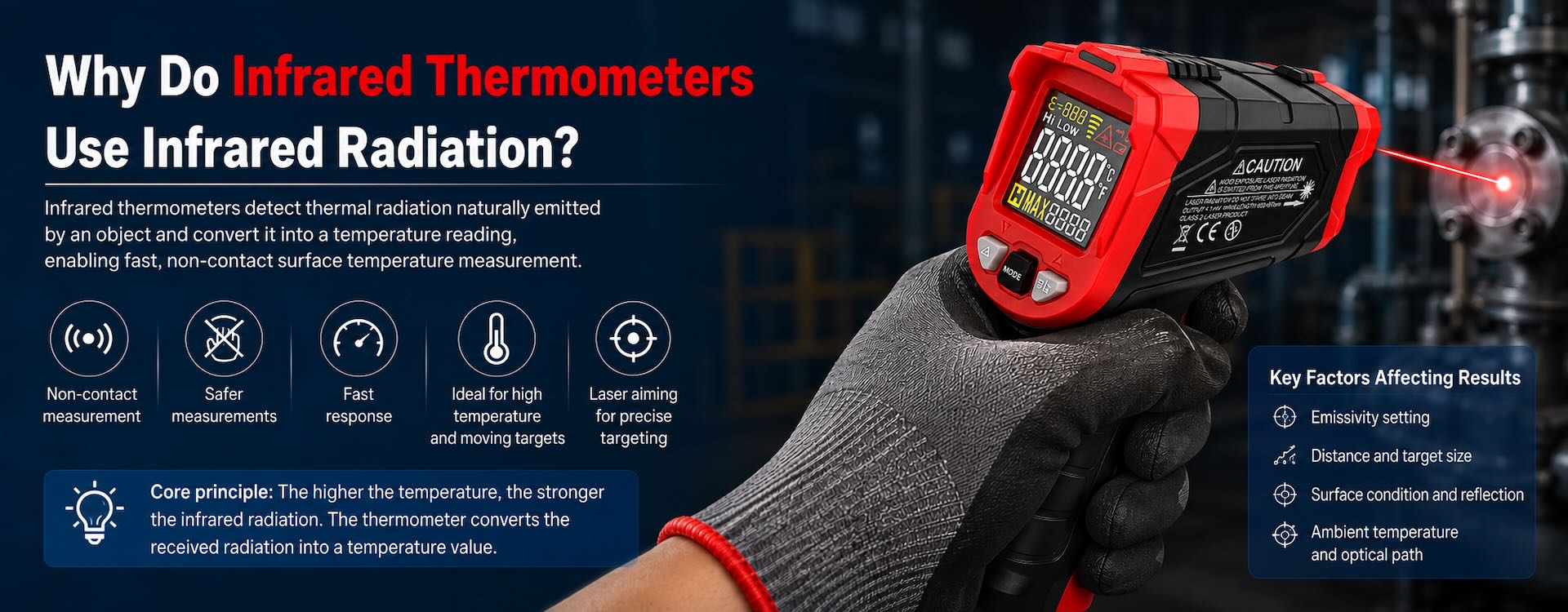
● Measurement accuracy can be affected by emissivity, measuring distance, target size, surface condition, and environmental conditions.
● Infrared thermometers generally measure surface temperature, not the internal temperature of an object.
Why Do Objects Emit Infrared Radiation?
From a physical perspective, any object above absolute zero contains particles in thermal motion and continuously releases energy in the form of electromagnetic radiation. This phenomenon is known as thermal radiation.
Thermal radiation is not emitted at one single wavelength. Instead, it is distributed across a range of wavelengths. As the temperature of an object changes, both the intensity and spectral distribution of its radiation change.
For room-temperature objects, industrial equipment, mechanical components, electrical devices, and many other common targets, a substantial portion of this thermal radiation lies within the infrared region.
As the target temperature changes, the amount and distribution of infrared radiation also change. Infrared thermometers use this relationship between temperature and thermal radiation to determine surface temperature.
Why Use Infrared Radiation Instead of Visible Light?
Visible light represents only a small part of the electromagnetic spectrum. Objects at room temperature and within most normal industrial temperature ranges generally do not emit enough visible thermal radiation for their temperature to be determined from visible brightness.
For example, a machine housing at several tens of degrees Celsius may look completely normal to the human eye, yet it is continuously emitting infrared thermal radiation.
Only when an object becomes sufficiently hot does part of its thermal radiation shift into the visible spectrum. Heated metal, for example, may eventually begin to glow dull red, red, or brighter as its temperature increases.
For most practical temperature measurement applications, however, visible light is unsuitable. Infrared radiation is present across a much wider range of commonly encountered temperatures, which makes it particularly useful for non-contact thermometry.
What Does an Infrared Thermometer Actually Measure?
An infrared thermometer does not directly “see” temperature. It first measures the infrared radiation emitted from the target surface.
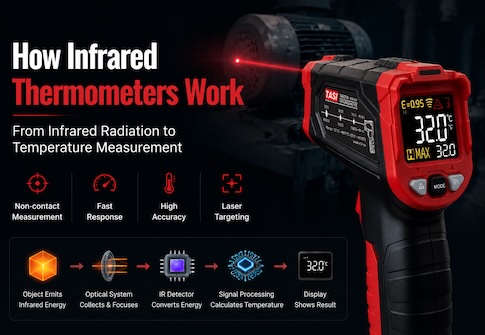
The basic measurement process can be summarized as follows:
● The target surface emits infrared thermal radiation.
● The thermometer's optical system collects radiation from a defined field of view.
● The infrared detector converts the received radiation into an electrical signal.
● The instrument processes the signal using emissivity, internal temperature compensation, and other calibration parameters.
● The microprocessor calculates the target surface temperature.
● The temperature result is displayed on the screen.
The measurement process can therefore be understood as:
Infrared radiation → electrical signal → temperature value
Why Is Infrared Radiation Suitable for Non-Contact Temperature Measurement?
Conventional contact thermometers require a probe to touch the target. Heat must transfer between the target and the probe until the sensor reaches a sufficiently representative temperature.
Infrared thermometers do not require this physical contact. As long as the infrared radiation emitted by the target can reach the instrument's detector, temperature measurement can be performed.
This provides several important advantages:
● No physical contact is required. This is useful when the target should not be touched, is difficult to reach, or may be contaminated by contact.
● Fast response. The instrument does not need to wait for thermal equilibrium between a probe and the target.
● Suitable for hot surfaces. High-temperature equipment and heated components can be checked from a safer distance.
● Suitable for moving targets. Examples include rotating machinery and products moving on a production line.
● Useful for certain energized equipment inspections. When appropriate safety procedures are followed, temperature can be checked without making contact with the surface for measurement purposes.
These characteristics explain why infrared thermometers are widely used in industrial maintenance, electrical inspection, HVAC, mechanical servicing, and production monitoring.
Why Can Infrared Thermometers Respond Quickly?
Contact temperature probes depend on heat transfer. Their response time is influenced by probe construction, thermal mass, contact quality, target material, and other factors.
Infrared thermometers detect radiation that is already being emitted by the target. They do not need to wait for the sensing element to reach thermal equilibrium with the measured surface, so readings can normally be obtained much more quickly.
Fast response is particularly useful when inspecting multiple locations, such as electrical equipment, machine bearings, HVAC components, production processes, or suspected hot spots.
However, fast response does not mean every reading is immediately accurate under all conditions. Target size, measuring distance, ambient temperature changes, and instrument stabilization after moving between significantly different environments can still affect the result.
Why Does Infrared Thermometry Usually Measure Surface Temperature?
Infrared thermometers primarily detect radiation emitted from the surface of an object. Their readings therefore normally represent surface temperature.
Standard handheld infrared thermometers should not be considered devices that directly measure temperature deep inside ordinary materials.
For example:
● Measuring a pipe normally provides the outer surface temperature of the pipe, not the direct temperature of the fluid inside.
● Measuring a food container normally provides the temperature of the container surface or exposed food surface.
● Measuring a motor normally provides the surface temperature of the housing or component being aimed at.
● When measuring glass, transmission, reflection, and emission characteristics within the relevant infrared wavelength range must also be considered.
If internal temperature is required, a thermocouple, resistance temperature sensor, penetration probe, or another suitable contact measurement method may be more appropriate.
Why Does Emissivity Affect Infrared Temperature Measurement?
Different materials do not emit infrared radiation equally efficiently at the same temperature. This property is described by emissivity.
Many non-metallic surfaces, painted surfaces, coatings, and oxidized materials have relatively high emissivity and are generally easier to measure reliably with an infrared thermometer.
Polished or shiny metals often have low emissivity and high reflectivity. In these cases, the thermometer may detect not only radiation emitted by the target itself but also infrared radiation from the surroundings reflected by the surface.
This can produce significant measurement errors.
Therefore, it is not correct to assume that infrared thermometers will provide equally accurate measurements on every material. Correct emissivity settings and suitable measurement conditions are essential.
Why Does Measuring Distance Matter?
An infrared thermometer does not measure only the small point indicated by the laser. It measures the average infrared radiation from an area determined by the instrument's optical field of view.
As the distance from the target increases, the measured spot generally becomes larger. This relationship is commonly expressed as the D:S ratio, or Distance-to-Spot Ratio.
If the target is smaller than the actual measurement area, infrared radiation from the surrounding background can enter the field of view and affect the displayed temperature.
For reliable measurement:
● Ensure the target fully covers the measurement area.
● Select the measuring distance according to the instrument's D:S specification.
● Do not assume that the laser-dot diameter represents the actual infrared measurement spot.
Infrared thermometry can therefore be performed from a distance, but greater distance is not automatically better.
Does the Laser Measure the Temperature?
No.
The visible red laser on many handheld infrared thermometers is primarily an aiming aid.
Actual temperature measurement is performed by the infrared optical system and infrared detector, which receive the thermal radiation emitted by the target.
An infrared thermometer can therefore operate without a laser pointer, provided that its infrared sensing system is functioning correctly.
The laser spot should also not be treated as an exact indication of the complete measurement area. The actual spot size must be evaluated according to the instrument's optical design and D:S ratio.
What Are the Main Advantages of Infrared Thermometry?
Infrared thermometry remains widely used because its measurement principle offers several practical advantages:
● Non-contact measurement reduces the need to touch hot, moving, inaccessible, or potentially hazardous surfaces.
● Fast response makes it suitable for equipment inspection and rapid screening of multiple measuring points.
● No temperature sensor needs to be permanently installed on the target.
● Measurement has minimal influence on the thermal state of the target.
● Hard-to-reach surfaces can often be checked more easily than with contact probes.
● Temperature differences between surface areas can be compared to help identify abnormal hot spots or thermal irregularities.
Infrared measurement does not completely replace contact thermometry. The two methods serve different applications and should be selected according to target material, temperature range, required accuracy, accessibility, and whether surface or internal temperature is needed.
What Factors Can Affect Infrared Temperature Measurements?
Infrared thermometry is fast and convenient, but measurement quality depends on the target's radiation characteristics and the surrounding conditions.
Common influencing factors include:
● Emissivity: An incorrect emissivity setting can produce substantial errors.
● Surface condition: Polished, oxidized, painted, coated, and rough surfaces may have different infrared emission characteristics.
● Measuring distance: Excessive distance may cause the measurement area to extend beyond the target.
● Target size: The target should fully cover the instrument's field of view.
● Reflected radiation: Low-emissivity surfaces can reflect infrared radiation from nearby hot or cold objects.
● Optical path: Dust, smoke, steam, and certain transparent materials may absorb, attenuate, or alter infrared radiation.
● Ambient temperature changes: After moving the instrument between environments with large temperature differences, time may be required for thermal stabilization.
Controlling these factors helps infrared thermometers deliver their expected advantages of fast and convenient non-contact measurement.
FAQ
Do infrared thermometers emit infrared radiation to measure temperature?
Generally, no. Handheld infrared thermometers mainly detect infrared thermal radiation emitted by the target itself and convert it into a temperature reading. The visible laser is normally used only for aiming.
Why do all objects emit infrared radiation?
Any object above absolute zero has thermal energy and emits electromagnetic radiation. Within common temperature ranges, a significant portion of this thermal radiation lies in the infrared spectrum.
Can an infrared thermometer measure internal temperature?
Usually not. Standard infrared thermometers mainly measure surface temperature. Internal temperature normally requires a contact probe or another suitable measurement method.
What is the red laser on an infrared thermometer used for?
It is primarily used to help aim the instrument. It does not perform the actual temperature measurement.
Why are shiny metals difficult to measure accurately?
Shiny metals often have low emissivity and high reflectivity, so the thermometer may detect reflected infrared radiation from the surrounding environment in addition to radiation emitted by the target.
Is infrared thermometry more accurate than contact temperature measurement?
Not necessarily. Infrared thermometry is fast and non-contact but is sensitive to emissivity and surface conditions. Contact thermometry is often more suitable when internal temperature or a defined contact-point temperature is required.
Conclusion
Infrared thermometers use infrared radiation because there is a measurable physical relationship between an object's temperature and its emitted thermal radiation. Within common measurement ranges, objects continuously emit infrared energy, and infrared detectors can rapidly convert this radiation into a temperature reading without touching the target.
Compared with conventional contact measurement, infrared thermometry offers fast response, non-contact operation, and practical advantages when measuring hot, moving, energized, or difficult-to-reach objects.
However, infrared thermometers primarily measure surface temperature, and the result can be affected by emissivity, target size, measuring distance, surface condition, reflected radiation, and environmental factors. Understanding that an infrared thermometer measures the thermal radiation emitted by the target surface is fundamental to selecting and using the instrument correctly.