Introduction
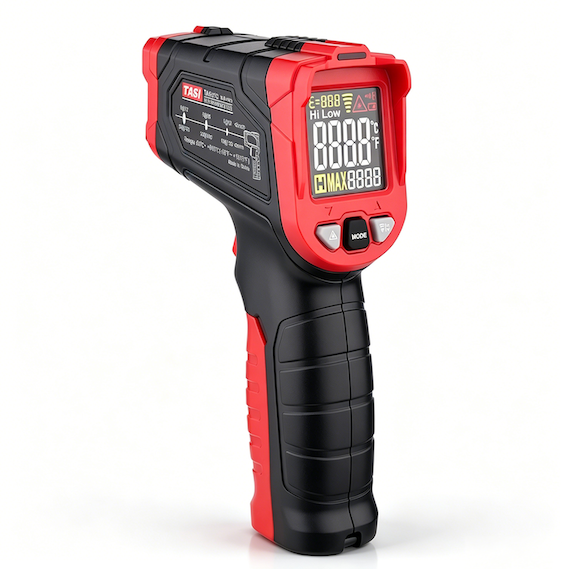
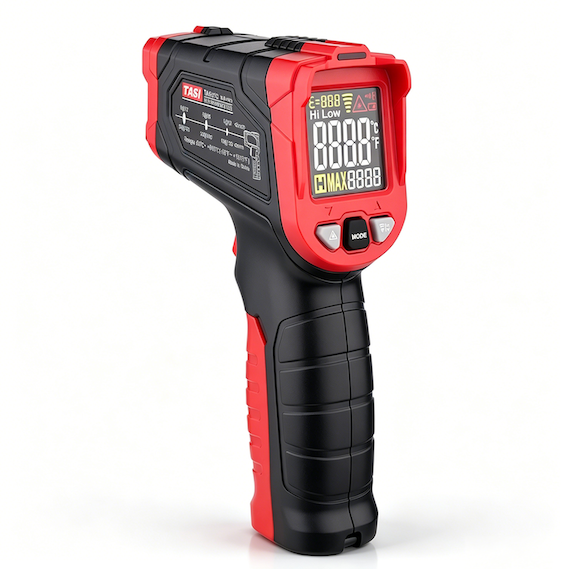
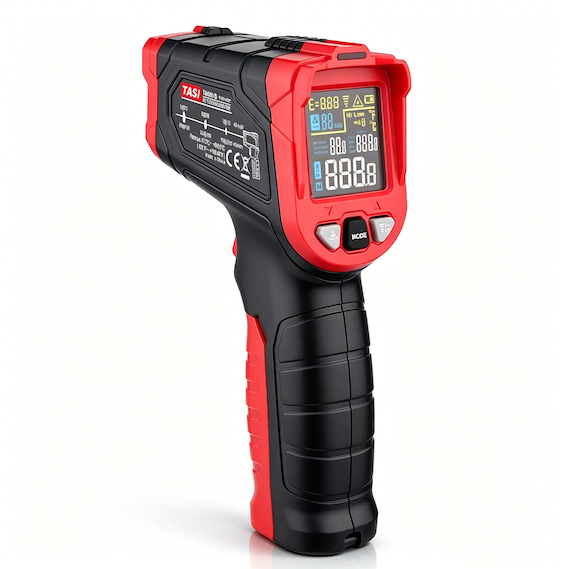
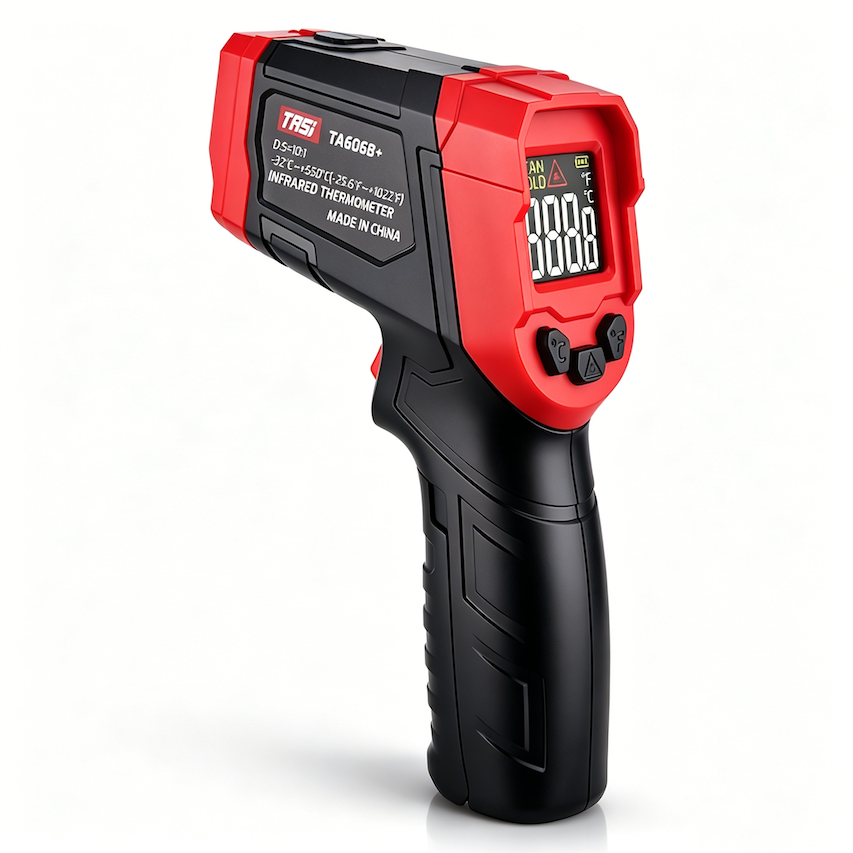
An infrared thermometer is a non-contact temperature measurement instrument that determines surface temperature by detecting infrared radiation emitted by a target. Basic models are designed for fast temperature checks, while instruments intended for industrial maintenance, electrical inspection, HVAC, and equipment troubleshooting may also include laser targeting, adjustable emissivity, maximum/minimum measurement, temperature alarms, data storage, and other functions.
More functions do not necessarily mean a better instrument. In practical applications, it is more important to understand what each function is designed to do and whether it is relevant to the target, measurement conditions, and working environment. This article explains the most common infrared thermometer functions and their practical uses.
Key Points
● The primary function of an infrared thermometer is to quickly measure the surface temperature of a target; it does not directly measure internal temperature.
● Laser targeting helps identify the approximate measurement location but does not perform the temperature measurement itself.
● Adjustable emissivity is important when measuring materials with different surface characteristics, including metals, plastics, coatings, and wood.
● MAX, MIN, AVG, and DIF functions are useful for equipment inspection and temperature trend assessment.
● High and low temperature alarms help users quickly identify readings outside predefined limits.
● Data storage, Bluetooth, and PC connectivity are additional functions available on selected models.
Non-Contact Surface Temperature Measurement
This is the fundamental function of every infrared thermometer.
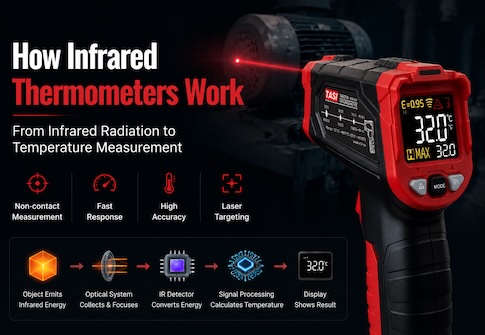
The instrument detects infrared radiation emitted from the surface of an object and converts the detected radiation into a temperature reading using its internal electronics and measurement algorithm.
Unlike thermocouples, RTDs, and other contact temperature sensors, an infrared thermometer does not have to physically touch the target. It is therefore particularly suitable for:
● Machinery that is moving or rotating;
● Hot or difficult-to-reach surfaces;
● Energized equipment and areas where a safe working distance is required;
● Products moving along a production line;
● Applications requiring rapid inspection of multiple measurement points.
Infrared thermometers normally measure surface temperature. If the temperature inside a liquid, food product, pipe, or other object must be measured, an appropriate contact temperature probe is generally required.
Laser Targeting
Many infrared thermometers incorporate a single laser, dual laser, or another laser-based targeting system.
The laser helps the operator identify the approximate area at which the instrument is aimed, making target alignment easier.
It is important to understand that the laser does not measure temperature.
The actual temperature measurement is performed by the infrared sensing system inside the instrument. A laser spot therefore should not be interpreted as the exact size of the measured area.
An infrared thermometer receives radiation from an area that becomes larger as the distance from the target increases. This relationship is determined by the instrument's distance-to-spot ratio, commonly expressed as D:S.
Emissivity Adjustment
Emissivity is one of the key parameters affecting infrared temperature measurement accuracy.
Different materials emit infrared radiation with different efficiencies. Painted surfaces, rubber, wood, and many non-metallic materials generally have relatively high emissivity, while shiny metals, polished aluminium, stainless steel, and similar reflective surfaces can have considerably lower emissivity.
Infrared thermometers generally use one of two designs:
● Fixed emissivity, such as ε = 0.95;
● Adjustable emissivity, allowing the setting to be matched more closely to the target material.
A fixed-emissivity instrument is convenient for many common non-metallic surfaces. Adjustable emissivity is more useful when measurements involve a wider range of materials, particularly metallic surfaces.
Even with adjustable emissivity, measurements on shiny, low-emissivity metals require additional care because reflected infrared energy from the surrounding environment can influence the reading.
Data Hold
Data Hold, often indicated as HOLD, is a common infrared thermometer function.
When the trigger is released or a measurement is completed, the instrument temporarily retains the last temperature reading on the display.
This is particularly useful when:
● The display cannot be viewed conveniently during measurement;
● Readings must be entered manually into inspection records;
● The measured value needs to be compared with other parameters.
Many instruments automatically switch off after the reading has been held for a defined period, helping to reduce battery consumption.
Maximum and Minimum Temperature
Some infrared thermometers can record MAX and MIN values during continuous measurement.
● MAX records the highest temperature detected during the measurement period;
● MIN records the lowest temperature detected during the measurement period.
When inspecting motors, bearings, electrical equipment, HVAC outlets, or larger equipment surfaces, the user can scan across the target area and use MAX/MIN functions to identify the hottest or coolest location quickly.
This is often more efficient than recording and manually comparing individual readings.
Average and Temperature Difference
Some advanced infrared thermometers also provide AVG and DIF measurement modes.
● AVG indicates the average temperature over a measurement sequence;
● DIF indicates the difference between the highest and lowest temperatures recorded during the measurement period. The exact calculation method should always be confirmed in the instrument manual.
Average temperature is useful for assessing the general temperature level across an area or during a continuous scan, while temperature difference can help reveal abnormal temperature variations.
For example, when comparing similar equipment or different positions on the same machine, a location that differs significantly from surrounding areas may require further investigation.
High and Low Temperature Alarms
High and low temperature alarm functions may be identified as HAL, LAL, High Alarm, Low Alarm, or similar terms.
The user can define upper and lower temperature limits. When the measured value exceeds the configured range, the instrument may provide an audible alarm, display indication, backlight change, or another warning signal.
Typical applications include:
● High-temperature alarms for detecting abnormal heating in bearings, motors, or electrical connections;
● Low-temperature alarms for checking refrigeration or cooling systems;
● Defined temperature limits for rapid pass/fail screening in production processes.
Alarm functions are particularly useful for repetitive inspection because the operator does not need to continuously monitor small changes in the numerical reading.
Alarm thresholds should be based on the normal operating temperature of the equipment, process requirements, and actual site conditions rather than applying the same limits to every application.
Celsius and Fahrenheit Selection
Most infrared thermometers allow users to switch between °C and °F.
● °C: degrees Celsius;
● °F: degrees Fahrenheit.
Changing the unit does not affect measurement accuracy. It only changes how the temperature is displayed.
This feature is useful for international users, multinational engineering projects, and applications where different temperature units are commonly used.
Backlit Display
In plant rooms, equipment enclosures, electrical installations, or low-light environments, a standard LCD can be difficult to read.
For this reason, many infrared thermometers include an LCD backlight to improve visibility of temperature readings and instrument status information.
Some models may also use different display indications to identify alarm conditions, although the exact design varies by instrument.
Because continuous backlight operation increases battery consumption, some instruments allow the backlight to be switched on or off independently.
Continuous Scanning
Most infrared thermometers can perform continuous temperature measurement while the trigger is held.
The operator can move the instrument slowly across a target area and observe temperature changes in real time. When used together with MAX and MIN functions, this can help identify hot or cold spots.
Typical applications include:
● Locating abnormal hot spots in electrical panels;
● Scanning motor or bearing surfaces;
● Checking HVAC supply air outlets;
● Finding temperature variations along pipes;
● Comparing adjacent machines or components.
During scanning, the measurement distance and target size must still be considered to ensure that the target adequately fills the instrument's field of view.
Automatic Power-Off
To reduce battery consumption, most handheld infrared thermometers include an automatic power-off function.
If no operation is detected for a defined period after measurement, the instrument switches off automatically.
This does not affect normal measurement operation and helps prevent unnecessary battery drain, especially during field inspection and frequent portable use.
Data Storage
Some professional infrared thermometers can store multiple measurement results for later review.
Unlike the basic HOLD function, data storage allows several readings to be retained and is useful for:
● Equipment inspections;
● Batch temperature checks;
● Quality control;
● Field measurement records;
● Comparing multiple measurement locations.
Storage capacity and data recall methods vary between models and should be confirmed from the relevant product specifications.
Bluetooth or PC Connectivity
Some infrared thermometers with data-logging capability may also support Bluetooth, USB, or PC software connectivity.
Depending on the model, these functions can be used to:
● Transfer measurement data to a smartphone or computer;
● Review historical readings;
● Record continuous measurements;
● Track temperature changes over time;
● Support later analysis and report preparation.
These functions are not essential for basic spot temperature measurement. However, they can significantly improve workflow efficiency where traceability, equipment management, or long-term data analysis is required.
Contact Temperature Probe Support
Some multifunction infrared thermometers also support an external temperature probe, such as a K-type thermocouple.
This combines non-contact infrared measurement and contact temperature measurement in a single instrument.
Infrared measurement is useful for rapid scanning and locating abnormal temperature areas, while a contact probe can be used to verify specific measurement points or measure targets that are not suitable for infrared measurement.
Not all infrared thermometers support external probes, so this should be considered an additional feature available only on selected models.
Which Functions Affect Measurement Accuracy?
A larger number of functions does not automatically result in higher measurement accuracy.
Functions such as Data Hold, backlight, alarms, Bluetooth, and data storage mainly improve operating convenience and workflow efficiency. They do not directly increase the accuracy of the infrared measurement.
Factors that have a more direct influence on measurement results include:
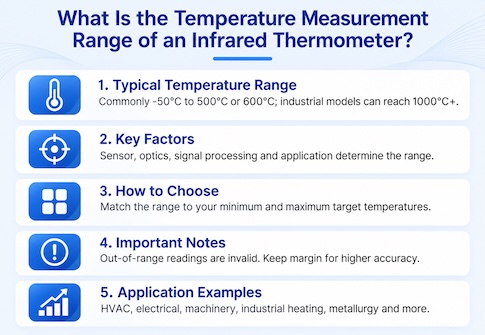
● The instrument's specified accuracy and temperature range;
● Correct emissivity setting;
● D:S distance-to-spot ratio;
● Target size and measuring distance;
● Surface material and condition;
● Ambient temperature and reflected infrared radiation;
● Cleanliness of the optical lens;
● Sufficient stabilization of the instrument before measurement.
For this reason, infrared thermometer selection should focus on core measurement performance rather than simply comparing the number of additional functions.
How to Select the Functions You Need
For general temperature checks, temperature measurement, Data Hold, display backlight, and °C/°F selection are usually sufficient.
For industrial equipment maintenance, useful functions may include:
● Adjustable emissivity;
● An appropriate D:S ratio;
● MAX/MIN measurement;
● High and low temperature alarms;
● Continuous scanning.
Where inspection records need to be retained, data storage, Bluetooth, or PC connectivity may also be useful.
If the application frequently involves different materials, long measuring distances, high-temperature targets, or small components, core specifications such as temperature range, D:S ratio, emissivity adjustment range, and measurement accuracy should generally take priority over additional convenience features.
FAQ
Does the laser on an infrared thermometer measure temperature?
No. The laser is primarily a targeting aid. Temperature is measured by the infrared sensing system inside the instrument. The laser spot should not be considered identical to the actual measurement area.
Can all infrared thermometers adjust emissivity?
No. Some basic models use fixed emissivity, while other models allow emissivity adjustment. Adjustable emissivity is generally more useful when measuring different surface materials.
What are MAX and MIN functions used for?
MAX records the highest temperature and MIN records the lowest temperature during a measurement sequence. They are useful for scanning equipment and locating abnormal hot or cold areas.
Does a high/low temperature alarm improve measurement accuracy?
No. Alarm functions only indicate whether a reading exceeds a defined threshold. They do not change the measurement accuracy of the instrument.
Can an infrared thermometer save measurement data?
Some models can. Basic instruments generally provide Data Hold only, while more advanced models may offer memory, Bluetooth, or PC connectivity for more comprehensive data recording.
Is an infrared thermometer with more functions always better?
Not necessarily. The instrument should be selected according to the application. For most professional applications, measurement accuracy, temperature range, D:S ratio, and emissivity capability are generally more important than the total number of additional functions.
Can an infrared thermometer measure internal temperature?
Generally no. Infrared thermometers primarily measure surface temperature. A suitable contact probe should be used for internal liquid temperature, food core temperature, or other internal measurements.
Conclusion
The primary purpose of an infrared thermometer is to provide fast, non-contact surface temperature measurement. Depending on the model, additional functions may include laser targeting, adjustable emissivity, HOLD, MAX/MIN/AVG/DIF modes, high and low temperature alarms, backlit displays, data storage, Bluetooth, and PC connectivity.
Each function serves a different purpose. Laser targeting assists with alignment, emissivity adjustment helps accommodate different surface materials, MAX/MIN and alarm functions improve inspection efficiency, while data storage and communication functions support applications requiring measurement records and further analysis.
When selecting an infrared thermometer, users should first consider the target, required temperature range, measuring distance, and operating environment, then determine which additional functions are genuinely useful. Matching the instrument's measurement performance and features to the application is more important than simply choosing the model with the largest number of functions.