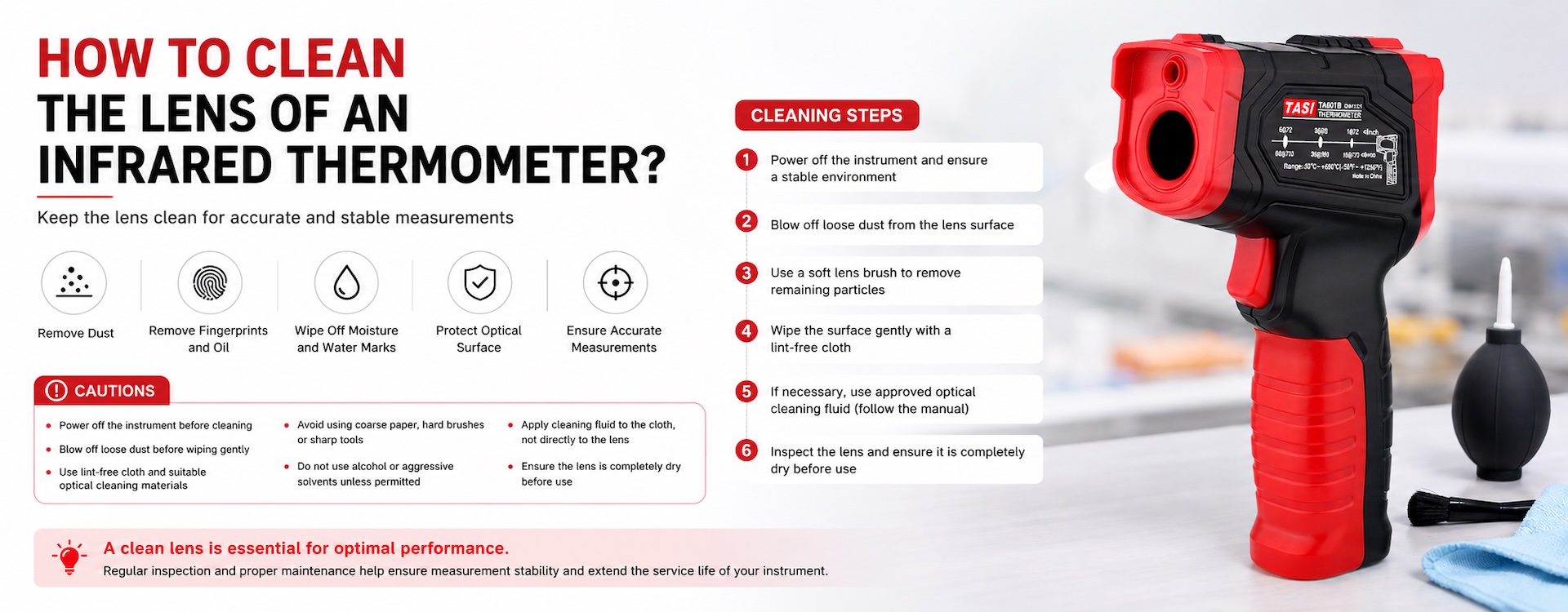
How to Clean the Lens of an Infrared Thermometer

Publisher: Amy Published: 2026-03-11 Last Updated: 2026-08-23 Reading Time: 5min. 0sec.
Tags: infrared thermometer lens cleaninginfrared thermometer maintenanceinfrared thermometer careinfrared thermometer accuracyIR thermometer cleaninginfrared thermometer troubleshooting

Introduction

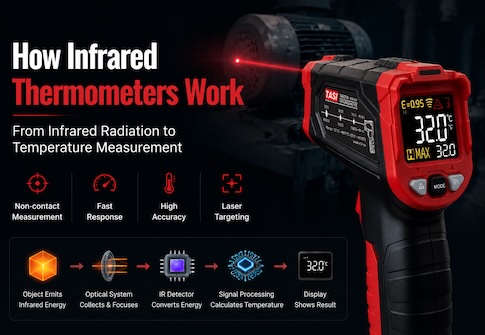
An infrared thermometer is a non-contact temperature measurement instrument that detects infrared radiation emitted by a target surface. Its optical system collects this radiation and directs it toward the infrared sensor, where the signal is converted into a temperature reading.

The lens or infrared optical window at the front of the instrument is therefore an important part of the measurement path. Over time, dust, oil, water spots, fingerprints, and other contaminants may accumulate on its surface. Heavy contamination can reduce the amount of infrared energy reaching the sensor and may affect response time, measurement stability, and accuracy.

Correct cleaning helps maintain reliable measurement performance while reducing the risk of damaging sensitive optical surfaces.


Key Takeaways

● Keep the infrared lens or optical window clean, as dust, oil, and moisture may interfere with infrared energy transmission.
● Switch off the instrument before cleaning and remove loose particles before wiping the surface.
● Use an air blower, soft lens brush, lint-free optical cloth, or approved optical cleaning materials.
● Do not use rough paper towels, hard brushes, or sharp objects on the lens.
● Do not use alcohol, aggressive solvents, or chemical cleaners unless specifically permitted by the manufacturer.
● Allow the optical surface to dry completely before taking measurements.


Why Should the Infrared Thermometer Lens Be Kept Clean?

An infrared thermometer does not measure temperature with the laser pointer. Temperature measurement is based on infrared radiation emitted by the target surface. The optical system collects infrared energy from a defined field of view and focuses it onto the infrared detector.

Dust, oil, moisture, or other contamination on the lens or optical window can absorb, scatter, or obstruct part of this radiation, changing the amount of energy reaching the sensor.

A small amount of surface dust may not immediately cause a noticeable error, but increasing contamination can lead to:

● Slower measurement response;
● Reduced reading stability;
● Greater variation between repeated measurements;
● Measurement deviation compared with normal operating conditions;
● More noticeable effects when measuring small targets or at longer distances.

For this reason, checking the optical window should be part of routine troubleshooting when an infrared thermometer produces unusual readings.


What Should Be Used to Clean an Infrared Thermometer Lens?

Cleaning tools should be suitable for delicate optical surfaces and should minimize unnecessary physical contact.

Recommended options include:

● Air blower: Suitable for removing loose dust and particles and generally recommended as the first cleaning step.
● Soft lens brush: Useful for particles that cannot be removed by air alone.
● Lint-free lens cloth or microfiber cloth: Suitable for gently removing fingerprints, light oil, or water marks.
● Optical lens tissue: May be used carefully on compatible optical surfaces without excessive rubbing.
● Approved optical cleaning fluid: May be used for more persistent oily contamination when permitted by the product instructions.

If the lens material or optical coating is unknown, follow the manufacturer's maintenance instructions before using any cleaning chemical.


How Should an Infrared Thermometer Lens Be Cleaned?

A good general rule is to remove particles first and wipe only when necessary.

● Switch off the infrared thermometer. Make sure the instrument is stable and at normal ambient temperature before cleaning.
● Inspect the optical surface. Check for dust, fingerprints, oil, water spots, or other contamination under adequate lighting.
● Remove loose particles first. Use an air blower and, if necessary, a soft optical brush.
● Clean light marks gently. Use a clean, lint-free optical cloth with very light pressure.
● Treat oily or persistent contamination carefully. If permitted by the manufacturer, apply a small amount of suitable optical cleaning fluid to the cloth rather than directly onto the instrument.
● Inspect and allow to dry. Confirm that no residue, fibers, or moisture remain before using the thermometer again.

Avoid unnecessary wiping. If sand, metal particles, or other hard debris are present, wiping before removing them may scratch the optical surface.


Why Should Ordinary Paper Towels Not Be Used?

Facial tissue, kitchen paper, and other general-purpose paper products may feel soft but are not necessarily suitable for precision optical surfaces.

Their fibers may leave residue or create fine scratches during repeated use. The risk is greater when hard particles such as sand or metal dust are present on the optical window, because wiping can drag these particles across the surface.

Always remove loose particles first and use materials designed for optical cleaning when wiping is required.


Can Alcohol Be Used to Clean an Infrared Thermometer Lens?

Alcohol should not be used unless the lens material, protective window, and coating are known to be compatible with it.

Infrared thermometers may use different optical materials and coatings. Some can be sensitive to certain solvents, which may cause haze, coating deterioration, discoloration, or permanent surface damage.

Therefore:

● Use alcohol only when explicitly permitted by the product documentation;
● If no cleaning chemical is specified, start with dry air cleaning and a soft lint-free cloth;
● For persistent oil contamination, use only a cleaning method recommended by the manufacturer.

General glass cleaners, acetone, strong acidic or alkaline cleaners, and other unapproved solvents should also be avoided.


What Precautions Should Be Taken During Cleaning?

● Do not touch the optical surface directly with your fingers.
● Do not scrape contamination away with sharp objects.
● Do not use stiff brushes or abrasive materials.
● Do not apply excessive pressure to the optical window.
● Do not spray large amounts of liquid directly into the lens area.
● Do not use high-pressure compressed air at close range, as contamination may be forced into the instrument.
● Do not take measurements while moisture remains on the lens.
● If the optical window is scratched, cracked, delaminated, or contaminated internally, professional inspection is recommended instead of disassembly by the user.


How Often Should the Lens Be Cleaned?

There is no fixed cleaning interval for all infrared thermometers. Cleaning frequency should depend on the operating environment and the level of contamination.

In laboratories, offices, or other relatively clean indoor environments, periodic inspection and cleaning only when necessary may be sufficient.

In workshops, HVAC service, industrial maintenance, construction, or dusty and oily environments, the optical window should be inspected more frequently.

Cleaning should not be performed more often than necessary. Excessive wiping can increase mechanical wear on sensitive optical surfaces.


What If the Readings Are Still Inaccurate After Cleaning?

Lens contamination is only one possible cause of inaccurate infrared temperature measurements. If abnormal readings remain after the optical surface has been cleaned, also check the following:

● Whether the target emissivity is suitable for infrared measurement;
● Whether the emissivity setting is correct;
● Whether the measurement distance complies with the instrument's D:S ratio;
● Whether the target completely fills the measurement spot;
● Whether measurement is being attempted through ordinary glass or transparent plastic;
● Whether the target surface is highly reflective;
● Whether the instrument has recently moved between environments with significantly different temperatures and needs time to stabilize;
● Whether condensation, steam, smoke, or dust is affecting infrared transmission;
● Whether calibration or professional inspection is required.

Lens cleaning is therefore an important maintenance and troubleshooting step, but it should be considered together with emissivity, measurement distance, target size, and environmental conditions.


FAQ

Will a small amount of dust on the lens affect measurement accuracy?
A light layer of dust may not immediately cause a noticeable error, but accumulated contamination can reduce infrared transmission. Periodic inspection and gentle removal with an air blower are recommended.

Can I clean the lens with a damp cloth?
An ordinary damp cloth is not recommended because it may leave residue or moisture and may not be suitable for optical surfaces. Use an appropriate lint-free optical cloth instead.

How should fingerprints be removed?
Remove loose dust first, then gently wipe the surface with a clean lint-free lens cloth. If necessary, use an approved optical cleaning fluid according to the manufacturer's instructions.

Can I blow dust off the lens with my mouth?
This is not recommended. Exhaled air contains moisture and microscopic droplets that may leave additional contamination on the optical surface.

Can an infrared thermometer still be used if the lens is scratched?
The effect depends on the position and severity of the scratch. If the damage is significant or the readings become abnormal, professional inspection is recommended.

Will cleaning the lens solve every measurement accuracy problem?
No. Emissivity, target size, measuring distance, reflective surfaces, environmental conditions, and instrument condition can all affect infrared temperature readings.


Summary

The lens or infrared optical window of an infrared thermometer is responsible for transmitting infrared radiation from the target to the detector. Dust, oil, water marks, and fingerprints can interfere with this signal and may reduce measurement stability.

The recommended approach is to remove loose particles first and wipe the surface only when necessary. Use an air blower, soft optical brush, and lint-free optical cleaning materials, while avoiding abrasive paper, sharp tools, aggressive solvents, and excessive pressure.

Keeping the optical window clean, together with correct emissivity settings, proper measurement distance, and appropriate operating procedures, helps maintain stable and reliable infrared temperature measurement performance.

Related Technical Articles
What Is the Temperature Measurement Range of an Infrared Thermometer?
How Does Target Size Relate to the Measurement Spot of an Infrared Thermometer?
Detailed Explanation of How Infrared Thermometers Work
Introduction to the Optical System of an Infrared Thermometer
Why Does Surface Roughness Affect Infrared Temperature Measurement?
What Is the Relationship Between Emissivity, Reflectivity, and Transmissivity?
What Is Emissivity in an Infrared Thermometer? How to Set It Correctly?
What Is the Difference Between an Infrared Thermometer and a Contact Thermometer?
How Do Dust and Oil Mist Affect Infrared Temperature Measurements?
What Is the Difference Between an Infrared Thermometer and a Thermal Imaging Camera?
How to Properly Use an Infrared Thermometer for Temperature Measurement?
How to Measure Surfaces That Heat Up or Cool Down Rapidly with an Infrared Thermometer
What Does the Spectral Response Range of an Infrared Thermometer Mean?
How to Evaluate the Quality of an Infrared Thermometer
What Does Measurement Uncertainty Mean in Infrared Temperature Measurement?
Why Does Reflected Background Temperature Affect Infrared Temperature Measurements?
How Does a Thermopile Sensor Work in an Infrared Thermometer?
What Objects Can an Infrared Thermometer Measure?
Infrared Thermometer Measurement Range, Response Time and Resolution Explained
Why Do Infrared Thermometers Need Laser Aiming?
What Does Resolution Mean on an Infrared Thermometer?
What Is the Relationship Between Blackbody Radiation and Infrared Temperature Measurement?
How Is Infrared Thermometer Accuracy Defined?
Why Can’t an Infrared Thermometer Measure Temperature Through Glass?
Why Do Infrared Thermometers Use Infrared Radiation to Measure Temperature?
How Does Measurement Angle Affect Infrared Thermometer Readings?
What Materials Can an Infrared Thermometer Measure?
What Factors Affect the Accuracy of Infrared Thermometers?
How to Measure Moving Objects with an Infrared Thermometer
Do Air, Steam, and Smoke Affect Infrared Temperature Measurement?
How Do Temperature Gradients Affect Infrared Temperature Measurements?
Infrared Thermometer Calibration Principles Explained
Why Doesn’t the Laser Dot on an Infrared Thermometer Represent the Actual Measurement Area?
What Is the Difference Between Repeatability and Accuracy in an Infrared Thermometer?
What Does Response Time Mean on an Infrared Thermometer?
What Does Thermal Equilibrium Mean in Infrared Temperature Measurement?
How Does Response Time Affect Temperature Measurement of Fast-Moving Objects?
How to Calculate the Measurement Spot Size of an Infrared Thermometer at Different Distances
What Does the D:S Distance-to-Spot Ratio Mean on an Infrared Thermometer?
How Do Infrared Thermometers Account for Ambient Background Radiation?
What Is an Infrared Thermometer? Working Principle and Applications
How Does Ambient Temperature Affect Infrared Temperature Measurement?
Common Functions of Infrared Thermometers
What Does Field of View (FOV) Mean on an Infrared Thermometer?
Types of Sensors Used in Infrared Thermometers
Related FAQs
Why Can’t an Infrared Thermometer Measure Transparent Objects?
Can an Infrared Thermometer Still Be Used After Being Dropped?
Why Does an Infrared Thermometer Give Different Readings on Different Colors?
Why Does Black Tape Improve the Accuracy of Infrared Temperature Measurement?
How to Calibrate an Infrared Thermometer
Why Does an Infrared Thermometer Show Different Temperatures at Different Points on the Same Object?
Common Mistakes When Using an Infrared Thermometer
Can an Infrared Thermometer Measure Objects in a Steam Environment?
Why Do Two Infrared Thermometers Give Different Readings on the Same Object?
Why Are Infrared Thermometer Readings Unstable on Stainless Steel Surfaces?
What Does “OL” Mean on an Infrared Thermometer Display?
Can an Infrared Thermometer Measure Liquid Temperature?
What Do HI and LO Mean on an Infrared Thermometer?
Why Does an Infrared Thermometer Show the Laser but No Temperature Reading?
Why Does an Infrared Thermometer Need a Stable Environment?
Does an Infrared Thermometer Need Regular Performance Verification?
Why Is the Infrared Thermometer Inaccurate?
Why Should an Infrared Thermometer Be Allowed to Stabilize After Moving from Outdoors to Indoors?
What Happens If You Measure from Too Far Away with an Infrared Thermometer?
How to Clean the Lens of an Infrared Thermometer
Does Low Battery Power Affect the Measurement Accuracy of an Infrared Thermometer?
Why Does an Infrared Thermometer Reading Fluctuate When Measuring a Moving Belt or Roller?
How to Maintain and Care for an Infrared Thermometer
Does Condensation on an Infrared Thermometer Lens Affect Temperature Measurement?
Does an Infrared Thermometer Measure the Glass Temperature or the Object Behind the Glass?
Can an Infrared Thermometer Measure Metal Surfaces?
Does an Infrared Thermometer Need Calibration?
Can an Infrared Thermometer Be Used for Continuous Long-Term Measurement?
Can an Infrared Thermometer Be Used in Bright Light or Direct Sunlight?
Can an Infrared Thermometer Measure Human Body Temperature?
Why Do Infrared Thermometers Often Read Too Low on Metal Surfaces?
Are Infrared Thermometers Accurate When Measuring Black Objects?
Why Is My Infrared Thermometer Showing the Wrong Temperature?
Can an Infrared Thermometer Measure Transparent Objects?
What Are the Common Mistakes When Using an Infrared Thermometer?
Can an Infrared Thermometer Measure Highly Reflective Metals Such as Aluminum and Copper?
What to Do If an Infrared Thermometer Is Inaccurate in Winter
What Is the Alarm Function on an Infrared Thermometer Used For?
Can an Infrared Thermometer Measure Temperature Through Plastic Film?
Related Products
TA601A TA601 Series Non-Contact Infrared Thermometers

TA601A

TA601 Series
Non-Contact Infrared Thermometers
-50 to 480°C | 12:1
Abstract:
The TA601 Series Infrared Thermometers are professional non-contact temperature measurement instruments, also known as infrared temperature guns, laser thermometers, handheld infrared thermometers, IR temperature testers, and industrial infrared temperature meters. By detecting the infrared energy emitted from the surface of an object, these devices provide fast, accurate, and safe temperature measurements without physical contact, making them ideal for measuring high-temperature, hazardous, or hard-to-reach areas. Featuring a 12:1 distance-to-spot ratio, the TA601 Series infrared thermometer combines laser targeting technology with fast response performance to accurately identify the measurement area even from a distance. The adjustable emissivity range from 0.10 to 1.00 allows the instrument to measure different surface materials including metal, plastic, rubber, glass, stone, and wood. Additional functions include high/low temperature alarms, audible alerts, data hold, maximum value recording, and ℃/℉ unit conversion, providing reliable temperature monitoring for various professional applications. With its compact design, quick measurement capability, and easy operation, the TA601 Series handheld infrared thermometer is widely used in electrical maintenance, industrial equipment inspection, manufacturing, automotive repair, HVAC systems, building inspection, food processing, cold chain management, laboratories, chemical equipment monitoring, and energy management applications. In electrical applications, it helps detect overheating issues in distribution cabinets, cables, terminals, circuit breakers, and transformers. In industrial environments, it supports temperature monitoring of motors, bearings, gearboxes, molds, production lines, and mechanical equipment. For HVAC applications, it is suitable for checking air conditioners, heating systems, pipelines, and underfloor heating systems. In automotive maintenance, it assists with temperature diagnosis of engines, exhaust systems, brake systems, and vehicle components. In food processing and cold storage industries, it helps monitor processing temperatures, refrigeration systems, and quality control procedures. The TA601 Series infrared thermometer provides maintenance engineers, technicians, and inspectors with an efficient solution for fast temperature diagnosis, preventive maintenance, and safety inspection, helping improve operational efficiency and reduce equipment failure risks.
View More ›
TA601B TA601 Series Non-Contact Infrared Thermometers

TA601B

TA601 Series
Non-Contact Infrared Thermometers
-50 to 680°C | 12:1
Abstract:
The TA601 Series Infrared Thermometers are professional non-contact temperature measurement instruments, also known as infrared temperature guns, laser thermometers, handheld infrared thermometers, IR temperature testers, and industrial infrared temperature meters. By detecting the infrared energy emitted from the surface of an object, these devices provide fast, accurate, and safe temperature measurements without physical contact, making them ideal for measuring high-temperature, hazardous, or hard-to-reach areas. Featuring a 12:1 distance-to-spot ratio, the TA601 Series infrared thermometer combines laser targeting technology with fast response performance to accurately identify the measurement area even from a distance. The adjustable emissivity range from 0.10 to 1.00 allows the instrument to measure different surface materials including metal, plastic, rubber, glass, stone, and wood. Additional functions include high/low temperature alarms, audible alerts, data hold, maximum value recording, and ℃/℉ unit conversion, providing reliable temperature monitoring for various professional applications. With its compact design, quick measurement capability, and easy operation, the TA601 Series handheld infrared thermometer is widely used in electrical maintenance, industrial equipment inspection, manufacturing, automotive repair, HVAC systems, building inspection, food processing, cold chain management, laboratories, chemical equipment monitoring, and energy management applications. In electrical applications, it helps detect overheating issues in distribution cabinets, cables, terminals, circuit breakers, and transformers. In industrial environments, it supports temperature monitoring of motors, bearings, gearboxes, molds, production lines, and mechanical equipment. For HVAC applications, it is suitable for checking air conditioners, heating systems, pipelines, and underfloor heating systems. In automotive maintenance, it assists with temperature diagnosis of engines, exhaust systems, brake systems, and vehicle components. In food processing and cold storage industries, it helps monitor processing temperatures, refrigeration systems, and quality control procedures. The TA601 Series infrared thermometer provides maintenance engineers, technicians, and inspectors with an efficient solution for fast temperature diagnosis, preventive maintenance, and safety inspection, helping improve operational efficiency and reduce equipment failure risks.
View More ›
TA601C TA601 Series Non-Contact Infrared Thermometers

TA601C

TA601 Series
Non-Contact Infrared Thermometers
-50 to 880°C | 12:1
Abstract:
The TA601 Series Infrared Thermometers are professional non-contact temperature measurement instruments, also known as infrared temperature guns, laser thermometers, handheld infrared thermometers, IR temperature testers, and industrial infrared temperature meters. By detecting the infrared energy emitted from the surface of an object, these devices provide fast, accurate, and safe temperature measurements without physical contact, making them ideal for measuring high-temperature, hazardous, or hard-to-reach areas. Featuring a 12:1 distance-to-spot ratio, the TA601 Series infrared thermometer combines laser targeting technology with fast response performance to accurately identify the measurement area even from a distance. The adjustable emissivity range from 0.10 to 1.00 allows the instrument to measure different surface materials including metal, plastic, rubber, glass, stone, and wood. Additional functions include high/low temperature alarms, audible alerts, data hold, maximum value recording, and ℃/℉ unit conversion, providing reliable temperature monitoring for various professional applications. With its compact design, quick measurement capability, and easy operation, the TA601 Series handheld infrared thermometer is widely used in electrical maintenance, industrial equipment inspection, manufacturing, automotive repair, HVAC systems, building inspection, food processing, cold chain management, laboratories, chemical equipment monitoring, and energy management applications. In electrical applications, it helps detect overheating issues in distribution cabinets, cables, terminals, circuit breakers, and transformers. In industrial environments, it supports temperature monitoring of motors, bearings, gearboxes, molds, production lines, and mechanical equipment. For HVAC applications, it is suitable for checking air conditioners, heating systems, pipelines, and underfloor heating systems. In automotive maintenance, it assists with temperature diagnosis of engines, exhaust systems, brake systems, and vehicle components. In food processing and cold storage industries, it helps monitor processing temperatures, refrigeration systems, and quality control procedures. The TA601 Series infrared thermometer provides maintenance engineers, technicians, and inspectors with an efficient solution for fast temperature diagnosis, preventive maintenance, and safety inspection, helping improve operational efficiency and reduce equipment failure risks.
View More ›
TA601D TA601 Series Non-Contact Infrared Thermometers

TA601D

TA601 Series
Non-Contact Infrared Thermometers
Abstract:
The TA601 Series Infrared Thermometers are professional non-contact temperature measurement instruments, also known as infrared temperature guns, laser thermometers, handheld infrared thermometers, IR temperature testers, and industrial infrared temperature meters. By detecting the infrared energy emitted from the surface of an object, these devices provide fast, accurate, and safe temperature measurements without physical contact, making them ideal for measuring high-temperature, hazardous, or hard-to-reach areas. Featuring a 12:1 distance-to-spot ratio, the TA601 Series infrared thermometer combines laser targeting technology with fast response performance to accurately identify the measurement area even from a distance. The adjustable emissivity range from 0.10 to 1.00 allows the instrument to measure different surface materials including metal, plastic, rubber, glass, stone, and wood. Additional functions include high/low temperature alarms, audible alerts, data hold, maximum value recording, and ℃/℉ unit conversion, providing reliable temperature monitoring for various professional applications. With its compact design, quick measurement capability, and easy operation, the TA601 Series handheld infrared thermometer is widely used in electrical maintenance, industrial equipment inspection, manufacturing, automotive repair, HVAC systems, building inspection, food processing, cold chain management, laboratories, chemical equipment monitoring, and energy management applications. In electrical applications, it helps detect overheating issues in distribution cabinets, cables, terminals, circuit breakers, and transformers. In industrial environments, it supports temperature monitoring of motors, bearings, gearboxes, molds, production lines, and mechanical equipment. For HVAC applications, it is suitable for checking air conditioners, heating systems, pipelines, and underfloor heating systems. In automotive maintenance, it assists with temperature diagnosis of engines, exhaust systems, brake systems, and vehicle components. In food processing and cold storage industries, it helps monitor processing temperatures, refrigeration systems, and quality control procedures. The TA601 Series infrared thermometer provides maintenance engineers, technicians, and inspectors with an efficient solution for fast temperature diagnosis, preventive maintenance, and safety inspection, helping improve operational efficiency and reduce equipment failure risks.
View More ›
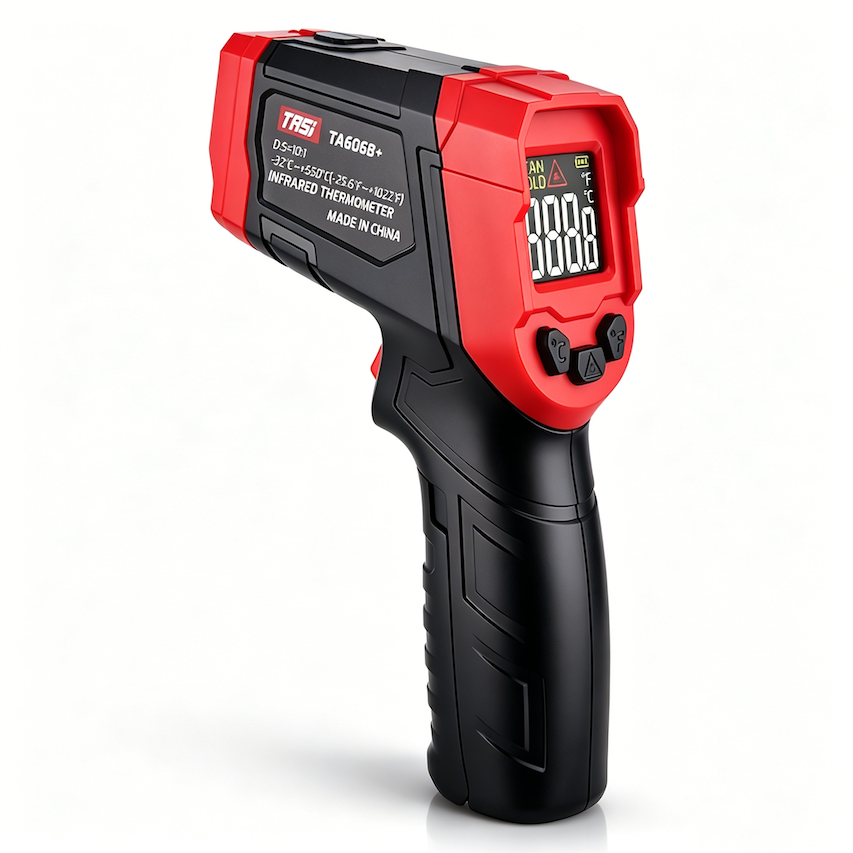
TA606B+ TA606 Series Non-contact Infrared Thermometer

TA606B+

TA606 Series
Non-contact Infrared Thermometer
-32 to 550℃ | 10:1
Abstract:
The TA606 Series Infrared Thermometer is a professional non-contact temperature measurement tool, also known as an infrared temperature gun, laser thermometer, infrared temperature meter, industrial thermometer, or handheld infrared thermometer. It measures surface temperature by detecting infrared energy emitted from target objects, providing fast, safe, and accurate temperature readings without physical contact, reducing risks when measuring hot surfaces, moving equipment, or energized components. The TA606 Series includes two models: TA606A+ with a temperature range of -32℃ to 400℃, and TA606B+ with an extended range up to -32℃ to 550℃, meeting various industrial temperature inspection requirements. Equipped with a 10:1 distance-to-spot ratio and laser aiming guidance, the infrared thermometer allows users to quickly identify measurement areas and improve inspection efficiency. The fixed 0.95 emissivity setting enables direct measurement on most common solid materials without complicated configuration. Featuring ℃/℉ temperature unit switching, data hold function, and a compact handheld design, the TA606 infrared thermometer is easy to operate and suitable for daily field temperature testing. It is widely used in electrical inspection, industrial maintenance, HVAC systems, automotive repair, food processing, building inspection, facility management, and engineering applications. In electrical and industrial environments, the infrared temperature gun can be used for checking switchgear, cables, terminals, circuit breakers, motors, bearings, and mechanical equipment, helping technicians quickly identify abnormal heat conditions. In HVAC applications, it supports temperature inspection of air conditioners, refrigeration systems, heating pipes, and underfloor heating systems. For automotive maintenance, it enables temperature diagnosis of engines, exhaust systems, brake components, and vehicle parts. It is also suitable for food production temperature monitoring, cold chain management, building insulation inspection, and energy efficiency testing, making it an ideal handheld infrared thermometer for professional field measurements.
View More ›
Related Technical Articles
Related FAQs