Introduction
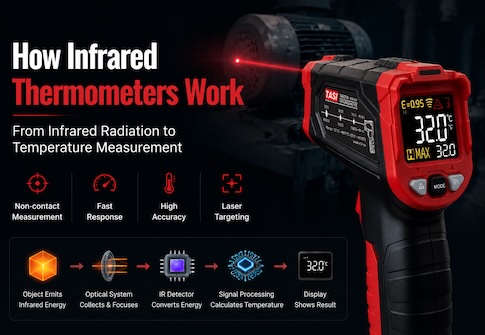
Infrared thermometers calculate temperature by detecting infrared radiation emitted from a target surface. They provide fast, non-contact temperature measurement and are widely used in industrial maintenance, HVAC, process inspection, and general troubleshooting.
However, the performance of the infrared detector, optical system, temperature compensation circuitry, and electronic components may gradually change over time. Environmental exposure and mechanical shock can also affect measurement stability.
So, does an infrared thermometer need regular calibration? The answer depends on the application, required accuracy, operating conditions, and quality-control requirements. Understanding the purpose of calibration helps determine when calibration is necessary and how measurement reliability can be maintained over time.
Key Takeaways
● An infrared thermometer does not need to be calibrated after every use, but measurement drift may occur over time.
● Applications involving process control, quality inspection, or measurement traceability may require a defined calibration program.
● Calibration or performance verification should be considered after significant impact, a drop, major environmental changes, or persistent abnormal readings.
● Professional calibration normally uses a stable blackbody radiation source with known temperature and radiometric characteristics.
● Calibration cannot correct every measurement problem. Emissivity, measurement distance, target size, surface condition, and ambient conditions also affect results.
● There is no single calibration interval suitable for every infrared thermometer. The interval should reflect usage, environment, accuracy requirements, and historical calibration results.
Does an Infrared Thermometer Need Calibration?
Yes, but this does not mean that every infrared thermometer requires frequent calibration.
Infrared thermometers are normally adjusted and tested during manufacturing and can generally be used directly under their specified operating conditions. Over time, however, the infrared detector, temperature compensation circuitry, optical components, and electronic components may experience gradual drift.
For routine equipment inspection, HVAC maintenance, or general temperature checking, professional calibration may not be required frequently if readings remain stable and the instrument continues to perform as expected.
For production process control, laboratory testing, quality inspection, equipment condition assessment, or other applications where measurement accuracy is important, a defined calibration schedule is generally more appropriate.
Why Might an Infrared Thermometer Need Calibration Over Time?
An infrared thermometer contains several measurement components, including an infrared detector, optical system, ambient temperature sensor, and signal-processing electronics. Changes in any of these components can influence the final temperature reading.
Common causes include:
● Long-term drift of the infrared detector;
● Extended exposure to high or low temperatures;
● Frequent or rapid changes in ambient temperature;
● Drops, impacts, or strong mechanical shock;
● Contamination, aging, or damage to the optical system;
● Changes in internal temperature compensation performance;
● Gradual drift of electronic components;
● Long-term storage followed by return to service.
These changes may not immediately produce an obvious measurement error. For applications with tighter accuracy requirements, periodic verification helps identify performance changes before they affect critical measurements.
When Is Calibration Recommended?
Calibration does not need to wait until an infrared thermometer shows an obvious fault. Calibration or performance verification should be considered in the following situations:
● The instrument has reached the calibration interval defined by the organization or recommended for the application;
● Readings consistently differ significantly from a reliable reference instrument;
● Measurements on the same stable target show unusual drift;
● The instrument has been dropped or subjected to significant mechanical impact;
● It has been used extensively in high-temperature, high-humidity, dusty, or otherwise harsh environments;
● The instrument has been repaired or important internal components have been replaced;
● It has been stored for an extended period before returning to critical service;
● It is used for quality control, metrology management, or measurements requiring traceability.
If abnormal readings are caused by dust, oil, condensation, or other contamination on the infrared lens, the lens should first be cleaned correctly before concluding that calibration is required.
How Is an Infrared Thermometer Calibrated?
Professional infrared thermometer calibration is normally performed against a stable blackbody radiation source rather than by simply comparing the instrument with an ordinary contact thermometer.
A typical calibration procedure includes:
● Setting the blackbody source to a specified temperature and allowing it to stabilize;
● Setting the required emissivity and other measurement parameters on the infrared thermometer;
● Positioning the thermometer at the specified distance and angle so that its measurement spot remains fully within the effective blackbody target area;
● Recording the infrared thermometer reading and the reference temperature;
● Repeating the measurement at one or more calibration points;
● Calculating the deviation at each temperature point and comparing it with the specified instrument accuracy;
● If adjustment is supported and required, modifying the instrument according to the manufacturer's procedure and then verifying it again.
For infrared thermometers with a wide measurement range, testing at only one temperature point is generally insufficient to evaluate performance across the entire range. Professional calibration therefore commonly uses several representative temperature points.
Are Calibration and Adjustment the Same Thing?
Not exactly.
Calibration primarily determines the difference between the infrared thermometer reading and a reliable reference value under defined conditions.
If the measured deviation exceeds the permissible limit and the instrument supports adjustment, internal parameters may then be changed to bring the measurement performance back within specification.
Therefore, an infrared thermometer can be calibrated without being adjusted. If calibration confirms that the instrument already meets its accuracy specification, no adjustment is necessary.
How Often Should an Infrared Thermometer Be Calibrated?
There is no universal calibration interval for all infrared thermometers.
The appropriate interval should be determined according to the instrument's application, frequency of use, operating environment, accuracy requirements, and previous calibration history.
When defining the interval, consider:
● Whether the instrument is used daily or only occasionally;
● Whether it operates in harsh or highly variable environments;
● Whether measurement results directly affect product quality or process control;
● The required measurement accuracy;
● The stability of previous calibration results;
● Internal quality-management requirements.
If historical calibration results remain consistently stable, the interval may be reviewed according to the organization's measurement-management policy. If repeated calibration shows significant drift, shorter verification or calibration intervals may be appropriate.
Does an Inaccurate Reading Always Mean Recalibration Is Required?
No.
Before assuming that an infrared thermometer has drifted out of calibration, measurement conditions should first be checked. Many apparent accuracy problems are caused by measurement technique rather than instrument calibration.
Common factors include:
● Incorrect emissivity setting: Different materials emit infrared radiation differently, and an incorrect emissivity setting can create significant measurement error.
● Excessive measurement distance: Because of the D:S ratio, the measurement spot becomes larger as distance increases.
● Target too small: If the target does not completely fill the measurement area, radiation from the surrounding background may influence the reading.
● Highly reflective surfaces: Shiny metals and other low-emissivity surfaces can reflect surrounding thermal radiation.
● Contaminated optics: Dust, oil, moisture, or condensation can reduce the infrared energy reaching the detector.
● Rapid ambient temperature changes: An instrument moved quickly between substantially different environments may require time to reach thermal equilibrium.
● Measurement through glass: Most general-purpose infrared thermometers measure the temperature of the glass surface rather than the actual temperature of an object behind the glass.
These factors should be eliminated before deciding that professional recalibration is necessary.
Can You Check an Infrared Thermometer's Accuracy Yourself?
A basic performance check can be performed by the user, but it does not replace professional calibration.
For example, a stable target with relatively high emissivity can be measured repeatedly and compared with another known, stable reference instrument.
This type of comparison can help identify obvious abnormalities, such as one instrument suddenly showing significantly different readings from the others. However, it does not provide a formal determination of measurement error.
Where quantified measurement uncertainty, documented calibration results, or traceability are required, calibration should be performed using suitable blackbody calibration equipment or by a competent calibration laboratory.
How Can Measurement Drift Be Reduced?
Good operating and maintenance practices can reduce abnormal drift and unnecessary calibration.
● Avoid dropping the instrument or exposing it to strong impact and vibration;
● Do not store it for long periods outside its specified temperature and humidity conditions;
● Keep the infrared optics clean and avoid touching the lens with hard or abrasive objects;
● After moving the instrument between significantly different environments, allow sufficient time for thermal stabilization before precision measurements;
● Use the correct emissivity setting, measurement distance, and target size;
● Maintain usage and calibration records for important instruments;
● If readings remain persistently abnormal, remove the instrument from critical measurement tasks until its performance has been verified.
FAQ
Does a new infrared thermometer need to be calibrated immediately?
Normally not. A properly manufactured infrared thermometer is generally adjusted and tested before leaving the factory. Unless specific quality or metrology requirements apply, it can normally be used according to the manufacturer's instructions.
Does an infrared thermometer have to be calibrated every year?
Not necessarily. The interval should be based on application, usage frequency, environmental conditions, accuracy requirements, calibration history, and the organization's measurement-management policy.
Should an infrared thermometer be recalibrated after being dropped?
If the instrument has experienced a significant impact, its performance should be verified. If readings become abnormal or the thermometer is used for critical measurements, professional inspection or calibration is advisable.
If an infrared thermometer and a thermocouple show different temperatures, does that mean the infrared thermometer is inaccurate?
Not necessarily. An infrared thermometer measures surface temperature remotely, while a thermocouple measures through physical contact. Measurement location, thermal contact, response characteristics, surface emissivity, and other factors can cause different results.
Can ice water or boiling water be used to calibrate an infrared thermometer?
These methods are not suitable for rigorous infrared thermometer calibration. Infrared thermometers respond to surface radiation, and liquid surface conditions, steam, reflected radiation, and emissivity can all influence the reading. Professional calibration normally uses a blackbody radiation source.
Will a calibrated infrared thermometer accurately measure every material?
No. Calibration verifies instrument performance under defined conditions. Actual field measurements remain affected by emissivity, surface condition, target size, measurement distance, and ambient conditions.
Summary
Infrared thermometers may require calibration, but the appropriate calibration frequency depends on the application. For routine temperature checks, periodic performance verification may be sufficient if the instrument remains stable. For process control, quality inspection, and applications requiring higher accuracy or traceability, a formal calibration program is more appropriate.
An abnormal reading does not automatically mean the instrument has lost calibration. Emissivity, D:S ratio, target size, lens condition, reflective surfaces, and ambient temperature can all affect infrared measurements. These factors should first be checked before determining whether professional calibration is required.