Introduction
When measuring the rotational speed of motors, fans, pulleys, shafts, or other rotating equipment with a non-contact tachometer, a small piece of reflective tape is often applied to the rotating part. This leads to a common question: Does a non-contact tachometer always require reflective tape?
The answer is no, not always. However, for most optical or laser tachometers based on reflected-light detection, reflective tape is the recommended method for achieving stable and repeatable measurements.
What the tachometer actually requires is not the tape itself, but a clearly detectable optical target that produces a distinct signal once during each revolution. Reflective tape is widely used because it provides this contrast in a simple and reliable way.
Key Takeaways
● Reflective tape is not mandatory in every non-contact tachometer application.
● For most optical and laser tachometers, reflective tape improves signal strength, measurement range, and reading stability.
● If the rotating surface already has a clear and repeatable difference in color, brightness, or reflectivity, measurement may be possible without additional tape.
● The sensor must detect a distinct periodic optical change corresponding to each revolution.
● Normally, only one effective reflective mark should be used per revolution; multiple marks may cause the displayed RPM to be multiplied.
● When measuring without reflective tape, verify that the reading is stable and consistent with the actual operating speed.
What Does Reflective Tape Do in Non-Contact RPM Measurement?
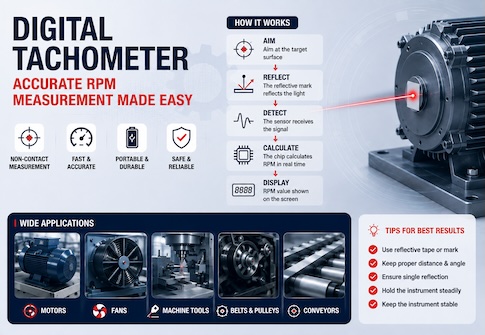
Most handheld non-contact tachometers operate using an optical sensing principle. The instrument directs a light beam toward the rotating target and detects variations in the returned light.
When the reflective tape passes through the sensing area, the reflected light intensity is usually significantly higher than that of the surrounding surface. This creates a clear optical pulse that can be detected by the sensor.
If the tape passes the sensor once per revolution, the tachometer can calculate rotational speed from the number of detected pulses over time.
The main functions of reflective tape are therefore to:
● Increase reflected signal strength;
● Create strong optical contrast between the target mark and the surrounding surface;
● Help the sensor identify each revolution consistently;
● Reduce interference caused by surface color, material, and ambient lighting;
● Improve measurement stability at greater distances or higher rotational speeds.
In practical terms, reflective tape provides the tachometer with a clear reference mark for detecting each revolution.
When Is Reflective Tape Recommended?
For most handheld optical and laser tachometers, reflective tape is recommended whenever practical, particularly under the following conditions.
● The target surface has a uniform color or reflectivity. A black shaft, metallic shaft, plastic fan, or similar rotating surface may not naturally provide enough optical variation for reliable revolution detection.
● The surface has low reflectivity. Dark, rough, or light-absorbing materials may return only a weak signal. Reflective tape can significantly improve detection.
● The measuring distance is relatively long. Returned optical energy decreases with distance, making a high-reflectivity target easier to detect.
● The equipment rotates at high speed. At high RPM, the reflective target remains in the sensing area for only a very short period, so a clear signal is important.
● The environment contains strong ambient light or complex optical backgrounds. A high-contrast reflective mark can help improve signal discrimination.
If the tachometer produces unstable readings, fails to display RPM, shows obviously incorrect values, or only works at very short distances, the reflective target should be one of the first items checked.
When Can a Non-Contact Tachometer Be Used Without Reflective Tape?
Reflective tape may not be necessary if the rotating component already provides a distinct, repeatable optical feature.
Examples include:
● A rotating part with clearly separated black and white areas;
● A factory-applied high-reflectivity mark;
● A surface area with reflectivity significantly different from the rest of the rotating component;
● Equipment incorporating an optical speed-sensing reference mark;
● A surface that naturally produces one strong and repeatable reflection change per revolution.
For example, if most of a rotating disc is black but one section is clearly white, the white section may effectively perform the same function as reflective tape.
The important question is therefore not whether adhesive tape is present, but whether the sensor receives a clear, stable signal that corresponds correctly to the rotational period.
Can a Tachometer Measure Directly from a Metallic Surface?
Sometimes, but relying solely on natural reflections from metal is generally not recommended.
Polished metal can produce strong reflections, but those reflections are highly dependent on surface geometry and angle. As the component rotates, the reflected beam may continually change direction, causing the signal received by the sensor to fluctuate.
This can result in:
● Unstable RPM readings;
● Successful measurement at one angle but failure at another;
● Different displayed values at the same actual speed;
● Multiple irregular reflections being interpreted as separate pulses.
Therefore, a shiny surface is not necessarily an ideal measurement surface. A controlled high-contrast reference mark is usually more reliable than unpredictable reflections from bare metal.
Why Can RPM Sometimes Be Measured Without Reflective Tape?
A tachometer detects changes in optical signals rather than the reflective tape material itself.
A rotating fan, coupling, pulley, or shaft may already contain different colors, openings, text, edges, surface finishes, or geometric features. During rotation, these features can create periodic changes in reflected light.
If the changes are strong and repeatable enough, the tachometer may successfully calculate RPM without any additional reflective tape.
However, obtaining a numerical reading does not automatically mean that the reading is correct. A natural surface may generate several reflection peaks during each revolution, causing the tachometer to interpret one revolution as multiple revolutions.
For this reason, readings obtained without a controlled reflective mark should always be checked for plausibility and stability.
Why Is Only One Reflective Mark Normally Used?
For tachometers that interpret one detected optical pulse as one revolution, one effective reflective mark per revolution is normally used.
For example, if the actual speed is 1000 RPM and two equally detectable reflective marks are applied to the same rotating disc, the tachometer may detect two pulses per revolution. If the instrument assumes one pulse equals one revolution, the display may show approximately 2000 RPM.
In general:
● 1 effective mark per revolution → normally indicates the actual RPM;
● 2 effective marks per revolution → the displayed value may be approximately twice the actual RPM;
● 3 effective marks per revolution → the displayed value may be approximately three times the actual RPM.
The exact behavior depends on the tachometer's measurement logic, so the manufacturer's operating instructions should always be followed.
Where Should Reflective Tape Be Applied?
Reflective tape should be applied to a location on the rotating component that is safe, secure, and easy to target optically.
Recommended practice includes:
● Select a flat, clean surface where the tape can adhere securely;
● Remove dust, oil, moisture, or other contamination before application;
● Make sure the tape cannot detach at operating speed;
● Prefer a location where the surrounding surface has relatively low reflectivity;
● Aim the instrument so the light beam intersects the path of the reflective target;
● Avoid applying tape where it could significantly affect the dynamic balance of the rotating component.
If the surrounding surface is highly reflective, a darker background treatment may sometimes be used, subject to the instrument manufacturer's recommendations, to create greater optical contrast.
Is a Larger Reflective Mark Always Better?
No.
The reflective area only needs to be large enough for the tachometer's optical system to detect it reliably. Making the mark excessively large does not continuously improve measurement accuracy and may make installation less practical.
This is particularly important on small-diameter or high-speed rotating components, where thick, heavy, or poorly secured materials should be avoided.
A suitable reflective target should:
● Be large enough for reliable optical detection;
● Provide clear contrast against the surrounding surface;
● Remain securely attached;
● Not interfere with normal rotation;
● Not significantly alter the mass distribution of the rotating component.
For recommended target size and measuring distance, refer to the specifications of the tachometer being used.
What If the Tachometer Still Cannot Measure RPM After Reflective Tape Is Applied?
Applying reflective tape does not guarantee a valid reading. If the tachometer still cannot measure correctly, check the following points.
● Beam position. Confirm that the optical beam actually intersects the path of the reflective tape rather than a stationary housing, bearing support, or nearby surface.
● Measuring distance. Operating too close or too far away may place the target outside the instrument's effective optical range.
● Measurement angle. Adjust the angle so the sensor receives a sufficiently stable reflected signal.
● Reflective tape condition. Dust, oil, wear, or partial detachment can reduce reflectivity.
● Background reflections. Multiple highly reflective areas may generate false pulses.
● Ambient light. Strong sunlight, flashing light sources, or other intense illumination may interfere with some optical sensors.
● Measurement range. Verify that the rotational speed is within the tachometer's specified RPM range.
What Should Be Considered When Applying Reflective Tape to High-Speed Equipment?
For high-speed shafts, spindles, impellers, motors, or other rotating machinery, safety takes priority over obtaining a measurement.
Always stop the equipment and confirm that the rotating component has come to a complete standstill before applying, adjusting, or replacing reflective tape. Never attempt to touch a rotating shaft, coupling, pulley, or blade.
Also consider the following:
● Make sure the reflective tape is firmly attached;
● Avoid thick or heavy marking materials;
● Do not significantly disturb the dynamic balance of the rotating component;
● Maintain a safe distance from rotating machinery during measurement;
● Do not move the instrument or hands unnecessarily close to the rotating target;
● Do not remove required machine guards solely to obtain an RPM reading.
One of the main advantages of a non-contact tachometer is its ability to measure rotational speed from a safe distance. This advantage should be fully utilized in practical applications.
FAQ
Does a non-contact tachometer require the manufacturer's original reflective tape?
Not necessarily. The key requirement is a material that provides a sufficiently strong and stable optical reflection for the instrument. However, using reflective material recommended by the manufacturer is the most reliable approach.
Can a laser tachometer work without reflective tape?
In some cases, yes. If the rotating surface already provides a clear and repeatable change in reflectivity, the tachometer may measure it directly. Reflective tape is still recommended for uniform, dark, or optically unstable surfaces.
Can two pieces of reflective tape be used?
If the tachometer assumes one detected pulse equals one revolution, two effective reflective marks may cause the displayed value to be approximately twice the actual RPM. For standard RPM measurements, one effective mark is normally preferred.
Why does the reading fluctuate even after reflective tape has been applied?
Possible causes include incorrect measuring distance, poor beam alignment, contaminated tape, unwanted background reflections, machine vibration, measurement angle, or strong ambient light.
Does a black rotating surface always require reflective tape?
Not always, but dark surfaces generally produce weaker reflected signals. If the surface does not contain a distinct optical feature, reflective tape usually improves reliability.
Can white paint or ordinary white tape replace reflective tape?
Sometimes they may provide enough contrast to generate a reading, but ordinary white materials do not necessarily offer the same reflective performance as dedicated reflective tape. For repeatable professional measurements, suitable reflective material is recommended.
Conclusion
A non-contact tachometer does not always require reflective tape. For optical and laser tachometers, the essential requirement is a stable periodic optical signal that can be associated with each revolution.
If the rotating surface already provides one clear and repeatable reflective feature per revolution, direct measurement may be possible. In most industrial environments, however, surface color, material, finish, and ambient lighting vary considerably. Reflective tape therefore remains the simplest and most reliable method for producing a controlled measurement target.
For accurate results, pay particular attention to the number and position of reflective marks, measuring distance, beam alignment, and background reflections. On high-speed equipment, always install reflective tape with the machinery stopped and maintain a safe non-contact measuring distance.