Introduction
Yes. Bright ambient light can affect non-contact tachometers that operate using an optical reflection principle. Direct sunlight, high-intensity industrial lighting, LED lamps, flashing light sources, and welding arcs may all interfere with measurement to varying degrees.
This does not mean that a non-contact tachometer cannot be used in bright environments. The main issue is that excessive ambient light can approach or exceed the effective reflected signal returned from the reflective tape, making it more difficult for the optical sensor to identify each rotation reliably.
Therefore, when measuring motors, fans, shafts, pulleys, or other rotating components outdoors or under intense industrial lighting, unstable readings, abnormal RPM values, or complete loss of measurement may indicate ambient-light interference.
Key Points
● Bright ambient light can reduce the contrast between the reflected signal from the tape and the optical background;
● Direct sunlight, high-output LED lighting, strobe lights, and welding arcs are common sources of interference;
● Interference may cause fluctuating readings, unexpectedly high or low values, unstable measurements, or no reading;
● The effect generally becomes more noticeable when the measuring distance is long, the reflective target is small, or the alignment is poor;
● Shielding the sensor from strong light, reducing the measuring distance, improving alignment, and maintaining the reflective tape can improve measurement stability.
Why Can Bright Light Affect a Non-Contact Tachometer?
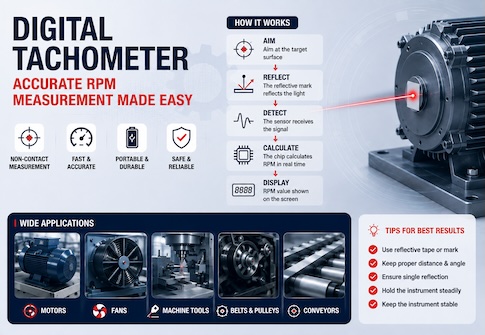
A non-contact tachometer generally emits a light beam toward reflective tape attached to a rotating component. Each time the reflective tape passes through the measuring area, it produces a distinct change in reflected light. The internal photoelectric sensor detects these periodic changes and calculates rotational speed from the number of pulses received over a given period.
Under ideal conditions, the reflective tape produces a clear optical contrast compared with the rest of the rotating surface.
In a high-intensity lighting environment, however, additional ambient light can enter the sensor's receiving area and raise the optical background level. If the background becomes too strong, the difference between the reflected signal and the surrounding light decreases, making pulse detection more difficult.
The key issue is therefore not simply whether the laser or aiming light is bright enough. What matters is whether the tachometer can reliably distinguish the periodic reflected signal from the surrounding optical background.
Which Bright-Light Conditions Are Most Likely to Cause Interference?
Not all lighting conditions have the same effect. The degree of interference depends on light intensity, direction, distance, surface reflectivity, and the optical design of the tachometer.
● Direct sunlight: Outdoor measurements are more susceptible to interference when sunlight directly illuminates the reflective tape or enters the sensor receiving area;
● High-intensity LED lighting: Some industrial LED luminaires produce very strong illumination and may also exhibit periodic variations in light output;
● Strobe or flashing lights: Periodically changing light can potentially be interpreted by the optical sensor as additional pulses;
● Welding arcs: Arc welding produces extremely intense and rapidly changing light that can cause significant optical interference;
● Highly reflective surfaces: Polished metal, stainless steel, and aluminium surfaces can generate strong reflections that reduce the optical contrast between the tape and the background.
When investigating interference in an industrial environment, it is therefore important to consider not only overall brightness, but also direct illumination, specular reflection, and periodically fluctuating light sources.
What Are the Typical Symptoms of Bright-Light Interference?
Bright-light interference does not always result in a complete loss of measurement.
Common symptoms include:
● RPM values continuously fluctuating instead of stabilising;
● Noticeable differences between repeated measurements at the same rotational speed;
● Loss of the reading when the measuring distance is slightly increased;
● Intermittent readings, zero values, or no displayed RPM;
● Measured speed that appears significantly higher or lower than the actual speed;
● Readings becoming stable immediately after changing the measuring angle or shielding the sensor from the light source.
If the machine speed itself is stable but the measured value changes noticeably with the lighting direction, ambient-light interference should be considered.
Why Is Outdoor Measurement More Difficult in Direct Sunlight?
Sunlight is normally much more intense than conventional indoor lighting.
When reflective tape is exposed to direct sunlight, or when sunlight can enter the optical receiving area of the tachometer, the sensor may be subjected to a much higher background-light level.
Metal shafts, fan blades, pulleys, and other machine surfaces can also produce strong reflections in sunlight, further reducing the contrast between the reflective target and the surrounding surface.
For this reason, being able to see the laser spot clearly does not necessarily mean that the instrument can detect the reflected pulse reliably. Visibility of the aiming spot and successful detection of the reflected signal are two different conditions.
How Can Measurement Be Improved in Bright-Light Conditions?
If ambient light is suspected of affecting the measurement, the following actions can help:
● Shield the target from direct light: Use a suitable machine guard, shade, or other safe method to prevent direct sunlight or intense lighting from striking the reflective tape or entering the sensor;
● Reduce the measuring distance: Within the specified operating range of the instrument, moving closer to the target can increase the strength of the useful reflected signal;
● Align the tachometer correctly: Aim the emitted beam directly at the reflective tape so that the sensor receives a stronger and more consistent return signal;
● Inspect the reflective tape: Make sure it is clean, intact, securely attached, and free from oil, dust, or excessive wear;
● Improve background contrast: Avoid applying reflective tape to an already highly reflective area where possible;
● Eliminate unwanted reflective points: Multiple reflective areas during one revolution can generate additional pulses and cause incorrect RPM readings;
● Adjust the measuring position: Reposition or re-angle the tachometer so that intense ambient light does not enter the receiving optics directly;
● Keep the instrument steady: Hand movement changes distance and alignment and can further reduce measurement stability.
Can Bright Light Make the RPM Reading Too High?
Yes, but bright light does not always cause a high reading.
If the environment contains strobing LEDs, flashing lamps, or another periodically changing light source, the optical sensor may detect additional light variations. If these variations are interpreted as rotational pulses, the displayed RPM may become abnormally high.
Conversely, strong continuous light may mask part of the useful reflected signal, causing missed pulses. In this situation, the tachometer may display a lower value, fluctuate, or fail to detect the speed entirely.
Bright-light interference can therefore cause both false triggering and missed detection. It should not be assumed that the error will always occur in one direction.
Why Is Reflective Tape Important in Bright Environments?
Reflective tape creates a deliberately defined area that produces a strong and repeatable optical signal.
The surface of a shaft or other rotating component may have uneven colour, texture, or reflectivity. Suitable reflective tape provides a clearer change in reflected light and makes it easier for the tachometer to identify each revolution.
This optical contrast becomes especially important under strong ambient lighting.
If the tape is too small, contaminated, worn, badly positioned, or surrounded by other highly reflective areas, the instrument may struggle to obtain a stable signal even when the emitted light reaches the target correctly.
FAQ
Can a non-contact tachometer still be used in bright environments?
Yes. In many cases, normal measurement is still possible if direct light is prevented from entering the sensor, the reflective tape is in good condition, and the measuring distance and alignment are appropriate.
Why does the reading become stable after sunlight is blocked?
Blocking the sunlight reduces the optical background level, increasing the contrast of the useful reflected signal from the tape. This makes each rotational pulse easier for the sensor to identify.
Why is there no RPM reading even though I can see the laser spot?
A visible laser or aiming spot only confirms that the emitted light reaches the target. It does not confirm that the return signal is strong enough for the sensor to detect. Distance, reflective-tape condition, alignment, and ambient light can all affect signal reception.
Can indoor LED lighting also affect RPM measurement?
Yes. Conventional indoor lighting usually has limited influence, but high-intensity LEDs, dimmed LEDs, or luminaires with noticeable flicker can interfere with some optical tachometers.
Will using a larger reflective target improve measurement in bright light?
Within reasonable limits, a more easily detected reflective area may improve signal reliability. However, there should not be multiple independent reflective markers within one revolution unless the instrument is configured to compensate for them, as multiple pulses can produce an incorrect RPM calculation.
Conclusion
Bright ambient light can affect non-contact tachometers, particularly instruments that detect reflective tape using photoelectric sensing. The main issue is the instrument's ability to distinguish the useful reflected signal from the ambient optical background, rather than whether the laser spot itself is visible.
If unstable, abnormal, or missing RPM readings occur in direct sunlight, under high-intensity LEDs, near strobe lighting, or close to welding operations, ambient-light interference should be considered. Shielding the sensor, reducing the measuring distance, improving alignment, maintaining the reflective tape, and changing the measuring angle can all improve reliability.
For applications requiring frequent measurements outdoors or in complex industrial lighting environments, the instrument's practical measuring distance, optical interference resistance, and suitability for the operating environment should also be considered during product selection.