Introduction
When using a non-contact laser tachometer to measure a rotating machine, the laser spot may be clearly visible on a shaft, pulley, fan, or other rotating component while the display still shows no RPM value or remains at zero.
This does not necessarily indicate a fault with the tachometer. The laser primarily helps identify the measurement area. Actual speed measurement depends on whether the photoelectric sensor receives a clear and periodic reflected-light signal.
In other words, “the laser is hitting the target” and “the tachometer is detecting a valid rotational signal” are two different conditions.
Key Points
● A visible laser spot does not guarantee that the tachometer is receiving a usable reflected signal.
● Most photoelectric laser tachometers require a strong contrast between the reflective marker and the surrounding surface.
● Reflective tape that is too small, dirty, damaged, or incorrectly positioned can result in no reading.
● Measuring distance, aiming angle, rotational speed, vibration, and ambient light can affect signal detection.
● Multiple reflective points per revolution can cause doubled or otherwise incorrect readings.
● Troubleshooting should begin with the reflective target, measurement position, and distance before assuming an instrument fault.
Why Can There Be No Reading Even When the Laser Hits the Rotating Object?
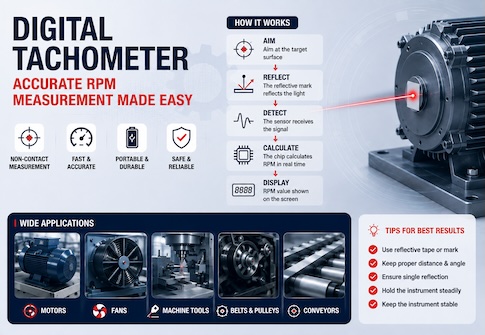
A non-contact laser tachometer typically projects a light beam onto the rotating object and uses an internal photoelectric sensor to detect reflected light.
When reflective tape passes through the measurement area, it produces a distinct change in reflected intensity. The tachometer detects these periodic pulses and calculates rotational speed from their frequency.
The instrument therefore needs to detect periodic changes in reflectivity, not simply the presence of reflected laser light.
For example, if the beam continuously strikes a metal shaft with a nearly uniform colour and reflectivity, the reflected signal may remain almost constant even while the shaft is rotating. Without a distinguishable recurring signal, the tachometer cannot determine how many revolutions have occurred.
No Reflective Tape Has Been Applied
This is one of the most common reasons a laser tachometer fails to display a reading.
Most non-contact tachometers based on photoelectric reflection require a clearly distinguishable reflective marker, typically reflective tape, on the rotating component.
● The reflective tape produces a relatively strong return signal when it passes the measurement point.
● The surrounding surface produces a weaker return signal.
● This alternating reflection creates a periodic pulse.
● The tachometer converts the pulse frequency into RPM.
If a uniformly coloured shaft, wheel, or pulley is measured directly, the instrument may not be able to identify each revolution.
Where operating conditions permit, apply reflective tape in accordance with the tachometer manufacturer's instructions.
The Reflective Tape Is in the Wrong Position
Even when reflective tape has been installed, the tachometer cannot obtain a stable reading if the laser does not intersect the tape's rotational path.
For example, the tape may be positioned near the outer edge of a pulley while the laser remains aimed at the centre. In that case, the reflective marker never passes through the sensing point.
For reliable measurement:
● The reflective tape must rotate together with the measured component.
● The marker should pass through the measurement area once per revolution.
● The laser should remain aligned with the marker's path.
● The sensor should receive a clear reflected pulse on every revolution.
Before starting the machine, it can be useful to check the alignment while the component is stationary.
The Reflective Tape Is Too Small, Dirty, or Damaged
The reflective marker must generate a sufficiently distinct return signal.
If the reflective area is too small, contaminated, worn, wrinkled, or partially detached, the sensor may receive a signal that is too weak or inconsistent.
Common issues include:
● Reflective tape that is too small.
● Dust, grease, or oil covering the reflective surface.
● Worn or deteriorated reflective material.
● Poorly adhered or wrinkled tape.
● Partial detachment at high rotational speed.
● The laser spot not fully covering the effective reflective area.
Clean or replace the reflective tape and realign the measurement point if necessary.
The Measured Surface Is Too Reflective
Higher reflectivity does not always improve measurement.
Polished stainless steel, chrome-plated parts, and other shiny surfaces can produce strong background reflections. If the difference between the background surface and the reflective tape becomes too small, the sensor may have difficulty distinguishing the marker.
The objective is not to create the strongest possible reflection, but to create a clear and repeatable difference in reflected intensity between the marker and the surrounding surface.
The Measuring Distance Is Incorrect
Laser tachometers are designed to operate within a specified measurement distance.
If the instrument is positioned too far from the target:
● Less optical energy reaches the target.
● The reflected signal returning to the sensor becomes weaker.
● The laser spot may become larger.
● The reflective tape occupies a smaller proportion of the illuminated area.
Very short distances are not automatically better either, because transmitting and receiving optics differ between tachometer designs.
Always operate within the distance range specified for the instrument and adjust the position within that range to obtain the most stable signal.
The Measuring Angle Is Unsuitable
A visible laser spot does not necessarily mean that sufficient reflected light is returning to the receiving sensor.
At a steep angle, particularly on smooth or metallic surfaces, reflected light may be directed away from the receiver because of specular reflection.
Keep the tachometer steadily aligned with the reflective marker's path and adjust the angle slightly if necessary.
Never move your hands or the instrument dangerously close to exposed shafts, couplings, fans, pulleys, or other rotating components simply to obtain a reading.
There Are Multiple Reflective Points per Revolution
For tachometers that interpret one detected pulse as one revolution, a single effective reflective marker is normally used.
Additional reflective points may be created by:
● More than one piece of reflective tape.
● Bright areas on a metal surface.
● Screws, blades, edges, or surface features that generate periodic reflections.
● Other reflective objects within the sensing area.
The instrument may then detect multiple pulses during one revolution.
This may not always result in no reading. Instead, the displayed RPM may be doubled, unstable, or otherwise incorrect.
The Rotational Speed Is Outside the Instrument Range
Every tachometer has a specified RPM measurement range.
If the actual speed is below the minimum detectable speed or above the maximum measuring range, the instrument may fail to display a valid value or may produce unstable readings.
Before assuming an instrument fault, verify:
● The approximate speed of the rotating equipment.
● The specified RPM range of the tachometer.
● Whether the actual speed falls within the instrument's operating range.
For machines with significant speed fluctuations, allow the speed to stabilise before recording the measurement.
Ambient Light Is Interfering with the Sensor
Strong external light can affect photoelectric detection.
Possible sources include:
● Direct sunlight on the measurement area.
● High-intensity lighting directed toward the receiver.
● Flickering or stroboscopic light sources.
● Other laser or infrared sources entering the sensing area.
These conditions can reduce the contrast between the valid reflective pulse and the optical background.
Where safe and practical, change the measurement direction, reduce direct external light, or move to another measurement position.
The Reflective Tape Is Unstable at High Speed
Reflective tape must be securely attached to high-speed rotating components.
If an edge lifts, the tape vibrates, or part of the marker detaches, the reflection angle may change continuously and produce an unstable signal.
On high-speed machinery, the tape must also be applied with consideration for mechanical safety. It should not be unnecessarily large or positioned in a way that could affect rotor balance.
For high-energy or high-speed rotating equipment, follow the equipment manufacturer's safety requirements and site procedures before adding any material to the rotating part.
The Rotating Part Is Vibrating or Wobbling
Excessive vibration or radial runout can cause the reflective marker to move in and out of the laser measurement area.
This can result in:
● The laser hitting the tape only intermittently.
● Large variations in reflected signal strength.
● RPM values appearing and disappearing.
● Significant fluctuation in the displayed reading.
Keep the tachometer stable and determine whether the machine itself is operating with abnormal vibration.
If vibration is outside normal operating conditions, the equipment problem should be addressed before continuing close-range measurement.
How to Troubleshoot a Laser Tachometer with No Reading
If the laser is visibly aimed at the rotating component but no RPM value is displayed, check the following in sequence:
● Check the reflective tape: Make sure it is installed, clean, intact, and securely attached.
● Check the laser position: Confirm that the beam intersects the actual path of the reflective marker.
● Adjust the measuring distance: Move the instrument within its specified working range and observe whether the reading stabilises.
● Adjust the measuring angle: Avoid extreme angles and excessive specular reflection.
● Check for unwanted reflections: Look for additional bright or reflective areas on the rotating component.
● Check ambient light: Reduce interference from sunlight, flickering lamps, or other strong optical sources.
● Confirm the RPM range: Make sure the actual rotational speed is within the tachometer's specified range.
● Check the instrument condition: Verify the battery level, measurement mode, and basic operation of the tachometer.
If there is still no reading, test the tachometer on another rotating object with a known speed and a clearly installed reflective target. If it operates correctly on the second object, the original problem is likely related to surface reflectivity, alignment, or operating conditions.
Important Points for Correct Laser Tachometer Use
Reliable measurement depends on providing the photoelectric sensor with a clear and repeatable pulse signal.
Recommended practice includes:
● Use reflective tape that is suitable for the tachometer.
● Normally use one effective reflective marker per revolution.
● Make sure the tape is securely attached.
● Aim the laser at the marker's rotational path.
● Operate within the specified measurement distance.
● Hold the instrument steady during measurement.
● Minimise strong ambient light and unwanted reflections.
● Record the RPM only after the display becomes stable.
For exposed high-speed shafts, fans, couplings, and pulleys, maintain a safe distance. A major advantage of a non-contact tachometer is that speed can be measured without touching the moving component.
FAQ
Why is there still no reading when the laser is clearly hitting the reflective tape?
The measuring distance, angle, ambient light, marker size, surface contamination, or RPM range may still be unsuitable. Confirm that the tape passes through the measurement area on every revolution and adjust the distance and angle within the instrument's specified range.
Can rotational speed be measured without reflective tape?
Sometimes. If the rotating surface naturally provides a clear periodic change in reflectivity, the sensor may be able to detect it. For more stable and repeatable measurements, however, reflective tape is generally recommended when specified by the instrument manufacturer.
Does the laser have to point at the centre of the rotating shaft?
No. The beam should be aimed at the path followed by the reflective marker. If the marker is placed near the outer edge of a pulley or disc, the measurement point should correspond to that path rather than the shaft centre.
Why does the reading appear intermittently and then return to zero?
This usually indicates an unstable reflected signal. Possible causes include poor alignment, vibration, insufficient reflective area, unsuitable distance, or ambient-light interference.
Why is the displayed speed twice the actual RPM?
Check whether the sensor is detecting two reflective points per revolution. Two pieces of reflective tape or another bright surface feature can generate two pulses for each revolution.
Does no reading mean the tachometer is faulty?
Not necessarily. Reflective conditions, distance, angle, ambient light, and the RPM range can all prevent a valid reading. Measurement conditions should be checked before diagnosing an instrument fault.
Conclusion
When a laser tachometer shows no RPM reading even though the laser is visibly hitting the rotating object, the most likely issue is not simply incorrect aiming. The photoelectric sensor may not be receiving a sufficiently clear and stable periodic reflection.
The main factors to check are reflective tape, laser position, measuring distance, angle, surface reflectivity, ambient light, vibration, and the instrument's RPM range.
Understanding the difference between laser aiming and photoelectric signal detection makes it easier to identify the cause of a failed measurement and obtain more stable, reliable non-contact RPM readings.