Introduction
● Rotational speed is an important parameter for evaluating the operating condition of motors, fans, spindles, rollers, pulleys, and other rotating machinery. It is commonly expressed in RPM (revolutions per minute). A tachometer is an instrument specifically designed to measure this rotational speed.
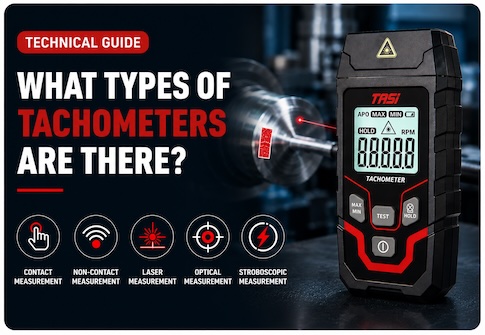
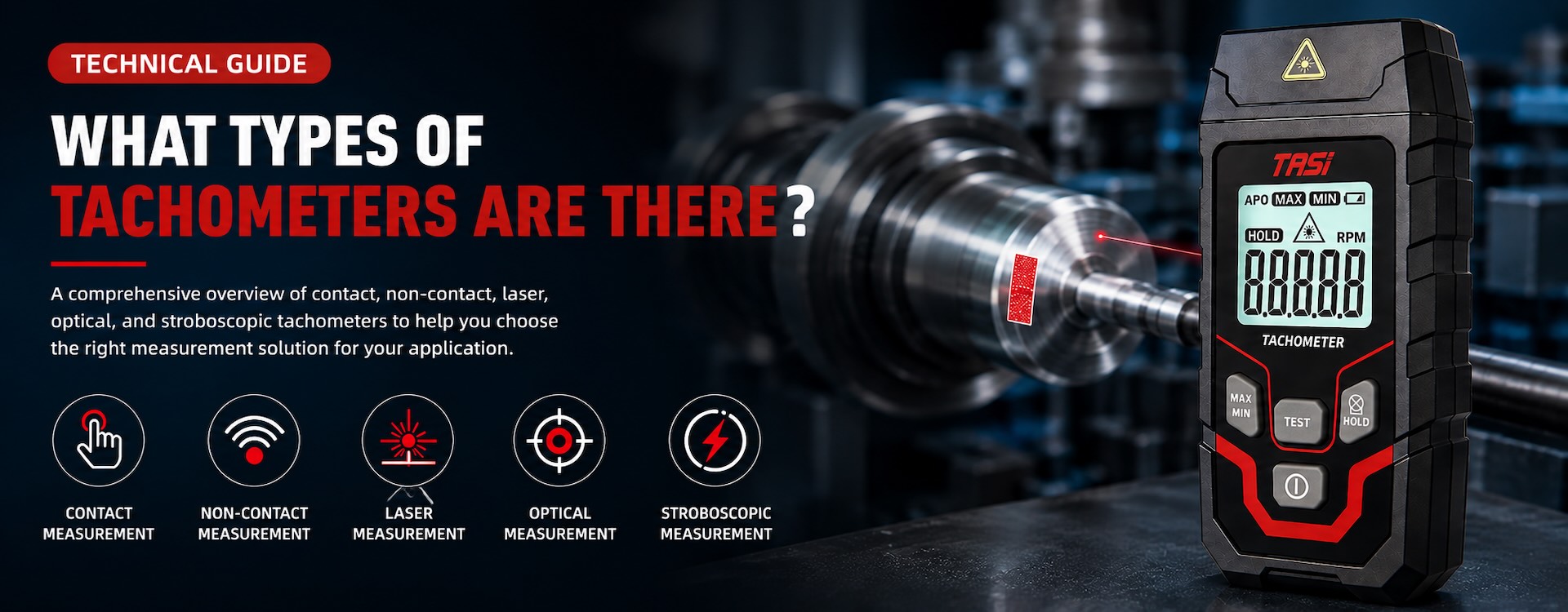
● Because equipment structures, speed ranges, and operating environments vary considerably, tachometers are available in several forms. By measurement method, they can first be divided into contact and non-contact tachometers. According to their sensing principle, they may also be classified as optical, laser, stroboscopic, and other types.
● Understanding the characteristics of each type helps users select the most appropriate measurement method based on accessibility, rotational speed, working distance, and safety requirements.
Key Takeaways
● Tachometers are primarily divided into contact and non-contact types according to how the measurement is performed.
● Contact tachometers require direct physical contact with the rotating component and are suitable for shafts and wheels that can be approached safely.
● Non-contact tachometers measure rotational motion optically or by other sensing methods without touching the rotating part.
● Laser and optical tachometers are among the most common non-contact speed measurement instruments.
● Stroboscopic tachometers determine rotational speed by adjusting the flash frequency until the rotating target appears stationary.
● Tachometer selection should consider speed range, measuring distance, machine configuration, surface condition, safety, and required accuracy.
Contact Tachometers
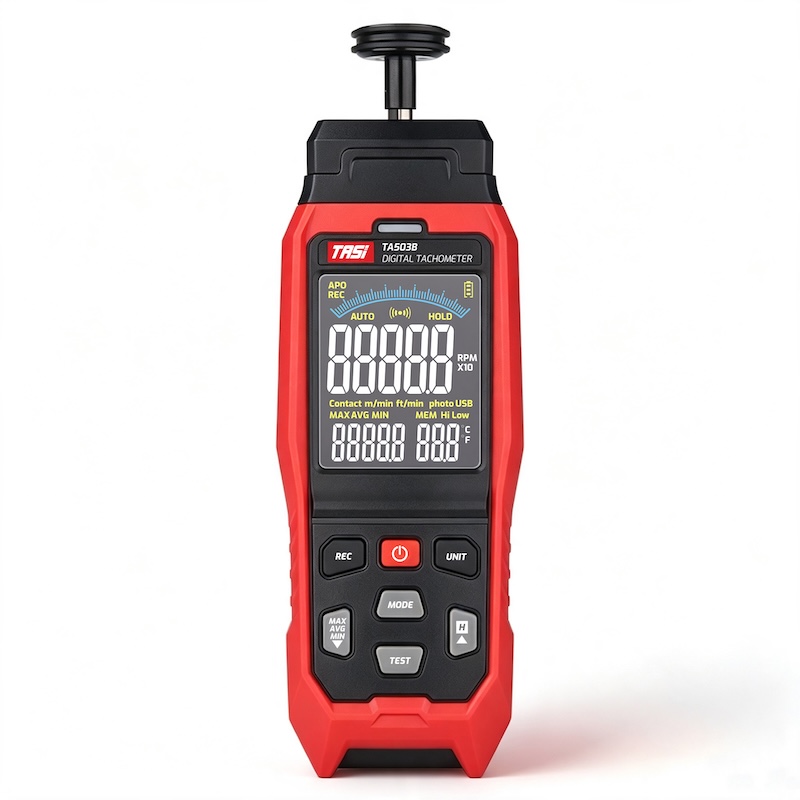
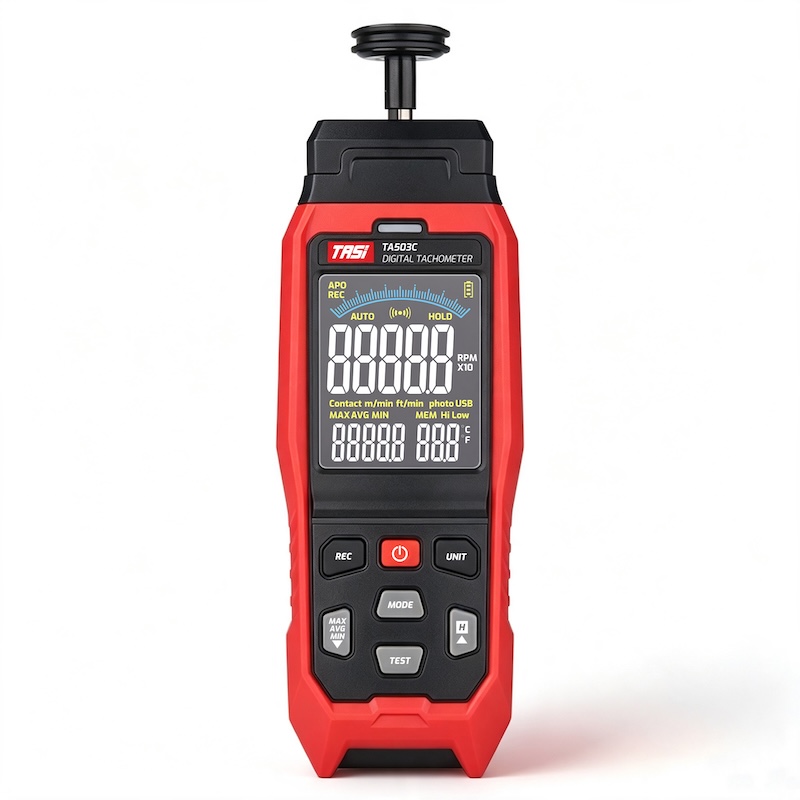
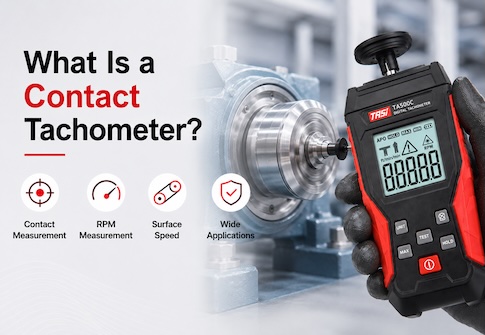
● A contact tachometer measures rotational speed by placing a measurement tip directly against a rotating shaft, wheel, or other moving component. The contact adapter rotates with the target, and an internal sensor converts the mechanical movement into an electrical signal from which rotational speed is calculated.
● Common accessories include conical tips, funnel-shaped tips, and surface-speed wheels. Different accessories allow measurements on shaft ends, rotating wheels, and moving surfaces.
● One advantage of contact measurement is that the measurement point is clearly defined. When the probe maintains stable contact with the shaft, the instrument can directly determine the actual rotational speed.
● With a suitable surface-speed wheel, some contact tachometers can also measure the linear speed of conveyor belts, cables, web material, and other moving objects, making them useful for machine maintenance and production-line inspection.
● Because physical contact with the moving part is required, this method is generally less suitable for very high-speed shafts, confined machinery, or locations where approaching rotating parts would create a safety risk.
Non-Contact Tachometers
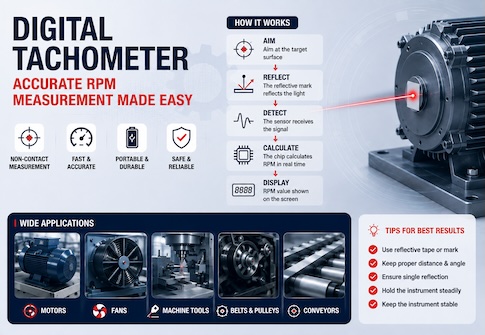
● A non-contact tachometer measures rotational speed without touching the rotating target. Instead, it detects periodic changes in the target surface or reflected optical signal, making it particularly suitable for high-speed equipment or components that are difficult to access directly.
● In many applications, a small piece of reflective tape is attached to the shaft, disc, or other rotating surface. The instrument directs light toward the target, and the optical sensor detects a strong reflection each time the reflective mark passes through the measurement area.
● By counting these pulses over a defined period, the instrument calculates the RPM. If one reflective mark produces one pulse per revolution, the pulse frequency can be directly converted into rotational speed.
● Non-contact measurement eliminates mechanical loading from the instrument and reduces the need for the operator to approach fast-moving components. It is therefore widely used for motors, fans, machine-tool spindles, pumps, rollers, and industrial drive systems.
Laser Tachometers
● A laser tachometer is one of the most common types of non-contact tachometers. It uses a laser beam to assist with target positioning while an optical sensor detects changes in reflected light and calculates rotational speed.
● The laser generally serves primarily as an aiming aid. Actual speed detection depends on the optical sensing system identifying periodic variations in the reflected signal. Reflective tape is commonly applied to the rotating target to provide a strong and stable signal.
● Compared with contact measurement, a laser tachometer allows readings to be taken from a distance, making it suitable for fast-moving components, elevated machinery, and equipment where guards or structural features limit direct access.
● Measurement distance, beam alignment, reflective target size, and ambient light should all be considered. Excessive distance, insufficient reflective area, or strong optical interference may reduce measurement stability.
Optical Tachometers
● An optical tachometer uses a light emitter and photosensor to detect periodic optical changes generated by a rotating target and convert them into rotational speed. Laser tachometers are a common implementation of optical speed measurement.
● Optical sensing systems may use reflective or through-beam arrangements. Portable tachometers typically use the reflective method, where reflective tape creates a clearly distinguishable change in returned light intensity.
● In fixed industrial systems, optical sensors may detect gear teeth, blades, slots, holes, or other repeating features. If several pulses are generated during each revolution, the control system must account for the number of pulses per revolution when calculating RPM.
● Optical measurement offers fast response, no mechanical contact, and suitability for continuous monitoring. It is therefore used both in handheld tachometers and in industrial automation systems.
Stroboscopic Tachometers
● A stroboscopic tachometer, or stroboscope, uses a different principle from conventional optical tachometers. It illuminates the rotating object with rapidly flashing light. When the flash frequency reaches a specific relationship with the rotational frequency, the rotating target appears stationary or to move slowly.
● The operator adjusts the flash frequency until a blade, mark, or other visible feature appears stable, then determines the rotational speed from the corresponding flashing frequency.
● A major advantage of stroboscopic measurement is that no physical contact with the machine is required. It also allows users to observe the motion of blades, belts, gears, and similar components while the machine continues operating.
● Harmonic effects must be considered. Apparent stationary images may also occur at multiples or fractions of the actual rotational frequency, so the expected speed range and repeated frequency adjustments should be used to confirm the correct reading.
Digital Tachometers
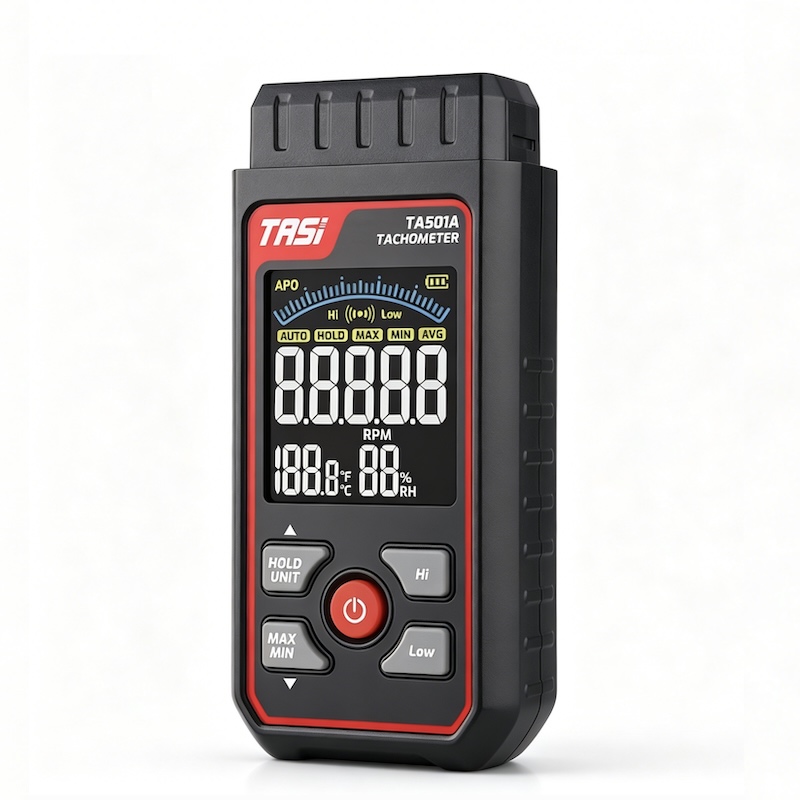
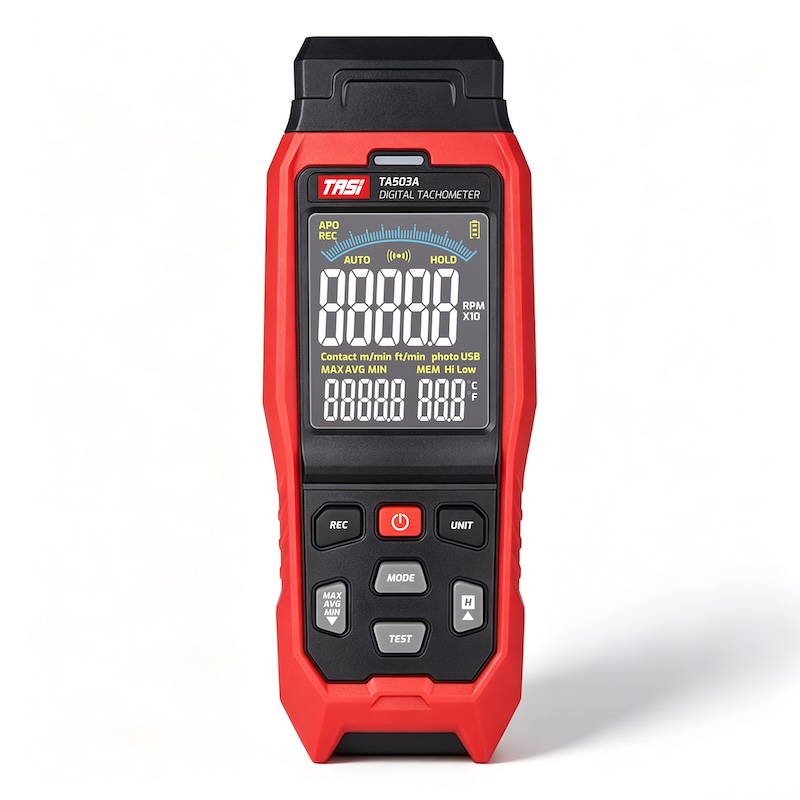
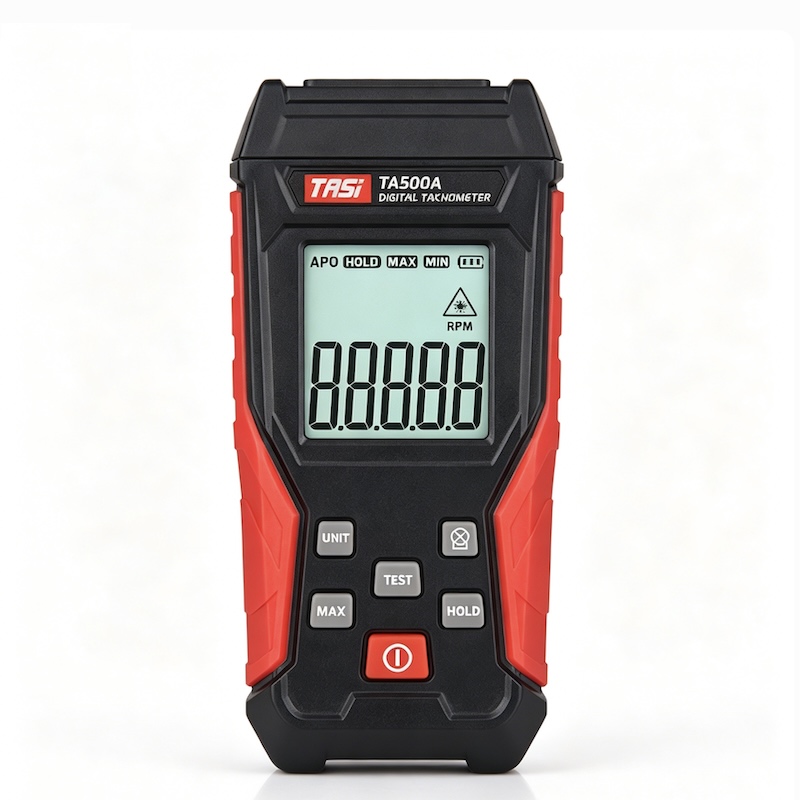
● Digital tachometer describes the instrument's electronic signal processing and display method rather than a specific sensing principle. Most modern portable tachometers use electronic sensors, digital processing circuitry, and an LCD, so contact, non-contact, and multifunction instruments may all be digital tachometers.
● Compared with traditional mechanical instruments, digital tachometers provide direct numerical RPM readings. Depending on the model, additional functions may include maximum, minimum, and average values, data hold, and memory.
● Therefore, “digital tachometer” is not a classification parallel to “contact tachometer” or “non-contact tachometer.” A digital tachometer may use either contact or non-contact measurement.
Mechanical Tachometers
● A mechanical tachometer uses a mechanical transmission mechanism to convert rotational movement into pointer displacement, allowing rotational speed to be read from a scale. This type of instrument was widely used in older machinery, vehicles, and industrial equipment.
● Mechanical tachometers generally do not depend on complex electronic circuitry and have a straightforward design, but their measurement functions, data-handling capabilities, and portability are usually more limited than those of modern digital instruments.
● For current field maintenance and portable measurement, digital handheld tachometers are more common, while mechanical tachometers remain in certain legacy or dedicated mechanical systems.
Combination Contact and Non-Contact Tachometers
● Some digital tachometers integrate both contact and non-contact measurement modes, allowing the user to select the most suitable method for different machines.
● For an exposed low-speed shaft that can be approached safely, a contact adapter can be used. For a high-speed motor, fan, or inaccessible rotating component, the instrument can be switched to optical non-contact measurement.
● When equipped with a surface-speed wheel, these multifunction instruments may also measure both RPM and linear speed in units such as m/min or ft/min, providing additional flexibility for machinery maintenance and production-line inspection.
How Do the Main Tachometer Types Compare?
| Type | Contact Required | Measurement Principle | Main Characteristics | Typical Applications |
|---|---|---|---|---|
| Contact tachometer | Yes | Probe contacts rotating component | Defined measurement point; can support surface-speed wheels | Shafts, rollers, belts, low- to medium-speed machinery |
| Non-contact tachometer | No | Detects periodic optical signals | No mechanical contact; suitable for high-speed equipment | Motors, fans, spindles, pumps |
| Laser tachometer | No | Laser aiming + optical detection | Convenient positioning and flexible measuring distance | Industrial maintenance, high-speed rotating machinery |
| Optical tachometer | No | Photosensor detects reflection or interruption | Fast response; suitable for continuous measurement | Automation systems, rotating machinery |
| Stroboscopic tachometer | No | Synchronizes flash frequency with rotational motion | Enables visual observation of moving components | Fans, impellers, belts, printing machinery |
| Contact/non-contact combination | Optional | Combines both methods | Broad application range | General machinery maintenance |
How to Choose the Right Tachometer
● Consider whether the rotating component can be approached safely. Contact measurement may be appropriate for exposed, low-speed shafts that can be accessed safely. For high-speed equipment, guarded machinery, or confined spaces, non-contact measurement is generally preferable.
● Check the required speed range. The instrument's specified measurement range should cover both the minimum and maximum rotational speeds expected in the application, preferably with sufficient margin.
● Consider the measuring distance. Non-contact tachometers have an effective optical detection distance. For measurements from farther away, the specified measuring distance and optical performance should be reviewed carefully.
● Determine whether linear speed is also required. If conveyor belts, rollers, cables, or other moving surfaces must be measured in addition to RPM, a tachometer with a contact surface-speed wheel may be appropriate.
● Evaluate the operating environment. Strong ambient light, vibration, dust, oil contamination, and target reflectivity may influence measurement performance. Optical systems require a clearly visible reflective target and suitable positioning.
● Review accuracy and resolution requirements. Routine maintenance checks and precision machinery adjustment may require different performance levels, so the instrument should be selected according to the required measurement accuracy.
FAQ
● Which is better, a contact or non-contact tachometer?
Neither is universally better. Contact tachometers are suitable for shafts and wheels that can be approached safely, while non-contact tachometers are preferable for high-speed, remote, or inaccessible rotating equipment.
● Is a laser tachometer a non-contact tachometer?
Yes. A laser tachometer normally uses a laser for target positioning and an optical sensor to detect periodic reflected signals, making it a non-contact rotational speed measurement instrument.
● Does a non-contact tachometer always require reflective tape?
Not in every application. However, for common reflective optical tachometers, applying suitable reflective tape creates a stronger and more stable optical signal and generally improves measurement reliability.
● Can a tachometer measure anything other than RPM?
Yes. Some contact or multifunction tachometers can also measure linear surface speed when used with a suitable speed wheel. Available functions and units depend on the instrument specification.
● Which tachometer is suitable for high-speed motors?
Where direct contact is impractical or unsafe, an optical or laser non-contact tachometer is generally preferred because it avoids mechanical contact and reduces measurement interference.
● What is the difference between a digital tachometer and a laser tachometer?
“Digital tachometer” refers primarily to electronic processing and digital display, whereas “laser tachometer” describes a non-contact optical measurement method. A laser tachometer is therefore usually also a digital tachometer.
Summary
● Tachometers can be classified in several ways, but for practical field measurement the most important distinction is generally between contact and non-contact tachometers. Contact instruments obtain speed through direct mechanical contact, while non-contact instruments determine rotational cycles mainly through optical signals.
● Laser and optical tachometers are well suited to motors, fans, machine-tool spindles, and other high-speed rotating equipment. Stroboscopic tachometers are useful when the motion of the rotating component also needs to be observed, while combination instruments provide greater versatility for maintenance work.
● Selecting a tachometer should not be based on instrument type alone. Rotational speed range, measuring distance, machine configuration, safety conditions, required accuracy, and the need for linear-speed measurement should all be considered to ensure stable and reliable results.