Introduction
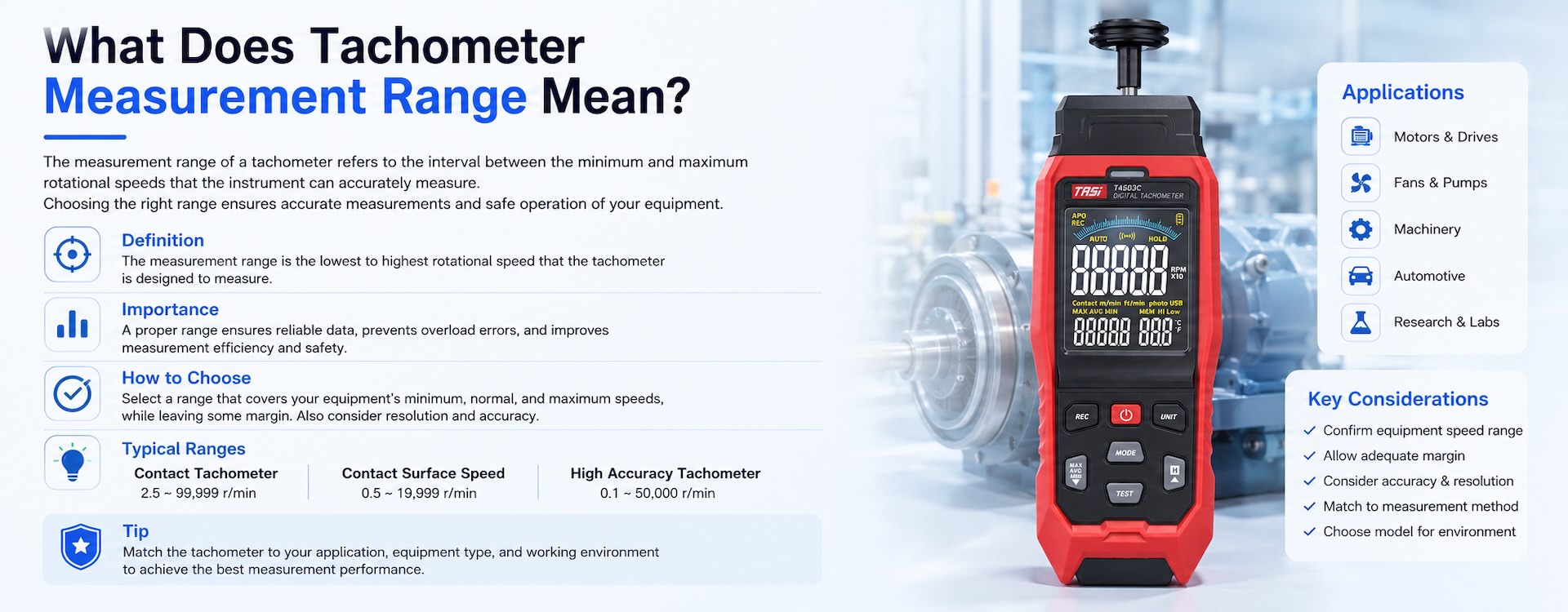
When reviewing the specifications of a digital tachometer, you will often see terms such as “Measurement Range,” “RPM Range,” or specifications such as “10–99,999 RPM.” This parameter defines the rotational speed interval within which the tachometer is designed to operate and is one of the key factors in determining whether an instrument is suitable for a particular machine or application.
A wider measurement range is not automatically better. The important point is to ensure that the actual operating speed of the equipment falls within the tachometer's specified range while also considering accuracy, resolution, measurement method, and operating conditions.
Key Points
● A tachometer measurement range normally specifies the minimum and maximum rotational speeds the instrument can measure effectively.
● Rotational speed is commonly expressed in RPM, meaning revolutions per minute.
● Contact and non-contact tachometers may have different measurement ranges because they use different measurement principles.
● Measurement range, accuracy, and resolution are separate specifications and should not be confused.
● The selected range should cover the equipment's minimum, normal, and maximum operating speeds.
● A speed being within the specified range does not guarantee stable readings under all measurement conditions.
What Is a Tachometer Measurement Range?
A tachometer's measurement range is the interval between the minimum and maximum rotational speeds that the instrument can measure under specified operating conditions.
For example, if a tachometer is specified as:
● Measurement range: 10–99,999 RPM
this means that, under the measurement method and operating conditions defined by the manufacturer, the instrument can measure rotational speeds from 10 RPM up to 99,999 RPM.
In this specification:
● 10 RPM is the lower limit;
● 99,999 RPM is the upper limit;
● RPM means revolutions per minute.
If the rotational speed is below the lower limit, the instrument may not detect the rotational signal reliably. If the speed exceeds the upper limit, the input signal may exceed the instrument's processing capability, resulting in no reading, an unstable reading, or performance outside the specified accuracy.
How Should an RPM Measurement Range Be Interpreted?
RPM is the most common unit used for rotational speed and indicates how many complete revolutions an object makes in one minute.
For example:
● 60 RPM means 60 revolutions per minute;
● 1,500 RPM means 1,500 revolutions per minute;
● 10,000 RPM means 10,000 revolutions per minute.
Therefore, a tachometer specified for “100–30,000 RPM” is designed to measure rotational speeds from 100 to 30,000 revolutions per minute.
The measurement range indicates how low and how high the instrument can measure. It does not mean that resolution, response time, or measurement performance are identical across the entire range. These characteristics should be evaluated separately from the manufacturer's technical specifications.
Why Does a Tachometer Have a Minimum Measurement Range?
Users often focus on maximum RPM, but the minimum measurable speed can be equally important.
A tachometer calculates rotational speed from periodic signals generated by a rotating object. At very low rotational speeds, the time between consecutive signals becomes longer, so the instrument requires more time to collect enough information to calculate and update the reading.
With a non-contact optical or laser tachometer, for example, a reflective target may generate one valid signal per revolution. At low speeds, the interval between reflected signals becomes longer, which can increase the display update time.
At excessively low speeds, this may result in:
● Longer waiting time before a reading appears;
● Slower display updates;
● Greater reading fluctuation;
● No valid measurement below the instrument's specified lower limit.
For very slow-moving machinery, the minimum RPM specification should therefore be considered carefully rather than focusing only on maximum speed.
Why Does a Tachometer Have a Maximum Measurement Range?
As rotational speed increases, the number of signals that the instrument must detect and process per unit of time also increases.
A non-contact tachometer, for example, detects periodic optical signals produced by a reflective mark. At very high speeds, the optical sensor and internal processing circuitry must respond rapidly enough to distinguish consecutive signals and calculate their frequency accurately.
If the rotational speed exceeds the instrument's specified maximum range, possible results include:
● Unstable readings;
● Incorrect displayed values;
● Failure to detect the signal;
● Measurement outside the specified performance range.
For high-speed motors, machine-tool spindles, turbines, centrifuges, and similar equipment, the maximum RPM capability is therefore an important selection criterion.
How Do the Measurement Ranges of Contact and Non-Contact Tachometers Differ?
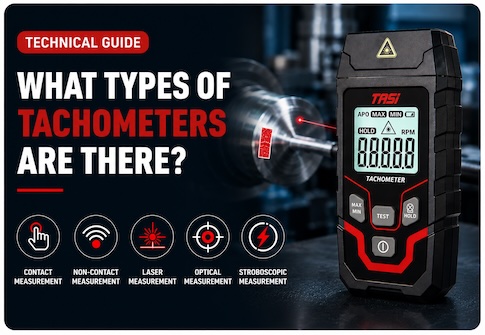
Contact and non-contact tachometers use different measurement methods, so their applicable measurement ranges may also differ.
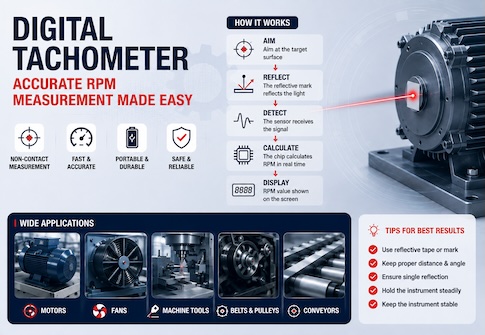
A non-contact tachometer normally uses an optical or laser sensing system to detect a reflective target on a rotating component. Because the instrument does not physically contact the rotating surface, it is often suitable for relatively high-speed measurements.
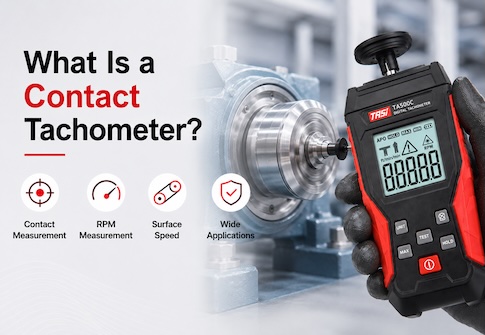
A contact tachometer requires a contact tip to touch a rotating shaft or a measuring wheel to contact a moving surface. Its maximum permissible speed can therefore be influenced not only by the internal sensor but also by the mechanical limits of the contact tip, measuring wheel, and related accessories.
In practical applications:
● Non-contact measurement is often preferred for high-speed rotating machinery;
● Contact tachometers can be suitable for low-speed shafts and applications where direct contact is practical;
● Contact tachometers with surface-speed functions can be used for belts, conveyors, and other moving surfaces.
The actual measurement range should always be confirmed from the specifications of the individual model rather than assumed solely from whether the instrument is contact or non-contact.
What Is the Difference Between Measurement Range and Accuracy?
Measurement range and accuracy describe two different characteristics.
Measurement range answers the question:
“How low and how high a rotational speed can this tachometer measure?”
Accuracy answers the question:
“How close can the indicated result be to the actual value under specified conditions?”
A tachometer may have a very wide RPM range without necessarily providing higher accuracy than an instrument with a narrower range.
For this reason, a tachometer rated up to 99,999 RPM should not automatically be considered more accurate than one rated up to 30,000 RPM. Measurement range and accuracy must be evaluated separately.
What Is the Difference Between Measurement Range and Resolution?
Resolution describes the smallest change in the displayed value that the instrument can distinguish, while measurement range describes the overall interval of rotational speeds that can be measured.
For example, if the resolution in a particular range is 0.1 RPM, the displayed value may change in increments of 0.1 RPM.
A measurement range of 10–99,999 RPM, by contrast, defines the overall speed interval covered by the instrument.
Therefore:
● Measurement range determines “how low and how high the instrument can measure”;
● Resolution determines “how finely the reading can be displayed”;
● Accuracy determines “how close the measurement can be to the actual value.”
All three specifications should be considered when selecting a digital tachometer.
Is a Wider Measurement Range Always Better?
Not necessarily.
A wide measurement range can make one instrument suitable for a larger variety of machines, which can be useful in general maintenance and multi-equipment applications. However, range alone does not determine overall measurement performance.
For example, if a motor normally operates at approximately 1,450 RPM, a tachometer capable of measuring up to 100,000 RPM will not automatically measure 1,450 RPM more accurately.
More important selection criteria include:
● The measurement range covers the actual equipment speed;
● Accuracy is suitable within the required operating range;
● Resolution meets the required reading detail;
● The measurement method is appropriate for the application;
● The instrument can acquire a stable rotational signal.
In most cases, selecting a range appropriate for the application is more important than simply choosing the widest available range.
How Should the Measurement Range Be Selected for a Machine?
Before selecting a tachometer, determine the minimum, normal, and maximum operating speeds of the equipment.
For example, a motor may normally operate around 1,500 RPM but vary between 500 and 3,000 RPM during startup, speed control, or different load conditions. The tachometer should therefore cover at least this actual operating interval.
When selecting an instrument:
● Check the rated speed on the machine nameplate, manual, or control system;
● Determine the minimum operating speed under speed-control conditions;
● Confirm the maximum permitted operating speed;
● Allow a reasonable margin beyond the normal operating range;
● For high-speed equipment, pay particular attention to maximum RPM;
● For slow-moving equipment, pay particular attention to minimum RPM.
If one tachometer will be used on several types of equipment, select a range that covers the combined speed requirements of all intended machines.
Why Can a Tachometer Fail to Read Even When the Speed Is Within Range?
A rotational speed being within the specified measurement range does not guarantee a valid reading under every operating condition.
For non-contact tachometers, measurement may also be affected by:
● Incorrect reflective tape position;
● Reflective target that is too small or contaminated;
● Measurement distance outside the specified working distance;
● The optical beam not remaining on the reflective target;
● Strong ambient light interference;
● Multiple highly reflective areas on the rotating component.
For contact tachometers, possible factors include:
● Unstable contact between the measuring tip and shaft;
● Excessive or insufficient contact pressure;
● Slippage of the contact tip or measuring wheel;
● A shaft surface unsuitable for contact measurement;
● Incorrect alignment between the measuring attachment and rotating shaft.
Measurement range is therefore only one part of determining whether an instrument is suitable. Correct measurement conditions must also be maintained.
What Else Should Be Considered Besides Measurement Range?
In addition to RPM measurement range, the following specifications and functions should be considered:
● Accuracy: Defines the permissible measurement error under specified conditions;
● Resolution: Defines the smallest displayed increment;
● Measurement method: Contact or non-contact measurement should be selected according to the application;
● Measurement distance: For non-contact tachometers, the specified working distance must be considered;
● Surface-speed measurement: If m/min, ft/min, or similar units are required, confirm that the instrument supports linear-speed measurement;
● Data Hold: Useful when the display cannot be viewed easily during measurement;
● Maximum/minimum recording: Helpful for observing speed variation during equipment operation;
● Operating environment: Consider access space, rotating-part location, ambient lighting, and operator safety.
For industrial maintenance and machine testing, the complete application should be evaluated rather than comparing only one specification.
FAQ
What unit is normally used for tachometer measurement range?
RPM, or revolutions per minute, is the most common unit. Some contact tachometers can also measure linear or surface speed in units such as m/min or ft/min.
Does the specified measurement range include both the minimum and maximum values?
The published range normally defines the instrument's specified operating interval. Exact endpoint conditions and performance should be confirmed in the manufacturer's technical specifications.
Does a wider measurement range mean higher accuracy?
No. Measurement range and accuracy are independent specifications. A wider range does not directly indicate higher measurement accuracy.
Can a tachometer measure above its specified maximum speed?
It should not be relied upon to do so. Above the specified range, the instrument may fail to detect the signal correctly and the manufacturer-specified performance can no longer be guaranteed.
What happens below the minimum measurable speed?
The display may update slowly, readings may become unstable, or the instrument may fail to produce a valid result. Very low-speed applications require a tachometer with a suitably low minimum RPM specification.
If a motor is rated at 3,000 RPM, do I need a tachometer that measures up to 100,000 RPM?
Usually not. The instrument only needs to cover the machine's actual minimum and maximum operating speeds while providing suitable accuracy, resolution, and measurement method.
Do non-contact tachometers always have a wider range than contact tachometers?
Not necessarily. Non-contact tachometers are often well suited to high-speed measurements, but actual performance depends on the sensor, electronics, mechanical design, and specifications of the individual model.
Conclusion
A tachometer's measurement range defines the minimum and maximum rotational speeds that the instrument is designed to measure, normally expressed in RPM. It is one of the first specifications to check when determining whether a tachometer is suitable for a particular machine.
Measurement range alone, however, does not define overall instrument performance. Accuracy, resolution, contact or non-contact measurement method, operating conditions, and the equipment's actual minimum and maximum speeds should also be considered.
The objective is not simply to select the tachometer with the highest possible RPM rating, but to choose an instrument whose specified range reliably covers the intended application while providing the required measurement performance.