Can Multiple Reflective Tapes Be Applied to One Rotating Object?

Publisher: Amy Published: 2026-05-22 Reading Time: 5min. 0sec.
Tags: reflective tapetachometer reflective tapelaser tachometeroptical tachometerRPM measurementnon-contact tachometer

Introduction

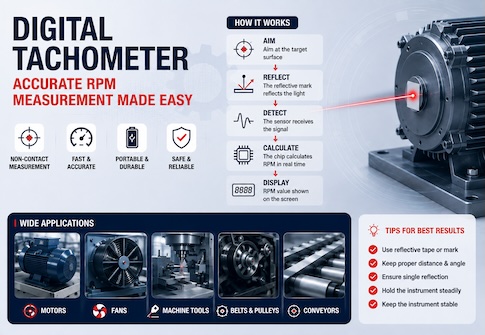
Laser tachometers, optical tachometers, and other non-contact speed measurement instruments use reflective tape to create a clearly detectable optical reference point. When the reflective mark passes through the measurement beam once per revolution, the tachometer calculates rotational speed from the frequency of the returned optical signal.

Can two, three, or even more reflective marks be applied to the same rotating object?

Physically, yes. However, for most non-contact tachometers that assume one detected pulse equals one revolution, using several effective reflective marks at the same time is generally not recommended for standard RPM measurement. Multiple marks can generate several pulses during a single revolution, which may cause a proportional measurement error.


Key Points

● For standard non-contact RPM measurement, one effective reflective mark per revolution is normally recommended;
● Two detectable reflective marks may produce two pulses per revolution and cause the displayed speed to approach twice the actual RPM;
● Three marks may produce approximately three times the actual RPM, and the same principle applies to additional marks;
● Instruments that support PPR or pulses-per-revolution settings may compensate for multiple reflective marks;
● Multiple marks can sometimes be used intentionally for very low-speed measurement, provided the pulse count is correctly configured or mathematically compensated;
● For routine field measurements, one clean, stable, clearly detectable reflective mark is usually the simplest and most reliable arrangement.


Why Is One Reflective Mark Normally Used?

A non-contact tachometer does not directly observe a complete mechanical revolution. Instead, it detects the periodic optical signal generated when a reflective mark enters the measurement area.

For example, if one reflective strip is attached to the side of a rotating shaft:

● The shaft completes one revolution;
● The reflective mark passes through the measurement beam once;
● The tachometer detects one optical pulse;
● The instrument calculates RPM from the interval between consecutive pulses or the number of pulses detected within a defined period.

In this arrangement:

1 reflective mark = 1 effective pulse per revolution

This allows the tachometer to calculate RPM directly without requiring an additional correction factor.

For this reason, one clearly defined reflective mark within each complete revolution is normally the preferred configuration.


What Happens If Two Reflective Marks Are Used?

Assume a motor shaft is actually rotating at 600 RPM and two reflective marks are installed on the shaft.

During each revolution:

● The first reflective mark passes the measurement point and produces one pulse;
● The second mark passes the same point and produces another pulse;
● Two effective pulses are generated during one mechanical revolution.

If the tachometer assumes that each pulse represents one revolution, it may interpret these two pulses as two revolutions.

The displayed value could therefore approach:

600 RPM × 2 = 1200 RPM

The shaft has not increased in speed. The higher reading occurs because the number of detected optical pulses per revolution has doubled.


What If Three or More Reflective Marks Are Used?

The same principle applies.

Assume the actual rotational speed is 500 RPM:

● 1 effective mark per revolution → approximately 500 RPM;
● 2 effective marks per revolution → potentially approximately 1000 RPM;
● 3 effective marks per revolution → potentially approximately 1500 RPM;
● 4 effective marks per revolution → potentially approximately 2000 RPM.

For a tachometer configured to interpret one detected pulse as one revolution:

Displayed RPM ≈ Actual RPM × Number of Effective Reflective Marks per Revolution

Therefore, adding more reflective tape does not automatically improve measurement accuracy. For normal RPM measurement, multiple marks may instead become a significant source of error.


When Can Multiple Reflective Marks Be Used?

Multiple reflective marks are not inherently incorrect. The important factor is whether the measuring system knows how many pulses correspond to one mechanical revolution.

Some professional tachometers, counters, control systems, and data acquisition instruments allow the user to configure PPR, or pulses per revolution.

For example, if four reflective marks are installed around a rotating component and the instrument is configured as:

PPR = 4

the device can interpret four detected pulses as one complete revolution rather than four revolutions.

However, if a basic handheld laser tachometer does not provide a PPR setting, adding multiple reflective marks is generally not recommended.


Can Multiple Reflective Marks Help at Very Low Speeds?

In certain professional low-speed applications, multiple reflective marks may be useful.

For example, if a shaft rotates at only 10 RPM, using one pulse per revolution creates a relatively long interval between two successive signals. Increasing the number of marks increases the pulse frequency and reduces the time between detectable events.

For example:

Actual speed = 10 RPM
Number of reflective marks = 6
Equivalent pulse-based reading = 60 RPM

The actual speed would then be:

60 ÷ 6 = 10 RPM

This method requires the operator to know the exact number of effective marks and either configure the instrument accordingly or apply the correct conversion.

It is therefore more suitable for controlled measurement systems than for routine handheld RPM checks.


Do Multiple Reflective Marks Always Cause an Exact Multiple Error?

Not necessarily.

If every reflective mark is detected consistently, the displayed value may show a clear proportional relationship to the number of marks. In real applications, however, other factors may influence the optical signal:

● Reflective marks may have different sizes;
● One or more marks may be partially obstructed;
● Tape surfaces may be dirty, worn, or damaged;
● Reflective marks may be positioned too close together;
● The beam may not consistently strike every mark;
● The rotating object may contain additional highly reflective areas;
● Measurement distance, angle, or ambient lighting may change.

As a result, multiple reflective regions can cause unstable or fluctuating readings rather than a simple 2× or 3× error.


What If the Rotating Object Already Has Several Reflective Areas?

Metal shafts, couplings, fans, impellers, pulleys, and polished components may naturally contain several surfaces that strongly reflect the tachometer beam.

Even with only one reflective tape installed, the instrument may detect additional optical signals from:

● Reflective tape;
● Polished metal surfaces;
● Bright edges;
● Chrome-plated areas;
● White labels or markings.

If these areas create sufficiently strong optical contrast, the tachometer may detect several pulses during each revolution.

For reliable measurement, the intended reflective mark should therefore have a clear optical contrast with the surrounding surface.

Where necessary, unwanted reflective areas can be covered or treated to reduce unwanted reflections.


How Should Reflective Tape Be Applied?

For routine non-contact RPM measurement:

● Stop the equipment before installing reflective tape; never apply tape to a rotating component;
● Normally use only one effective reflective mark within each complete revolution;
● Clean oil, dust, moisture, and other contamination from the mounting surface;
● Apply the tape flat and securely to prevent lifting or detachment;
● Use a reflective area large enough for reliable detection without unnecessarily covering a large portion of the component;
● When measuring a shaft, the reflective tape can be installed on the side surface and the tachometer beam aimed at the point where the tape passes;
● Prevent the beam from simultaneously detecting other highly reflective surfaces;
● Hold the tachometer steady and observe the specified measuring distance.

For high-speed rotating machinery, the reflective tape must be firmly attached to prevent it from being thrown from the component during operation.


What Should I Do If Several Reflective Marks Are Already Installed?

First check whether the tachometer supports a PPR or pulses-per-revolution setting.

If it does, configure the parameter according to the number of effective reflective marks.

If it does not, either:

● Remove or cover the additional marks so that only one remains detectable;
● Or mathematically correct the indicated RPM if the exact number of effective marks is known.

For example, if the instrument displays 2400 RPM and four equally detectable reflective marks are present:

2400 ÷ 4 = 600 RPM

For routine maintenance and troubleshooting, however, retaining only one reflective reference mark is generally preferable because it reduces the risk of calculation errors.


Does Using More Reflective Tape Improve Tachometer Accuracy?

Not for a standard handheld non-contact tachometer.

Stable RPM measurement depends more strongly on:

● Optical contrast between the reflective mark and the background;
● Cleanliness and condition of the reflective tape;
● Stable beam alignment;
● Appropriate measuring distance;
● Operation within the tachometer's specified RPM range;
● Ambient light conditions;
● Instrument resolution, response characteristics, and signal-processing method.

If the reading is unstable, adding more reflective marks should therefore not be the first corrective action. Measurement conditions should be checked first.


FAQ

Can two reflective tapes be installed on one rotating shaft?

Yes, but this is normally not recommended for standard RPM measurement. If both marks are detected, two pulses may be generated per revolution and the indicated speed may approach twice the actual RPM.

Why can two reflective marks cause the RPM reading to increase?

The tachometer measures the frequency of optical pulses. If it assumes one pulse equals one revolution, two pulses per revolution can be interpreted as two revolutions.

What if multiple reflective marks are required?

Use an instrument that supports PPR or an equivalent pulses-per-revolution setting whenever possible. Otherwise, the displayed value must be corrected according to the number of effective marks.

Should a reading obtained from three reflective marks be divided by three?

If all three marks are consistently detected and the instrument assumes one pulse per revolution, the indicated RPM can theoretically be divided by three. The actual operating principle of the instrument should still be confirmed.

Does more reflective tape provide better accuracy?

No. On a standard handheld tachometer, multiple reflective marks can create proportional errors or unstable readings. One clear reflective reference is normally preferred.

Why can the RPM reading still be too high when only one reflective tape is installed?

Other reflective surfaces on the rotating component may also be detected. Check polished metal, labels, bolts, bright edges, or other high-reflectivity areas that may create additional pulses.


Conclusion

Multiple reflective tapes can physically be applied to a rotating object, but for most handheld laser and optical tachometers, one effective reflective mark per revolution is recommended for standard RPM measurement.

A tachometer determines rotational speed from the frequency of detected optical pulses. If several reflective marks generate several pulses during each revolution, the instrument may interpret them as additional revolutions, causing the displayed RPM to be proportionally higher than the actual speed.

Multiple reflective marks should therefore only be used intentionally when the instrument supports pulses-per-revolution configuration or when the operator can correctly compensate for the number of detected marks.

For routine measurement of motors, shafts, fans, rollers, pulleys, and other rotating machinery, one clean, stable, clearly detectable reflective mark is normally the most straightforward and reliable solution.

Related Products
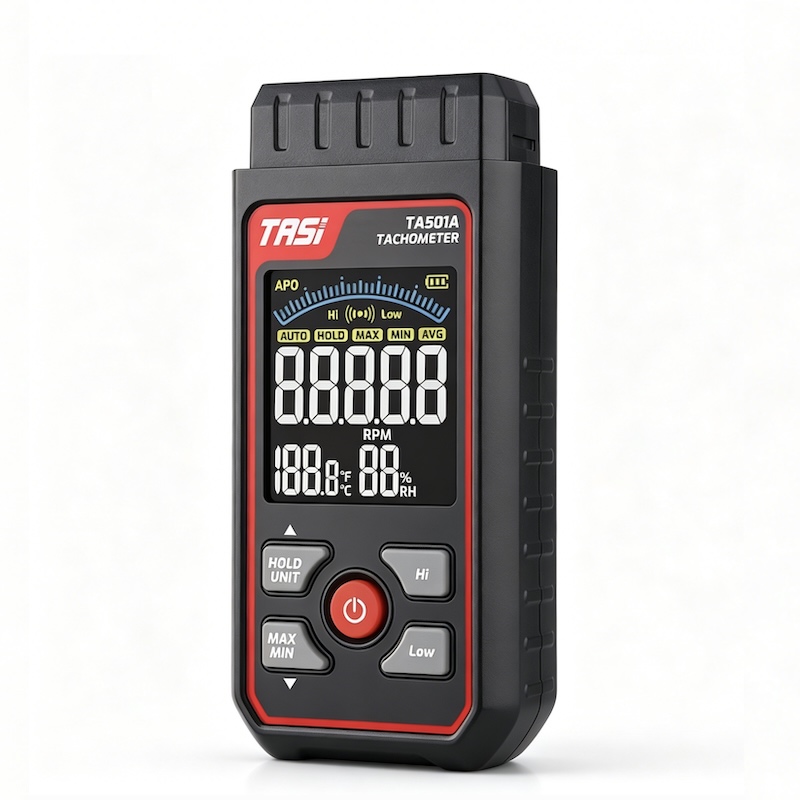
TA501A TA501 Series Digital Laser Tachometer

TA501A

TA501 Series
Digital Laser Tachometer
Abstract:
The TA501A Digital Laser Tachometer (Digital Tachometer / Laser RPM Meter / RPM Tester / Rotational Speed Meter) adopts advanced photoelectric sensing technology and anti-interference semiconductor laser technology to provide fast, accurate, and reliable non-contact rotational speed measurement. With a wide RPM measurement range, this handheld tachometer is designed for testing the speed of motors, fans, shafts, pulleys, grinding wheels, conveyor systems, and various rotating mechanical components. The TA501 Series Digital Tachometer integrates RPM measurement, environmental temperature and humidity detection, data hold, maximum/minimum/average value recording, high/low limit alarm, color backlight display, and dynamic analog bar indication functions. Its compact and portable design makes it suitable for industrial field inspection, equipment commissioning, maintenance, and performance verification. Widely used in power plants, steel manufacturing, petrochemical industries, aerospace equipment, automotive production, machinery manufacturing, HVAC ventilation systems, industrial automation lines, motor factories, laboratory testing, equipment maintenance, and quality inspection applications, the TA501 laser tachometer provides accurate speed measurement solutions for motors, gearboxes, pumps, compressors, fans, conveyor belts, textile machines, woodworking equipment, and other rotating machinery. It helps engineers perform equipment diagnostics, preventive maintenance, and production quality control efficiently.
View More ›
TA503A TA503 Series Digital Tachometers

TA503A

TA503 Series
Digital Tachometers
Abstract:
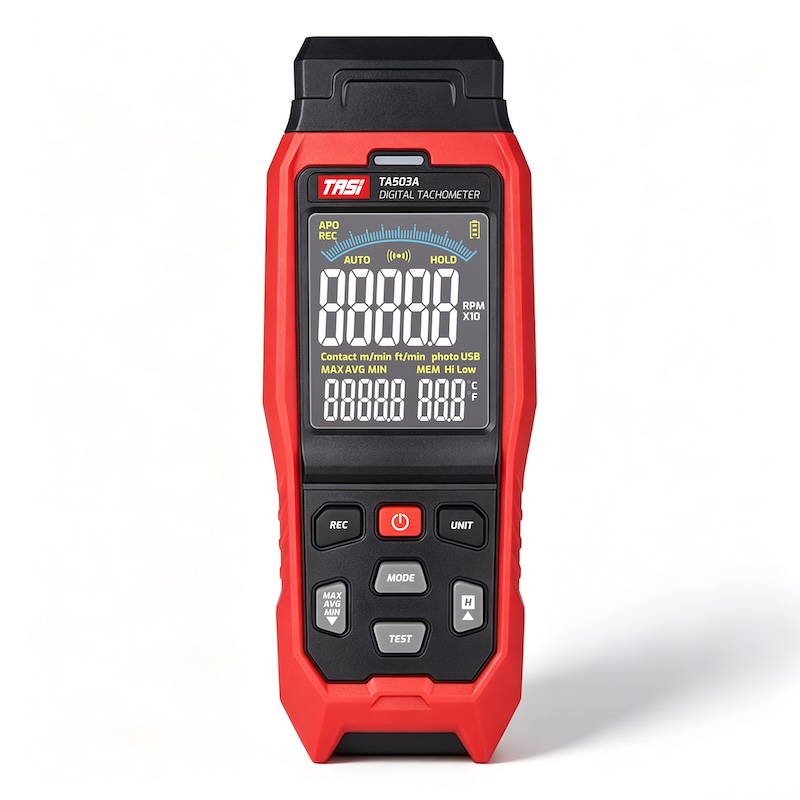
The TA503 Series Digital Tachometers are high-accuracy and multifunctional rotational speed measuring instruments, also known as digital tachometers, RPM meters, speed meters, rotation testers, electronic tachometers, optical tachometers, contact tachometers, and non-contact tachometers. The series supports both non-contact optical measurement and contact measurement modes, providing fast and reliable measurement of rotational speed (RPM), linear speed, and length for various rotating equipment. The TA503 series includes the TA503A Non-Contact Digital Tachometer, TA503B Contact Digital Tachometer, and TA503C Contact & Non-Contact Digital Tachometer, offering flexible solutions for different industrial measurement requirements. The TA503C model is equipped with a USB communication interface, allowing connection to a computer for data acquisition, measurement record export, and further data analysis. Designed for industrial inspection and engineering applications, the tachometers provide fast response, stable readings, and high repeatability. Integrated functions include Data Hold, MAX/MIN/Average measurement, high/low limit alarm, data logging, multiple measurement units, ambient temperature display, and automatic power-off. The compact and portable design makes them ideal for field inspection, equipment maintenance, production line testing, and laboratory applications. The TA503 Series Digital Tachometers are widely used in motor manufacturing, automation equipment, mechanical engineering, HVAC systems, fan production, power equipment, automotive maintenance, petrochemical plants, steel manufacturing, conveyor systems, and educational laboratories. They are suitable for measuring the rotational speed of AC motors, DC motors, servo motors, engines, fans, pumps, generators, machine tool spindles, and transmission systems for performance testing, troubleshooting, and preventive maintenance.
View More ›
TA503B TA503 Series Digital Tachometers

TA503B

TA503 Series
Digital Tachometers
Abstract:
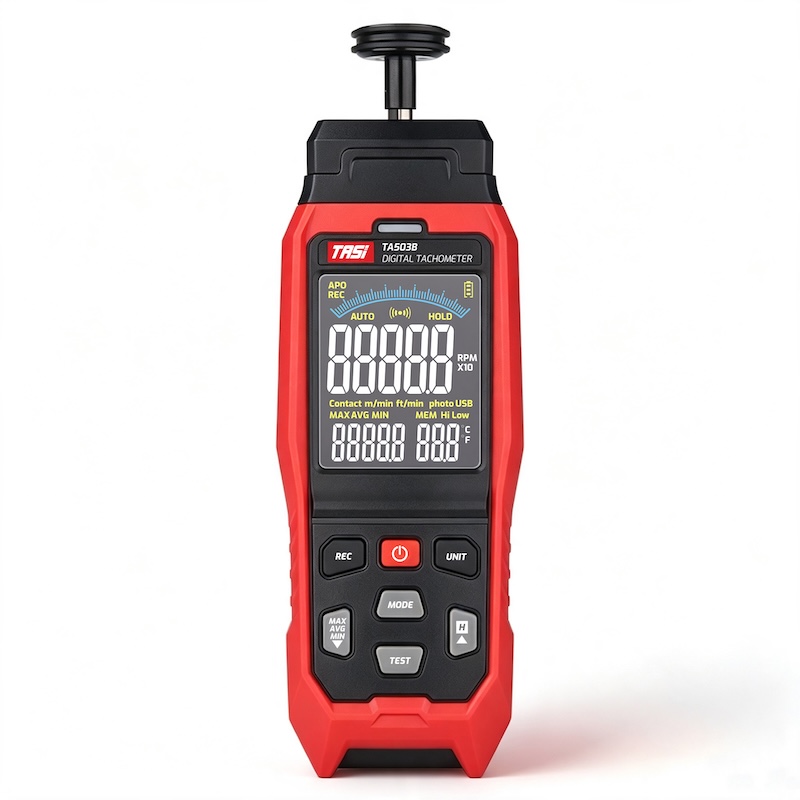
The TA503 Series Digital Tachometers are high-accuracy and multifunctional rotational speed measuring instruments, also known as digital tachometers, RPM meters, speed meters, rotation testers, electronic tachometers, optical tachometers, contact tachometers, and non-contact tachometers. The series supports both non-contact optical measurement and contact measurement modes, providing fast and reliable measurement of rotational speed (RPM), linear speed, and length for various rotating equipment. The TA503 series includes the TA503A Non-Contact Digital Tachometer, TA503B Contact Digital Tachometer, and TA503C Contact & Non-Contact Digital Tachometer, offering flexible solutions for different industrial measurement requirements. The TA503C model is equipped with a USB communication interface, allowing connection to a computer for data acquisition, measurement record export, and further data analysis. Designed for industrial inspection and engineering applications, the tachometers provide fast response, stable readings, and high repeatability. Integrated functions include Data Hold, MAX/MIN/Average measurement, high/low limit alarm, data logging, multiple measurement units, ambient temperature display, and automatic power-off. The compact and portable design makes them ideal for field inspection, equipment maintenance, production line testing, and laboratory applications. The TA503 Series Digital Tachometers are widely used in motor manufacturing, automation equipment, mechanical engineering, HVAC systems, fan production, power equipment, automotive maintenance, petrochemical plants, steel manufacturing, conveyor systems, and educational laboratories. They are suitable for measuring the rotational speed of AC motors, DC motors, servo motors, engines, fans, pumps, generators, machine tool spindles, and transmission systems for performance testing, troubleshooting, and preventive maintenance.
View More ›
TA503C TA503 Series Digital Tachometers

TA503C

TA503 Series
Digital Tachometers
Abstract:
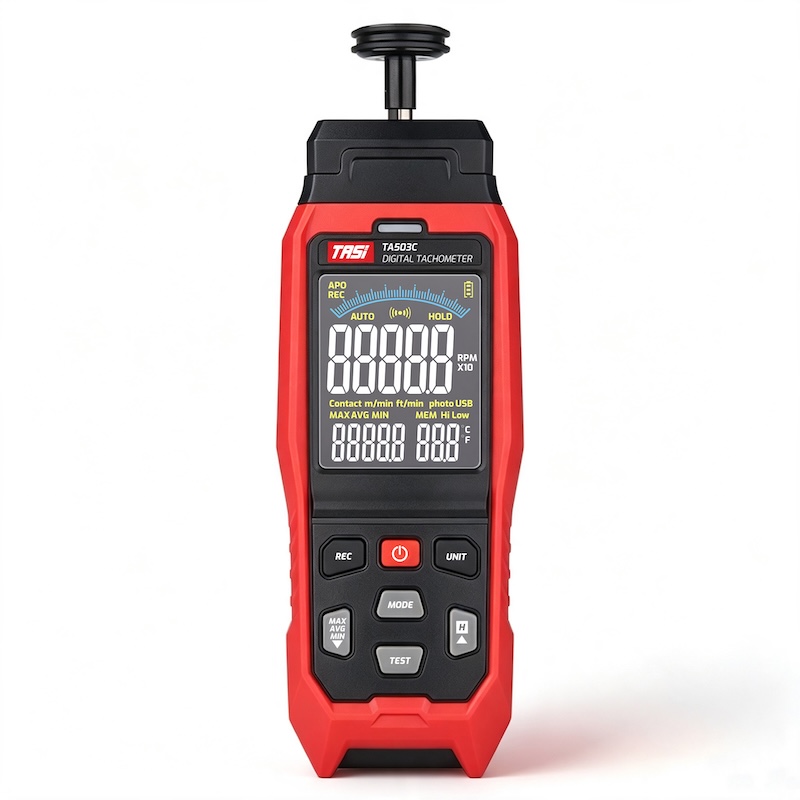
The TA503 Series Digital Tachometers are high-accuracy and multifunctional rotational speed measuring instruments, also known as digital tachometers, RPM meters, speed meters, rotation testers, electronic tachometers, optical tachometers, contact tachometers, and non-contact tachometers. The series supports both non-contact optical measurement and contact measurement modes, providing fast and reliable measurement of rotational speed (RPM), linear speed, and length for various rotating equipment. The TA503 series includes the TA503A Non-Contact Digital Tachometer, TA503B Contact Digital Tachometer, and TA503C Contact & Non-Contact Digital Tachometer, offering flexible solutions for different industrial measurement requirements. The TA503C model is equipped with a USB communication interface, allowing connection to a computer for data acquisition, measurement record export, and further data analysis. Designed for industrial inspection and engineering applications, the tachometers provide fast response, stable readings, and high repeatability. Integrated functions include Data Hold, MAX/MIN/Average measurement, high/low limit alarm, data logging, multiple measurement units, ambient temperature display, and automatic power-off. The compact and portable design makes them ideal for field inspection, equipment maintenance, production line testing, and laboratory applications. The TA503 Series Digital Tachometers are widely used in motor manufacturing, automation equipment, mechanical engineering, HVAC systems, fan production, power equipment, automotive maintenance, petrochemical plants, steel manufacturing, conveyor systems, and educational laboratories. They are suitable for measuring the rotational speed of AC motors, DC motors, servo motors, engines, fans, pumps, generators, machine tool spindles, and transmission systems for performance testing, troubleshooting, and preventive maintenance.
View More ›
TA500A TA500 Series Digital Tachometer

TA500A

TA500 Series
Digital Tachometer
Non-Contact Measurement
Abstract:
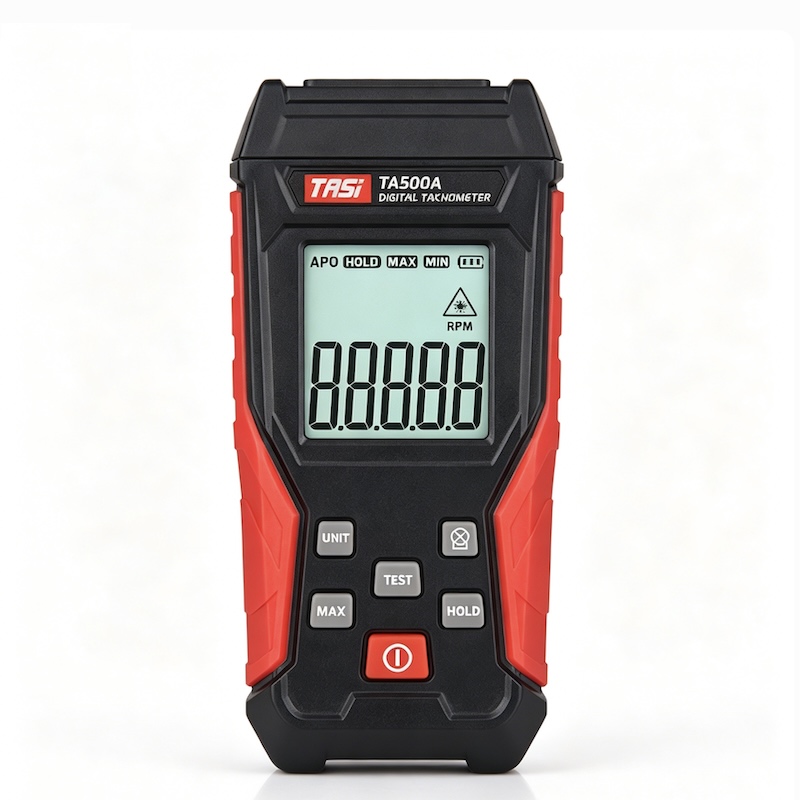
The TA500 Series Digital Tachometer is a professional handheld rotational speed measurement instrument designed for accurate RPM, surface speed, and length measurement. The series includes the TA500A non-contact laser tachometer, TA500B contact tachometer, and TA500C combination laser and contact tachometer, providing flexible solutions for different industrial measurement requirements. Featuring high-precision sensing technology and a five-digit large LCD display, the TA500 Series tachometer, RPM meter, rotation speed tester, and speed measurement instrument deliver fast and reliable readings for various rotating equipment applications. The non-contact laser measurement mode of TA500A and TA500C allows safe RPM testing from a 50–500mm distance without touching rotating parts, while the contact measurement mode of TA500B and TA500C is suitable for direct measurement of shaft speed, surface velocity, and running length. With practical functions including data hold, maximum/minimum value recording, backlight display, and automatic power-off, the TA500 Series digital RPM meter is widely used in motor manufacturing, fan production, pump testing, automation systems, power generation, petrochemical plants, steel and metallurgy industries, aerospace equipment, HVAC systems, mechanical maintenance, and warehouse automation applications. It is ideal for testing motors, engines, fans, blowers, conveyor belts, rollers, rotating shafts, and other industrial machinery for quality inspection, commissioning, troubleshooting, and preventive maintenance.
View More ›
TA500B TA500 Series Digital Tachometer

TA500B

TA500 Series
Digital Tachometer
Contact Measurement
Abstract:
The TA500 Series Digital Tachometer is a professional handheld rotational speed measurement instrument designed for accurate RPM, surface speed, and length measurement. The series includes the TA500A non-contact laser tachometer, TA500B contact tachometer, and TA500C combination laser and contact tachometer, providing flexible solutions for different industrial measurement requirements. Featuring high-precision sensing technology and a five-digit large LCD display, the TA500 Series tachometer, RPM meter, rotation speed tester, and speed measurement instrument deliver fast and reliable readings for various rotating equipment applications. The non-contact laser measurement mode of TA500A and TA500C allows safe RPM testing from a 50–500mm distance without touching rotating parts, while the contact measurement mode of TA500B and TA500C is suitable for direct measurement of shaft speed, surface velocity, and running length. With practical functions including data hold, maximum/minimum value recording, backlight display, and automatic power-off, the TA500 Series digital RPM meter is widely used in motor manufacturing, fan production, pump testing, automation systems, power generation, petrochemical plants, steel and metallurgy industries, aerospace equipment, HVAC systems, mechanical maintenance, and warehouse automation applications. It is ideal for testing motors, engines, fans, blowers, conveyor belts, rollers, rotating shafts, and other industrial machinery for quality inspection, commissioning, troubleshooting, and preventive maintenance.
View More ›
TA500C TA500 Series Digital Tachometer

TA500C

TA500 Series
Digital Tachometer
Contact / Non-Contact Measuremen
Abstract:
The TA500 Series Digital Tachometer is a professional handheld rotational speed measurement instrument designed for accurate RPM, surface speed, and length measurement. The series includes the TA500A non-contact laser tachometer, TA500B contact tachometer, and TA500C combination laser and contact tachometer, providing flexible solutions for different industrial measurement requirements. Featuring high-precision sensing technology and a five-digit large LCD display, the TA500 Series tachometer, RPM meter, rotation speed tester, and speed measurement instrument deliver fast and reliable readings for various rotating equipment applications. The non-contact laser measurement mode of TA500A and TA500C allows safe RPM testing from a 50–500mm distance without touching rotating parts, while the contact measurement mode of TA500B and TA500C is suitable for direct measurement of shaft speed, surface velocity, and running length. With practical functions including data hold, maximum/minimum value recording, backlight display, and automatic power-off, the TA500 Series digital RPM meter is widely used in motor manufacturing, fan production, pump testing, automation systems, power generation, petrochemical plants, steel and metallurgy industries, aerospace equipment, HVAC systems, mechanical maintenance, and warehouse automation applications. It is ideal for testing motors, engines, fans, blowers, conveyor belts, rollers, rotating shafts, and other industrial machinery for quality inspection, commissioning, troubleshooting, and preventive maintenance.
View More ›
TA506A TA506 Series Handheld Non-Contact Laser Digital Tachometer

TA506A

TA506 Series
Handheld Non-Contact Laser Digital Tachometer
Abstract:
The TA506 Series Handheld Non-Contact Laser Digital Tachometer, also known as a laser tachometer, optical tachometer, RPM meter, or rotational speed tester, is designed for fast and accurate measurement of rotating equipment speed. Using advanced laser reflection technology, the instrument measures the rotational speed of motors, fans, pumps, shafts, gears, rollers, and other rotating machinery without physical contact. With a wide measuring range of 3 to 100,000 RPM, the TA506 series allows operators to perform speed inspections without stopping equipment operation, improving workplace safety and maintenance efficiency. Both TA506A and TA506B models provide reliable RPM measurement performance, while the TA506B features Bluetooth wireless data transmission, enabling convenient data recording, monitoring, and analysis through smart devices. Equipped with a five-digit high-resolution display, the tachometer supports data hold, maximum/minimum value recording, and backlight illumination for clear readings in various industrial environments. Its compact handheld design makes it ideal for portable inspection, equipment commissioning, and routine maintenance tasks. The TA506 Series Digital Tachometer is widely used in machinery manufacturing, motor production, power generation, steel and metallurgy, petrochemical plants, aviation equipment, HVAC systems, fan manufacturing, automation equipment, warehouse machinery, and industrial maintenance applications. It is suitable for motor speed testing, fan performance verification, pump monitoring, production line quality control, preventive maintenance, and troubleshooting of rotating equipment.
View More ›
TA506B TA506 Series Handheld Non-Contact Laser Digital Tachometer

TA506B

TA506 Series
Handheld Non-Contact Laser Digital Tachometer
Abstract:
The TA506 Series Handheld Non-Contact Laser Digital Tachometer, also known as a laser tachometer, optical tachometer, RPM meter, or rotational speed tester, is designed for fast and accurate measurement of rotating equipment speed. Using advanced laser reflection technology, the instrument measures the rotational speed of motors, fans, pumps, shafts, gears, rollers, and other rotating machinery without physical contact. With a wide measuring range of 3 to 100,000 RPM, the TA506 series allows operators to perform speed inspections without stopping equipment operation, improving workplace safety and maintenance efficiency. Both TA506A and TA506B models provide reliable RPM measurement performance, while the TA506B features Bluetooth wireless data transmission, enabling convenient data recording, monitoring, and analysis through smart devices. Equipped with a five-digit high-resolution display, the tachometer supports data hold, maximum/minimum value recording, and backlight illumination for clear readings in various industrial environments. Its compact handheld design makes it ideal for portable inspection, equipment commissioning, and routine maintenance tasks. The TA506 Series Digital Tachometer is widely used in machinery manufacturing, motor production, power generation, steel and metallurgy, petrochemical plants, aviation equipment, HVAC systems, fan manufacturing, automation equipment, warehouse machinery, and industrial maintenance applications. It is suitable for motor speed testing, fan performance verification, pump monitoring, production line quality control, preventive maintenance, and troubleshooting of rotating equipment.
View More ›
Related Technical Articles
Related FAQs