How to Choose an Infrared Thermometer for Warehouse and Cold Chain Temperature Checks

Publisher: Amy Published: 2026-03-31 Reading Time: 7min. 30sec.
Tags: infrared thermometercold chain temperature measurementcold storage temperaturewarehouse temperature inspectionnon-contact temperature measurementcold chain monitoring

Introduction

Temperature control is critical in warehouses, cold rooms, and cold chain transportation, particularly for food, fresh produce, pharmaceuticals, frozen products, refrigerated logistics, and temperature-sensitive storage.

Infrared thermometers allow operators to check surface temperatures quickly without contacting the target. This makes them well suited for product screening, locating abnormal temperature areas, and routine inspections. However, different warehouse and cold chain applications place different demands on temperature range, D:S ratio, accuracy, emissivity, and environmental performance.

For this reason, selecting an infrared thermometer should not be based simply on choosing the widest possible temperature range. The first step is to define the target, measuring distance, target size, and purpose of the measurement.


Key Points

● Infrared thermometers measure surface temperature. They do not directly measure the temperature inside packaging, food products, or liquids.
● General warehouse inspections usually prioritize measurement speed, ease of use, and repeatability, while cold rooms and cold chain environments also require attention to low-temperature capability and operating conditions.
● The D:S ratio determines the size of the measurement spot at a given distance. Higher D:S ratios are preferable for longer distances or smaller targets.
● Cardboard, plastic packaging, rubber, and other high-emissivity surfaces are generally easier to measure than aluminum foil, stainless steel, or other reflective materials.
● For frequent screening, high/low temperature alarms, continuous measurement, and MAX/MIN functions can be more useful than an extremely wide temperature range.
● Where the internal temperature of food, pharmaceuticals, or other products must be verified, an appropriate thermocouple or contact temperature probe should also be used.


What Is Typically Measured in Warehouses and Cold Chain Operations?

In warehouse and cold chain applications, infrared thermometers are generally used to check the surface temperature of specific products, structures, or equipment rather than the temperature of the surrounding air.

Typical measurement targets include:

● Cardboard boxes, plastic packaging, palletized goods, and refrigerated packaging;
● Frozen and chilled food packaging;
● Cold room walls, floors, doors, and insulation surfaces;
● Evaporators, condensers, compressors, refrigeration pipes, and other equipment surfaces;
● Interior surfaces of refrigerated vehicles, insulated containers, and cold chain transport equipment;
● Product surfaces during loading and unloading, including different areas or batches.

For example, during receiving inspection, an operator can rapidly scan the surfaces of several packages from the same shipment. If most packages show similar temperatures but one is significantly warmer, that package can be identified for further inspection.

In this role, an infrared thermometer is best used as a rapid screening instrument.


First Understand That Infrared Thermometers Measure Surface Temperature

This is one of the most important considerations in cold chain temperature measurement.

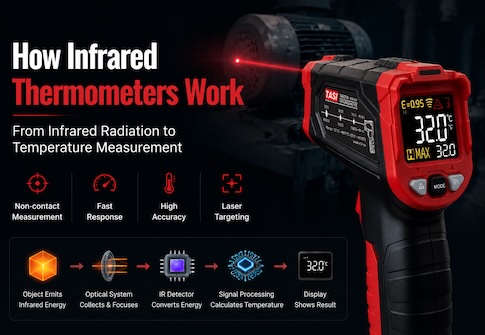
An infrared thermometer calculates temperature from infrared radiation emitted by the target surface. The displayed value therefore represents the radiometric surface temperature within the instrument's field of view.

When measuring a carton of frozen food, for example, the instrument normally measures the temperature of the carton or packaging surface, not the temperature at the center of the food inside.

Infrared measurement alone is generally insufficient when:

● The internal temperature of frozen food must be verified;
● The core temperature of meat, liquids, or other foods must be measured;
● Internal temperature verification is required for pharmaceuticals or other temperature-sensitive products;
● A specified inspection procedure requires contact or probe measurement.

In such cases, a thermocouple thermometer, penetration probe, or another suitable contact temperature instrument should be used for confirmation.


How to Choose the Temperature Range

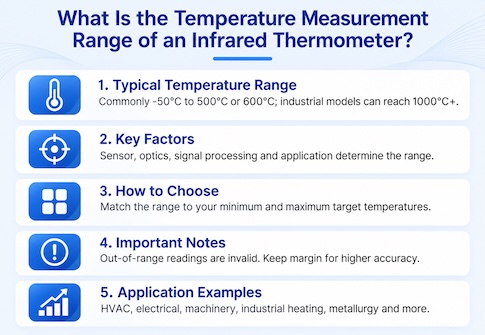
Warehouse and cold chain applications are generally focused on low and moderate temperatures, so an extremely high upper temperature limit is usually unnecessary.

For normal storage, refrigerated, and frozen applications, it is more important to confirm that the lower end of the measurement range covers the actual operating conditions.

For example:

● General warehouses and ambient logistics mainly operate around room temperature;
● Refrigerated environments often require measurements around 0°C and below;
● Frozen storage may require measurements at −18°C, −20°C, or lower;
● Refrigeration maintenance may also involve warmer surfaces such as compressors and piping.

As long as the selected infrared thermometer covers the lowest and highest surface temperatures expected in the application, its range is generally sufficient. For cold chain work, low-temperature capability and accuracy within the relevant operating range are usually more important than an exceptionally high maximum temperature.


Why D:S Matters in Warehouse Inspections

D:S refers to the distance-to-spot ratio and determines the approximate size of the area being measured at a given distance.

For example, with a D:S ratio of 12:1, a measuring distance of approximately 120 cm corresponds to a spot diameter of about 10 cm.

In warehouses, operators may need to check:

● Cartons stored on high racks;
● Goods located toward the center of a pallet;
● Refrigeration equipment installed overhead or at a distance;
● Areas inside transport vehicles that are difficult to approach.

If the measuring distance is long and the target is small, a low D:S ratio may cause the measurement spot to include both the target and the surrounding background. The reading may then no longer represent the target accurately.

As a general guide:

● Short-distance measurements of large packages require less demanding D:S performance;
● Long-distance rack inspections benefit from a higher D:S ratio;
● Small packages, pipes, and localized components are also better measured with a higher D:S ratio.

Regardless of the D:S specification, the target should ideally be significantly larger than the measurement spot.


Accuracy and Repeatability Matter More Than an Extremely Wide Range

Cold chain temperature management often involves comparing different products or areas to identify abnormal temperature differences. Stable and repeatable readings are therefore especially important.

If repeated measurements of similar products fluctuate excessively, an instrument with a very wide temperature range may still be unsuitable for efficient screening.

Important specifications to consider include:

● Stated measurement accuracy;
● Whether a separate accuracy specification is provided for lower temperatures;
● Repeatability when measuring the same target;
● Response to rapid temperature changes;
● Additional errors that may occur under different ambient conditions.

For applications that compare multiple areas or batches, good repeatability can be especially valuable.


Why Adjustable Emissivity Is Useful in Complex Cold Chain Environments

Different materials emit infrared radiation differently. This characteristic is represented by emissivity, usually expressed as ε.

Many common warehouse materials, including cardboard, adhesive tape, rubber, food surfaces, and certain plastics, have relatively high emissivity and are generally easier to measure with an infrared thermometer.

Particular attention is required for:

● Aluminum foil packaging;
● Polished metal;
● Stainless-steel equipment surfaces;
● Chrome-plated fittings;
● Highly reflective metal containers.

These low-emissivity, reflective surfaces can reflect infrared radiation from their surroundings, causing the measured temperature to differ significantly from the actual surface temperature.

Where many different materials are measured, an infrared thermometer with adjustable emissivity is generally more suitable.

For reflective metal surfaces, where practical, a high-emissivity reference area can also be created or used on the target surface before measurement.


Why Response Time Matters for High-Volume Inspections

Warehouse and cold chain inspections often require many products to be checked in a short period.

An operator may need to scan multiple pallets, cartons, or transport containers one after another. If the instrument responds slowly, overall inspection efficiency can be reduced.

A faster response is particularly useful for:

● Incoming goods screening;
● Large-volume package inspection;
● Routine cold room inspections;
● Refrigerated vehicle loading and unloading checks;
● Locating temperature anomalies in refrigeration systems.

However, a fast response does not mean the instrument should be moved rapidly and continuously across targets without control. The thermometer should still be held steadily enough for the measurement spot to remain fully on the intended surface.


Are High/Low Temperature Alarms Worth Choosing?

High and low temperature alarm functions can be particularly useful for operators who perform frequent cold chain screening.

HI and LO thresholds can be configured according to internal operating requirements. When a measured value falls outside the specified range, the instrument can provide a visual, audible, or other warning, reducing the need to evaluate every reading manually.

This is useful for:

● Receiving inspection of chilled and frozen goods;
● Cold chain loading and unloading;
● Batch inspection in cold storage;
● Refrigerated display or storage inspections in retail operations;
● Warehouses with multiple temperature zones.

Alarm thresholds should always be selected according to the actual product requirements, internal quality procedures, or applicable inspection criteria.


Cold Room Use Also Requires Attention to Ambient Temperature Changes

Cold rooms present a particularly demanding operating environment for handheld infrared thermometers.

If an instrument is stored in a warm office and then taken directly into a low-temperature cold room, its internal components and optical system undergo a rapid temperature change.

Likewise, when an instrument is moved from a cold environment into warm, humid air, condensation may develop on the lens or housing.

This can result in:

● Temporary instability in readings;
● Fogging or condensation on the infrared optical window;
● Moisture affecting the optical path;
● Temporary temperature drift inside the instrument;
● Additional stress from repeated thermal cycling.

For frequent cold room use, check the manufacturer's specified operating temperature range and, for important measurements, allow the instrument sufficient time to acclimatize to the new environment.

If visible condensation has formed on the optical window, measurement should be delayed until the moisture has cleared. Avoid wiping the optical window aggressively while condensation is still present.


Laser Configuration Is Not the Most Important Selection Criterion

Many infrared thermometers use single-laser or dual-laser aiming systems.

The laser is primarily an aiming aid. It does not measure the temperature itself.

Laser guidance can be useful when locating packages in warehouses, but the choice of thermometer should not be based solely on whether it uses one laser, two lasers, or another laser pattern.

More important specifications include:

● D:S ratio;
● Temperature range;
● Accuracy;
● Emissivity;
● Response time;
● Operating temperature range.

It is also important to remember that the laser point does not necessarily represent the actual infrared measurement area. Even when the laser is positioned on the target, the reading can still include surrounding surfaces if the target is smaller than the infrared spot.


Which Functions Are Most Useful for Warehouse and Cold Chain Applications?

For warehouse and cold chain inspections, the following functions can be especially useful:

Continuous measurement: Helps scan multiple products and locate temperature anomalies quickly;
MAX/MIN: Records the highest and lowest surface temperatures during an inspection;
High/low alarms: Supports rapid screening against preset temperature limits;
Adjustable emissivity: Improves flexibility when measuring different surface materials;
Backlit display: Useful in cold rooms, inside racks, and other low-light areas;
Data Hold: Allows the reading to be reviewed after moving away from the target;
Data logging or USB export: Suitable when inspection records, batch data, or equipment temperature history must be retained.

For occasional warehouse checks, not every function is necessary. The final configuration should match the inspection frequency and data management requirements.


How to Choose for Different Applications

For general warehouse inspections, a straightforward infrared thermometer with stable readings, fast response, and easy operation is usually sufficient. If most targets are cardboard or plastic packaging, adjustable emissivity is not always essential, although it provides greater flexibility for mixed materials.

For routine cold room inspection, greater attention should be given to low-temperature range, operating temperature, response time, and the instrument's behavior during rapid environmental temperature changes.

For cold chain transportation and receiving inspection, high/low alarms, continuous measurement, and fast response are often highly practical because many products must be screened in a limited period.

For high racks, distant equipment, or targets that cannot be approached closely, a higher D:S ratio is preferable to reduce the amount of background included in the measurement spot.

For food, pharmaceutical, or other applications where internal temperature must be verified, an infrared thermometer with K-type thermocouple input can be useful, or a separate thermocouple thermometer can be used to combine rapid infrared screening with contact measurement confirmation.


FAQ

Can an infrared thermometer measure cold room air temperature directly?

It should not normally be used as an air thermometer. Infrared thermometers detect radiation from surfaces such as walls, products, and equipment rather than directly measuring the surrounding air. A suitable air temperature sensor or temperature/humidity instrument should be used for cold room air measurements.

Can an infrared thermometer measure the internal temperature of frozen food?

No. It measures the surface temperature only. A penetration thermocouple or other suitable contact probe should be used to verify core temperature.

Is a higher D:S ratio always better for cold chain measurements?

Not necessarily. A higher D:S ratio is mainly beneficial for longer measuring distances or smaller targets. If large cartons or palletized loads are always measured from close range, an extremely high D:S ratio may not be necessary.

Does emissivity need to be adjusted for plastic packaging?

Many opaque plastics have relatively high emissivity and are suitable for infrared measurement. However, emissivity can vary with material, color, thickness, and surface finish. Where higher measurement accuracy is required, the emissivity setting should be verified for the actual material.

Why are readings unstable on aluminum foil packaging?

Aluminum foil has low emissivity and high reflectivity, so it can reflect infrared radiation from surrounding objects. This can create significant measurement errors. Where possible, measure a paper label, adhesive tape, or another higher-emissivity area instead.

Can the thermometer be used immediately after moving it from an office into a cold room?

For general screening, the instrument can be observed for stability, but for more reliable measurements it is advisable to allow sufficient acclimatization and follow the manufacturer's specified operating conditions.


Conclusion

When selecting an infrared thermometer for warehouse and cold chain applications, first determine whether the main targets are product surfaces, packaging, cold room structures, or refrigeration equipment. Then select the instrument according to the actual temperature range, measuring distance, and target size.

For most warehouse and cold chain applications, appropriate low-temperature capability, stable accuracy and repeatability, sufficient D:S ratio, fast response, and high/low alarm functions are usually more valuable than an exceptionally wide temperature range.

Where aluminum foil, stainless steel, or other reflective surfaces must be measured, adjustable emissivity and careful measurement technique become more important.

Above all, infrared temperature measurement should be regarded primarily as a fast method for surface temperature screening and anomaly detection. When the internal temperature of food, pharmaceuticals, or other products must be verified, a thermocouple or another suitable contact probe should be used for confirmation. Combining infrared and contact measurement can improve both the efficiency and reliability of warehouse and cold chain temperature inspection.

Related Technical Articles
What Is the Temperature Measurement Range of an Infrared Thermometer?
How Does Target Size Relate to the Measurement Spot of an Infrared Thermometer?
Detailed Explanation of How Infrared Thermometers Work
Introduction to the Optical System of an Infrared Thermometer
Why Does Surface Roughness Affect Infrared Temperature Measurement?
What Is the Relationship Between Emissivity, Reflectivity, and Transmissivity?
What Is Emissivity in an Infrared Thermometer? How to Set It Correctly?
What Is the Difference Between an Infrared Thermometer and a Contact Thermometer?
How Do Dust and Oil Mist Affect Infrared Temperature Measurements?
What Is the Difference Between an Infrared Thermometer and a Thermal Imaging Camera?
How to Properly Use an Infrared Thermometer for Temperature Measurement?
How to Measure Surfaces That Heat Up or Cool Down Rapidly with an Infrared Thermometer
What Does the Spectral Response Range of an Infrared Thermometer Mean?
How to Evaluate the Quality of an Infrared Thermometer
What Does Measurement Uncertainty Mean in Infrared Temperature Measurement?
Why Does Reflected Background Temperature Affect Infrared Temperature Measurements?
How Does a Thermopile Sensor Work in an Infrared Thermometer?
What Objects Can an Infrared Thermometer Measure?
Infrared Thermometer Measurement Range, Response Time and Resolution Explained
Why Do Infrared Thermometers Need Laser Aiming?
What Does Resolution Mean on an Infrared Thermometer?
What Is the Relationship Between Blackbody Radiation and Infrared Temperature Measurement?
How Is Infrared Thermometer Accuracy Defined?
Why Can’t an Infrared Thermometer Measure Temperature Through Glass?
Why Do Infrared Thermometers Use Infrared Radiation to Measure Temperature?
How Does Measurement Angle Affect Infrared Thermometer Readings?
What Materials Can an Infrared Thermometer Measure?
What Factors Affect the Accuracy of Infrared Thermometers?
How to Measure Moving Objects with an Infrared Thermometer
Do Air, Steam, and Smoke Affect Infrared Temperature Measurement?
How Do Temperature Gradients Affect Infrared Temperature Measurements?
Infrared Thermometer Calibration Principles Explained
Why Doesn’t the Laser Dot on an Infrared Thermometer Represent the Actual Measurement Area?
What Is the Difference Between Repeatability and Accuracy in an Infrared Thermometer?
What Does Response Time Mean on an Infrared Thermometer?
What Does Thermal Equilibrium Mean in Infrared Temperature Measurement?
How Does Response Time Affect Temperature Measurement of Fast-Moving Objects?
How to Calculate the Measurement Spot Size of an Infrared Thermometer at Different Distances
What Does the D:S Distance-to-Spot Ratio Mean on an Infrared Thermometer?
How Do Infrared Thermometers Account for Ambient Background Radiation?
What Is an Infrared Thermometer? Working Principle and Applications
How Does Ambient Temperature Affect Infrared Temperature Measurement?
Common Functions of Infrared Thermometers
What Does Field of View (FOV) Mean on an Infrared Thermometer?
Types of Sensors Used in Infrared Thermometers
Related FAQs
Why Can’t an Infrared Thermometer Measure Transparent Objects?
Can an Infrared Thermometer Still Be Used After Being Dropped?
Why Does an Infrared Thermometer Give Different Readings on Different Colors?
Why Does Black Tape Improve the Accuracy of Infrared Temperature Measurement?
How to Calibrate an Infrared Thermometer
Why Does an Infrared Thermometer Show Different Temperatures at Different Points on the Same Object?
Common Mistakes When Using an Infrared Thermometer
Can an Infrared Thermometer Measure Objects in a Steam Environment?
Why Do Two Infrared Thermometers Give Different Readings on the Same Object?
Why Are Infrared Thermometer Readings Unstable on Stainless Steel Surfaces?
What Does “OL” Mean on an Infrared Thermometer Display?
Can an Infrared Thermometer Measure Liquid Temperature?
What Do HI and LO Mean on an Infrared Thermometer?
Why Does an Infrared Thermometer Show the Laser but No Temperature Reading?
Why Does an Infrared Thermometer Need a Stable Environment?
Does an Infrared Thermometer Need Regular Performance Verification?
Why Is the Infrared Thermometer Inaccurate?
Why Should an Infrared Thermometer Be Allowed to Stabilize After Moving from Outdoors to Indoors?
What Happens If You Measure from Too Far Away with an Infrared Thermometer?
How to Clean the Lens of an Infrared Thermometer
Does Low Battery Power Affect the Measurement Accuracy of an Infrared Thermometer?
Why Does an Infrared Thermometer Reading Fluctuate When Measuring a Moving Belt or Roller?
How to Maintain and Care for an Infrared Thermometer
Does Condensation on an Infrared Thermometer Lens Affect Temperature Measurement?
Does an Infrared Thermometer Measure the Glass Temperature or the Object Behind the Glass?
Can an Infrared Thermometer Measure Metal Surfaces?
Does an Infrared Thermometer Need Calibration?
Can an Infrared Thermometer Be Used for Continuous Long-Term Measurement?
Can an Infrared Thermometer Be Used in Bright Light or Direct Sunlight?
Can an Infrared Thermometer Measure Human Body Temperature?
Why Do Infrared Thermometers Often Read Too Low on Metal Surfaces?
Are Infrared Thermometers Accurate When Measuring Black Objects?
Why Is My Infrared Thermometer Showing the Wrong Temperature?
Can an Infrared Thermometer Measure Transparent Objects?
What Are the Common Mistakes When Using an Infrared Thermometer?
Can an Infrared Thermometer Measure Highly Reflective Metals Such as Aluminum and Copper?
What to Do If an Infrared Thermometer Is Inaccurate in Winter
What Is the Alarm Function on an Infrared Thermometer Used For?
Can an Infrared Thermometer Measure Temperature Through Plastic Film?
Related Products
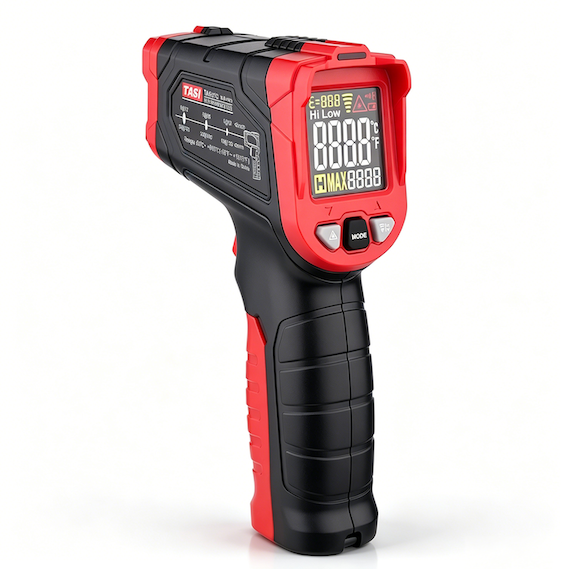
TA601A TA601 Series Non-Contact Infrared Thermometers

TA601A

TA601 Series
Non-Contact Infrared Thermometers
-50 to 480°C | 12:1
Abstract:
The TA601 Series Infrared Thermometers are professional non-contact temperature measurement instruments, also known as infrared temperature guns, laser thermometers, handheld infrared thermometers, IR temperature testers, and industrial infrared temperature meters. By detecting the infrared energy emitted from the surface of an object, these devices provide fast, accurate, and safe temperature measurements without physical contact, making them ideal for measuring high-temperature, hazardous, or hard-to-reach areas. Featuring a 12:1 distance-to-spot ratio, the TA601 Series infrared thermometer combines laser targeting technology with fast response performance to accurately identify the measurement area even from a distance. The adjustable emissivity range from 0.10 to 1.00 allows the instrument to measure different surface materials including metal, plastic, rubber, glass, stone, and wood. Additional functions include high/low temperature alarms, audible alerts, data hold, maximum value recording, and ℃/℉ unit conversion, providing reliable temperature monitoring for various professional applications. With its compact design, quick measurement capability, and easy operation, the TA601 Series handheld infrared thermometer is widely used in electrical maintenance, industrial equipment inspection, manufacturing, automotive repair, HVAC systems, building inspection, food processing, cold chain management, laboratories, chemical equipment monitoring, and energy management applications. In electrical applications, it helps detect overheating issues in distribution cabinets, cables, terminals, circuit breakers, and transformers. In industrial environments, it supports temperature monitoring of motors, bearings, gearboxes, molds, production lines, and mechanical equipment. For HVAC applications, it is suitable for checking air conditioners, heating systems, pipelines, and underfloor heating systems. In automotive maintenance, it assists with temperature diagnosis of engines, exhaust systems, brake systems, and vehicle components. In food processing and cold storage industries, it helps monitor processing temperatures, refrigeration systems, and quality control procedures. The TA601 Series infrared thermometer provides maintenance engineers, technicians, and inspectors with an efficient solution for fast temperature diagnosis, preventive maintenance, and safety inspection, helping improve operational efficiency and reduce equipment failure risks.
View More ›
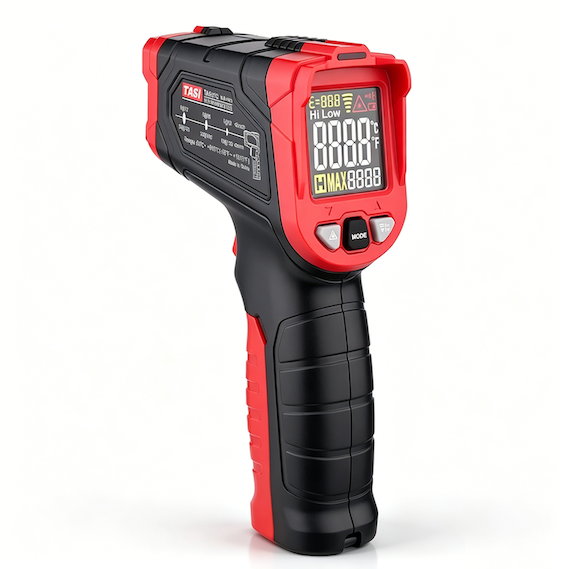
TA601B TA601 Series Non-Contact Infrared Thermometers

TA601B

TA601 Series
Non-Contact Infrared Thermometers
-50 to 680°C | 12:1
Abstract:
The TA601 Series Infrared Thermometers are professional non-contact temperature measurement instruments, also known as infrared temperature guns, laser thermometers, handheld infrared thermometers, IR temperature testers, and industrial infrared temperature meters. By detecting the infrared energy emitted from the surface of an object, these devices provide fast, accurate, and safe temperature measurements without physical contact, making them ideal for measuring high-temperature, hazardous, or hard-to-reach areas. Featuring a 12:1 distance-to-spot ratio, the TA601 Series infrared thermometer combines laser targeting technology with fast response performance to accurately identify the measurement area even from a distance. The adjustable emissivity range from 0.10 to 1.00 allows the instrument to measure different surface materials including metal, plastic, rubber, glass, stone, and wood. Additional functions include high/low temperature alarms, audible alerts, data hold, maximum value recording, and ℃/℉ unit conversion, providing reliable temperature monitoring for various professional applications. With its compact design, quick measurement capability, and easy operation, the TA601 Series handheld infrared thermometer is widely used in electrical maintenance, industrial equipment inspection, manufacturing, automotive repair, HVAC systems, building inspection, food processing, cold chain management, laboratories, chemical equipment monitoring, and energy management applications. In electrical applications, it helps detect overheating issues in distribution cabinets, cables, terminals, circuit breakers, and transformers. In industrial environments, it supports temperature monitoring of motors, bearings, gearboxes, molds, production lines, and mechanical equipment. For HVAC applications, it is suitable for checking air conditioners, heating systems, pipelines, and underfloor heating systems. In automotive maintenance, it assists with temperature diagnosis of engines, exhaust systems, brake systems, and vehicle components. In food processing and cold storage industries, it helps monitor processing temperatures, refrigeration systems, and quality control procedures. The TA601 Series infrared thermometer provides maintenance engineers, technicians, and inspectors with an efficient solution for fast temperature diagnosis, preventive maintenance, and safety inspection, helping improve operational efficiency and reduce equipment failure risks.
View More ›
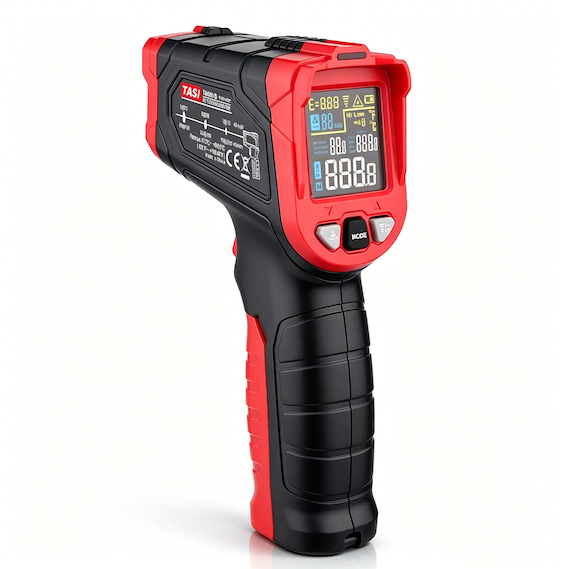
TA601C TA601 Series Non-Contact Infrared Thermometers

TA601C

TA601 Series
Non-Contact Infrared Thermometers
-50 to 880°C | 12:1
Abstract:
The TA601 Series Infrared Thermometers are professional non-contact temperature measurement instruments, also known as infrared temperature guns, laser thermometers, handheld infrared thermometers, IR temperature testers, and industrial infrared temperature meters. By detecting the infrared energy emitted from the surface of an object, these devices provide fast, accurate, and safe temperature measurements without physical contact, making them ideal for measuring high-temperature, hazardous, or hard-to-reach areas. Featuring a 12:1 distance-to-spot ratio, the TA601 Series infrared thermometer combines laser targeting technology with fast response performance to accurately identify the measurement area even from a distance. The adjustable emissivity range from 0.10 to 1.00 allows the instrument to measure different surface materials including metal, plastic, rubber, glass, stone, and wood. Additional functions include high/low temperature alarms, audible alerts, data hold, maximum value recording, and ℃/℉ unit conversion, providing reliable temperature monitoring for various professional applications. With its compact design, quick measurement capability, and easy operation, the TA601 Series handheld infrared thermometer is widely used in electrical maintenance, industrial equipment inspection, manufacturing, automotive repair, HVAC systems, building inspection, food processing, cold chain management, laboratories, chemical equipment monitoring, and energy management applications. In electrical applications, it helps detect overheating issues in distribution cabinets, cables, terminals, circuit breakers, and transformers. In industrial environments, it supports temperature monitoring of motors, bearings, gearboxes, molds, production lines, and mechanical equipment. For HVAC applications, it is suitable for checking air conditioners, heating systems, pipelines, and underfloor heating systems. In automotive maintenance, it assists with temperature diagnosis of engines, exhaust systems, brake systems, and vehicle components. In food processing and cold storage industries, it helps monitor processing temperatures, refrigeration systems, and quality control procedures. The TA601 Series infrared thermometer provides maintenance engineers, technicians, and inspectors with an efficient solution for fast temperature diagnosis, preventive maintenance, and safety inspection, helping improve operational efficiency and reduce equipment failure risks.
View More ›
TA601D TA601 Series Non-Contact Infrared Thermometers

TA601D

TA601 Series
Non-Contact Infrared Thermometers
Abstract:
The TA601 Series Infrared Thermometers are professional non-contact temperature measurement instruments, also known as infrared temperature guns, laser thermometers, handheld infrared thermometers, IR temperature testers, and industrial infrared temperature meters. By detecting the infrared energy emitted from the surface of an object, these devices provide fast, accurate, and safe temperature measurements without physical contact, making them ideal for measuring high-temperature, hazardous, or hard-to-reach areas. Featuring a 12:1 distance-to-spot ratio, the TA601 Series infrared thermometer combines laser targeting technology with fast response performance to accurately identify the measurement area even from a distance. The adjustable emissivity range from 0.10 to 1.00 allows the instrument to measure different surface materials including metal, plastic, rubber, glass, stone, and wood. Additional functions include high/low temperature alarms, audible alerts, data hold, maximum value recording, and ℃/℉ unit conversion, providing reliable temperature monitoring for various professional applications. With its compact design, quick measurement capability, and easy operation, the TA601 Series handheld infrared thermometer is widely used in electrical maintenance, industrial equipment inspection, manufacturing, automotive repair, HVAC systems, building inspection, food processing, cold chain management, laboratories, chemical equipment monitoring, and energy management applications. In electrical applications, it helps detect overheating issues in distribution cabinets, cables, terminals, circuit breakers, and transformers. In industrial environments, it supports temperature monitoring of motors, bearings, gearboxes, molds, production lines, and mechanical equipment. For HVAC applications, it is suitable for checking air conditioners, heating systems, pipelines, and underfloor heating systems. In automotive maintenance, it assists with temperature diagnosis of engines, exhaust systems, brake systems, and vehicle components. In food processing and cold storage industries, it helps monitor processing temperatures, refrigeration systems, and quality control procedures. The TA601 Series infrared thermometer provides maintenance engineers, technicians, and inspectors with an efficient solution for fast temperature diagnosis, preventive maintenance, and safety inspection, helping improve operational efficiency and reduce equipment failure risks.
View More ›
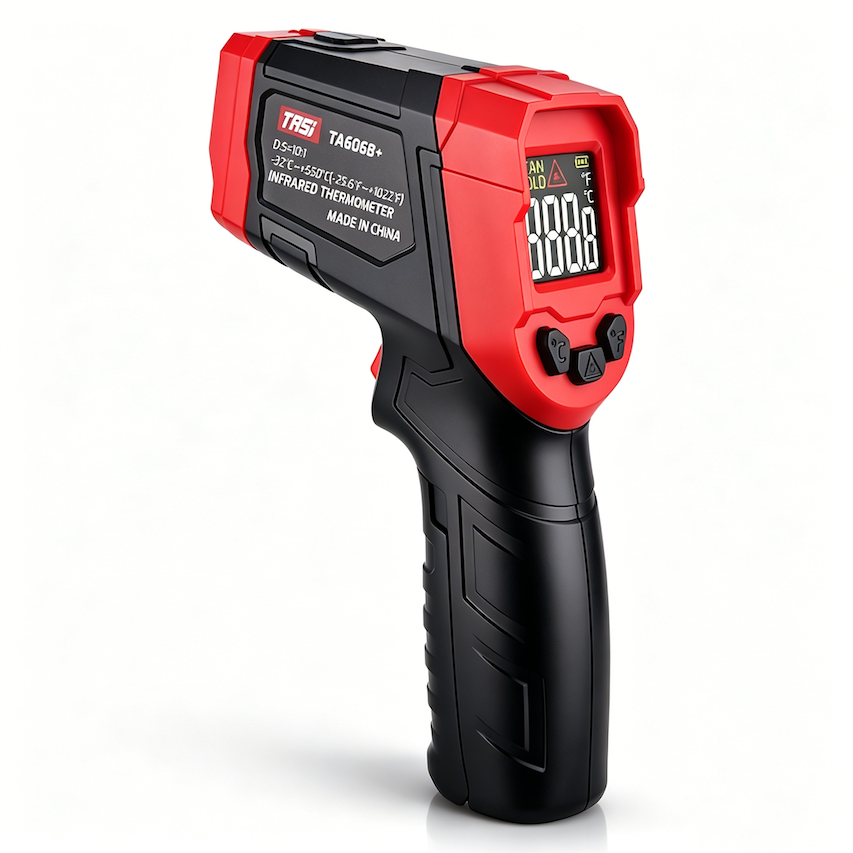
TA606B+ TA606 Series Non-contact Infrared Thermometer

TA606B+

TA606 Series
Non-contact Infrared Thermometer
-32 to 550℃ | 10:1
Abstract:
The TA606 Series Infrared Thermometer is a professional non-contact temperature measurement tool, also known as an infrared temperature gun, laser thermometer, infrared temperature meter, industrial thermometer, or handheld infrared thermometer. It measures surface temperature by detecting infrared energy emitted from target objects, providing fast, safe, and accurate temperature readings without physical contact, reducing risks when measuring hot surfaces, moving equipment, or energized components. The TA606 Series includes two models: TA606A+ with a temperature range of -32℃ to 400℃, and TA606B+ with an extended range up to -32℃ to 550℃, meeting various industrial temperature inspection requirements. Equipped with a 10:1 distance-to-spot ratio and laser aiming guidance, the infrared thermometer allows users to quickly identify measurement areas and improve inspection efficiency. The fixed 0.95 emissivity setting enables direct measurement on most common solid materials without complicated configuration. Featuring ℃/℉ temperature unit switching, data hold function, and a compact handheld design, the TA606 infrared thermometer is easy to operate and suitable for daily field temperature testing. It is widely used in electrical inspection, industrial maintenance, HVAC systems, automotive repair, food processing, building inspection, facility management, and engineering applications. In electrical and industrial environments, the infrared temperature gun can be used for checking switchgear, cables, terminals, circuit breakers, motors, bearings, and mechanical equipment, helping technicians quickly identify abnormal heat conditions. In HVAC applications, it supports temperature inspection of air conditioners, refrigeration systems, heating pipes, and underfloor heating systems. For automotive maintenance, it enables temperature diagnosis of engines, exhaust systems, brake components, and vehicle parts. It is also suitable for food production temperature monitoring, cold chain management, building insulation inspection, and energy efficiency testing, making it an ideal handheld infrared thermometer for professional field measurements.
View More ›
Related Technical Articles
Related FAQs