Introduction
A common question when using an infrared thermometer is whether it can measure an object located behind a glass window, inspection panel, or transparent protective cover. Because the object is clearly visible to the human eye, it may seem reasonable to assume that the infrared thermometer can also “see through” the glass.
However, the fact that visible light can pass through glass does not mean that the infrared wavelengths used for temperature measurement can do the same.
With most conventional handheld infrared thermometers, a measurement taken through ordinary glass primarily represents the temperature of the glass surface rather than the true temperature of the object behind it.
Key Takeaways
● Ordinary glass is transparent to visible light but is generally not transparent to the infrared wavelengths used by many handheld infrared thermometers.
● When measuring through ordinary glass, most handheld infrared thermometers produce a reading that is closer to the glass surface temperature.
● Glass absorbs infrared radiation from the object behind it while also emitting its own infrared radiation and reflecting part of the surrounding thermal radiation.
● Being able to visually see an object through glass does not mean that an infrared thermometer can measure its temperature through the glass.
● Whether temperature can be measured through a material depends on both the instrument’s spectral response range and the material’s infrared transmittance within that wavelength range.
● For accurate measurement of an object behind glass, ordinary glass should be removed from the optical path whenever possible.
Why Can We See Through Glass While an Infrared Thermometer Usually Cannot?
The main reason is that the human eye and an infrared thermometer detect different wavelength ranges.
The human eye responds primarily to visible light at approximately 0.4–0.7 μm. Ordinary glass has relatively high transmittance within this range, which is why objects behind it can be seen clearly.
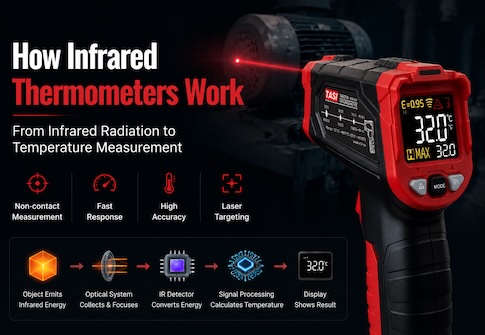
An infrared thermometer does not determine temperature from visible light. Instead, it detects infrared thermal radiation emitted by the target surface. Many standard handheld infrared thermometers operate in the long-wave infrared region, commonly around 8–14 μm.
Ordinary glass has very low transmittance at these wavelengths. As a result, infrared radiation emitted by an object behind the glass generally cannot pass through the glass effectively and reach the detector.
This is why “visible to the eye” does not necessarily mean “measurable by infrared.”
What Does an Infrared Thermometer Actually Detect When Pointed at Glass?
When an infrared thermometer is aimed at glass, the detector may receive several components of infrared energy.
● Infrared radiation emitted by the glass itself;
● Infrared radiation from surrounding objects, people, walls, or equipment that is reflected by the glass surface;
● A very small amount of infrared radiation that may be transmitted through the glass at certain wavelengths.
For a typical handheld infrared thermometer, the portion of infrared radiation transmitted directly from an object behind ordinary glass is usually very small.
The calculated temperature therefore mainly represents the thermal radiation characteristics and temperature of the glass surface, rather than the true temperature of the object behind it.
Why Does the Reading Sometimes Appear to Follow the Temperature of the Object Behind the Glass?
In some situations, placing a hot or cold object behind glass causes the infrared thermometer reading to change. This does not necessarily mean that the instrument is measuring directly through the glass.
For example, a hot object positioned close to glass for an extended period can warm the glass through thermal radiation, convection, or heat transfer.
The infrared thermometer may then indicate a higher temperature because the glass itself has become warmer. The reading may appear to represent the hot object behind the glass, while the instrument is still primarily measuring the glass surface.
The same can occur with a cold object or cold air behind the glass, which may reduce the glass surface temperature.
A change in the displayed temperature therefore does not prove that the infrared thermometer has measured through the glass.
How Do Glass Emissivity and Reflection Affect the Measurement?
Infrared thermometers do not directly detect “temperature.” They first measure infrared radiation from the target surface and then calculate temperature based on factors such as emissivity.
Glass has its own infrared emissivity and can also reflect part of the thermal radiation from the surrounding environment.
If the glass surface is smooth and nearby sources such as hot machinery, heaters, sunlit surfaces, or people are present, reflected infrared radiation can enter the thermometer and influence the reading.
When measuring glass itself, consider the following:
● Whether the emissivity setting is appropriate;
● Whether significant reflections are present on the glass surface;
● Whether hot or cold radiation sources are located nearby;
● Whether the measurement angle increases reflected radiation;
● Whether the entire measurement spot falls within the intended glass area.
Can No Infrared Thermometer Measure Through Glass?
It would be incorrect to state that every infrared thermometer is completely unable to measure through every type of glass or transparent material.
Infrared transmission depends mainly on two factors: the spectral operating range of the temperature measurement instrument and the transmittance of the window material within that wavelength range.
Different materials, including certain types of glass, quartz, sapphire, and specialized infrared window materials, have different transmission characteristics at different wavelengths. Infrared thermometers may also be designed for different spectral ranges.
In specialized industrial applications, an infrared thermometer operating in a suitable wavelength band can therefore be combined with a compatible infrared window material to perform non-contact temperature measurement through a viewing window.
However, with conventional 8–14 μm handheld infrared thermometers and ordinary architectural glass, accurate measurement of an object behind the glass should generally not be expected.
How Large Can the Measurement Error Be Through Glass?
There is no single fixed error value that applies to every measurement through glass.
The error can be influenced by several factors:
● Temperature of the glass;
● Glass thickness and material;
● Temperature of the object behind the glass;
● Distance between the object and the glass;
● Air temperature on both sides of the glass;
● Spectral response range of the infrared thermometer;
● Infrared transmittance of the glass within the instrument’s wavelength range;
● Reflections from the glass surface;
● Emissivity setting of the instrument.
For example, if an object behind the glass is at 100°C while the glass surface is only 30°C, a conventional long-wave infrared thermometer may display a temperature much closer to 30°C than to 100°C.
It is therefore not recommended to correct this type of measurement simply by adding or subtracting a fixed temperature value.
How Should an Object Behind Glass Be Measured Correctly?
If the true surface temperature of an object behind glass is required, the most reliable approach is usually to remove ordinary glass from the measurement path.
● Where conditions permit, open the glass door, inspection window, or protective cover and measure the target directly.
● Check the measurement distance and D:S ratio to ensure that the measurement spot remains completely within the target area.
● Set the emissivity according to the target material and surface condition.
● If the glass cannot be removed, consider another temperature measurement method such as a contact temperature sensor or thermocouple.
● For permanent industrial monitoring, a dedicated infrared window material may be selected according to the instrument’s operating wavelength, but the window material must be spectrally compatible with the thermometer.
● Critical process temperatures should not be assessed solely from infrared measurements taken through ordinary glass.
Can Adjusting the Emissivity Setting Solve the Problem?
Usually not.
The emissivity setting compensates primarily for differences in the infrared emission characteristics of the target surface. The problem introduced by glass is not limited to emissivity; it also involves the inability of the target’s infrared radiation to transmit effectively through the glass.
If most of the infrared radiation from the object is absorbed or blocked by the glass, changing the emissivity setting cannot restore the missing radiation from the object behind it.
Adjusting emissivity should therefore not be regarded as a method of making an infrared thermometer “see through” glass.
FAQ
What temperature does an infrared thermometer measure through an ordinary window?
It usually measures mainly the temperature of the glass surface and may also be influenced by reflected infrared radiation from the surrounding environment. It does not reliably represent the true temperature of an object located behind the glass.
Why can the laser pointer pass through glass?
The laser is primarily an aiming aid and normally operates in the visible wavelength range. Visible light can pass through ordinary glass, but this does not mean that the infrared wavelengths used for temperature measurement can also pass through it. The position of the laser spot does not indicate whether the thermal infrared radiation can penetrate the glass.
Can an infrared thermometer measure objects inside a vehicle through the windshield or side window?
This is generally not recommended with a conventional handheld infrared thermometer. The reading is mainly affected by the temperature of the automotive glass and by reflected thermal radiation, rather than the true surface temperature of the object inside the vehicle.
Can body temperature be measured through glass?
No accurate measurement should be expected. Ordinary glass blocks most of the thermal infrared radiation used by common infrared temperature measurement devices, so body surface temperature should not be measured through glass.
Can changing the emissivity setting allow measurement of the object behind the glass?
Usually not. Emissivity adjustment cannot compensate for the lack of infrared transmission through ordinary glass.
Can a thermal imager see through glass?
Most common long-wave infrared thermal imagers also cannot see the true thermal radiation of objects through ordinary glass. The thermal image typically represents the glass surface temperature together with reflected infrared radiation.
Are there transparent windows that infrared thermometers can measure through?
Yes. Certain specialized infrared window materials provide high transmittance within specific infrared wavelength ranges. The window material must be selected to match the spectral response range of the infrared thermometer and cannot simply be replaced with ordinary glass.
Conclusion
For most conventional handheld infrared thermometers, a measurement taken through ordinary glass primarily represents the temperature of the glass surface rather than the true temperature of the object behind it.
Ordinary glass is transparent to visible light but not to many of the infrared wavelengths used by infrared thermometers. Most of the thermal radiation from the object is absorbed or blocked by the glass, while the detector mainly receives radiation emitted by the glass itself and infrared energy reflected from the surrounding environment.
When the temperature of an object behind glass must be measured, the glass should therefore be removed from the measurement path whenever possible. Where temperature measurement through an inspection window is required in industrial applications, a dedicated infrared window material should be selected according to the instrument’s spectral response range.