Introduction
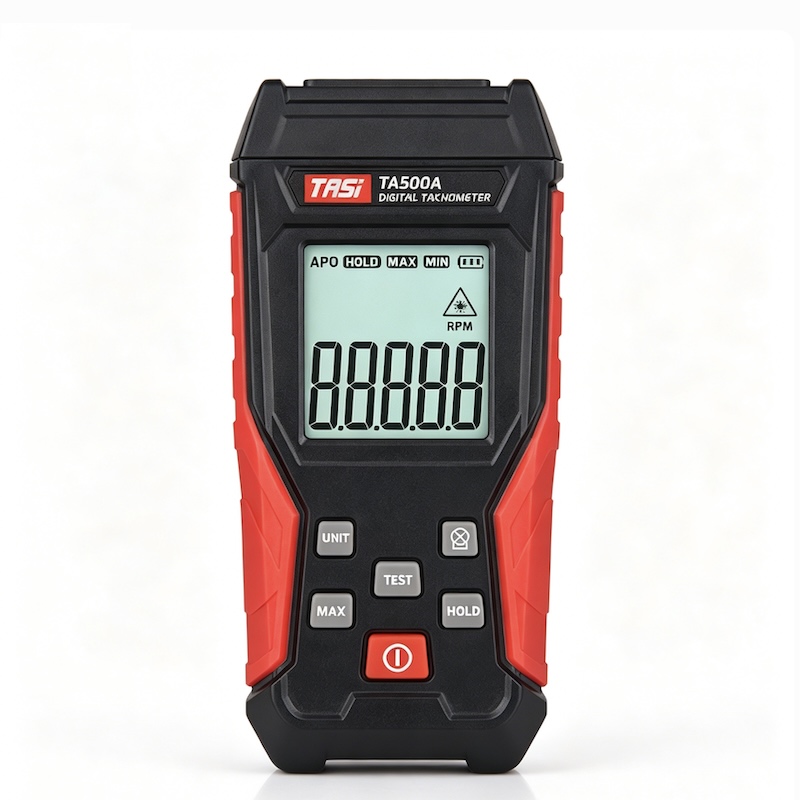
Black rotating objects can be measured with a laser tachometer, but whether a stable reading can be obtained directly depends on the surface reflectivity of the target and the sensitivity of the tachometer’s optical detection system.
A laser tachometer does not determine rotational speed by identifying the “color” of the target. Instead, it calculates RPM by detecting a periodic change in reflected light from the rotating surface. A black surface therefore does not automatically make measurement impossible. However, if the surface absorbs a large proportion of the incident light and returns only a weak optical signal, the instrument may not detect each revolution reliably.
For industrial measurements involving black motor shafts, pulleys, fans, rollers, or similar rotating components, applying a small piece of dedicated reflective tape is generally recommended.
Key Points
● Black rotating objects can be measured with a laser tachometer;
● Black, matte, and low-reflectivity surfaces are more likely to produce weak optical signals;
● A laser tachometer requires a stable, periodic reflected-light signal with sufficient contrast;
● Reflective tape is recommended when measuring low-reflectivity surfaces;
● Normally, only one primary reflective marker should be used per revolution to avoid doubled or multiplied readings;
● The optical sensing area should remain aligned with the path of the reflective marker during measurement.
Why Are Black Surfaces More Difficult to Measure?
Laser tachometers are generally non-contact optical speed-measuring instruments. The instrument emits light toward the rotating target while an internal photosensor detects the reflected signal.
When a reflective area passes through the sensing position once per revolution, the instrument detects one optical pulse. By counting these pulses over time, it calculates the rotational speed.
Black surfaces, especially matte black finishes, typically absorb more incident light and return a weaker signal to the optical receiver. If the difference between the reflected signal and the surrounding background is too small, the tachometer may have difficulty identifying each revolution reliably.
The key issue is therefore not that “black surfaces cannot be measured,” but whether the reflected signal is sufficiently clear and stable.
Can a Black Object Be Measured Directly Without Reflective Tape?
Sometimes.
Color is only one factor affecting optical reflectivity. Surface material, roughness, gloss, angle of incidence, and ambient light also influence the amount of reflected light reaching the sensor.
For example:
● Glossy black plastic may still produce noticeable specular reflection;
● Smooth black-painted metal may generate a relatively strong reflection at certain angles;
● Matte black rubber, textured coatings, and rough dark surfaces generally produce weaker usable reflections;
● Two black materials can behave very differently depending on their surface finish.
Some black rotating objects may therefore produce a direct RPM reading. However, this does not necessarily mean the measurement will have good repeatability.
Where reflective tape can be applied, it is generally preferable not to rely on occasional reflections from the untreated black surface.
Why Is Reflective Tape Recommended on Black Rotating Objects?
Reflective tape creates a high-reflectivity reference area against a low-reflectivity background.
When most of the rotating surface is black and only a small area has high reflectivity, the sensor can more easily distinguish between the reflective marker and the surrounding surface.
For example:
Black motor shaft surface → low reflected signal
Reflective tape passes the sensing point → high reflected signal
Reflective tape moves away → low reflected signal again
This distinct optical transition creates a clear periodic pulse and normally provides a more reliable measurement than depending on the natural reflectivity of a black surface.
For black, dark-colored, oxidized, rough, matte, or otherwise low-reflectivity rotating parts, reflective tape is usually the preferred method.
How Should Reflective Tape Be Applied to a Black Rotating Object?
The reflective tape should be attached to a location that rotates synchronously with the component being measured.
For example, when measuring motor shaft speed, a small piece of reflective tape can be applied to the side of the shaft. The tachometer should then be directed toward the area through which the marker passes during rotation.
Recommended practice includes:
● Clean away oil, dust, and moisture before applying the tape;
● Ensure the tape is securely attached, particularly on high-speed rotating parts;
● The tape does not need to cover the entire surface; it only needs to provide a clear optical reference;
● Normally use one primary reflective marker per revolution;
● Keep the tachometer directed toward the front surface of the marker as it passes;
● Avoid allowing the laser spot or sensing area to move repeatedly outside the marker path.
For high-speed equipment, always ensure that the reflective tape is securely bonded and maintain a safe working distance from moving machinery.
Why Is Only One Reflective Marker Normally Used?
A laser tachometer calculates rotational speed from the number of optical pulses detected.
If there is one reflective marker per revolution:
1 revolution = 1 primary optical pulse.
The instrument can therefore calculate RPM directly from the pulse frequency.
If two clearly separated reflective areas are present on the same rotating component, the instrument may detect two pulses during every revolution. Unless the tachometer is configured to compensate for this, the displayed value may be approximately twice the actual speed.
For example, if the true rotational speed is:
1500 RPM
and the instrument detects two valid pulses per revolution, it may display approximately:
3000 RPM
For conventional single-marker RPM measurement, one clear and unique reflective reference is therefore preferable.
Why Is There Still No Reading After Applying Reflective Tape?
If reflective tape has already been applied but the tachometer still does not provide a stable reading, check the following factors:
● Incorrect tape position: the marker may not pass through the actual optical sensing area;
● Excessive measurement angle: insufficient reflected light may return to the optical receiver;
● Incorrect measuring distance: the returned signal may become too weak outside the recommended operating range;
● Reflective area too small: the sensor may not detect the marker consistently;
● Contaminated tape: oil, dust, or surface damage can reduce reflectivity;
● Laser spot not aligned with the marker path: the beam may appear to hit the rotating object without actually intercepting the reflective marker;
● Other highly reflective areas are present: metal edges, bolts, polished surfaces, or other features may create additional optical pulses;
● Strong ambient light: intense external illumination can reduce optical signal-to-noise ratio in some conditions;
● Rotational speed exceeds the instrument range: even a strong reflected signal cannot produce a valid reading outside the tachometer’s specified measurement range.
Troubleshooting should therefore focus not only on whether the laser reaches the rotating object, but also on whether the optical receiver is detecting a clean and periodic reflected signal.
Do Matte Black and Glossy Black Surfaces Behave the Same?
Usually not.
Matte black surfaces absorb more light and produce diffuse reflections, so the amount of usable light returning to the tachometer may be relatively low. Direct measurement is therefore often more difficult.
Glossy black surfaces can produce stronger specular reflections at certain angles, which means an RPM reading may sometimes be obtained without reflective tape.
However, specular reflection is highly directional. A small change in instrument position or measurement angle may greatly reduce the amount of reflected light reaching the sensor. Direct measurement from a glossy black surface may therefore still be unstable.
For measurements where repeatability and reliability are important, dedicated reflective tape is generally the better choice for both matte and glossy black surfaces.
Can the Speed of a Black Rubber Belt Be Measured Directly?
It depends on what needs to be measured.
If the objective is to measure the rotational speed of a pulley or roller, it is usually preferable to place reflective tape on the pulley, shaft, or another rigid rotating component rather than relying on the surface of the black rubber belt.
Black rubber often has low reflectivity, a textured surface, and small positional changes during operation, all of which can make optical detection less stable.
If the actual requirement is to measure belt linear speed, the RPM of the driving or measuring roller may need to be converted using the roller diameter, or a contact tachometer with a linear-speed measurement function can be used.
Can White Paint or White Tape Be Used Instead of Reflective Tape?
In some cases, a white marker on a black background can create sufficient optical contrast for the tachometer to produce a reading.
However, ordinary white tape, labels, or paint do not necessarily have the same reflective properties as dedicated retroreflective material. Their performance can vary considerably depending on light wavelength, measurement angle, and distance.
For temporary checks, a white marker may be tested if the instrument can detect it reliably. For repeatable, routine, or industrial measurements, dedicated reflective tape is generally preferred.
Does the Laser Have to Be Perpendicular to the Reflective Tape?
For a stable reflected signal, the tachometer should normally be aimed as directly as practical toward the front surface of the reflective tape, while avoiding excessive inclination.
This becomes particularly important when the reflective area is small, the measuring distance is relatively long, or ambient lighting conditions are difficult.
The actual measuring distance and recommended operating angle should always follow the specifications in the tachometer manual.
It is also important to understand that the visible laser spot mainly helps the operator identify the target position. RPM measurement ultimately depends on whether the instrument’s optical receiver can reliably detect the reflected-light pulses produced during rotation.
FAQ
Can a laser tachometer measure a black motor shaft?
Yes. Applying a piece of reflective tape to the side of the shaft and aiming the tachometer at the path of the rotating marker is generally recommended. This usually provides a more stable result than measuring the untreated black shaft surface directly.
Why can some black surfaces still produce an RPM reading directly?
Color alone does not determine reflectivity. Glossy black plastic, coated metal, and other smooth surfaces may still return sufficient light to the optical sensor.
If the laser hits a black rotating object but there is no reading, is the tachometer faulty?
Not necessarily. A more common cause is insufficient reflected light. Apply reflective tape, check the measurement distance and angle, and test again before assuming the instrument is defective.
Is a larger reflective marker always better?
No. The marker only needs to be large enough for reliable optical detection. An excessively large marker on a small-diameter or high-speed component can make pulse transitions less distinct.
Can two pieces of reflective tape be placed on one shaft?
For conventional RPM measurement, this is generally not recommended. Two reflective markers may produce two pulses per revolution and can result in a reading close to twice the actual rotational speed.
Are black objects always more difficult to measure than white objects?
Not always. Reflectivity is also affected by material, roughness, gloss, angle, and ambient light. However, matte black surfaces generally provide weaker reflected signals and are therefore more likely to require reflective tape.
Conclusion
Black rotating objects can be measured with a laser tachometer. The determining factor is not the color itself, but whether the rotating target produces a clear, stable, and periodic reflected-light signal.
Direct measurement of black, matte, rough, or low-reflectivity surfaces may result in no reading, fluctuating values, or poor repeatability. A more reliable approach is to apply one suitable reflective marker to the rotating component so that the tachometer can clearly identify each revolution.
For consistent industrial measurements, also pay attention to reflective-tape position, measuring distance, sensing angle, surface cleanliness, and the presence of other reflective features.