Introduction
Infrared thermometers generally provide stable readings on materials such as plastics, rubber, wood, and coated surfaces. When the target is stainless steel, aluminium, copper, or another metal, however, a common problem appears: the metal may be very hot while the infrared thermometer indicates a much lower temperature.
This does not necessarily mean that the thermometer is faulty. In most cases, the cause is related to the infrared radiation characteristics of the metal surface.
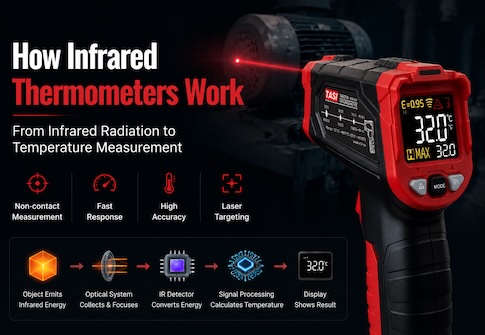
An infrared thermometer does not directly “read” the true temperature of an object. It detects infrared radiation from the target surface and converts that radiation into a temperature value based on factors such as the configured emissivity. Low-emissivity, highly reflective metal surfaces are therefore much more sensitive to reflected background radiation, surface condition, and measurement geometry.
Key Points
● Shiny metals generally have low emissivity and emit relatively little infrared radiation of their own.
● The lower the emissivity of a metal surface, the more significant reflected background radiation can become.
● If a thermometer uses a high default emissivity when measuring shiny metal, the displayed temperature can be significantly inaccurate.
● Oxidation, paint, surface roughness, and contamination can all change the effective emissivity of a metal surface.
● Measurement angle, nearby heat sources, target size, and spot size can also affect infrared measurements on metals.
● Measurement reliability can often be improved by setting emissivity correctly or by creating a high-emissivity measurement area.
Why Do Infrared Thermometers Tend to Read Metal Surfaces Too Low?
An infrared thermometer estimates temperature by detecting radiant energy emitted from a target surface within a specific infrared wavelength range.
For high-emissivity materials, most of the infrared radiation detected by the instrument originates from the target itself. This makes reliable temperature measurement relatively straightforward.
Shiny metals behave differently.
● Polished aluminium, copper, stainless steel, and similar surfaces often have low emissivity.
● They emit relatively little infrared radiation of their own.
● They also reflect infrared radiation from their surroundings more strongly.
● The radiation received by the thermometer may therefore contain a large reflected component.
If the surrounding environment is much cooler than the metal—for example, a hot metal component in a room-temperature environment—the metal surface can reflect infrared radiation from the cooler surroundings.
The total radiation received by the thermometer may then be lower than would be expected from a high-emissivity surface at the same temperature. As a result, the calculated temperature may be significantly lower than the actual metal surface temperature.
Emissivity Is the Main Cause of Low Readings
Emissivity describes how effectively a surface emits infrared radiation and is usually expressed as a value between 0 and 1.
An ideal blackbody has an emissivity of 1. Real surfaces generally have lower values.
Many non-metallic materials have relatively high emissivity, whereas clean or polished metals may have much lower emissivity.
At the same actual temperature:
● A high-emissivity surface emits relatively strong infrared radiation.
● A low-emissivity metal surface emits less radiation of its own and reflects more radiation from the surroundings.
Consequently, two surfaces at exactly the same true temperature can produce very different infrared signals.
If the emissivity setting of the thermometer does not correspond reasonably well to the actual metal surface, the calculated temperature can be inaccurate.
Why Is the Default Emissivity Not Always Suitable for Metals?
Some infrared thermometers use a fixed emissivity, often around ε = 0.95. Models with adjustable emissivity may also use a value close to 0.95 as the default setting.
This works well for many common high-emissivity materials, but it is not appropriate for every shiny metal surface.
If the actual emissivity of the metal is significantly lower than the value configured in the thermometer, the instrument calculates temperature using radiation assumptions that do not match the target surface.
For infrared thermometers with adjustable emissivity, the user should therefore identify the material and surface condition as accurately as possible and configure an appropriate emissivity value.
However, metal emissivity is not a single fixed number. It can vary with surface roughness, oxidation, coating, temperature, and spectral wavelength. Emissivity tables should therefore be treated as reference data rather than absolute values.
Why Can the Same Metal Produce Different Readings?
Reliable infrared measurement depends not only on the type of metal, but also on the actual condition of its surface.
For example, stainless steel can have very different infrared properties depending on its finish:
● Mirror-polished stainless steel is highly reflective and normally has relatively low emissivity.
● Brushed or roughened stainless steel may behave differently.
● Oxidation can significantly increase emissivity.
● Paint, coatings, dirt, oil, or other surface contamination can alter the radiation detected by the thermometer.
The same base metal can therefore produce very different infrared measurement results after different surface treatments.
For this reason, simply applying one fixed “metal emissivity” value does not guarantee accurate measurements in every application.
Why Can Reflected Radiation Make a Hot Metal Surface Appear Cooler?
For an opaque surface, radiation that is not emitted by the surface is largely associated with reflected environmental radiation.
This effect becomes especially important for low-emissivity metals.
Consider a shiny metal surface at 150°C in an environment of approximately 25°C.
Because the metal has low emissivity, the thermometer receives not only infrared radiation emitted by the hot metal itself, but also radiation from cooler walls, machinery, floors, and other surroundings reflected by the metal surface.
The instrument therefore receives a combined radiation signal.
If low emissivity and reflected background radiation are not properly accounted for, the indicated temperature can be substantially lower than the actual surface temperature.
Will Metal Surfaces Always Read Too Low?
No.
Low readings are common, but low emissivity does not inherently create only negative measurement errors. The main issue is that the reading becomes highly sensitive to reflected background radiation.
If the metal is hotter than its surroundings and mainly reflects cooler objects, the reading will often be too low.
However, if the metal reflects a furnace wall, heater, hot pipe, or another object hotter than the target itself, the detected infrared radiation may increase and the indicated temperature may be too high.
A more accurate interpretation is therefore:
● Low-emissivity surfaces are highly sensitive to reflected environmental radiation.
● Low readings are especially common when hot metal is surrounded by cooler objects.
● Hot reflected backgrounds can also cause readings to be too high or unstable.
Why Does Measurement Angle Matter on Metal Surfaces?
When measuring low-emissivity metals, very oblique viewing angles should generally be avoided.
As the measurement angle changes, the reflective behaviour of the metal also changes. The thermometer may begin receiving reflected infrared radiation from different parts of the surroundings.
A mirror-like metal surface can effectively behave like an “infrared mirror.”
A small change in instrument position may cause the surface to reflect a wall, a machine, an operator, lighting equipment, or a heater instead of the previous background.
For more repeatable results, the measurement position and angle should remain consistent, and measurements should preferably be made as close to perpendicular to the target surface as practical.
How Can Infrared Temperature Measurement of Metals Be Improved?
For low-emissivity metals, simply aiming an infrared thermometer at the bare surface and reading the display is often not the most reliable method.
The following measures can improve the measurement:
● Set emissivity appropriately. If the thermometer supports emissivity adjustment, configure it according to the target material and actual surface condition.
● Prefer oxidised, roughened, painted, or coated areas. These surfaces are generally easier to measure than highly polished bare metal.
● Create a high-emissivity measurement area. Where permitted, apply suitable high-emissivity tape or coating and allow it to reach thermal equilibrium with the metal before measuring.
● Minimise reflected background radiation. Avoid measurement positions where strong heat sources or large background temperature differences are reflected from the target.
● Use an appropriate viewing angle. Measure as close to perpendicular to the surface as practical.
● Ensure the target is larger than the measurement spot. The complete measurement spot should remain within the target area.
For industrial applications requiring higher confidence, a contact temperature sensor may also be used as a reference to verify the infrared measurement setup and emissivity configuration.
Why Is Black Tape Often Used to Measure Metal Surfaces?
Using black tape is a practical method for measuring low-emissivity metals.
Clean, shiny metal may have low emissivity, while suitable black tape can provide a higher and more stable emissivity.
After applying the tape to the metal, sufficient time should be allowed for the tape and the metal surface to reach thermal equilibrium. The infrared thermometer can then be aimed at the taped area.
The instrument is then primarily measuring the radiation from the high-emissivity tape rather than directly from the reflective bare metal, which can substantially reduce errors associated with emissivity and reflected background radiation.
The tape must be suitable for the actual surface temperature. It should never be used beyond its specified temperature range.
When Should a Metal Surface Not Be Measured Directly with an Infrared Thermometer?
Extra caution is required in the following situations:
● The surface is highly polished or mirror-like.
● The actual surface emissivity cannot be determined with reasonable confidence.
● Furnaces, heaters, or other strong infrared sources are present nearby.
● The metal target is too small to fully cover the measurement spot.
● High absolute temperature accuracy is required.
● Stable and repeatable measurement conditions cannot be established.
Where the process permits, a high-emissivity measurement area can be created, or an appropriate contact temperature method can be used for verification.
FAQ
Can an infrared thermometer measure stainless steel?
Yes, but direct measurement of shiny stainless steel can produce substantial errors. The emissivity should be evaluated according to whether the surface is polished, brushed, oxidised, painted, or coated, and reflected background radiation should also be considered.
Why does an infrared thermometer show only a moderate temperature when the metal is obviously very hot?
A common cause is low surface emissivity combined with reflection of cooler environmental radiation. If the configured emissivity also differs significantly from the actual surface emissivity, the displayed temperature can be much lower than the true temperature.
Are copper and aluminium particularly difficult to measure?
Shiny copper and aluminium are among the more challenging surfaces for general infrared temperature measurement because they may have very low emissivity and high reflectivity. Their readings are therefore highly sensitive to surface condition and surrounding radiation.
Will lowering the emissivity setting always solve the problem?
No. Correct emissivity adjustment can improve the result, but low-emissivity surfaces also reflect significant background radiation. Adjusting emissivity alone cannot eliminate every measurement error.
Why is oxidised metal easier to measure?
Oxidation changes the infrared properties of the metal surface. Many oxidised surfaces have higher emissivity than clean polished metal, increasing the contribution of radiation emitted by the target itself and reducing relative sensitivity to reflected background radiation.
Can black tape be applied to the metal before measuring?
Yes. This is a common measurement technique. Use tape that is suitable for the required temperature and allow it to reach thermal equilibrium with the metal surface before taking the measurement.
Conclusion
Infrared thermometers often indicate temperatures that are too low on metal surfaces because shiny metals typically have low emissivity and high infrared reflectivity.
The thermometer may therefore receive not only radiation emitted by the metal itself, but also a substantial amount of reflected radiation from the surrounding environment. Under the common condition of hot metal surrounded by cooler objects, this can make the indicated temperature significantly lower than the true surface temperature.
When measuring aluminium, copper, stainless steel, and similar metals, emissivity, surface condition, reflected background radiation, viewing angle, target size, and spot size should all be considered.
For measurements requiring greater reliability, correctly configuring emissivity, selecting a more suitable surface area, or creating a stable high-emissivity measurement area with appropriate tape or coating is generally more dependable than directly measuring clean, shiny metal.