Introduction
Even when emissivity, measuring distance, and measuring angle are set correctly, infrared temperature readings may still change over time. One important reason is that either the target or the infrared thermometer itself has not yet reached a sufficiently stable thermal condition.
In infrared temperature measurement, “thermal equilibrium” does not necessarily mean that the target must be at exactly the same temperature as its surroundings. In practical measurement, the more important question is whether the target surface temperature and the internal thermal condition of the instrument have become stable enough for repeated measurements to produce consistent results.
Understanding thermal equilibrium is therefore important not only from a theoretical perspective but also for the reliability of real-world infrared measurements.
Key Points
● In infrared temperature measurement, thermal equilibrium usually refers to whether the measured surface temperature has become sufficiently stable.
● Thermal equilibrium does not mean that the target must be at the same temperature as the ambient environment.
● Heating, cooling, airflow, and continuous heat transfer can all cause surface temperature to change.
● An infrared thermometer may require time to acclimatize after being moved from a cold environment to a warm one, or vice versa.
● When measuring rapidly changing targets, it is important to distinguish between instantaneous surface temperature and stable-state temperature.
● Reliable measurements depend on a clear measurement objective and proper control of the factors affecting thermal stability.
What Is Thermal Equilibrium?
From a thermodynamic perspective, when two or more bodies are at different temperatures, heat may flow between them. As heat transfer continues, temperature differences tend to decrease. When no macroscopic net heat transfer is driven by temperature differences within the system, the system can be considered to have reached thermal equilibrium.
In industrial infrared temperature measurement, however, it is usually unnecessary to wait until the target and the entire environment reach strict thermodynamic equilibrium.
For example, the housing of a continuously operating motor may remain at 65°C while the surrounding air is only 25°C. The motor continues to generate heat while simultaneously dissipating it through convection, conduction, and radiation. Although the motor is not at the same temperature as its surroundings, its surface temperature may remain within a relatively stable range once heat generation and heat dissipation become approximately balanced.
For infrared measurement, this kind of steady thermal condition is generally more relevant than strict thermodynamic equilibrium.
Why Does Thermal Equilibrium Matter in Infrared Measurement?
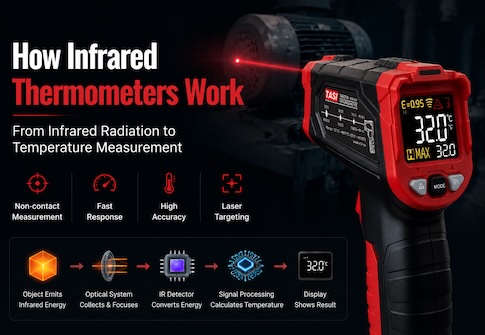
An infrared thermometer does not directly measure the internal temperature of an object. It detects infrared radiation from the target surface within a defined spectral range and calculates surface temperature based on the detected radiation together with parameters such as emissivity.
If the target surface is heating or cooling rapidly, the emitted infrared radiation also changes with time. The displayed temperature will therefore change accordingly.
For example, when a metal part is removed from a high-temperature furnace, its surface immediately begins to lose heat to the surrounding air, fixtures, and nearby objects. Infrared measurements taken at different times may therefore show noticeably different temperatures.
This does not necessarily indicate an error in the infrared thermometer. The target itself may simply still be undergoing a dynamic heat-transfer process.
Before interpreting the measurement, it is therefore important to determine whether the objective is:
● to measure the instantaneous temperature at a particular moment;
● or to obtain the temperature after the equipment has reached a stable operating condition.
These two objectives require different levels of thermal stability.
What Does a Thermally Stable Target Mean?
In practical infrared measurement, thermal stability can often be assessed by observing the temperature over a period of time.
If repeated measurements taken under the same conditions show only small changes, the measured area can generally be considered to have reached a relatively stable thermal state.
However, different parts of an object may require different amounts of time to stabilize.
For example, the surface of a thick metal component may heat up relatively quickly while its interior remains substantially cooler. As heat continues to conduct into the material, the surface temperature may still change.
Infrared thermometers measure the surface temperature of the observed area. A stable surface temperature does not necessarily mean that the entire object has reached a uniform internal temperature.
When Is Lack of Thermal Stability Common?
● Immediately after equipment startup: Motors, bearings, electrical equipment, and heating systems usually require time to reach a stable operating temperature. Early measurements represent the warm-up process rather than steady-state operation.
● Immediately after heating stops: Parts removed from furnaces, heaters that have just been switched off, and recently stopped mechanical components may continue to cool.
● After moving an object between environments: A component taken from cold storage will continue absorbing heat in a warmer room, while a hot object moved into a cooler area will continue losing heat.
● In strong airflow: Fans, air-conditioning outlets, compressed air, or natural wind can change convective heat transfer and alter local surface temperatures.
● When the target contacts another object at a different temperature: Placing a workpiece on a cold bench, fixture, or support can rapidly change the local temperature through heat conduction.
● With cyclically operating equipment: Some motors, compressors, and process equipment operate intermittently, so their temperature may naturally vary in cycles rather than stabilize at one fixed value.
Does the Infrared Thermometer Itself Need to Reach Thermal Stability?
Yes.
The infrared detector, optical system, internal temperature sensors, and compensation electronics inside an infrared thermometer can all be affected by the instrument's own temperature and the ambient environment.
Under normal conditions, the instrument uses internal temperature measurement and compensation algorithms to minimize these effects. However, if it is exposed to a sudden and significant temperature change, such as:
● moving directly from a cold outdoor environment into a warm workshop;
● moving from an air-conditioned room into a high-temperature production area;
● taking the instrument from a vehicle after prolonged hot or cold storage and measuring immediately;
● keeping the instrument close to a furnace or another strong heat source for an extended period;
its internal temperature may temporarily be changing rapidly.
In this condition, readings may drift for a short period even if the target temperature itself is stable. For measurements requiring higher reliability, allow the instrument to acclimatize to the new environment before taking formal measurements.
The required stabilization time depends on the instrument design and should follow the manufacturer's operating instructions rather than a single fixed time applied to all infrared thermometers.
What Is the Difference Between Thermal Equilibrium and Response Time?
Thermal equilibrium and response time are different concepts.
The response time of an infrared thermometer indicates how quickly the instrument reacts to a change in infrared radiation from the target. Modern infrared thermometers can typically update readings very quickly.
Thermal equilibrium, by contrast, describes whether the thermal condition of the target or the instrument itself is stable.
For example, if a hot workpiece is cooling rapidly, an infrared thermometer with a fast response time can quickly and accurately track its changing surface temperature. A shorter response time does not make the workpiece reach thermal equilibrium any faster.
Therefore:
● Response time determines how quickly the instrument can follow temperature changes.
● Thermal stability determines whether the measured temperature itself is continuing to change.
These two concepts should not be confused.
How Does Thermal Equilibrium Relate to Measurement Accuracy?
A target that has not reached a stable thermal condition does not necessarily mean that the infrared thermometer is inaccurate.
If a workpiece is cooling from 100°C to 80°C and the instrument successively displays 96°C, 92°C, 88°C, and 84°C, these readings may accurately represent the actual cooling process of the surface.
The key question is whether those readings match the purpose of the measurement.
If the objective is to monitor the cooling process, the changing temperatures are valuable data. If the objective is to compare the normal operating temperatures of several machines, measurements should be taken under similar load, operating time, and thermal conditions.
Thermal equilibrium therefore mainly affects the representativeness, repeatability, and comparability of the measurement data.
How Can Errors Caused by Changing Thermal Conditions Be Reduced?
● When stable temperature data is required, allow equipment to reach its normal operating condition before measurement.
● When comparing several machines, measure them under similar load, operating duration, and ambient conditions.
● Avoid performing high-reliability measurements immediately after moving the infrared thermometer between environments with significantly different temperatures.
● Keep measuring distance, angle, emissivity setting, and target area consistent.
● Avoid strong airflow, nearby heat sources, and rapidly changing ambient conditions whenever possible.
● For targets that are heating or cooling, use continuous or repeated measurements rather than relying on a single reading.
● If temperature continues to change, record the measurement time and equipment operating condition so the results can be interpreted correctly.
For industrial trend analysis, consistent measurement conditions are often more important than focusing only on a single absolute temperature value.
How Can You Determine Whether a Target Is Stable Enough?
In field applications, it is usually unnecessary to prove strict thermodynamic equilibrium. The practical objective is to determine whether temperature variation has become small enough for the intended measurement.
A simple method is to observe the target continuously from the same position while keeping the distance and emissivity setting unchanged.
If the temperature is still clearly rising or falling, the target remains in a dynamic thermal process. If the temperature variation becomes small over time, the target can generally be considered relatively stable.
There is no universal temperature-change limit that defines stability for every application. Equipment maintenance, production process control, laboratory measurement, and general inspection can require different levels of stability. The acceptable variation should therefore be determined according to the measurement objective.
FAQ
Must the target reach the same temperature as the environment before infrared measurement?
No. Industrial equipment often generates heat continuously during stable operation and may remain substantially warmer than the surrounding environment. The more relevant question is whether the target surface temperature is stable enough for the intended measurement.
Why does the temperature at the same point keep increasing during repeated measurements?
The equipment may still be warming up, or its load, cooling conditions, or surrounding environment may be changing. First confirm whether the equipment has reached a stable operating condition.
Can an infrared thermometer be used immediately after being brought indoors from outside?
It can be used for general observation, but if the indoor and outdoor temperature difference is large and measurement reliability is important, allow the instrument to acclimatize before taking formal measurements.
Does an unstable thermal condition mean the infrared thermometer is displaying the wrong temperature?
Not necessarily. The temperature may actually be changing. The important question is whether the reading represents the condition you intend to measure.
Does a stable surface temperature mean the internal temperature is also fully stable?
Not necessarily. Infrared measurement primarily indicates surface temperature. Thick materials, low thermal conductivity, or internal heat sources can create significant differences between surface and internal temperatures.
Conclusion
In infrared temperature measurement, thermal equilibrium is more practically understood as whether the relevant thermal condition has become sufficiently stable, rather than whether the target has reached exactly the same temperature as its surroundings.
When a target is heating, cooling, operating, or continuously exchanging heat with its environment, its surface infrared radiation changes with temperature, and the infrared temperature reading may change accordingly. The instrument itself may also require time to reach thermal stability after experiencing a substantial change in ambient temperature.
Before measuring, it is important to determine whether the objective is an instantaneous temperature, a temperature trend, or a stable operating temperature. Only when measurement conditions are controlled and the thermal state of the target is properly understood can infrared temperature data provide reliable repeatability, comparability, and practical value.