Introduction
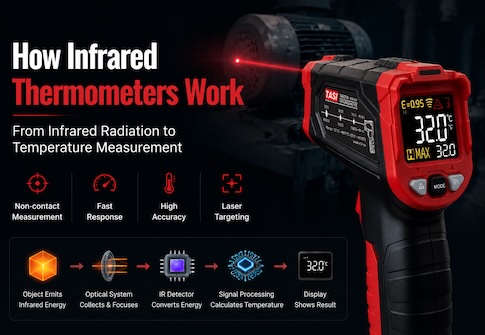
Infrared thermometers determine temperature by detecting infrared radiation emitted from a target surface. Under ideal conditions, when the entire measurement area is at a uniform temperature, the received radiation is relatively consistent and the displayed value can represent the target surface temperature more reliably.
In practical applications, however, surface temperatures are often non-uniform. Heated metal parts, operating motors, electronic components, pipes, hot plates, molds, and cooling workpieces may all contain hotter and cooler areas at the same time.
This spatial variation in temperature is referred to as a temperature gradient. When one measurement spot covers regions at different temperatures, the thermometer does not display the temperature of one specific point. Instead, it calculates a temperature based on the combined infrared radiation received within its field of view.
For this reason, even a high-accuracy infrared thermometer can produce a reading that differs from the expected local temperature if the measurement area is not selected correctly.
Key Points
● An infrared thermometer measures an area rather than an infinitely small point.
● If the measurement spot covers areas at different temperatures, radiation from all of these areas contributes to the reading.
● The greater the temperature gradient, the more sensitive the result becomes to spot size and aiming position.
● Increasing the measurement distance usually increases the spot size, making it more likely that surrounding hotter or cooler surfaces will enter the measurement area.
● Infrared radiation does not vary linearly with temperature, so the displayed result should not be interpreted as a simple arithmetic average of the temperatures within the spot.
● For targets with significant temperature gradients, the measurement area should be kept as small and as consistent as practical.
What Is a Temperature Gradient?
A temperature gradient describes how temperature changes with position across a surface or within an object.
For example, a metal plate heated from its center may reach 200°C in the middle, while an area several centimeters away may be at 150°C and the outer edge at only 80°C. The plate therefore has a clear temperature gradient across its surface.
Similar situations are common in industrial applications:
● The center and edges of a hot plate may be at different temperatures.
● A motor bearing may be hotter than the surrounding housing.
● An electrical connection may develop a localized hot spot while the adjacent conductor remains cooler.
● Changes in internal fluid temperature may create a temperature distribution across a pipe wall.
● Molds, furnace walls, and workpieces may develop multiple temperature zones during heating or cooling.
● Moving workpieces may experience rapid surface temperature changes immediately after leaving a heating zone.
A temperature gradient does not prevent an infrared thermometer from operating, but it makes the measurement result more dependent on spot position, spot size, and measurement timing.
Why Temperature Gradients Change Infrared Measurement Results
An infrared thermometer has a defined field of view. Its detector therefore receives infrared radiation from a finite area rather than from a single point.
If the entire measurement spot lies within a uniform-temperature region, most of the detected radiation comes from that region and the reading is generally stable.
If part of the spot covers a hot area and another part covers a cooler area, however, the detector receives different levels of infrared radiation simultaneously.
The instrument then converts the total received radiation into a corresponding temperature value. The displayed reading therefore represents the combined radiometric response of the entire measurement field.
For example, one measurement spot may include:
● A hot central area;
● A surrounding region at an intermediate temperature;
● A cooler outer area or background.
In this case, the displayed temperature will generally not equal the actual temperature of the hottest central area. If the objective is to measure a local hot spot, the result may appear lower than the hot spot temperature. Conversely, if the intended target is a cooler region but part of the spot includes a hotter area, the displayed value may be higher.
The Reading Is Not a Simple Temperature Average
A common misunderstanding is to assume that if half of the measurement spot is at 100°C and the other half is at 200°C, the thermometer will simply display 150°C.
Infrared temperature measurement does not work that way.
The thermometer first detects infrared radiant energy from the different areas and then converts that signal into a temperature based on its spectral response, emissivity setting, and internal calibration.
Thermal radiation has a nonlinear relationship with absolute temperature. As a result, a hotter area may contribute disproportionately more radiation than a cooler area.
The final reading may also be influenced by:
● The proportion of the measurement spot occupied by each region;
● The actual temperature of each region;
● The emissivity of the different surfaces;
● The spectral response range of the instrument;
● The optical characteristics of the field of view;
● Reflected radiation from the surroundings.
For targets with clearly non-uniform temperature distributions, the displayed value is therefore better understood as an equivalent radiometric temperature for the complete measurement field, rather than a simple arithmetic average of several local temperatures.
A Larger Measurement Spot Usually Increases the Effect of Temperature Gradients
Infrared thermometers are specified with a distance-to-spot ratio, commonly written as D:S.
D represents the measurement distance, while S represents the corresponding measurement spot size.
As measurement distance increases, the area covered by the instrument generally becomes larger.
If the target surface is thermally uniform, a somewhat larger spot may not cause a significant problem. If the surface contains a strong temperature gradient, however, a larger spot can include several temperature zones and reduce the visibility of localized hot or cold areas.
For example, suppose the objective is to measure a small, hot bearing area. If the thermometer is used too far away, its spot may cover not only the bearing but also surrounding mechanical structures at lower temperatures. The displayed value may then be lower than the actual temperature of the bearing hot spot.
For small targets with significant temperature gradients, the target should not merely be larger than the measurement spot; the specific area of interest should fill the measurement field as completely as possible.
The Greater the Temperature Gradient, the More Critical the Measurement Position
If surface temperature changes gradually, for example from 50°C to 55°C, a slight shift in measurement position may not cause a major difference.
If the target contains a steep temperature gradient, such as a small electronic component at 100°C next to an area at only 30°C, moving the thermometer by only a few millimeters may substantially change the proportion of hot and cool areas inside the spot.
This can cause a noticeable change in the displayed temperature.
For repeat measurements of localized hot spots, it is therefore important to maintain:
● The same measurement position;
● The same measurement distance;
● The same measurement angle;
● A comparable operating condition of the target;
● The same or a comparable emissivity setting.
If these conditions vary from one measurement to another, measurement repeatability may be poor even when the actual target temperature has changed very little.
Rapid Temperature Changes Also Create a Time-Dependent Measurement Challenge
In addition to spatial temperature gradients, temperature can also change rapidly over time.
Typical examples include:
● A workpiece immediately after leaving a furnace;
● A metal surface undergoing rapid cooling;
● A heating element immediately after power is applied;
● Moving material passing continuously through a heating zone;
● Equipment during start-up or shutdown.
In these situations, the target temperature may continue changing even though the thermometer remains aimed at the same position.
Every infrared thermometer has a defined response time. If the target temperature changes significantly faster than the instrument can respond, the displayed value may lag behind the actual temperature.
Dynamic measurements should therefore consider two factors:
● Spatial temperature gradient — whether different temperatures exist within one measurement spot;
● Time-dependent temperature change — whether the target temperature changes faster than the instrument response.
When both effects occur simultaneously, interpretation of the measurement becomes more complex.
Temperature Gradients on Moving Targets Require Particular Attention
On conveyors, rotating components, continuous production lines, and other moving targets, different positions may be at different temperatures.
When a small hot region passes rapidly through the thermometer's field of view, the detected radiation changes as the hot region enters, fills, and leaves the measurement spot.
If the target moves quickly, the hot area is small, or the measurement spot is large, the instrument may not have sufficient time or spatial resolution to capture the peak temperature completely. The maximum temperature may therefore be underestimated.
For these applications, key factors include:
● Instrument response time;
● Measurement spot size;
● Target speed;
● Actual hot-spot size;
● Stability of the measurement position.
For small hot spots on fast-moving targets, an infrared thermometer with a faster response time and a suitable optical D:S ratio is generally required.
Emissivity Differences Can Make Temperature Gradients More Complex
Different areas of a real target may vary not only in temperature, but also in surface condition.
For example, a metal surface may contain:
● Oxidized areas;
● Polished areas;
● Oil-contaminated areas;
● Coated areas;
● Bare metal areas.
These areas can have significantly different emissivities.
As a result, even two regions at the same actual temperature may generate different effective infrared signals at the detector. If such regions are present within one measurement spot, the reading may be affected by both temperature gradients and emissivity differences.
For low-emissivity metals, reflective surfaces, or targets with non-uniform surface finishes, reducing spot size alone may therefore not solve the entire measurement problem. Emissivity settings and reflected background temperature should also be considered.
How to Reduce Measurement Errors Caused by Temperature Gradients
For targets with clearly non-uniform surface temperatures, the following practices can improve measurement reliability:
● Reduce the measurement distance. When permitted by the optical design and application conditions, moving closer to the target generally reduces the spot size and limits the influence of surrounding areas.
● Check the D:S specification. Calculate or estimate the actual spot size at the required distance instead of relying only on the laser aiming point.
● Ensure the target area fills the spot. When measuring a local hot spot, keep the complete infrared measurement area within the region of interest whenever possible.
● Maintain a fixed measurement position. Use the same position, distance, and angle when comparing repeated measurements.
● Avoid temperature boundaries. Where possible, do not place the measurement spot directly across a sharp transition between hot and cool areas.
● Consider response time. For rapidly heating, cooling, or moving targets, verify that the instrument can respond fast enough to the temperature change.
● Check emissivity differences. If different temperature zones also have different surface conditions, emissivity effects should be evaluated at the same time.
For trend monitoring, maintaining consistent measurement conditions is often more important than focusing on a single isolated reading.
Practical Example
Suppose a localized hot spot on operating equipment has a diameter of approximately 20 mm and a temperature of 120°C, while the surrounding housing is only about 50°C.
If the infrared thermometer produces a 10 mm measurement spot at the selected distance and the entire spot falls within the hot region, the reading has a better chance of representing the hot-spot temperature accurately.
If the measurement distance is increased until the spot diameter becomes 40 mm, the measurement area will contain both the 20 mm hot spot and a substantial amount of the cooler surrounding housing.
The detector will then receive infrared radiation from both regions, and the displayed value may be significantly lower than the actual temperature at the center of the hot spot.
This does not indicate an instrument fault. It means that the measurement spot is no longer small enough to resolve the local high-temperature region independently.
FAQ
Can a temperature gradient make an infrared thermometer inaccurate?
It can affect the measurement result. More precisely, a temperature gradient can cause the displayed value to differ from the temperature at a specific local point. If the measurement spot covers several temperature zones, the instrument responds to the combined radiation within its field of view.
Is measuring from a shorter distance always more accurate?
Not necessarily. A shorter distance often reduces spot size and can help when measuring small hot spots, but the measurement must still comply with the instrument's optical design and application requirements. The key is to ensure that the intended target area adequately fills the measurement spot.
Is it enough to aim the laser at the hottest point?
Not necessarily. The laser is generally an aiming aid and does not represent the complete infrared measurement spot. Even if the laser is centered on a hot spot, the displayed temperature may still be lower if the infrared spot also includes a significant cooler area.
Why does the reading change significantly when I move the thermometer slightly?
With a steep temperature gradient, even a small change in position can alter the proportion of hot and cool areas inside the measurement spot. This can produce a noticeable change in the displayed temperature. Reducing spot size and keeping the measurement position fixed can improve consistency.
Can an infrared thermometer identify the highest temperature within a temperature gradient?
A single-point infrared thermometer mainly reports the temperature corresponding to its current measurement field. If the objective is to visualize the complete temperature distribution and locate hot spots, a thermal imager is generally more suitable. Once the hot-spot location is known, an infrared thermometer with an appropriate D:S ratio and response time can be used for fixed-point measurements.
Conclusion
Temperature gradients are an important field condition that can influence infrared temperature measurements.
An infrared thermometer does not measure an infinitely small point. It detects infrared radiation from a defined measurement spot. When that spot covers areas at different temperatures, the instrument displays a temperature derived from their combined radiation rather than the exact temperature of one individual location. The result should also not be interpreted as a simple arithmetic average.
The greater the temperature gradient, the more sensitive the measurement becomes to spot size, distance, aiming position, target movement, and instrument response time.
In practical applications, measurement distance should be selected according to the target's temperature distribution so that the area of interest adequately fills the infrared measurement spot. Position, angle, and measurement conditions should also be kept consistent during repeated measurements.
For targets with localized hot spots, understanding the relationship between temperature gradients and measurement spot size is essential for obtaining reliable infrared temperature data.