Introduction
When using an infrared thermometer, users often see specifications such as D:S, 12:1, 20:1, or 50:1, but the practical meaning of these values is not always clear.
D:S stands for Distance-to-Spot Ratio. It describes the relationship between the measuring distance and the diameter of the measurement spot. In general, the farther the thermometer is from the target, the larger the area from which it receives infrared radiation.
Therefore, when measuring small components, electrical terminals, pipes, bearings, or other localized areas, simply aiming the laser at the target is not sufficient. The actual infrared measurement spot must also remain completely within the target area.
Understanding how to calculate spot size from the D:S ratio helps users determine an appropriate measuring distance and reduce the influence of surrounding surfaces.
Key Points
● An infrared thermometer measures an area, not a single laser point.
● D:S describes the ratio between measuring distance and measurement spot diameter.
● For a basic approximation, spot diameter can be estimated by dividing measuring distance by the D:S value.
● At the same distance, a higher D:S ratio generally produces a smaller measurement spot.
● The target should fully cover the measurement spot, preferably with additional margin.
● For actual optical performance, always refer to the D:S diagram or optical specifications provided for the specific thermometer model.
What Is the Measurement Spot of an Infrared Thermometer?
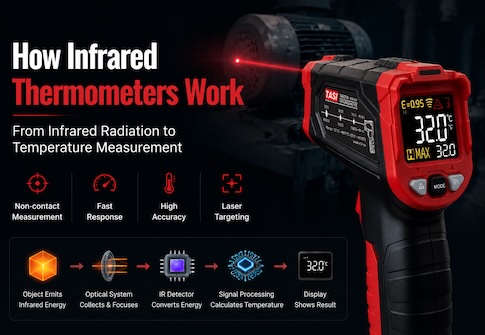
An infrared thermometer uses an optical system to collect infrared radiation emitted from the target surface. The detector converts this radiation into an electrical signal, which is then used to calculate the surface temperature.
The area from which the instrument receives infrared radiation is commonly called the measurement spot or measurement area.
This area has a finite size. It is not an infinitely small point. For example, if the measurement spot has a diameter of 50 mm, the displayed temperature is based on infrared radiation received from that area rather than from only its center.
If the measurement spot includes both the intended target and the surrounding background, infrared radiation from both areas may contribute to the reading. The displayed temperature may therefore differ from the actual surface temperature of the intended target.
Understanding measurement spot size is consequently essential for correct infrared temperature measurement.
What Does D:S Mean?
D:S is the abbreviation for Distance-to-Spot Ratio.
In this ratio:
● D stands for Distance;
● S stands for Spot diameter.
For example, if an infrared thermometer has a D:S ratio of:
12:1
this means that, under a simplified approximation, the measuring distance is approximately 12 times the corresponding spot diameter.
Example:
Measuring distance = 1200 mm
D:S = 12:1
Approximate spot diameter:
1200 ÷ 12 = 100 mm
At a distance of approximately 1.2 m, the measurement spot would therefore be about 100 mm in diameter.
It is important to understand that D:S describes the infrared optical measurement area, not the size of the laser aiming point.
How Do You Calculate Spot Size at Different Distances?
For a basic estimation, the following formula can be used:
Spot diameter S ≈ Measuring distance D ÷ D:S value
For example, consider an infrared thermometer with a D:S ratio of 12:1.
At a measuring distance of 600 mm:
S ≈ 600 ÷ 12
S ≈ 50 mm
The approximate spot diameter is therefore 50 mm.
If the distance increases to 1200 mm:
S ≈ 1200 ÷ 12
S ≈ 100 mm
At 2400 mm:
S ≈ 2400 ÷ 12
S ≈ 200 mm
This demonstrates that, under this simplified relationship, the measurement spot becomes larger as the measuring distance increases.
How Does Spot Size Change with Different D:S Ratios?
Assume three infrared thermometers have D:S ratios of 10:1, 12:1, and 50:1 and are all used at a measuring distance of 1000 mm.
The approximate spot diameters are:
● 10:1: approximately 100 mm;
● 12:1: approximately 83 mm;
● 50:1: approximately 20 mm.
This shows that:
The higher the D:S ratio, the smaller the measurement spot generally is at the same distance.
For example, a thermometer with a 50:1 ratio is better suited than a 10:1 model for measuring relatively small targets from a greater distance.
However, a higher D:S ratio does not automatically mean that the instrument is better for every application. Measurement range, accuracy, response time, emissivity settings, and environmental conditions must also be considered.
How Can You Estimate the Maximum Measuring Distance from the Target Size?
The relationship can also be used in reverse to estimate an appropriate measuring distance based on the target size.
The simplified relationship is:
Measuring distance D ≈ Spot diameter S × D:S value
For example, if the thermometer has a D:S ratio of 12:1 and the intended measurement area is approximately 50 mm in diameter:
D ≈ 50 × 12
D ≈ 600 mm
This means that if the measurement spot needs to remain approximately 50 mm or smaller, the measuring distance should theoretically not exceed about 600 mm.
In practice, however, the measurement spot should not be exactly the same size as the target. Additional margin is recommended.
Why Should the Target Be Larger Than the Measurement Spot?
Suppose the calculated spot diameter is 50 mm and the target is also exactly 50 mm in diameter.
Although these dimensions match theoretically, several practical factors may cause part of the measurement area to extend beyond the target:
● slight movement during handheld measurement;
● aiming error;
● variation in measurement angle;
● irregular target edges;
● differences between theoretical and actual optical response.
If part of the measurement area extends beyond the target, infrared radiation from the background may enter the thermometer’s field of view.
For this reason, the effective target area should preferably be clearly larger than the calculated spot diameter.
For example, if the calculated spot diameter is 50 mm, use a target area significantly larger than 50 mm whenever possible instead of relying on an exact size match.
The more completely the target fills the instrument’s optical field of view, the lower the risk that surrounding surfaces will influence the reading.
Why Does Increasing Distance Affect Small-Target Measurement?
Consider a 30 mm wide electrical terminal.
If a thermometer with a 12:1 D:S ratio is used from a distance of 600 mm:
Spot diameter:
600 ÷ 12 = 50 mm
The 50 mm measurement spot is larger than the 30 mm target. The thermometer may therefore receive infrared radiation from both the terminal and its surroundings.
Even if the laser aiming point is positioned exactly in the center of the terminal, the displayed temperature may not accurately represent the terminal surface alone.
If the distance is reduced to 240 mm:
240 ÷ 12 = 20 mm
The resulting spot is approximately 20 mm in diameter and is therefore much easier to keep entirely within the 30 mm target.
This is why small targets should generally be measured from a shorter distance or with an infrared thermometer that has a higher D:S ratio.
Is the Laser Point the Same Size as the Measurement Spot?
No.
This is one of the most common misunderstandings when using infrared thermometers.
The laser is primarily an aiming aid. The temperature measurement itself is performed by the infrared optical system inside the instrument.
Therefore:
● A small laser point does not mean the infrared measurement area is equally small.
● The laser being positioned on the target does not guarantee that the entire measurement spot lies within the target.
● Dual-laser or other aiming systems are designed to assist positioning; their exact meaning depends on the optical design of the specific model.
To determine the actual measurement area, users should refer to the D:S specification and optical diagram, rather than judging by the laser point alone.
Why Is the D:S Calculation Only an Approximation?
The formula “distance ÷ D:S” provides a convenient engineering estimate, but it does not always fully describe the optical performance of every infrared thermometer.
Different instruments may use different optical designs. For example:
● some models may have a minimum spot size at a specified focal distance;
● short-distance behavior may not follow a perfectly linear relationship;
● manufacturers may define D:S according to different optical response criteria;
● lens design, detector size, and optical geometry can affect the actual field of view.
If the product manual provides a distance-to-spot diagram, that information should take priority over a simplified calculation.
For applications requiring higher measurement confidence, the simple formula should therefore not be used as the only basis for determining measuring conditions.
How Should Spot Size Be Controlled in Practical Measurements?
To reduce errors caused by an unsuitable measurement area:
● Confirm the thermometer’s D:S specification before measurement.
● Estimate the spot diameter for the intended measuring distance.
● Make sure the target is clearly larger than the measurement spot.
● Reduce the measuring distance when measuring small targets.
● If the target cannot be approached safely, consider a model with a higher D:S ratio.
● Aim at the central area of the target rather than close to an edge.
● Refer to the optical diagram in the product manual instead of relying only on the laser aiming point.
This is especially important when there is a significant temperature difference between the target and the surrounding background. If the measurement spot includes both areas, the background can have a noticeable effect on the displayed temperature.
Calculation Example
Consider an infrared thermometer with a D:S ratio of 12:1. Measurements are required at distances of 300 mm, 600 mm, 1200 mm, and 1800 mm.
Using:
S ≈ D ÷ 12
the estimated spot sizes are:
● 300 mm distance: approximately 25 mm;
● 600 mm distance: approximately 50 mm;
● 1200 mm distance: approximately 100 mm;
● 1800 mm distance: approximately 150 mm.
If the effective target area is only 60 mm in diameter, measuring at approximately 300 mm or 600 mm makes it easier to keep the measurement spot within the target.
At 1200 mm, however, the estimated spot diameter increases to about 100 mm, which is considerably larger than the 60 mm target. The reading may then be influenced by the surrounding area.
The practical meaning of D:S is therefore not simply to indicate “how far the thermometer can measure.” It tells the user:
How large an area the thermometer is measuring at a given distance.
FAQ
If D:S is 12:1, does that mean the thermometer can only measure up to 12 metres?
No. A 12:1 ratio is not a maximum measuring distance specification. It describes the relationship between measuring distance and spot size. Whether a target can be measured effectively at a particular distance also depends on target size, environmental conditions, temperature range, and the optical characteristics of the instrument.
Does a higher D:S ratio mean higher temperature accuracy?
Not necessarily. D:S mainly describes optical resolution and is different from the specified temperature measurement accuracy. A higher D:S ratio allows a smaller area to be measured from the same distance, but it does not directly mean that temperature accuracy is better.
Is a shorter measuring distance always more accurate?
No. Reducing the distance helps reduce the measurement area and is particularly useful for small targets, but overall measurement accuracy also depends on emissivity, ambient conditions, target surface characteristics, measurement angle, and instrument performance.
Can the laser be used to determine the measurement spot size?
Usually not. The laser is mainly an aiming aid and does not represent the actual infrared measurement area. Use the D:S specification and the manufacturer’s optical diagram to determine spot size.
Can the measurement spot be exactly the same size as the target?
It may be possible theoretically, but it is not recommended in practical use. The effective target area should be larger than the measurement spot to reduce the effects of aiming error and surrounding background radiation.
Conclusion
The measurement spot size of an infrared thermometer at different distances can be estimated using its D:S ratio:
Spot diameter ≈ Measuring distance ÷ D:S value
For example, with a D:S ratio of 12:1, the theoretical spot diameter at a distance of 1200 mm is approximately 100 mm.
As measuring distance increases, the measurement spot generally becomes larger. At the same distance, a higher D:S ratio generally produces a smaller spot.
In practical applications, the most important principle is to ensure that the target fully covers the infrared thermometer’s measurement area, rather than simply checking whether the laser point is on the target.
For small targets, reduce the measuring distance or select a thermometer with a higher D:S ratio. For a specific instrument, always refer to the manufacturer’s distance-to-spot diagram and optical specifications to determine the most reliable measuring conditions.