Introduction
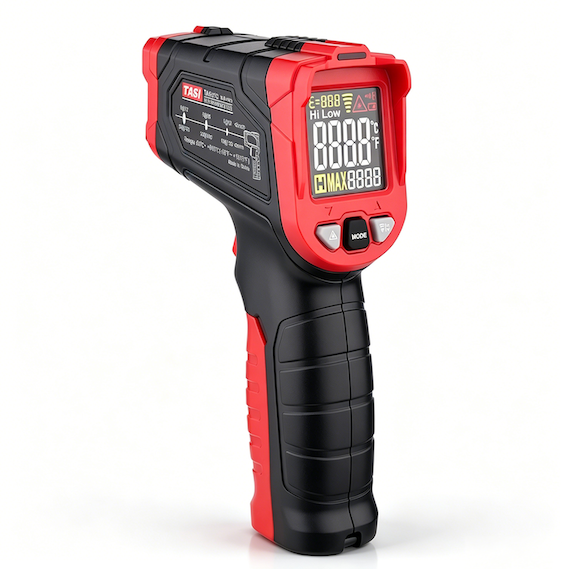
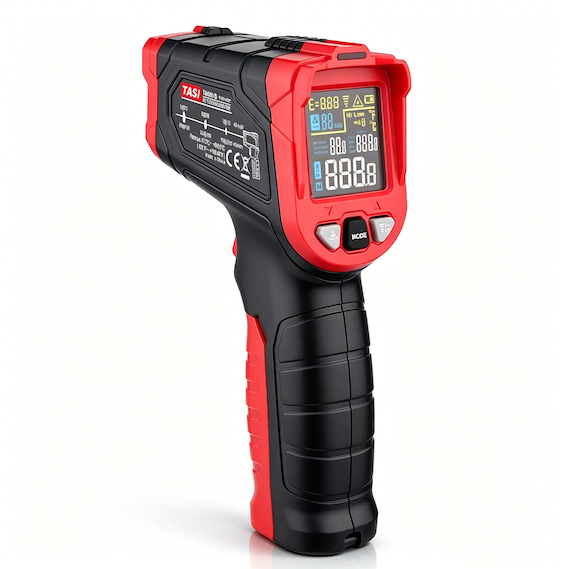
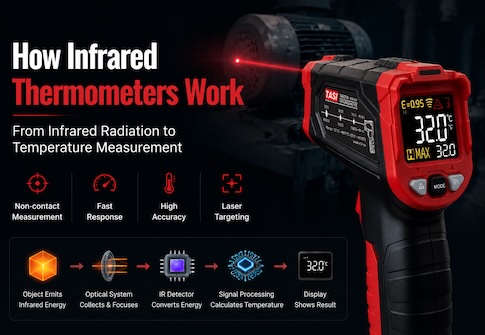
Infrared thermometers detect infrared radiation emitted from an object's surface and calculate its surface temperature based on the received radiation. In principle, aluminum, copper, stainless steel, and other metallic surfaces can all be measured using infrared technology.
However, being measurable does not mean that an accurate temperature can always be obtained directly.
Polished, machined, or shiny aluminum and copper surfaces usually have relatively low infrared emissivity and high reflectivity. The infrared thermometer may therefore receive a significant amount of reflected thermal radiation from the surrounding environment, causing the displayed temperature to differ substantially from the actual surface temperature.
When measuring highly reflective metals such as aluminum and copper, the main issue is not whether the infrared thermometer can detect a temperature, but how effectively emissivity and environmental reflections are controlled.
Key Points
● Infrared thermometers can measure aluminum, copper, and other metals, but shiny metallic surfaces are among the most challenging targets for infrared temperature measurement.
● Polished aluminum and copper generally have low emissivity and high reflectivity, making them sensitive to infrared radiation reflected from nearby equipment, people, walls, and hot objects.
● If the emissivity setting on the thermometer does not match the actual surface emissivity, the measurement may deviate significantly from the true temperature.
● Oxidized, painted, anodized, or roughened metal surfaces are generally easier to measure than polished or highly reflective surfaces.
● Where higher measurement accuracy is required, black tape with known emissivity, a suitable matte coating, or another controlled surface treatment can be used to create a more reliable measurement area.
● Target size, measuring distance, spot size, and reflected radiation from nearby heat sources must also be considered.
Why Are Aluminum and Copper Difficult to Measure with an Infrared Thermometer?
Infrared thermometers measure infrared radiation emitted from a target surface rather than directly sensing the temperature inside the material.
The infrared radiation characteristics of a surface are closely related to its emissivity. In general, a higher-emissivity surface emits more of its own thermal radiation and is therefore easier for an infrared thermometer to measure reliably. When emissivity is low, reflected radiation from the surroundings becomes much more significant.
Shiny aluminum and copper are typical low-emissivity materials. They emit relatively little infrared radiation themselves while reflecting a substantial amount of infrared radiation from their surroundings.
As a result, the infrared thermometer may receive a combination of the target's own radiation and reflected background radiation.
This is why the reading from the same metal surface may change even when the actual surface temperature remains stable, simply because the measuring angle, operator position, or nearby heat-source position has changed.
Why Do Highly Reflective Metals Often Read Too Low?
A common situation occurs when a metal surface is actually hot but the infrared thermometer displays a much lower temperature.
One important reason is a mismatch between the emissivity setting of the thermometer and the actual emissivity of the metal surface.
Many materials encountered in general non-contact temperature measurement have relatively high emissivity. If an infrared thermometer is configured for a high-emissivity surface while the actual target is a shiny, low-emissivity metal, the calculated temperature can contain a significant error.
However, measurement errors on reflective metals do not always result in readings that are too low.
If the metal surface reflects radiation from a nearby heater, furnace, hot machine, or another high-temperature object, the displayed temperature may instead be too high. For this reason, low-emissivity metal measurements cannot be corrected reliably by simply adding or subtracting a fixed temperature offset.
How Important Is Emissivity?
Emissivity is one of the most important parameters when measuring aluminum, copper, and other metallic surfaces.
Different metals have different emissivities, and even the same metal can exhibit substantially different emissivity depending on its surface condition.
For example, with aluminum:
● Polished aluminum can have very low emissivity;
● Oxidized aluminum may have a significantly higher emissivity;
● Painted aluminum mainly exhibits the infrared characteristics of the coating;
● Roughened, corroded, or otherwise treated aluminum may have very different emissivity from freshly machined shiny aluminum.
The same applies to copper. Bright copper, oxidized copper, and coated copper surfaces can exhibit significantly different infrared radiation characteristics.
Therefore, a single fixed emissivity value should not automatically be applied to every aluminum or copper surface.
Why Can the Reading Change When the Measuring Angle Changes?
Highly reflective metals strongly reflect infrared radiation. When the measuring angle changes, the source of environmental radiation reflected into the infrared thermometer may also change.
For example, when an operator measures a shiny metal surface directly from the front, thermal radiation emitted by the operator's body may be reflected by the metal toward the thermometer.
After changing position, the same surface may instead reflect a wall, ceiling, machine, furnace, or another heat source.
Even if the target temperature itself has not changed, the total infrared radiation reaching the thermometer can therefore vary, causing the displayed temperature to fluctuate.
If the reading changes noticeably when the measuring angle is changed, reflected background radiation should be considered before assuming that the thermometer is malfunctioning.
Are Oxidized Aluminum and Copper Easier to Measure?
In many cases, yes.
Oxidation, corrosion, paint, coatings, and other surface treatments change the infrared radiation characteristics of a metal surface.
Compared with mirror-like or highly polished metal, oxidized, coated, or roughened surfaces generally have higher emissivity and are less sensitive to reflected environmental radiation, making infrared temperature measurement easier.
However, an infrared thermometer always responds to the infrared characteristics of the outermost surface.
For example, when measuring a painted aluminum panel, the thermometer primarily detects radiation from the paint surface. If a significant temperature difference exists between the coating and the underlying metal, the displayed value should not automatically be considered the internal temperature of the metal.
How Can Measurement Reliability on Aluminum and Copper Be Improved?
If surface treatment is permitted, a stable high-emissivity measurement area can be created on the target.
One common method is to apply black tape with a known or sufficiently high emissivity to the measurement location. The tape should be allowed to reach thermal equilibrium with the metal before its surface temperature is measured with the infrared thermometer.
The purpose of the tape is not to change the temperature of the metal. It converts a low-emissivity, highly reflective measurement surface into a relatively high-emissivity, less reflective surface that is easier to measure reliably.
Where appropriate, a suitable matte coating or another surface treatment with known emissivity may also be used.
Any tape or coating must be suitable for the actual operating temperature and environment. Materials should not be applied casually to extremely hot surfaces, moving parts, electrically hazardous areas, or equipment that must not be touched.
Can Adjusting the Emissivity Setting Solve the Problem?
If the infrared thermometer supports adjustable emissivity, setting the correct emissivity can significantly improve measurement accuracy. However, emissivity adjustment alone cannot eliminate every source of error.
Low-emissivity surfaces remain highly sensitive to reflected thermal radiation.
Even if the emissivity setting is correct, radiation reflected from nearby hot equipment, people, or other thermal sources can still influence the measurement.
When measuring highly reflective metals such as aluminum and copper, consider all of the following:
● Whether the actual surface emissivity is known;
● Whether the thermometer's emissivity setting is appropriate;
● Whether significant hot or cold radiation sources are present nearby;
● Whether the measuring angle creates strong reflections;
● Whether the target is sufficiently large;
● Whether the measuring distance is appropriate.
Emissivity setting is only one part of the overall measurement conditions.
Why Is Measuring Distance Also Important?
Even with the correct emissivity setting, an unsuitable measuring distance can still produce an incorrect result.
An infrared thermometer does not measure only the location indicated by the laser pointer. It measures the average infrared radiation within a defined spot area. As the measuring distance increases, the measurement spot generally becomes larger.
If a copper pipe, aluminum busbar, metal terminal, or other target is smaller than the actual measurement spot, the thermometer will also receive infrared radiation from the surrounding background.
For example, when measuring a thin copper pipe from too far away, the measurement area may include both the pipe and the wall behind it. The displayed value then represents the combined radiation received from multiple surfaces rather than the temperature of the copper pipe alone.
The measuring distance should therefore be selected according to the thermometer's distance-to-spot ratio (D:S), and the target should preferably be clearly larger than the measurement spot.
Which Aluminum and Copper Measurement Situations Require Extra Caution?
The following situations are particularly prone to significant infrared measurement errors:
● Highly polished aluminum or copper plates;
● Newly machined shiny copper or aluminum busbars;
● Mirror-finish or near-mirror-finish metal components;
● Areas near furnaces, heating elements, or other high-temperature equipment;
● Small targets measured from excessive distances;
● Metal surfaces containing both oxidized and shiny areas;
● Laboratory, quality-control, or process applications where high absolute temperature accuracy is required.
If emissivity and reflected background conditions cannot be adequately controlled, a single infrared reading should not be used as the sole basis for an accurate temperature determination.
For applications requiring higher confidence, a suitable contact temperature sensor can be used as a reference or verification method.
Are Infrared Thermometers Suitable for Rapid Metal Temperature Checks?
Yes, provided that the difference between rapid screening and accurate absolute temperature measurement is understood.
In industrial maintenance, electrical inspection, and mechanical equipment checks, infrared thermometers are highly effective for quickly identifying abnormal temperature differences.
For example, multiple copper busbars, aluminum busbars, terminals, or components with similar construction and surface condition can be compared to identify an unusually hot location.
In such applications, relative temperature differences may be more useful than a single absolute temperature value.
However, if the objective is to determine the accurate surface temperature of a shiny copper or aluminum component, an uncorrected infrared reading may not be sufficiently reliable. Emissivity, reflected background radiation, surface condition, and measurement geometry should all be considered.
FAQ
Can an infrared thermometer directly measure a shiny aluminum plate?
● It can produce a reading, but shiny aluminum generally has low emissivity and high reflectivity, so direct measurements can contain substantial error. Where greater accuracy is required, the measurement surface should be treated appropriately or the result should be verified using another method.
Why does the temperature reading of a copper pipe sometimes fluctuate?
● In addition to actual temperature changes, fluctuations can result from reflected environmental infrared radiation, changes in measuring angle, excessive measuring distance, or an oversized measurement spot.
Can black tape really improve metal temperature measurement?
● Yes, within the tape's suitable operating-temperature range. Black tape can provide a relatively stable, high-emissivity, low-reflectivity surface. It should be allowed to reach thermal equilibrium with the metal before measurement.
Will setting the correct emissivity for aluminum always produce an accurate result?
● No. Even with an appropriate emissivity setting, reflected background radiation, oxidation state, measuring angle, target size, and spot size can still affect the result.
Can oxidized aluminum and shiny aluminum use the same emissivity setting?
● A single fixed value should not normally be assumed. Surface condition can significantly change infrared radiation characteristics, so the appropriate emissivity should be determined for the actual surface.
Can the laser point be used to determine the measurement area when measuring a copper busbar?
● The laser is mainly an aiming aid and does not represent the full infrared measurement area. The actual spot is generally larger than the laser point, so the thermometer's D:S ratio should be used to confirm that the target is sufficiently large.
Is a contact thermometer more reliable for highly reflective metals?
● Where safe physical contact is possible and the measurement conditions are suitable, a contact temperature sensor can provide an important reference or verification method, particularly when an accurate absolute temperature is required.
Conclusion
Infrared thermometers can measure aluminum, copper, and other highly reflective metals, but these materials are among the more challenging targets for infrared temperature measurement.
The main issue is not that metal surfaces fail to emit infrared radiation. Rather, shiny metals typically have low emissivity and high reflectivity, allowing reflected background radiation to have a much greater influence on the infrared signal received by the instrument.
For reliable measurements, surface condition, emissivity setting, reflected background radiation, measuring angle, target size, and D:S ratio should all be considered. Where higher accuracy is required, black tape with known emissivity, a suitable matte coating, or another controlled measurement surface may be used, with contact measurement applied when necessary for verification.
For industrial inspection and rapid abnormal-temperature screening, infrared thermometers remain highly efficient non-contact instruments. When measuring shiny aluminum, copper, or other low-emissivity metals, however, understanding and controlling the measurement conditions is more important than simply reading the displayed temperature.