Introduction
Infrared thermometers determine surface temperature by detecting infrared radiation emitted by an object. However, different materials emit infrared energy with different efficiencies. This property is expressed as emissivity (ε).
For this reason, emissivity capability should be considered alongside temperature range, D:S ratio, accuracy, and response time when selecting an infrared thermometer.
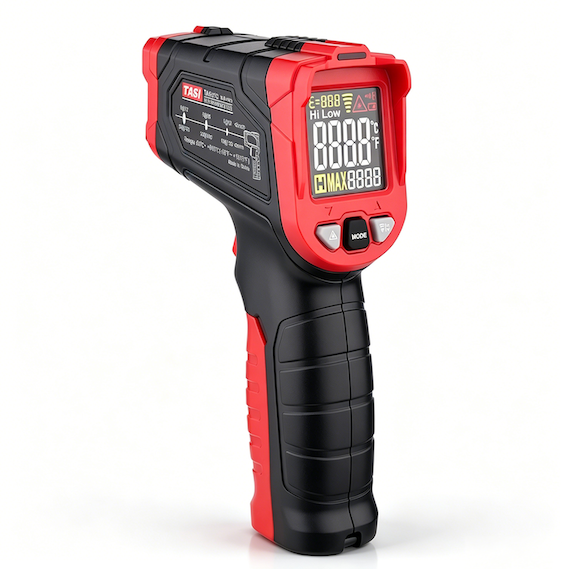
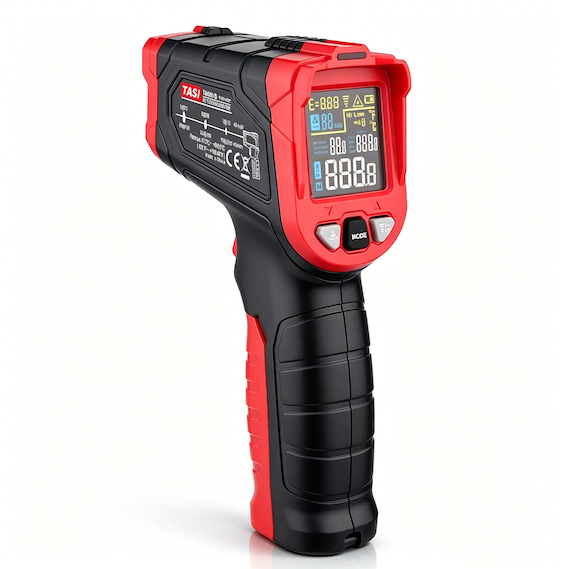
Handheld infrared thermometers generally fall into two categories: models with a fixed emissivity value, commonly ε=0.95, and models with adjustable emissivity, for example ε=0.10–1.00.
Neither design is inherently better in every situation. For high-emissivity materials such as wood, rubber, coatings, and many plastics, fixed emissivity is often sufficient. For stainless steel, aluminum, copper, and other low-emissivity or highly reflective surfaces, adjustable emissivity offers greater flexibility.
Key Points
● Fixed-emissivity infrared thermometers are commonly preset to ε=0.95 and are easy to use for many non-metallic, painted, coated, or oxidized surfaces.
● Adjustable-emissivity thermometers allow ε to be matched more closely to the target material and are better suited to mixed materials and more demanding applications.
● For high-emissivity materials, the practical difference between fixed and adjustable models may be relatively small.
● For polished metals and other low-emissivity targets, an incorrect emissivity setting can cause significant measurement error.
● Adjustable emissivity does not guarantee accurate results on its own. Reflected radiation, D:S ratio, measuring distance, ambient conditions, and surface condition must also be considered.
● For routine inspections and general surface temperature checks, fixed emissivity is often the simpler choice. For varied materials, especially bare or reflective metals, adjustable emissivity is generally more suitable.
Why Does Emissivity Matter in Infrared Temperature Measurement?
All objects above absolute zero emit infrared radiation, but materials do not emit it equally efficiently at the same temperature.
A theoretical blackbody has an emissivity of 1.00. Real-world materials normally have lower values. Paint, rubber, many plastics, wood, and other non-metallic materials typically have relatively high emissivity, while polished aluminum, copper, and stainless steel can have much lower emissivity.
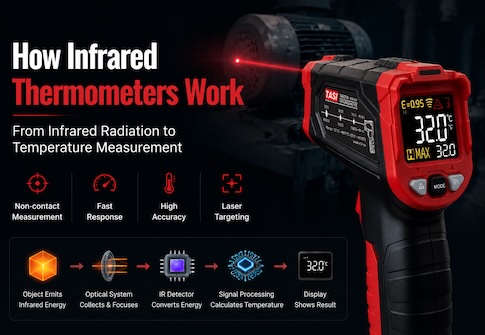
An infrared thermometer does not measure temperature directly. It detects infrared energy and calculates a surface temperature using its internal algorithm together with the selected emissivity value.
If the emissivity setting differs significantly from the actual surface characteristics of the target, the displayed temperature may deviate from the true surface temperature.
This effect is especially important with low-emissivity materials because they not only emit less infrared energy themselves but also tend to reflect more infrared radiation from surrounding equipment, people, hot objects, or cold surroundings.
What Is a Fixed-Emissivity Infrared Thermometer?
A fixed-emissivity infrared thermometer is factory-set to a specific emissivity value that cannot be changed by the user.
A common setting for general-purpose handheld infrared thermometers is ε=0.95 because many everyday industrial and non-metallic surfaces have emissivity values near this range.
The main advantage is simplicity. The operator can usually aim at the target and take a measurement without identifying the material type or changing parameters.
Fixed-emissivity models are therefore well suited to rapid inspection, comparative temperature checks, and measurements on high-emissivity surfaces.
Typical target materials include:
● Painted or coated surfaces;
● Rubber and tires;
● Many plastics;
● Wood, paper, and cardboard;
● Concrete, brick, and other building materials;
● Ceramics and some oxidized surfaces;
● Fabrics and other non-metallic materials.
If the measurement targets are relatively consistent and mainly fall into these categories, a fixed-emissivity infrared thermometer is often sufficient.
What Is an Adjustable-Emissivity Infrared Thermometer?
An adjustable-emissivity infrared thermometer allows the user to set the ε value according to the target material.
Some industrial models, for example, allow emissivity to be adjusted from ε=0.10 to 1.00, providing greater flexibility across different materials and surface conditions.
The benefit is not simply that the instrument becomes “more accurate.” Rather, the user can configure the calculation to better match the actual radiative characteristics of the surface.
The same metal may have very different emissivity depending on whether it is polished, oxidized, painted, coated, or otherwise treated. If every surface is measured using a fixed value of ε=0.95, the resulting error may vary significantly.
Adjustable emissivity is therefore particularly useful for:
● Applications involving frequent changes between different materials;
● Metalworking and machinery maintenance;
● Motors, bearings, piping, and industrial equipment inspections;
● Metal surface temperature measurement;
● Laboratory and R&D work;
● Quality-control processes requiring standardized measurement procedures;
● Applications where infrared readings are compared with contact-temperature measurements.
Who Should Choose a Fixed-Emissivity Model?
If most measurement targets are high-emissivity materials and the primary objective is fast temperature screening, a fixed-emissivity model is often the more practical choice.
For example, HVAC technicians may measure air-vent housings, insulation, walls, and certain pipe surfaces. Maintenance personnel may inspect rubber belts, painted enclosures, plastic housings, or oxidized equipment surfaces. In these situations, fixed emissivity can provide efficient and repeatable temperature screening.
Typical advantages include:
● Fewer operating steps;
● Reduced risk of user error caused by incorrect emissivity settings;
● Convenient use when instruments are shared by multiple operators;
● Good practicality for high-emissivity surfaces;
● Suitable for general-purpose temperature checks.
If operators do not routinely work with low-emissivity metals and have limited need to identify material-specific emissivity, additional emissivity adjustment may provide little practical benefit.
When Is Adjustable Emissivity the Better Choice?
Adjustable emissivity becomes more valuable when measurement targets vary widely, particularly when bare metals, polished surfaces, or differently treated materials are involved.
An industrial maintenance technician, for example, may need to inspect painted machine housings, oxidized metal, motor casings, stainless-steel pipes, copper busbars, and aluminum components during the same inspection. These surfaces have different radiative properties and cannot always be measured consistently using one fixed emissivity setting.
Adjustable emissivity is especially useful when:
● Different materials are measured frequently;
● Bare metal surfaces are part of the inspection;
● Greater measurement consistency is required across repeated inspections;
● Reliable emissivity data for the target material is available;
● Contact probes or reference instruments are available for verification;
● Standardized inspection procedures are required;
● Results are used for trend analysis, quality control, or technical evaluation.
For these applications, adjustable emissivity provides greater measurement flexibility.
Is Adjustable Emissivity Always More Accurate?
No.
Infrared temperature accuracy is not determined by emissivity alone.
Even if an instrument allows emissivity adjustment, an incorrect ε setting can still produce substantial error. In some cases, adjusting emissivity without understanding the surface characteristics can introduce more uncertainty than using a fixed ε=0.95 setting.
Other factors that affect infrared temperature measurement include:
● Whether the D:S ratio is suitable for the target size;
● Whether the entire measurement spot falls within the target;
● Whether the surface is shiny or strongly reflective;
● Whether oil, dust, oxidation, or coating is present on the surface;
● Whether steam, smoke, or other media are present between the instrument and target;
● Measurement angle;
● Whether the instrument has reached thermal equilibrium with the environment;
● Whether furnaces, heaters, or other strong thermal sources are present nearby.
Adjustable emissivity should therefore be understood as a measurement compensation tool rather than a standalone guarantee of accuracy.
Why Is Adjustable Emissivity More Important for Metals?
Metals are among the most challenging materials for infrared temperature measurement, especially when surfaces are bright, polished, or untreated.
Aluminum, copper, stainless steel, and similar materials may have low emissivity depending on their surface condition. This means they emit relatively little infrared energy of their own while reflecting more radiation from the surrounding environment.
As a result, the infrared energy detected by the thermometer may include:
● Radiation emitted by the target itself;
● Radiation from nearby equipment reflected by the target;
● Reflected radiation from people, lighting, heaters, and other environmental heat sources.
For this reason, entering an apparently correct emissivity value does not necessarily eliminate reflection-related error.
For critical measurements on metal surfaces, emissivity should be determined with reference to the actual surface condition and, where possible, verified using a contact temperature probe, reference thermometer, or known temperature source.
What Should You Do If the Material Emissivity Is Unknown?
If the instrument supports emissivity adjustment but the actual emissivity of the target is unknown, a reference measurement can be used.
One common method is to measure the target with a contact temperature probe and then adjust the infrared thermometer's emissivity until the infrared reading agrees closely with the reference temperature.
Where the surface allows it, high-emissivity black tape or another suitable high-emissivity reference material can also be applied.
A typical procedure is:
● Apply a small piece of high-emissivity tape suitable for the expected temperature range;
● Allow the tape and target surface to reach thermal equilibrium;
● Measure the taped area with the infrared thermometer;
● Use this reading as a reference for the target surface temperature;
● Adjust the measurement approach for the untreated surface as required.
This method can be particularly useful for reflective metal surfaces.
For high-temperature applications, always verify that the tape or reference material is rated for the target temperature.
How Should You Choose Between Fixed and Adjustable Emissivity?
The decision should be based on the actual measurement task rather than simply selecting the model with more functions.
● Mainly high-emissivity materials: Fixed emissivity is usually sufficient.
● Routine equipment inspections: Fixed emissivity is simpler and reduces the risk of incorrect settings.
● Frequent metal measurements: Adjustable emissivity should be strongly considered.
● Many different target materials: Adjustable emissivity provides greater versatility.
● More controlled temperature comparison is required: Use adjustable emissivity together with a standardized emissivity and measurement procedure.
● Operators have limited infrared measurement experience: For consistent target materials, fixed emissivity may provide better repeatability in practice.
● R&D, laboratory, or quality-control applications: Adjustable emissivity is generally the more appropriate choice.
The key question is therefore not which design is “more advanced,” but whether the measurement targets require emissivity compensation.
What Else Should Be Considered When Selecting an Infrared Thermometer?
Emissivity is only one part of infrared thermometer selection.
For industrial applications, temperature range, D:S ratio, measurement accuracy, repeatability, response time, and target size should also be evaluated.
For example, when measuring a small target from a long distance, the D:S ratio may be more important than emissivity adjustment. If the measurement spot is larger than the target, the instrument will also receive infrared energy from the surrounding background, even if the emissivity setting itself is correct.
For moving belts, rollers, or production-line materials, response time is also important. For high-temperature equipment, the thermometer's measurement range should comfortably cover the highest expected surface temperature.
A complete selection process should therefore consider:
● Temperature range;
● Measurement accuracy;
● D:S ratio;
● Emissivity adjustment range;
● Response time;
● Laser aiming system;
● Data Hold, MAX/MIN, and high/low alarm functions;
● Data logging or PC communication requirements.
FAQ
What fixed emissivity value is commonly used in infrared thermometers?
Many general-purpose infrared thermometers use ε=0.95, although the actual preset value depends on the model. Always check the product specification.
Can ε=0.95 be used for every material?
No. ε=0.95 works well for many high-emissivity surfaces, but it can produce significant error on shiny metals and other low-emissivity materials.
Is a wider emissivity adjustment range always better?
Not necessarily. A wider range increases flexibility, but accurate results still depend on selecting an appropriate emissivity value.
Should emissivity always be adjusted when measuring stainless steel?
For bare or polished stainless steel, an adjustable-emissivity instrument is recommended, together with consideration of reflected radiation. Painted, oxidized, or otherwise treated stainless steel may have substantially different emissivity.
Why can the same material have different emissivity values?
Emissivity depends not only on material type but also on surface roughness, oxidation, coatings, color, contamination, temperature, and measurement wavelength.
Can I directly use an emissivity value found in a reference table or online?
It can be used as an initial reference, but it should not automatically be treated as an exact value. For important measurements, verify the reading against the actual surface condition using a contact measurement or known reference temperature.
Can a fixed-emissivity infrared thermometer measure metal?
It can produce a reading, but on low-emissivity or highly reflective metal surfaces the displayed temperature may differ considerably from the true surface temperature. For trend monitoring, keep the measurement position, distance, angle, and surface condition consistent.
Can adjustable emissivity solve all metal-measurement problems?
No. Adjustable emissivity can reduce error caused by an emissivity mismatch, but it cannot completely eliminate errors caused by reflected radiation, excessive spot size, measurement angle, or changing surface conditions.
Conclusion
The essential difference between fixed- and adjustable-emissivity infrared thermometers is whether the user can modify the emissivity setting to match the radiative characteristics of the target surface.
For high-emissivity materials such as paint, rubber, plastics, wood, and building materials, as well as routine equipment inspection, HVAC maintenance, and rapid temperature screening, a fixed value such as ε=0.95 is often sufficient and easier to operate.
If the application involves stainless steel, aluminum, copper, or other metals, or if many different surface materials are measured, an adjustable-emissivity model provides greater flexibility and is generally better suited to industrial maintenance, quality control, R&D, and professional temperature measurement.
However, emissivity is not the only factor affecting infrared measurement accuracy. D:S ratio, measuring distance, target size, surface condition, reflected radiation, and correct operating technique are equally important.
The most effective selection approach is therefore to identify the main target materials and operating conditions first, and then determine whether adjustable emissivity is genuinely required.