How to Choose High and Low Temperature Alarm Functions on an Infrared Thermometer

Publisher: Amy Published: 2026-03-26 Reading Time: 7min. 30sec.
Tags: infrared thermometerhigh temperature alarmlow temperature alarmtemperature alarminfrared thermometer selectionnon-contact temperature measurement

Introduction

In addition to measuring surface temperature quickly and without contact, many infrared thermometers provide high-temperature, low-temperature, or dual-limit alarm functions. When the measured temperature exceeds a preset upper limit or falls below a preset lower limit, the instrument can alert the user through an audible signal, display color change, alarm icon, or indicator light.

These functions can significantly improve abnormal-temperature screening efficiency in equipment inspection, electrical maintenance, HVAC servicing, mechanical troubleshooting, and production-process checks.

However, selection should not be based simply on whether an instrument "has an alarm." It is also important to consider whether the alarm thresholds are adjustable, whether HI and LO limits can be set independently, how clearly the alarm is indicated, and whether the instrument's temperature range, D:S ratio, emissivity adjustment, and response time are appropriate for the application.


Key Points

● High-temperature alarms are mainly used to identify temperatures above an allowable upper limit, while low-temperature alarms identify temperatures below a specified lower limit.
● If the application requires verifying whether temperature remains within an acceptable range, choose a model with independently adjustable HI and LO limits.
● Alarm functions compare the measured value with a preset threshold; they do not improve the measurement accuracy of the infrared thermometer.
● For industrial inspection, alarm capability should be considered together with temperature range, accuracy, D:S ratio, emissivity, and response time.
● For moving targets or rapidly changing temperatures, response speed is important to reduce delayed alarm indication.
● In noisy or visually challenging environments, select an alarm method that remains easy to recognize, such as combined audible and visual indication.
● Alarm limits should be based on process requirements, normal equipment temperatures, or inspection criteria rather than assuming the infrared thermometer can determine equipment condition automatically.


What Are High and Low Temperature Alarms on an Infrared Thermometer?

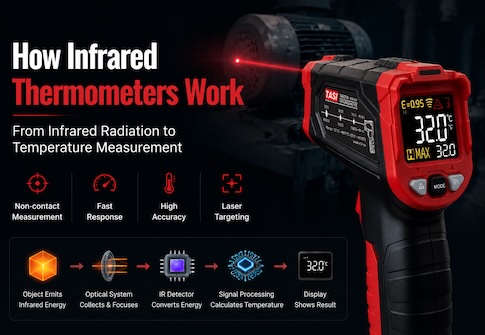
An infrared thermometer first detects infrared radiation emitted from the target surface and converts it into a temperature reading. The measured value is then compared with alarm thresholds set by the user.

A high-temperature alarm is commonly identified as HI or High Alarm. When:

Measured temperature ≥ High alarm setting

the instrument activates the corresponding alarm indication.

A low-temperature alarm is commonly identified as LO or Low Alarm. When:

Measured temperature ≤ Low alarm setting

the instrument activates the low-temperature alarm.

For example, if normal operating temperature is expected to remain between 40 and 80°C, the low limit may be set to 40°C and the high limit to 80°C. A reading below 40°C or above 80°C can then trigger an alert for further inspection.

Alarm logic can vary between models. Some infrared thermometers support both HI and LO alarms simultaneously, while others allow only one to be active at a time. Some also allow either alarm to be disabled independently. Always check the specifications of the specific model.


When Is a High-Temperature Alarm Useful?

High-temperature alarms are among the most common alarm functions on infrared thermometers. Their primary purpose is to quickly identify surfaces exceeding a defined upper temperature limit.

● Checking electrical panels, cable connections, circuit breakers, and terminals for overheating;
● Inspecting motors, bearings, pumps, gearboxes, and mechanical transmission components;
● Checking compressors, piping, and equipment surfaces in HVAC systems;
● Monitoring heaters, molds, hot plates, and industrial heating processes;
● Inspecting engines, braking systems, and related automotive components.

For example, if a machine normally operates below 70°C but an internal maintenance procedure requires further inspection above 80°C, the HI threshold can be set around 80°C.

This allows technicians to identify areas requiring attention without repeatedly interpreting every displayed value.


When Is a Low-Temperature Alarm Useful?

A low-temperature alarm identifies temperatures below a preset minimum limit.

Although high-temperature alarms are more common in overheating inspections, low-temperature alarms are important in many process and HVAC applications.

● Checking whether heating equipment has reached its required minimum temperature;
● Evaluating warm-air outlets, hot-water lines, or heating systems for insufficient temperature;
● Verifying whether materials or equipment have reached a required process temperature;
● Identifying abnormally cool areas on insulated surfaces;
● Screening equipment with specified minimum operating temperatures.

For example, if a heating process requires a workpiece surface temperature of at least 120°C, the LO alarm can be set to 120°C. A measured value below this limit will trigger an alert.

A low-temperature alarm therefore does not mean that the thermometer is specifically intended for low-temperature measurements. It simply indicates that the measured value has fallen below the user-defined lower limit.


When Should You Choose Dual High and Low Alarms?

If the application requires more than simply detecting overheating and instead needs to confirm that temperature remains within a specified operating window, a dual HI/LO alarm is generally more useful.

For example, if the acceptable process range is:

150–180°C

the limits can be set to:

● LO: 150°C;
● HI: 180°C.

A value below 150°C indicates insufficient temperature, while a value above 180°C indicates excessive temperature.

This approach is suitable for:

● Industrial process checks;
● Heating equipment verification;
● HVAC operating-condition checks;
● Temperature-range verification in laboratory and maintenance work;
● Rapid screening of multiple products or surfaces.

If the main purpose is simply to detect overheating in electrical or mechanical equipment, a high-temperature alarm alone may be sufficient.


Adjustable Alarm Thresholds Are Important

One of the first specifications to check is whether the HI and LO thresholds can be adjusted by the user.

Some applications have a fixed normal temperature range, while others vary significantly depending on load, operating condition, ambient temperature, or process stage.

For industrial maintenance and multi-application use, adjustable alarm limits are therefore generally preferable.

Also check:

● Available alarm-setting range;
● Alarm adjustment increment;
● Whether HI and LO can be set independently;
● Whether each alarm can be enabled or disabled separately;
● Whether alarm settings are retained after power-off.

If the thermometer will be used on different types of equipment, avoid models with overly restrictive alarm settings.


How Should You Choose the Alarm Indication Method?

Common alarm indications include a buzzer, display color change, alarm symbols, and LEDs.

Each has advantages in different environments.

Audible alarm: useful when the operator cannot continuously watch the display;
Display color alarm: allows rapid visual recognition of normal and abnormal conditions;
LED or icon indication: simple and suitable for general inspection;
Combined audible and visual alarm: often more practical in industrial environments.

In a noisy factory, an audible signal alone may be difficult to hear. In bright outdoor or industrial lighting, a display color change alone may also be less noticeable.

For factory maintenance, electrical inspection, and mechanical servicing, combined audible and visual indication is often the more practical choice.


Do Not Evaluate Alarm Functions Without Considering Temperature Range

Alarm functions are only useful if the thermometer can correctly measure the required temperature range.

For example, if an application requires monitoring equipment between 300 and 500°C, a thermometer with a maximum measuring temperature of 380°C is unsuitable even if it offers a HI alarm.

First determine:

The lowest and highest temperatures the target may realistically reach.

Then select an instrument with sufficient measurement range.

Ideally, normal operating temperatures should remain comfortably within the instrument's usable range rather than close to its upper or lower limits. This provides additional margin for unexpected temperature excursions.


Does D:S Affect Alarm Performance?

Yes.

D:S, or distance-to-spot ratio, determines the size of the measurement area at a given distance.

If the target is a small electrical terminal and the thermometer is used from too far away, the measurement spot may become larger than the target. The instrument may then measure both the hot terminal and cooler surrounding surfaces.

The displayed temperature can consequently be lower than the actual temperature of the target area.

In this situation, the terminal may already be overheating while the measured value remains below the HI alarm threshold.

D:S is therefore particularly important when measuring:

● Small electrical components;
● Targets at longer distances;
● Pipes, bearings, and small mechanical components;
● Localized hot spots.

The measurement spot should remain fully within the target area.


How Does Emissivity Affect High and Low Temperature Alarms?

Infrared thermometers determine temperature from infrared radiation emitted by a surface, so emissivity directly affects the measurement result.

Rubber, wood, painted surfaces, oxidized materials, and many non-metallic surfaces generally have relatively high emissivity and are easier to measure with infrared instruments.

Polished stainless steel, aluminum, copper, and other reflective metals have lower emissivity and can reflect infrared radiation from the surroundings, causing significant measurement errors.

If emissivity is set incorrectly, the displayed temperature may differ considerably from the actual surface temperature, and alarm decisions will be affected accordingly.

If the application involves different surface materials, especially metals, an infrared thermometer with adjustable emissivity is generally preferable.

A HI/LO alarm only compares the displayed temperature with the preset threshold. It cannot compensate automatically for an incorrect emissivity setting.


Why Does Response Time Matter?

Infrared thermometers do not respond instantaneously to every temperature change. Their sensors and electronic circuits require a certain response time.

For stationary equipment inspection, this is usually not a major concern.

Response time becomes more important when measuring:

● Moving belts;
● Fast rotating rollers;
● Products on continuous production lines;
● Surfaces heating or cooling rapidly;
● Objects passing briefly through the measurement area.

If response is too slow, the target may already have exceeded the alarm threshold before the displayed reading catches up. This can cause delayed alarms or missed short-duration temperature peaks.

For dynamic applications, alarm functionality should therefore be considered together with response time.


Alarm Functions Do Not Replace Measurement Accuracy

This is an important point in product selection.

If a high alarm is set to 100°C but the thermometer has a specified measurement uncertainty around that temperature, readings near 100°C should not be interpreted as exact pass/fail boundaries.

For example:

99°C

does not necessarily mean that the actual surface temperature is definitely below 100°C.

Likewise:

101°C

does not necessarily mean that the true temperature has certainly exceeded 100°C.

For measurements near critical process limits, safety thresholds, or quality-control limits, consider instrument accuracy, emissivity, target condition, and the overall measurement setup.

Where 100°C represents a critical limit, a suitable warning margin may be incorporated into the inspection procedure instead of relying entirely on a single exact threshold.


How Should Different Applications Be Matched to Alarm Functions?

For general electrical and mechanical inspection, the main objective is often to find abnormal hot spots. Prioritize:

● High-temperature alarm;
● Audible and visual indication;
● Suitable D:S ratio;
● Fast response;
● Adjustable emissivity.

For HVAC, heating systems, or applications requiring temperature-range verification, prioritize:

● Dual HI/LO alarms;
● Independently adjustable limits;
● Clear display indication;
● A temperature range suited to the application.

For production lines or repetitive product screening, focus on:

● HI/LO limit checking;
● Fast response;
● Clear alarm indication;
● Stable repeatability;
● Suitable D:S ratio.

For polished metals and highly reflective surfaces, alarm functionality should not be the primary selection criterion. First determine whether infrared measurement is appropriate for the material and whether emissivity and reflected radiation can be properly managed.


Which Specifications Should Be Checked During Selection?

If temperature alarms are an important part of the intended application, review the specifications in the following order:

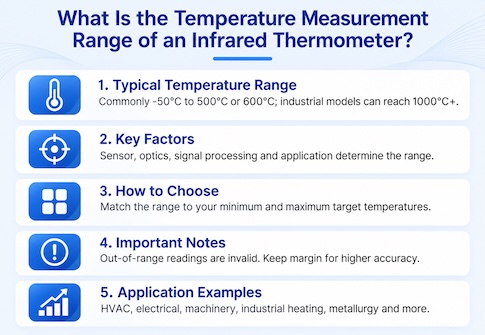
● Does the temperature range cover the actual target temperatures?
● Does the instrument support a HI alarm?
● Does it support a LO alarm?
● Can HI and LO limits be set independently?
● Does the alarm-setting range meet the application requirements?
● Is the indication audible, visual, LED-based, or combined?
● Is measurement accuracy suitable for the required decision threshold?
● Is the D:S ratio appropriate for the target size and working distance?
● Is emissivity adjustable?
● Is the response time suitable for stationary or moving targets?

This helps ensure that the alarm function is genuinely useful in the measurement process rather than simply being an additional feature.


FAQ

What does HI mean on an infrared thermometer?

HI generally refers to the high-temperature alarm or upper temperature limit. When the measured value reaches or exceeds the preset HI threshold, the thermometer activates the alarm indication specified by its design.

What does LO mean?

LO generally refers to the low-temperature alarm or lower temperature limit. When the measured temperature reaches or falls below the preset LO threshold, the thermometer activates the corresponding alert. On some instruments, "LO" may also indicate that the measured value is below the instrument's measuring range, so the user manual should be consulted.

Can HI and LO be set at the same time?

It depends on the model. Some infrared thermometers support simultaneous high and low limits, while others allow only one alarm mode at a time.

Should the alarm threshold be set as close as possible to the target temperature?

Not necessarily. Alarm thresholds should be based on equipment limits, process requirements, instrument accuracy, and the purpose of the inspection. A suitable warning margin may be necessary near critical limits.

Does an alarm function make measurement accuracy less important?

No. Alarm decisions are based directly on the measured value. If the measurement is affected by accuracy, emissivity, target size, or measuring distance, the alarm result will also be affected.

Can high and low alarms automatically determine whether equipment is faulty?

No. An infrared thermometer only compares the measured temperature with user-defined thresholds. Equipment condition must be evaluated together with equipment type, load, ambient temperature, operating condition, and maintenance criteria.


Conclusion

High and low temperature alarms convert infrared temperature readings into more intuitive abnormal-condition indications.

For electrical and mechanical overheating inspections, a high-temperature alarm is often sufficient. If the application requires confirming that temperature remains within a defined range, a model with independently adjustable HI and LO limits is more appropriate.

However, selection should not be based solely on whether alarms are available. Temperature range, accuracy, D:S ratio, emissivity, response time, and alarm indication method all affect whether the alarm function will perform effectively in practice.

Define the target temperature range, target size, measurement distance, surface material, and abnormal-condition criteria first. Then select an infrared thermometer with alarm functions that match the actual application.

Related Technical Articles
What Is the Temperature Measurement Range of an Infrared Thermometer?
How Does Target Size Relate to the Measurement Spot of an Infrared Thermometer?
Detailed Explanation of How Infrared Thermometers Work
Introduction to the Optical System of an Infrared Thermometer
Why Does Surface Roughness Affect Infrared Temperature Measurement?
What Is the Relationship Between Emissivity, Reflectivity, and Transmissivity?
What Is Emissivity in an Infrared Thermometer? How to Set It Correctly?
What Is the Difference Between an Infrared Thermometer and a Contact Thermometer?
How Do Dust and Oil Mist Affect Infrared Temperature Measurements?
What Is the Difference Between an Infrared Thermometer and a Thermal Imaging Camera?
How to Properly Use an Infrared Thermometer for Temperature Measurement?
How to Measure Surfaces That Heat Up or Cool Down Rapidly with an Infrared Thermometer
What Does the Spectral Response Range of an Infrared Thermometer Mean?
How to Evaluate the Quality of an Infrared Thermometer
What Does Measurement Uncertainty Mean in Infrared Temperature Measurement?
Why Does Reflected Background Temperature Affect Infrared Temperature Measurements?
How Does a Thermopile Sensor Work in an Infrared Thermometer?
What Objects Can an Infrared Thermometer Measure?
Infrared Thermometer Measurement Range, Response Time and Resolution Explained
Why Do Infrared Thermometers Need Laser Aiming?
What Does Resolution Mean on an Infrared Thermometer?
What Is the Relationship Between Blackbody Radiation and Infrared Temperature Measurement?
How Is Infrared Thermometer Accuracy Defined?
Why Can’t an Infrared Thermometer Measure Temperature Through Glass?
Why Do Infrared Thermometers Use Infrared Radiation to Measure Temperature?
How Does Measurement Angle Affect Infrared Thermometer Readings?
What Materials Can an Infrared Thermometer Measure?
What Factors Affect the Accuracy of Infrared Thermometers?
How to Measure Moving Objects with an Infrared Thermometer
Do Air, Steam, and Smoke Affect Infrared Temperature Measurement?
How Do Temperature Gradients Affect Infrared Temperature Measurements?
Infrared Thermometer Calibration Principles Explained
Why Doesn’t the Laser Dot on an Infrared Thermometer Represent the Actual Measurement Area?
What Is the Difference Between Repeatability and Accuracy in an Infrared Thermometer?
What Does Response Time Mean on an Infrared Thermometer?
What Does Thermal Equilibrium Mean in Infrared Temperature Measurement?
How Does Response Time Affect Temperature Measurement of Fast-Moving Objects?
How to Calculate the Measurement Spot Size of an Infrared Thermometer at Different Distances
What Does the D:S Distance-to-Spot Ratio Mean on an Infrared Thermometer?
How Do Infrared Thermometers Account for Ambient Background Radiation?
What Is an Infrared Thermometer? Working Principle and Applications
How Does Ambient Temperature Affect Infrared Temperature Measurement?
Common Functions of Infrared Thermometers
What Does Field of View (FOV) Mean on an Infrared Thermometer?
Types of Sensors Used in Infrared Thermometers
Related FAQs
Why Can’t an Infrared Thermometer Measure Transparent Objects?
Can an Infrared Thermometer Still Be Used After Being Dropped?
Why Does an Infrared Thermometer Give Different Readings on Different Colors?
Why Does Black Tape Improve the Accuracy of Infrared Temperature Measurement?
How to Calibrate an Infrared Thermometer
Why Does an Infrared Thermometer Show Different Temperatures at Different Points on the Same Object?
Common Mistakes When Using an Infrared Thermometer
Can an Infrared Thermometer Measure Objects in a Steam Environment?
Why Do Two Infrared Thermometers Give Different Readings on the Same Object?
Why Are Infrared Thermometer Readings Unstable on Stainless Steel Surfaces?
What Does “OL” Mean on an Infrared Thermometer Display?
Can an Infrared Thermometer Measure Liquid Temperature?
What Do HI and LO Mean on an Infrared Thermometer?
Why Does an Infrared Thermometer Show the Laser but No Temperature Reading?
Why Does an Infrared Thermometer Need a Stable Environment?
Does an Infrared Thermometer Need Regular Performance Verification?
Why Is the Infrared Thermometer Inaccurate?
Why Should an Infrared Thermometer Be Allowed to Stabilize After Moving from Outdoors to Indoors?
What Happens If You Measure from Too Far Away with an Infrared Thermometer?
How to Clean the Lens of an Infrared Thermometer
Does Low Battery Power Affect the Measurement Accuracy of an Infrared Thermometer?
Why Does an Infrared Thermometer Reading Fluctuate When Measuring a Moving Belt or Roller?
How to Maintain and Care for an Infrared Thermometer
Does Condensation on an Infrared Thermometer Lens Affect Temperature Measurement?
Does an Infrared Thermometer Measure the Glass Temperature or the Object Behind the Glass?
Can an Infrared Thermometer Measure Metal Surfaces?
Does an Infrared Thermometer Need Calibration?
Can an Infrared Thermometer Be Used for Continuous Long-Term Measurement?
Can an Infrared Thermometer Be Used in Bright Light or Direct Sunlight?
Can an Infrared Thermometer Measure Human Body Temperature?
Why Do Infrared Thermometers Often Read Too Low on Metal Surfaces?
Are Infrared Thermometers Accurate When Measuring Black Objects?
Why Is My Infrared Thermometer Showing the Wrong Temperature?
Can an Infrared Thermometer Measure Transparent Objects?
What Are the Common Mistakes When Using an Infrared Thermometer?
Can an Infrared Thermometer Measure Highly Reflective Metals Such as Aluminum and Copper?
What to Do If an Infrared Thermometer Is Inaccurate in Winter
What Is the Alarm Function on an Infrared Thermometer Used For?
Can an Infrared Thermometer Measure Temperature Through Plastic Film?
Related Products
TA601A TA601 Series Non-Contact Infrared Thermometers

TA601A

TA601 Series
Non-Contact Infrared Thermometers
-50 to 480°C | 12:1
Abstract:
The TA601 Series Infrared Thermometers are professional non-contact temperature measurement instruments, also known as infrared temperature guns, laser thermometers, handheld infrared thermometers, IR temperature testers, and industrial infrared temperature meters. By detecting the infrared energy emitted from the surface of an object, these devices provide fast, accurate, and safe temperature measurements without physical contact, making them ideal for measuring high-temperature, hazardous, or hard-to-reach areas. Featuring a 12:1 distance-to-spot ratio, the TA601 Series infrared thermometer combines laser targeting technology with fast response performance to accurately identify the measurement area even from a distance. The adjustable emissivity range from 0.10 to 1.00 allows the instrument to measure different surface materials including metal, plastic, rubber, glass, stone, and wood. Additional functions include high/low temperature alarms, audible alerts, data hold, maximum value recording, and ℃/℉ unit conversion, providing reliable temperature monitoring for various professional applications. With its compact design, quick measurement capability, and easy operation, the TA601 Series handheld infrared thermometer is widely used in electrical maintenance, industrial equipment inspection, manufacturing, automotive repair, HVAC systems, building inspection, food processing, cold chain management, laboratories, chemical equipment monitoring, and energy management applications. In electrical applications, it helps detect overheating issues in distribution cabinets, cables, terminals, circuit breakers, and transformers. In industrial environments, it supports temperature monitoring of motors, bearings, gearboxes, molds, production lines, and mechanical equipment. For HVAC applications, it is suitable for checking air conditioners, heating systems, pipelines, and underfloor heating systems. In automotive maintenance, it assists with temperature diagnosis of engines, exhaust systems, brake systems, and vehicle components. In food processing and cold storage industries, it helps monitor processing temperatures, refrigeration systems, and quality control procedures. The TA601 Series infrared thermometer provides maintenance engineers, technicians, and inspectors with an efficient solution for fast temperature diagnosis, preventive maintenance, and safety inspection, helping improve operational efficiency and reduce equipment failure risks.
View More ›
TA601B TA601 Series Non-Contact Infrared Thermometers

TA601B

TA601 Series
Non-Contact Infrared Thermometers
-50 to 680°C | 12:1
Abstract:
The TA601 Series Infrared Thermometers are professional non-contact temperature measurement instruments, also known as infrared temperature guns, laser thermometers, handheld infrared thermometers, IR temperature testers, and industrial infrared temperature meters. By detecting the infrared energy emitted from the surface of an object, these devices provide fast, accurate, and safe temperature measurements without physical contact, making them ideal for measuring high-temperature, hazardous, or hard-to-reach areas. Featuring a 12:1 distance-to-spot ratio, the TA601 Series infrared thermometer combines laser targeting technology with fast response performance to accurately identify the measurement area even from a distance. The adjustable emissivity range from 0.10 to 1.00 allows the instrument to measure different surface materials including metal, plastic, rubber, glass, stone, and wood. Additional functions include high/low temperature alarms, audible alerts, data hold, maximum value recording, and ℃/℉ unit conversion, providing reliable temperature monitoring for various professional applications. With its compact design, quick measurement capability, and easy operation, the TA601 Series handheld infrared thermometer is widely used in electrical maintenance, industrial equipment inspection, manufacturing, automotive repair, HVAC systems, building inspection, food processing, cold chain management, laboratories, chemical equipment monitoring, and energy management applications. In electrical applications, it helps detect overheating issues in distribution cabinets, cables, terminals, circuit breakers, and transformers. In industrial environments, it supports temperature monitoring of motors, bearings, gearboxes, molds, production lines, and mechanical equipment. For HVAC applications, it is suitable for checking air conditioners, heating systems, pipelines, and underfloor heating systems. In automotive maintenance, it assists with temperature diagnosis of engines, exhaust systems, brake systems, and vehicle components. In food processing and cold storage industries, it helps monitor processing temperatures, refrigeration systems, and quality control procedures. The TA601 Series infrared thermometer provides maintenance engineers, technicians, and inspectors with an efficient solution for fast temperature diagnosis, preventive maintenance, and safety inspection, helping improve operational efficiency and reduce equipment failure risks.
View More ›
TA601C TA601 Series Non-Contact Infrared Thermometers

TA601C

TA601 Series
Non-Contact Infrared Thermometers
-50 to 880°C | 12:1
Abstract:
The TA601 Series Infrared Thermometers are professional non-contact temperature measurement instruments, also known as infrared temperature guns, laser thermometers, handheld infrared thermometers, IR temperature testers, and industrial infrared temperature meters. By detecting the infrared energy emitted from the surface of an object, these devices provide fast, accurate, and safe temperature measurements without physical contact, making them ideal for measuring high-temperature, hazardous, or hard-to-reach areas. Featuring a 12:1 distance-to-spot ratio, the TA601 Series infrared thermometer combines laser targeting technology with fast response performance to accurately identify the measurement area even from a distance. The adjustable emissivity range from 0.10 to 1.00 allows the instrument to measure different surface materials including metal, plastic, rubber, glass, stone, and wood. Additional functions include high/low temperature alarms, audible alerts, data hold, maximum value recording, and ℃/℉ unit conversion, providing reliable temperature monitoring for various professional applications. With its compact design, quick measurement capability, and easy operation, the TA601 Series handheld infrared thermometer is widely used in electrical maintenance, industrial equipment inspection, manufacturing, automotive repair, HVAC systems, building inspection, food processing, cold chain management, laboratories, chemical equipment monitoring, and energy management applications. In electrical applications, it helps detect overheating issues in distribution cabinets, cables, terminals, circuit breakers, and transformers. In industrial environments, it supports temperature monitoring of motors, bearings, gearboxes, molds, production lines, and mechanical equipment. For HVAC applications, it is suitable for checking air conditioners, heating systems, pipelines, and underfloor heating systems. In automotive maintenance, it assists with temperature diagnosis of engines, exhaust systems, brake systems, and vehicle components. In food processing and cold storage industries, it helps monitor processing temperatures, refrigeration systems, and quality control procedures. The TA601 Series infrared thermometer provides maintenance engineers, technicians, and inspectors with an efficient solution for fast temperature diagnosis, preventive maintenance, and safety inspection, helping improve operational efficiency and reduce equipment failure risks.
View More ›
TA601D TA601 Series Non-Contact Infrared Thermometers

TA601D

TA601 Series
Non-Contact Infrared Thermometers
Abstract:
The TA601 Series Infrared Thermometers are professional non-contact temperature measurement instruments, also known as infrared temperature guns, laser thermometers, handheld infrared thermometers, IR temperature testers, and industrial infrared temperature meters. By detecting the infrared energy emitted from the surface of an object, these devices provide fast, accurate, and safe temperature measurements without physical contact, making them ideal for measuring high-temperature, hazardous, or hard-to-reach areas. Featuring a 12:1 distance-to-spot ratio, the TA601 Series infrared thermometer combines laser targeting technology with fast response performance to accurately identify the measurement area even from a distance. The adjustable emissivity range from 0.10 to 1.00 allows the instrument to measure different surface materials including metal, plastic, rubber, glass, stone, and wood. Additional functions include high/low temperature alarms, audible alerts, data hold, maximum value recording, and ℃/℉ unit conversion, providing reliable temperature monitoring for various professional applications. With its compact design, quick measurement capability, and easy operation, the TA601 Series handheld infrared thermometer is widely used in electrical maintenance, industrial equipment inspection, manufacturing, automotive repair, HVAC systems, building inspection, food processing, cold chain management, laboratories, chemical equipment monitoring, and energy management applications. In electrical applications, it helps detect overheating issues in distribution cabinets, cables, terminals, circuit breakers, and transformers. In industrial environments, it supports temperature monitoring of motors, bearings, gearboxes, molds, production lines, and mechanical equipment. For HVAC applications, it is suitable for checking air conditioners, heating systems, pipelines, and underfloor heating systems. In automotive maintenance, it assists with temperature diagnosis of engines, exhaust systems, brake systems, and vehicle components. In food processing and cold storage industries, it helps monitor processing temperatures, refrigeration systems, and quality control procedures. The TA601 Series infrared thermometer provides maintenance engineers, technicians, and inspectors with an efficient solution for fast temperature diagnosis, preventive maintenance, and safety inspection, helping improve operational efficiency and reduce equipment failure risks.
View More ›
TA606A+ TA606 Series Non-contact Infrared Thermometer

TA606A+

TA606 Series
Non-contact Infrared Thermometer
-32 to 400℃ | 10:1
Abstract:
The TA606 Series Infrared Thermometer is a professional non-contact temperature measurement tool, also known as an infrared temperature gun, laser thermometer, infrared temperature meter, industrial thermometer, or handheld infrared thermometer. It measures surface temperature by detecting infrared energy emitted from target objects, providing fast, safe, and accurate temperature readings without physical contact, reducing risks when measuring hot surfaces, moving equipment, or energized components. The TA606 Series includes two models: TA606A+ with a temperature range of -32℃ to 400℃, and TA606B+ with an extended range up to -32℃ to 550℃, meeting various industrial temperature inspection requirements. Equipped with a 10:1 distance-to-spot ratio and laser aiming guidance, the infrared thermometer allows users to quickly identify measurement areas and improve inspection efficiency. The fixed 0.95 emissivity setting enables direct measurement on most common solid materials without complicated configuration. Featuring ℃/℉ temperature unit switching, data hold function, and a compact handheld design, the TA606 infrared thermometer is easy to operate and suitable for daily field temperature testing. It is widely used in electrical inspection, industrial maintenance, HVAC systems, automotive repair, food processing, building inspection, facility management, and engineering applications. In electrical and industrial environments, the infrared temperature gun can be used for checking switchgear, cables, terminals, circuit breakers, motors, bearings, and mechanical equipment, helping technicians quickly identify abnormal heat conditions. In HVAC applications, it supports temperature inspection of air conditioners, refrigeration systems, heating pipes, and underfloor heating systems. For automotive maintenance, it enables temperature diagnosis of engines, exhaust systems, brake components, and vehicle parts. It is also suitable for food production temperature monitoring, cold chain management, building insulation inspection, and energy efficiency testing, making it an ideal handheld infrared thermometer for professional field measurements.
View More ›
Related Technical Articles
Related FAQs