Introduction
When selecting an infrared thermometer, users often encounter models with single-laser, dual-laser, or multi-point laser targeting. These configurations may appear to represent different levels of measurement performance, but in practice, the laser is primarily a targeting aid and does not directly measure temperature. Surface temperature is determined by the infrared optical system and sensor inside the instrument.
The main difference between single-, dual-, and multi-point laser systems is therefore how they help the operator identify the measurement location and approximate measurement area—not which one is inherently more accurate.
Key Points
● A single laser mainly indicates the approximate centre of the measurement area and is suitable for routine temperature checks.
● A dual-laser system can make it easier to judge the measurement area, although the exact indication method depends on the instrument's optical design.
● Multi-point laser systems use several laser points to indicate the measurement area or its approximate boundary, making them useful when target coverage must be checked quickly.
● The number of laser points does not directly determine measurement accuracy. Important specifications still include D ratio, temperature range, accuracy, emissivity, and target size.
● Regardless of the laser configuration, the target should completely cover the actual infrared measurement spot.
What Does the Laser Actually Do in an Infrared Thermometer?
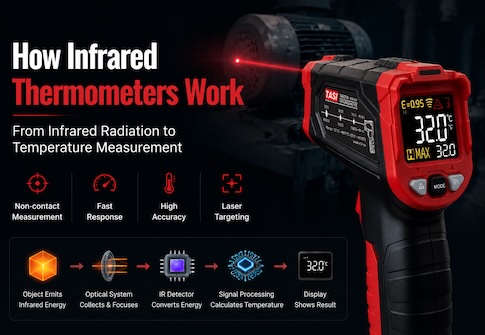
An infrared thermometer collects infrared radiation emitted from a target surface through its optical system. A thermopile or other infrared sensor converts the received radiation into an electrical signal, and the instrument calculates surface temperature according to parameters such as emissivity.
The laser is a separate targeting system.
● It helps the operator identify where the instrument is aimed.
● The laser beam is not the infrared sensing beam.
● The visible laser point does not normally represent the full measurement spot.
● On instruments designed to allow it, infrared temperature measurement can still operate when the laser is switched off.
It is therefore incorrect to assume that the thermometer measures only the small area illuminated by the laser dot. In reality, the instrument measures infrared radiation collected from a defined spot area.
What Are the Characteristics of a Single-Laser Infrared Thermometer?
A single-laser infrared thermometer normally uses one laser point to indicate the approximate centre of the measurement area. It is one of the most common targeting configurations.
Its main advantages are simple operation and clear aiming. For large targets, short measuring distances, and applications where the target is easy to identify, a single laser is often sufficient.
Typical applications include:
● HVAC equipment surface temperature checks;
● Motor, pump, and bearing housing inspection;
● Air outlet, pipe, and radiator checks;
● Food-processing equipment and general industrial surface measurements;
● Building maintenance and routine troubleshooting.
However, a single laser mainly indicates where the centre of the measurement area is located. It does not directly show how large the infrared measurement spot is.
When measuring a small target, working from a greater distance, or inspecting an object surrounded by surfaces at different temperatures, a single laser alone may not be enough to confirm that the target completely fills the measurement spot.
What Are the Characteristics of a Dual-Laser Infrared Thermometer?
A dual-laser system uses two laser points to provide additional spatial reference and can make the measurement area easier to judge than a single-laser system.
Some dual-laser infrared thermometers use the two laser points to indicate opposite sides of the approximate measurement spot. On some designs, the spacing between the laser points changes as the measurement distance changes.
This can be particularly useful for:
● Measuring relatively small mechanical components;
● Positioning the measurement area between closely spaced components;
● Inspecting electrical equipment, terminals, or mechanical assemblies;
● Quickly judging whether the target is large enough during medium-distance measurements;
● Maintenance tasks involving frequent movement between measurement points.
However, dual-laser designs are not standardised across all manufacturers. The two laser points should not automatically be assumed to represent the exact edges of the measurement spot. Always refer to the specific instrument's user manual and optical specifications.
What Are the Characteristics of a Multi-Point Laser Infrared Thermometer?
Multi-point laser systems use several laser points arranged in a circular, ring-shaped, or other pattern to make the approximate measurement area easier to visualise.
Instead of seeing only a single centre point, the operator gains a clearer indication of which area may be included in the infrared measurement.
This is particularly useful when:
● The target is relatively small;
● Measurement distance changes frequently;
● Nearby surfaces have significantly different temperatures;
● The operator needs to confirm quickly that the target covers the measurement area;
● Many measurement points must be checked during industrial maintenance.
The main advantage of multi-point targeting is generally not higher sensor accuracy. Its value lies in reducing errors caused by incorrect aiming or poor judgement of the measurement area.
This can help prevent the measurement spot from unintentionally covering both the target and the surrounding background.
Does More Laser Points Mean Higher Measurement Accuracy?
No.
Infrared thermometer accuracy is mainly affected by the sensor, optical system, calibration, emissivity setting, ambient conditions, and the characteristics of the target surface.
The laser primarily addresses the question of “where am I measuring?” rather than “how accurately does the instrument measure?”
For example, if a single-laser thermometer and a multi-point laser thermometer both have an accuracy specification of ±1.5% and otherwise comparable optical and sensing performance, the model with more laser points cannot automatically be considered more accurate.
The practical benefit of additional laser points is improved targeting and easier identification of the measurement area.
Why Is D More Important Than the Number of Laser Points?
When selecting an infrared thermometer, the D ratio—distance-to-spot ratio—is an important specification for determining how effectively the instrument can measure relatively small targets from a distance.
For example, a D ratio of 12:1 means that, under the stated optical relationship, the measurement distance is approximately 12 times the spot diameter. As the distance increases, the area from which infrared radiation is collected also generally increases.
Therefore, even if an instrument has multiple laser points, an insufficient D ratio can still result in the measurement spot extending beyond a small target and including the surrounding background.
Conversely, a single-laser thermometer with a suitable D ratio can provide reliable measurements when the operator understands the measurement spot size and uses the instrument correctly.
Before choosing the laser configuration, consider:
● How large is the target?
● From what distance will it normally be measured?
● Are nearby surfaces at significantly different temperatures?
● Can the operator approach the target closely?
● Is rapid confirmation of the measurement area important?
The answers to these questions should guide the choice of targeting system.
Which Laser Configuration Is Best for Different Applications?
If the main tasks involve large equipment, walls, pipes, air outlets, or machine housings at relatively short distances, a single-laser model is usually sufficient.
If smaller electrical or mechanical components are frequently measured and clearer indication of the measurement area is required, a dual-laser model may be more convenient.
If the work environment contains closely spaced targets, significant temperature differences, or frequent changes in measurement distance, multi-point laser targeting can make spot-area identification more intuitive.
In simple terms:
● Large targets and short distances: single laser is usually sufficient;
● Smaller targets where spot-area indication is useful: dual laser may be more convenient;
● Complex measurement areas requiring rapid spot identification: multi-point laser offers clearer visual guidance.
The final selection should still consider D ratio, accuracy, temperature range, and emissivity capability rather than relying on laser quantity alone.
What Should You Pay Special Attention to When Measuring Small Targets?
For terminals, bearings, narrow pipes, small electronic components, and similar targets, a common measurement problem is not poor laser alignment but an infrared measurement spot that is larger than the target.
If the spot covers both the target and its surroundings, the instrument receives infrared radiation from both surfaces, which can shift the displayed value away from the actual target temperature.
When measuring small targets:
● Reduce the measurement distance whenever possible;
● Make sure the target is clearly larger than the actual measurement spot;
● Use the D ratio to determine a suitable measurement distance;
● Do not judge the measurement area from laser-dot size alone;
● Take particular care when the surrounding background has a substantially different temperature.
From this perspective, dual- and multi-point laser systems are useful because they can make it easier to notice when the measurement area may extend beyond the target.
When Is the Number of Laser Points Less Important?
In some applications, laser targeting is not a major selection factor.
For example, when measuring a large wall, storage tank, large pipe, or broad heating surface, the target may be much larger than the measurement spot. In these situations, a single laser can already provide adequate aiming assistance.
In strong sunlight or very bright environments, visible laser points may also become difficult to see. Additional laser points cannot replace correct D selection and appropriate measurement distance.
For professional selection, a more practical order is usually:
● Confirm the required temperature range;
● Check accuracy and repeatability;
● Select a suitable D ratio based on target size;
● Determine whether fixed or adjustable emissivity is required;
● Then choose single-, dual-, or multi-point laser targeting according to operational needs.
FAQ
Does a single-laser thermometer measure only the area covered by the laser dot?
No. The laser is only a targeting aid. The actual infrared measurement spot is normally larger than the laser dot and generally increases as measurement distance increases.
Is the area between two laser points always the actual measurement spot?
Not necessarily. Some instruments use this design, but laser indication differs between models. Always refer to the specific optical design, D specification, and user manual.
Is a multi-point laser thermometer always better than a dual-laser model?
No. Multi-point targeting mainly improves visualisation of the measurement area. For large targets measured from short distances, a single- or dual-laser model may already be sufficient.
Why can the reading still be inaccurate even when the laser is correctly aimed?
The measurement spot may extend beyond the target, or the result may be affected by emissivity, reflective surfaces, background radiation, measurement distance, environmental conditions, or instrument accuracy. Correct laser alignment alone does not guarantee correct measurement conditions.
Should I choose more laser points for longer-distance measurements?
Not necessarily. For long-distance measurement, D ratio is the more important specification. When the target is small, a higher D ratio is usually more relevant than the number of laser points.
Does the number of laser points affect response time?
Normally no. Response time is primarily determined by the infrared sensor, electronics, and signal processing system, not by the number of targeting lasers.
Conclusion
The main difference between single-laser, dual-laser, and multi-point laser infrared thermometers is how they help the operator identify the measurement position and approximate measurement area.
Single-laser models are suitable for routine measurements of larger targets at relatively short distances. Dual-laser targeting can provide a clearer indication of the measurement area, while multi-point laser systems are particularly useful for smaller targets, complex measurement environments, or applications where the spot area must be identified quickly.
However, laser quantity should not be treated as the primary measure of infrared thermometer performance. D ratio, temperature range, accuracy, emissivity setting, target size, and measurement distance have a more direct influence on whether an instrument is suitable for a particular application.
The best selection starts with three questions: what needs to be measured, how large is the target, and from what distance will it be measured? The appropriate laser targeting system can then be selected according to operational convenience.