Introduction
Infrared thermometers measure surface temperature without making physical contact with the target. One of the key components that makes this possible is the infrared detector, commonly referred to as an infrared sensor.
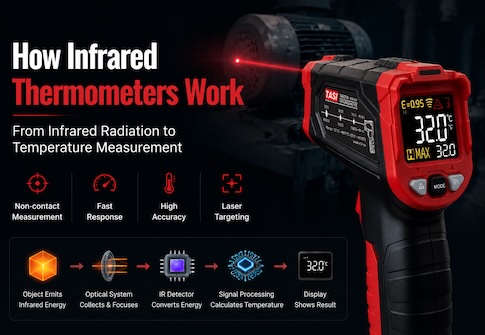
Any object with a temperature above absolute zero emits electromagnetic radiation. An infrared thermometer uses its optical system to collect a portion of this infrared energy and focus it onto the detector. The detector converts the radiation into an electrical signal, which is then processed together with ambient-temperature compensation, emissivity settings, calibration data, and temperature algorithms to determine the target temperature.
Not all infrared thermometers use the same type of detector. Thermopile detectors are widely used in general-purpose handheld infrared thermometers, while other detector technologies may be selected for high-speed measurement, specific spectral bands, or specialized industrial applications.
Key Points
● Infrared thermometers detect infrared radiation emitted from the target surface rather than temperature directly.
● The infrared detector converts incoming infrared radiation into an electrical signal that can be processed by the instrument.
● Thermopile detectors are among the most widely used sensor types in general-purpose handheld infrared thermometers.
● Pyroelectric and photon detectors can also detect infrared radiation, but their operating principles and typical applications differ from thermopiles.
● Detector type can affect spectral range, response time, sensitivity, cost, and applicable temperature range.
● Overall thermometer performance depends not only on the detector but also on the optical system, signal processing, emissivity compensation, ambient-temperature compensation, and calibration.
What Is the Sensor in an Infrared Thermometer?
In an infrared temperature measurement system, the term “sensor” normally refers to the detector element responsible for receiving infrared radiation.
Infrared energy emitted by the target first passes through the thermometer’s lens or optical assembly. The optical system defines the measurement field of view and directs the collected radiation onto the detector. The detector then converts the received energy into an electrical output such as voltage, current, or charge.
A typical infrared temperature measurement process can therefore be summarized as follows:
● The target emits infrared radiation.
● The optical system collects infrared energy from the defined target area.
● The infrared detector converts the radiation into an electrical signal.
● The electronic circuit amplifies and digitizes the signal.
● The system compensates for ambient temperature, emissivity, and other parameters.
● The calculated surface temperature is displayed.
The infrared detector is therefore a critical part of the measurement chain, but it does not determine the performance of the entire instrument by itself.
Thermopile Sensors
A thermopile is one of the most common infrared detector technologies used in handheld infrared thermometers.
It is a thermal infrared detector. Instead of detecting individual photons directly, a thermopile absorbs infrared radiation and converts the resulting temperature difference into an electrical signal through the thermoelectric effect.
A thermopile typically consists of multiple thermocouple junctions connected in series. When infrared radiation reaches the absorber area, a temperature difference develops between the sensing junctions and the reference junctions. This produces a voltage related to the amount of incident infrared energy.
Typical characteristics of thermopile detectors include:
● Operation at room temperature without a complex cooling system;
● Broad infrared response when used with suitable optical components;
● Low power consumption, making them suitable for battery-powered instruments;
● Mature and reliable detector technology;
● Easy integration with infrared optics, filters, and ambient-temperature compensation components;
● A practical balance between performance, size, power consumption, and cost.
These characteristics make thermopiles particularly suitable for industrial maintenance, electrical inspection, HVAC applications, machinery checks, and general non-contact surface-temperature measurement.
The raw output from a thermopile is usually very small. As a result, the thermometer also requires low-noise amplification, accurate analog-to-digital conversion, and temperature-compensation circuitry.
Why Are Thermopiles Commonly Used in Handheld Infrared Thermometers?
Handheld infrared thermometers generally need to be compact, power-efficient, cost-effective, and stable over a reasonably wide ambient-temperature range.
Thermopile technology meets these requirements well.
Many general-purpose infrared thermometers are designed for surface-temperature measurements from around ambient conditions to several hundred degrees Celsius. In such applications, extremely high detector speed or very narrow spectral selectivity is usually less important than stability, reliability, and portability.
When combined with suitable infrared optics and filters, thermopiles can provide a mature and practical detection solution for common non-contact temperature measurement tasks.
For this reason, thermopile detectors are a representative and widely adopted technology in handheld infrared thermometers.
Pyroelectric Infrared Detectors
Pyroelectric detectors are also thermal infrared detectors, but their operating principle differs from that of thermopiles.
Certain pyroelectric materials generate a change in surface charge when their temperature changes. This electrical change can be detected and used to indicate variations in incident infrared radiation.
Pyroelectric detectors are therefore particularly suitable for detecting changes in infrared radiation.
To measure a continuous infrared source, the incoming radiation generally needs to be modulated mechanically, optically, electronically, or through movement of the target.
Typical characteristics include:
● High sensitivity to changes in infrared radiation;
● Capability to operate across relatively broad spectral regions;
● A requirement for modulated or changing incident radiation in many applications;
● Common use in motion sensing, gas analysis, spectroscopy, and specialized infrared detection systems.
Although pyroelectric detectors are important infrared sensing devices, they are generally less common than thermopiles in conventional handheld spot infrared thermometers.
Photon Infrared Detectors
Another major category is the photon detector, also referred to as a quantum infrared detector.
These detectors rely on the interaction between incoming infrared photons and semiconductor materials. The absorbed photons alter the electrical properties or carrier population of the semiconductor, producing a measurable signal.
Different semiconductor materials are sensitive to different infrared spectral regions. Specialized systems may use materials such as InGaAs, InSb, or HgCdTe, depending on the required wavelength range and measurement application.
Compared with thermal detectors, photon detectors often provide:
● Faster response times;
● Higher detector sensitivity in suitable spectral bands;
● Spectral response optimized for specific wavelength ranges;
● Better suitability for rapidly changing targets or specialized optical measurements;
● More demanding system design and signal-processing requirements.
Some detector types also require cooling to reduce noise and achieve their intended performance. This increases system complexity, power consumption, and cost.
Photon detectors are therefore more common in high-speed industrial temperature measurement, scientific instrumentation, spectroscopy, thermal imaging, and other specialized infrared systems than in standard handheld infrared thermometers.
What Is the Difference Between Thermal and Photon Detectors?
Infrared detectors can broadly be divided into thermal detectors and photon detectors according to their operating principle.
A thermal detector first absorbs infrared radiation and experiences a temperature change. The detector then converts this temperature change into an electrical signal. Thermopiles and pyroelectric detectors belong to this category.
A photon detector responds more directly to incoming infrared photons through interactions within a semiconductor material.
Neither type can simply be described as universally “better” or “more accurate.” Each is suited to different measurement requirements.
For portable, low-power, general industrial temperature measurement, thermopile technology is often the more practical choice. Applications requiring very fast response, specific spectral bands, or higher detector sensitivity may benefit from photon-based technologies.
Why Is the Detector’s Spectral Range Important?
Objects at different temperatures do not emit infrared energy in exactly the same spectral distribution. The infrared measurement system therefore needs to be designed around an appropriate wavelength range for the target temperature, material, and application.
General-purpose infrared thermometers often operate in the long-wave infrared region because objects near ambient and moderate temperatures emit significant thermal radiation in this range.
High-temperature metals, glass, plastic films, and other specialized materials may require different measurement wavelengths and detector technologies.
The detector should therefore never be considered independently from the optical system. The effective spectral response of an infrared thermometer depends on several factors:
● Spectral sensitivity of the detector;
● Infrared transmission range of the lens material;
● Spectral characteristics of optical filters;
● Radiation properties of the target surface;
● Intended temperature range and application of the instrument.
These components must be matched as a complete measurement system.
How Does Sensor Type Affect Infrared Thermometer Performance?
The detector is one of several important factors influencing the performance of an infrared thermometer.
Response time: Different detector technologies convert infrared energy into an electrical signal at different speeds. Applications involving rapidly changing temperatures or fast-moving targets may require a faster response.
Sensitivity: The detector must be capable of distinguishing small changes in infrared radiation. Higher detector sensitivity can improve the ability to resolve weak radiation changes, although actual temperature resolution also depends on the electronics and processing algorithms.
Spectral range: Different detector materials respond to different wavelength regions, which directly influences the spectral band in which the thermometer can operate.
Environmental stability: The temperature of the detector itself affects the measurement system. Infrared thermometers therefore normally include reference-temperature sensing and compensation.
Power consumption and construction: Uncooled thermopiles are well suited to compact battery-powered instruments, while cooled high-performance detectors require more complex power and thermal-management systems.
Does the Sensor Determine Measurement Accuracy?
The detector is important, but a more advanced detector does not automatically result in a more accurate infrared thermometer.
An infrared thermometer is a complete optical, electronic, thermal, and computational measurement system. Its accuracy can be influenced by:
● Infrared detector performance;
● Optical-system design;
● D:S distance-to-spot ratio and field of view;
● Signal amplification and analog-to-digital conversion;
● Ambient-temperature compensation;
● Emissivity settings;
● Instrument calibration;
● Surface condition of the target;
● Measurement distance and target size;
● Steam, dust, nearby heat sources, and other environmental influences.
For example, even a high-performance detector cannot provide an accurate result if the target is smaller than the measurement spot or if the emissivity setting is significantly incorrect.
Infrared thermometer selection should therefore focus on complete instrument specifications rather than detector type alone.
What Is the Difference Between the Infrared Detector and the Ambient-Temperature Sensor?
An infrared thermometer normally contains more than one temperature-related sensing element.
The infrared detector measures infrared radiation from the target and forms the basis of non-contact temperature measurement.
The instrument also typically measures its own internal or detector reference temperature for compensation purposes.
This is necessary because the detector itself operates at a certain temperature, and its output is affected not only by radiation from the target but also by its own thermal condition. Accurate temperature calculation therefore requires the instrument to know the detector reference temperature and compensate for it mathematically.
The infrared detector and the internal temperature sensor consequently perform different functions but work together in the overall measurement process.
How Should Infrared Detector Technology Be Selected for Different Applications?
For general industrial maintenance, electrical inspection, HVAC servicing, and everyday surface-temperature measurement, a handheld infrared thermometer using a thermopile detector is usually well suited to the application.
Applications involving extremely fast temperature changes, high-speed production lines, very small high-temperature targets, special materials, or specific infrared wavelength requirements may need a more specialized detector technology.
When selecting an infrared thermometer, it is generally more useful to evaluate complete instrument performance than to focus only on the internal detector type:
● Is the temperature range suitable for the application?
● Does the specified accuracy meet the measurement requirement?
● Is the D:S ratio sufficient for the intended measuring distance?
● Is emissivity adjustable when required?
● Is the response time suitable for the target dynamics?
● Is the spectral response appropriate for the target material?
● Is the instrument rated for the intended environmental conditions?
FAQ
What is the most common sensor used in an infrared thermometer?
Thermopile detectors are among the most common infrared detector types used in general-purpose handheld infrared thermometers. They offer low power consumption, reliable room-temperature operation, broad infrared response, and practical integration.
Does the infrared sensor measure temperature directly?
No. The detector measures infrared radiation from the target and converts it into an electrical signal. The thermometer then calculates surface temperature using detector output, reference temperature, emissivity, and calibration data.
Is a thermopile the same as a thermocouple?
Both use thermoelectric effects, but their applications differ. A conventional thermocouple normally measures temperature through physical contact. A thermopile infrared detector uses multiple thermocouple junctions to detect the temperature difference created by absorbed infrared radiation.
Can pyroelectric sensors be used for infrared temperature measurement?
Pyroelectric detectors can detect infrared radiation, but they are particularly suited to varying or modulated infrared signals. They are therefore less common than thermopiles in general-purpose handheld spot thermometers.
Are photon detectors always more accurate than thermopiles?
No. Photon detectors can provide faster response and high sensitivity, but infrared temperature accuracy depends on the entire system, including optics, signal processing, temperature compensation, emissivity settings, and calibration.
Can changing the detector extend the temperature range of an infrared thermometer?
Detector type and spectral response can influence the available measurement range, but temperature range also depends on optics, filters, electronics, gain, and calibration. It cannot be determined by the detector alone.
Can an infrared sensor measure internal temperature?
Generally, no. Standard infrared thermometers measure surface temperature by detecting infrared radiation reaching the instrument from the target surface.
Conclusion
The infrared detector is a core component of a non-contact infrared temperature measurement system. Its function is to convert infrared radiation emitted by the target into a signal that can be processed electronically.
In general-purpose handheld infrared thermometers, thermopile detectors are widely used because they operate without cooling, consume little power, provide good reliability, and integrate well into portable instruments. Pyroelectric detectors are better suited to varying infrared signals, while photon detectors are commonly used where high-speed response, specific spectral performance, or specialized infrared detection is required.
Infrared temperature measurement, however, is not determined by the detector alone. Detector technology, optics, spectral range, signal processing, ambient-temperature compensation, emissivity settings, and calibration all contribute to the final measurement performance. For this reason, infrared thermometer selection should always be based on the complete application requirements and instrument specifications.