Introduction
A standard infrared thermometer primarily answers the question, “What is the temperature now?” A model with data logging can additionally answer questions such as “What was measured previously?”, “How has the temperature changed?”, and “How do readings at different locations compare?”
For equipment inspection, production monitoring, HVAC testing, quality inspection, and other industrial applications where measurement results need to be retained, data logging can provide significant practical value. However, if the instrument is only used occasionally to check the surface temperature of motors, pipes, air-conditioning components, or other objects, the additional logging function may not be necessary.
The key question is therefore not how many functions an infrared thermometer has, but whether temperature data must be stored, compared, or analyzed after measurement.
Key Points
● Data logging is primarily used to store multiple temperature readings for later review, comparison, and analysis.
● Data logging itself does not improve the measurement accuracy of an infrared thermometer.
● Equipment inspection, production testing, quality control, and temperature trend analysis are applications where logging functions are particularly useful.
● For occasional, simple point measurements, a standard infrared thermometer is usually sufficient.
● In addition to memory capacity, consider timestamps, logging intervals, USB or Bluetooth communication, software support, and export formats.
● In industrial applications, efficient data export and management are often more important than a large internal memory alone.
What Is an Infrared Thermometer with Data Logging?
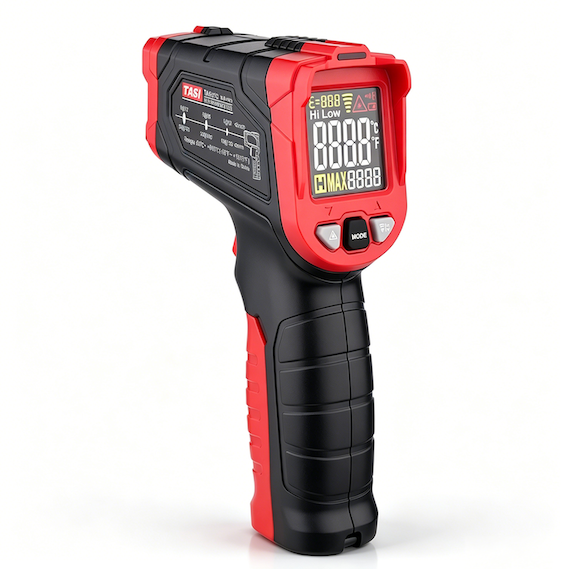
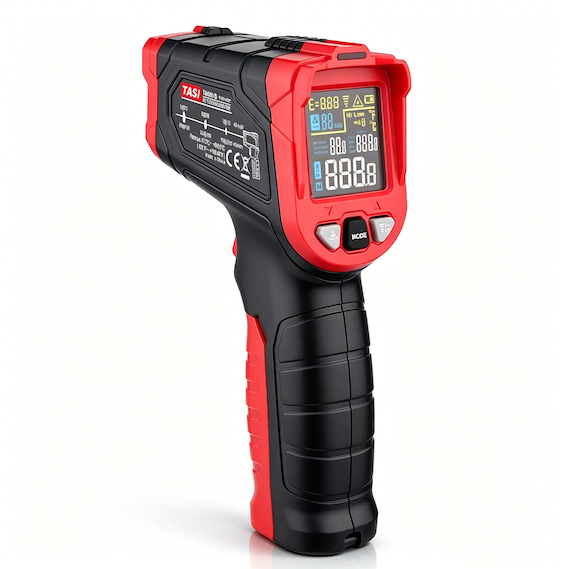
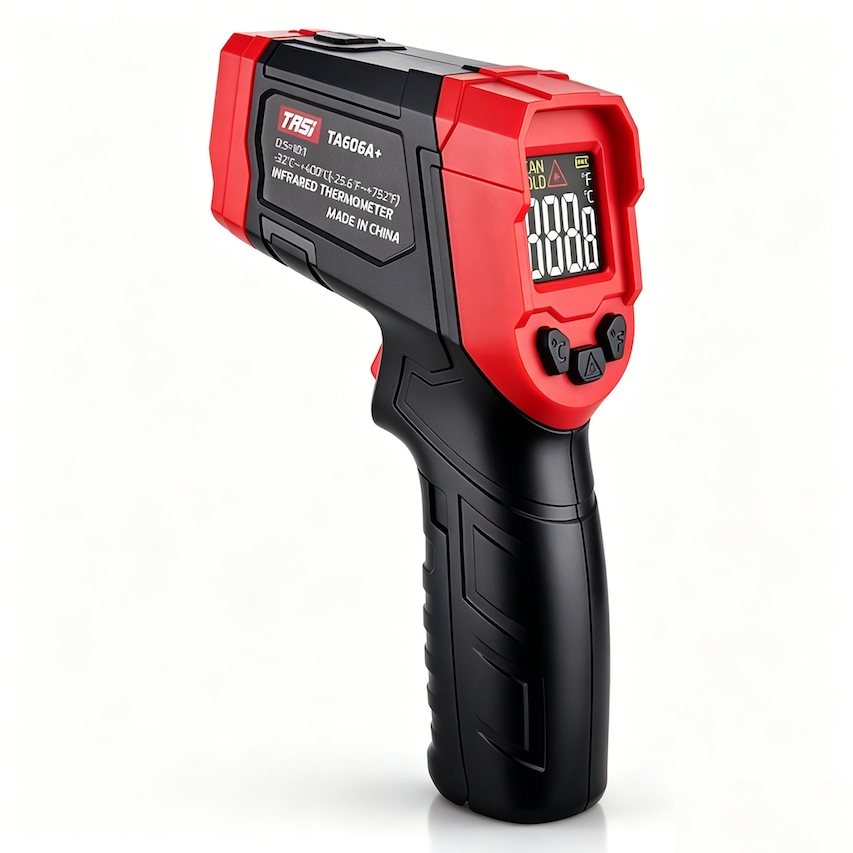
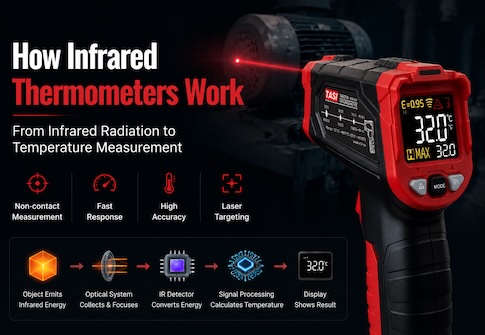
An infrared thermometer measures surface temperature without contact by detecting infrared radiation emitted from the target surface.
A standard infrared thermometer generally displays the current temperature and may include basic functions such as Hold, MAX, MIN, or AVG. A data-logging model can additionally store multiple measurements in internal memory. Some instruments can also transfer data to a computer or mobile device through USB, Bluetooth, or dedicated software.
Depending on the instrument design, data logging may include:
● Manual storage of individual measurements;
● Automatic recording at predefined intervals;
● Storage of MAX, MIN, AVG, or other statistical values;
● Date and time information for each measurement;
● USB data transfer to a computer;
● Bluetooth transmission to a smartphone or tablet;
● PC software for displaying measurement lists or trend graphs;
● Export to CSV, spreadsheet-compatible files, or other data formats.
Data logging is therefore more than simply adding memory. It makes temperature measurements easier to trace and manage over time.
What Is the Main Value of Data Logging?
For a one-time temperature check, the operator may only need to read the display and complete the task. In industrial maintenance and process inspection, however, a single temperature value often does not provide enough information about equipment condition.
For example, a motor measured at 65 °C today may not immediately appear abnormal. If the same location has consistently measured 45–50 °C over previous months, the 65 °C reading becomes much more significant.
This is where recorded historical data becomes valuable.
● Compare the same equipment at different times;
● Compare temperature differences between similar machines;
● Track temperature rise after equipment start-up;
● Record conditions before and after maintenance;
● Monitor temperature changes during production;
● Provide measurement records for maintenance reports, quality documentation, or customer reports.
For users responsible for long-term equipment condition monitoring, historical data can be more valuable than an isolated measurement.
Which Applications Benefit Most from Data Logging?
Data logging is particularly useful when measurements are repetitive, periodic, or need to be documented.
● Industrial equipment inspection: Regularly check motors, bearings, pumps, gearboxes, electrical cabinets, switchgear, and mechanical components while comparing results across inspection cycles.
● HVAC testing: Record surface temperatures on air outlets, ductwork, heat exchangers, compressors, condensers, and other HVAC equipment.
● Production process inspection: Check conveyors, rollers, heating systems, molds, plastics-processing equipment, and different stations along a production line.
● Quality control: Store product or workpiece measurements for batch comparison, anomaly analysis, and production documentation.
● Equipment maintenance: Record temperature before, during, and after maintenance to help assess the effect of corrective work.
● Laboratory and education: Record surface temperatures under different material, environmental, or time conditions.
When dozens or even hundreds of measurement points must be checked every day, manual transcription can be inefficient and prone to errors. In these cases, onboard storage and data export become considerably more valuable.
When Is a Standard Infrared Thermometer Sufficient?
Not every user needs a data-logging instrument.
A standard infrared thermometer is usually sufficient when the main tasks involve:
● Quickly checking whether an object is overheating;
● Occasional inspection of motors, pipes, or HVAC equipment;
● Viewing only the current surface temperature;
● Measuring a small number of points;
● No requirement to prepare inspection reports;
● No need to retain historical measurement data.
For example, if a technician only needs to confirm whether a bearing is running unusually hot and does not need to store the result, internal memory, USB communication, or analysis software may provide little practical benefit.
In such cases, budget is often better allocated to core measurement parameters such as temperature range, accuracy, D:S, emissivity, and response time.
Does Data Logging Improve Measurement Accuracy?
No.
This is a common misconception when selecting a data-logging infrared thermometer.
Data logging improves data storage, management, and analysis. It does not directly improve the optical system, infrared detector, or measurement algorithm. A model with data logging is therefore not automatically more accurate than a model without it.
Infrared measurement accuracy still depends on factors including:
● Instrument accuracy specification;
● D:S ratio;
● Target size;
● Emissivity setting;
● Measurement distance;
● Measurement angle;
● Surface material and condition;
● Ambient temperature;
● Steam, smoke, dust, or other obstructions in the optical path.
When comparing two infrared thermometers, first confirm that their fundamental measurement performance meets the application requirements, and only then consider whether data logging is needed.
Do Not Evaluate Data Logging Only by Memory Capacity
The number of stored readings is easy to compare, but it is not the only important parameter.
For example, an instrument may store several hundred measurements, but if the records have no timestamp and can only be reviewed individually on the display, managing a large volume of data may still be inefficient.
Important points to check include:
● Whether date and time can be stored;
● Whether automatic continuous logging is supported;
● Whether the logging interval can be configured;
● Whether MAX, MIN, and AVG values can be stored;
● Whether USB communication is available;
● Whether Bluetooth communication is available;
● Whether supporting software is provided;
● Whether data can be exported in batches;
● Whether the export format is convenient for further processing;
● Whether temperature trend graphs can be generated.
For large inspection programs, how easily the data can be retrieved is often more important than the total number of readings that can be stored internally.
What Is the Difference Between Manual and Automatic Logging?
Manual logging usually allows the operator to save the current reading after each measurement. This is suitable for equipment inspection, multi-point surveys, and applications where different locations need to be recorded individually.
Automatic logging records data continuously at a predefined interval, such as every second, every 10 seconds, or every minute. Available intervals and maximum recording duration depend on the individual instrument.
Automatic logging is particularly useful for observing temperature changes during:
● Equipment warm-up after start-up;
● Operation of heating systems;
● Cooling processes;
● Continuous workpiece processing;
● Periodic temperature changes on a surface.
When using a handheld infrared thermometer for continuous logging, the measurement position, angle, and distance should remain reasonably stable. Otherwise, apparent temperature changes may result from changing measurement conditions rather than from the target itself.
Are USB and Bluetooth Worth Having?
The value of USB or Bluetooth communication depends mainly on how the data will be used.
USB communication is often better suited to industrial inspection, laboratories, and applications where data must be archived on a computer. Large quantities of readings can be transferred to a PC for organization, trend analysis, or report preparation.
Bluetooth is convenient for field work, allowing measurements to be viewed, stored, or managed on a smartphone or tablet while reducing the need for manual transcription.
If an organization needs to maintain long-term equipment inspection records, it is generally more useful to select a model with practical data export or communication capabilities rather than one offering internal storage only.
For OEM, quality-management, and industrial maintenance applications, software compatibility, data format, and communication method should also be confirmed before purchase.
Can Data-Logging Infrared Thermometers Replace Dedicated Temperature Data Loggers?
Not necessarily.
The main advantages of a handheld infrared thermometer are non-contact measurement, fast response, and flexible inspection of many target surfaces.
Dedicated temperature data loggers are generally better suited to fixed, long-duration monitoring and may use thermocouples, RTDs, or other temperature sensors for continuous acquisition.
The two instruments serve different purposes.
If personnel need to inspect multiple pieces of equipment each day and retain the surface temperature of each measurement point, a data-logging infrared thermometer is often very practical.
If a fixed point must be monitored continuously for hours, days, or longer, a dedicated temperature data logger may be more appropriate.
The choice should therefore be based on the measurement method and monitoring duration rather than simply on whether an instrument can store data.
Which Other Infrared Thermometer Specifications Should Be Checked?
Even when data logging is required, the basic infrared measurement performance should remain the priority.
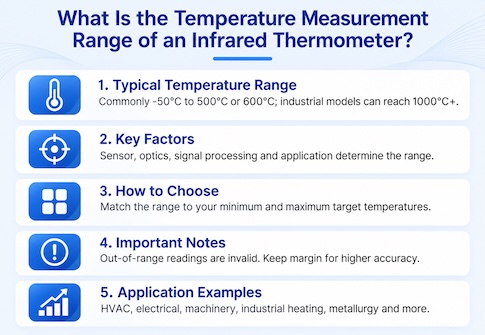
● Temperature range: Confirm that the minimum and maximum temperatures cover the intended application.
● D:S ratio: Determines the size of the measurement area at a given distance and is particularly important when measuring small targets from farther away.
● Emissivity: Adjustable emissivity provides greater flexibility for measuring different surface materials.
● Accuracy: Select an accuracy specification appropriate to the application.
● Response time: Particularly important for moving targets or rapidly changing surfaces.
● Spectral response: Determines the wavelength range over which the instrument detects infrared radiation.
● Alarm functions: HI/LO alarms can help identify abnormal temperatures quickly.
● Communication interface: Select USB, Bluetooth, or other interfaces according to the required data-management workflow.
Data logging should therefore be considered an additional productivity feature rather than a substitute for core measurement performance.
How Can You Decide Whether Data Logging Is Worth the Extra Cost?
Consider what happens to the measurement data after the reading is taken.
If your work frequently raises questions such as:
● What was the previous reading?
● Has the temperature of this machine been increasing over time?
● Where are today’s measurements from dozens of inspection points stored?
● Can the readings be transferred to a computer?
● Can the results be used in an inspection or quality report?
● How do temperatures compare between different production batches?
Then data logging is usually worth considering.
If the normal workflow is simply “aim—measure—read—finish,” a standard model is often the more economical and practical option.
The objective is not to purchase the instrument with the most functions, but to match the instrument to the actual measurement workflow.
FAQ
Is an infrared thermometer with data logging always better?
No. Data logging improves traceability and data management but does not automatically provide better accuracy, temperature range, or D:S performance. Selection should be based on the application.
Does data logging improve infrared temperature measurement accuracy?
No. Accuracy depends primarily on the instrument specification, emissivity, D:S ratio, target size, measurement distance, and environmental conditions.
Is internal memory useful without USB communication?
Yes, particularly when only a limited number of readings need to be retained and reviewed directly on the instrument. For larger datasets or report preparation, USB, Bluetooth, or another export method is more practical.
Is a data-logging infrared thermometer suitable for equipment inspection?
Yes. It is particularly useful when motors, bearings, electrical equipment, HVAC systems, or production equipment are inspected regularly and historical measurements need to be compared.
Can an infrared thermometer record temperature continuously for an entire day?
This depends on the model, memory capacity, battery life, logging interval, and software capabilities. For long-duration fixed monitoring, a dedicated temperature data logger should also be considered.
Which is better, Bluetooth or USB?
Bluetooth is convenient for field use and mobile-device data management. USB is generally more suitable for transferring large datasets to a computer for archiving and reporting. Some instruments provide both.
Conclusion
An infrared thermometer with data logging is not essential for every user, but it can significantly improve data management when measurements need to be repeated, stored, compared, or reviewed over time.
Equipment maintenance, HVAC testing, production process inspection, quality control, and industrial inspection are applications where internal logging, USB communication, Bluetooth connectivity, and PC software can provide clear practical benefits.
For occasional single-point surface temperature checks, a standard infrared thermometer is usually sufficient. In this case, temperature range, accuracy, D:S ratio, emissivity, and response time should take priority.
A simple selection principle applies: if temperature measurements need to be stored, compared, or analyzed after they are taken, data logging is generally worth considering. If only the current reading matters, there is usually little reason to pay extra solely for additional logging functions.