Introduction
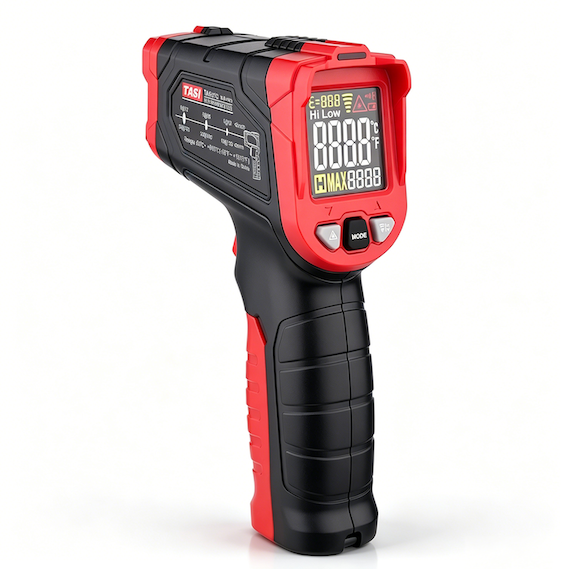
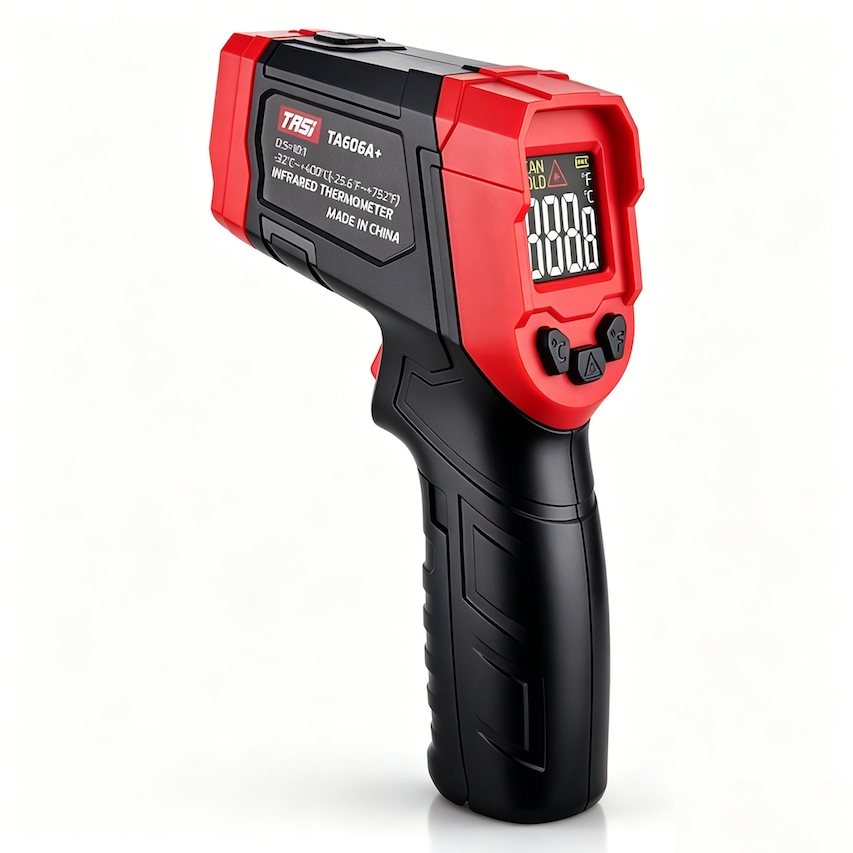
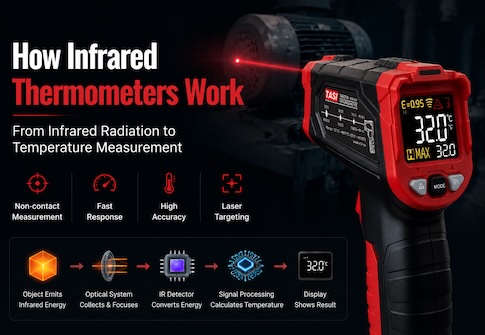
The main advantage of a standard infrared thermometer is fast, non-contact temperature measurement. The operator can measure a surface without physically touching the target. However, infrared temperature measurement is based on the thermal radiation emitted by a surface, so results can be affected by emissivity, surface reflectivity, measuring distance, target size, and environmental conditions.
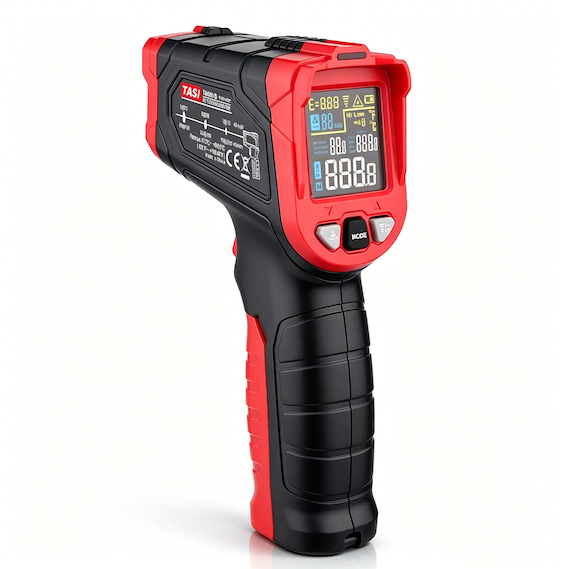
An infrared thermometer with a K-type thermocouple input adds contact temperature measurement to the same instrument. Depending on the application, the user can switch between infrared non-contact measurement and K-type thermocouple measurement.
This combination is more than an additional feature. It allows one instrument to handle a wider range of temperature measurement tasks. For professionals who need fast screening, local verification, surface measurement, and contact temperature checks, this type of thermometer can be more versatile than a single-method instrument.
Key Points
● An infrared thermometer with K-type thermocouple input supports both non-contact infrared measurement and contact temperature measurement;
● It is particularly suitable for industrial maintenance, HVAC, electrical inspection, equipment commissioning, production testing, and field engineering;
● Infrared measurement is ideal for rapid scanning and for hot, moving, energized, or difficult-to-access targets, while a K-type thermocouple is useful for contact verification and measurements at specific points;
● For low-emissivity metals and other surfaces that are difficult to measure reliably with infrared technology, a K-type thermocouple can provide an important complementary measurement method;
● Users who only perform simple surface temperature checks in consistent conditions may not require a thermocouple input;
● Selection should consider not only temperature range but also D:S ratio, emissivity adjustment, infrared accuracy, K-type thermocouple input range, and probe compatibility.
Why Combine Infrared and K-Type Thermocouple Measurement?
Infrared measurement and thermocouple measurement address different temperature measurement requirements.
Infrared measurement is fast and does not require physical contact with the target. It is therefore particularly suitable for hot surfaces, rotating equipment, moving components, energized equipment, and locations that are difficult or unsafe to reach directly.
A K-type thermocouple, by contrast, requires the sensing probe to contact the target or be inserted into the medium being measured. Depending on the probe design, it can be used for surfaces, air, liquids, pipes, internal equipment locations, and other defined measurement points.
Combining both methods in one instrument allows the user to select the more appropriate technique according to the actual measurement conditions.
For example, a maintenance technician can first scan dozens of equipment points with the infrared function to identify abnormal temperatures, and then use a suitable K-type thermocouple probe for further measurement or verification. This is often more efficient than taking contact measurements at every point.
Is It Suitable for Industrial Maintenance Personnel?
Industrial maintenance is one of the most typical applications for this type of instrument.
Motors, bearings, pumps, compressors, gearboxes, pipelines, heating equipment, and production machinery often contain numerous points that require temperature inspection. Maintenance personnel generally need to identify abnormal conditions quickly rather than attach a contact probe to every location.
Infrared measurement allows rapid scanning of equipment surfaces and can help identify abnormal temperature patterns by comparing different locations or monitoring the same equipment over time.
If an unusual temperature rise is detected and further confirmation is required, a suitable K-type surface probe or other thermocouple probe can be connected for contact measurement.
For users involved in preventive maintenance, routine equipment inspection, and troubleshooting, the combination of infrared and thermocouple measurement can therefore be highly practical.
Why Is This Type of Instrument Useful for HVAC Technicians?
HVAC systems involve many different temperature measurement points, including air outlets, ducts, coils, compressors, condensers, evaporators, supply and return pipes, and equipment housings.
Different targets do not always require the same measurement method.
● Infrared measurement can be used for air outlets, equipment surfaces, and external pipe surfaces;
● A suitable K-type air probe can be used for air temperature measurement;
● Surface or clamp probes can be used for contact measurement on pipes;
● Immersion, penetration, or other K-type probes can be selected for liquids or internal equipment measurements.
Compared with a thermometer offering only infrared measurement, a model with K-type thermocouple input is therefore better suited to HVAC installation, commissioning, service, and maintenance personnel who work with multiple types of temperature measurement.
Do Electrical Maintenance Professionals Need K-Type Thermocouple Input?
Infrared thermometers are convenient for inspecting electrical panels, circuit breakers, terminals, cable connections, transformer housings, and other electrical equipment because temperatures can be checked without direct contact with energized components.
However, infrared thermometers measure surface radiation, and the condition of a metal surface can significantly affect the result.
Bright copper, aluminum, stainless steel, and other low-emissivity metals may reflect infrared radiation from the surrounding environment, which can lead to substantial measurement errors.
If equipment has been de-energized and the measurement can be performed safely, a suitable K-type contact probe may provide an additional method of checking temperature.
A thermocouple input, however, does not mean that the probe may be used indiscriminately on energized equipment. Electrical safety procedures and applicable operating requirements must always be followed.
Is It Suitable for Production and Process Inspection?
Production environments often require both rapid inspection of multiple products and more specific temperature checks at critical points.
Applications may include plastics processing, mechanical manufacturing, drying, heating, packaging, food-processing equipment, and various material-processing operations.
Infrared mode is useful for quickly checking surface temperatures and temperature trends, while a K-type thermocouple can be used for defined points, internal locations, or applications requiring contact measurement.
For production, quality-control, and process personnel who need one handheld instrument for different temperature measurement tasks, this combination can reduce the need to carry separate devices.
Is It Suitable for High-Temperature, Moving, or Difficult-to-Reach Targets?
These are precisely the types of applications where infrared measurement provides a major advantage.
Rotating equipment, products moving on conveyors, heating elements, high-temperature surfaces, and locations that are difficult to access can often be checked more conveniently with infrared measurement.
However, once machinery has stopped, temperatures have decreased, or safe physical access is available, a further contact measurement may be required.
An infrared thermometer with K-type thermocouple input allows the operator to connect an appropriate probe without switching to a separate temperature meter.
For field engineers working in changing measurement conditions, this flexibility can often be more useful than simply choosing an instrument with a wider temperature range.
Do Users Measuring Metal Surfaces Benefit More from a K-Type Thermocouple Input?
For users who frequently measure bright metal, aluminum, copper, stainless steel, or similar surfaces, a K-type thermocouple input is especially worth considering.
Infrared measurement depends on target emissivity. Oxidized, painted, rough, or coated metal surfaces are generally easier to measure with infrared technology than polished metal.
On low-emissivity, highly reflective metal surfaces, changing the emissivity setting alone may not fully eliminate the influence of reflected infrared radiation from the surroundings.
Where safe and practical, a suitable K-type surface thermocouple can provide temperature information based on a different measurement principle.
For users in metalworking, equipment maintenance, machinery manufacturing, and industrial servicing, dual measurement capability can therefore provide greater practical value than infrared measurement alone.
Who May Not Need a K-Type Thermocouple Input?
Not every user needs a model with additional measurement functions.
If routine work mainly involves quick temperature checks on walls, floors, ordinary equipment housings, food surfaces, or other relatively high-emissivity targets, and contact measurement is not required, a standard infrared thermometer may be sufficient.
If a site already uses a dedicated professional thermocouple thermometer, users can also decide whether an additional thermocouple input on the infrared thermometer would provide meaningful operational benefits.
The key question is therefore not whether more functions are better, but whether the work frequently requires contact measurement after a rapid infrared inspection.
Which Specifications Matter Most When Choosing a Model?
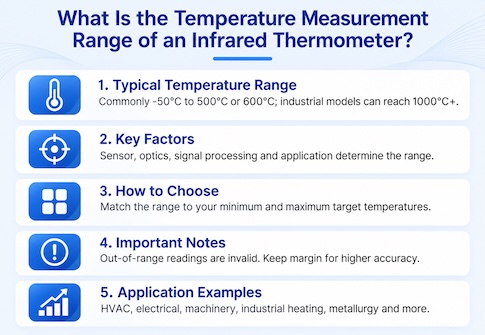
When selecting an infrared thermometer with K-type thermocouple input, the infrared and thermocouple functions should be evaluated separately rather than focusing only on the instrument’s maximum temperature range.
● Infrared temperature range: It should cover the actual target temperatures encountered in normal use with an appropriate margin;
● D:S ratio: This determines the measurement spot size at a given distance and is particularly important when measuring small targets or working from farther away;
● Emissivity adjustment: Adjustable emissivity provides greater flexibility when measuring different materials;
● Infrared accuracy: Evaluate accuracy within the actual operating temperature range rather than considering only the maximum range;
● Response time: Important for moving targets and surfaces undergoing rapid temperature changes;
● K-type thermocouple input range: It should match the temperatures expected in the intended applications;
● Probe type: Different K-type thermocouple probes are designed for surface, air, liquid, penetration, and other applications;
● Connector compatibility: Confirm that the instrument is compatible with the intended K-type thermocouple connector and probe;
● MAX, MIN, AVG, and Data Hold functions: These can be useful for maintenance, comparative measurements, and field recording.
Is a Higher K-Type Thermocouple Range Always Better?
Not necessarily.
The temperature range supported by the instrument’s K-type thermocouple input and the usable temperature range of the connected probe are two different specifications.
Even if the meter itself supports a high temperature range, this does not mean that every K-type thermocouple probe can be used continuously at that temperature.
The allowable probe temperature depends on factors such as thermocouple materials, probe construction, insulation, sheath material, cable design, and environmental conditions.
The input range of the instrument and the permitted operating range of the probe should therefore both be verified during selection.
Why Can Infrared and K-Type Thermocouple Readings Be Different?
The two methods operate according to different measurement principles and may not measure exactly the same physical location. A difference between their readings does not necessarily indicate an instrument fault.
An infrared thermometer detects thermal radiation from a defined measurement area on the surface, whereas a thermocouple measures the local temperature of its sensing junction after sufficient thermal contact has been established.
Differences may also result from the following factors:
● The infrared measurement area and thermocouple contact point are not exactly the same;
● A temperature gradient exists across the target surface;
● The emissivity setting does not match the target material;
● The thermocouple does not have adequate contact with the surface;
● The probe has not yet reached thermal stability;
● The infrared measurement spot includes surrounding areas;
● Ambient radiation or airflow affects one of the measurement methods.
The two modes should therefore not be expected to display exactly the same value under all conditions. A better approach is to make the measurement locations and conditions as consistent as possible and then evaluate any remaining difference.
Can Dual-Mode Temperature Measurement Replace Specialized Instruments?
That depends on the application.
For routine equipment inspection, HVAC maintenance, troubleshooting, field commissioning, and general production testing, an infrared thermometer with K-type thermocouple input can significantly improve field flexibility.
However, laboratory calibration, high-accuracy temperature metrology, long-term data logging, and specialized industrial process control may still require dedicated temperature measurement systems.
This type of product is therefore best regarded as a versatile field temperature measurement instrument rather than a replacement for every type of specialized temperature equipment.
FAQ
Can an infrared thermometer with K-type thermocouple input measure two temperatures at the same time?
This depends on the specific instrument design. Some models allow the user to switch between infrared and K-type readings, while others may support dual-temperature display or temperature-difference comparison. The product specifications should be checked before purchase.
Can any K-type thermocouple probe be connected?
Not necessarily. Connector size, mechanical interface, polarity, and supported thermocouple type must be confirmed. Even among K-type thermocouples, connector configurations may differ.
Do I still need to set emissivity when using a K-type thermocouple?
Yes, for infrared measurement. Emissivity is relevant to the infrared function. K-type thermocouple measurement does not depend on surface emissivity, but the correct emissivity setting is still required when switching back to infrared mode.
Should stainless steel be measured with infrared or a K-type thermocouple?
It depends on the surface condition and measurement environment. Bright, low-emissivity stainless steel is more susceptible to reflected infrared radiation. If safe physical contact is possible, an appropriate surface thermocouple can be used as an alternative or for additional verification.
Can a K-type thermocouple measure air and liquids?
Yes, provided an appropriate probe is selected. Air probes, immersion probes, surface probes, and penetration probes have different constructions and should be matched to the intended application.
Does a general user need an infrared thermometer with thermocouple input?
For occasional surface temperature checks, usually not. The thermocouple input becomes more valuable for industrial maintenance, HVAC inspection, equipment commissioning, metal-surface measurement, and other applications involving multiple temperature measurement methods.
Conclusion
An infrared thermometer with K-type thermocouple input is most suitable for professional users who need to handle a variety of temperature measurement tasks.
Its main advantage is not simply the addition of another function, but the combination of two complementary measurement methods: infrared measurement provides fast, non-contact screening, while a K-type thermocouple provides contact measurement and temperature checks at defined locations.
For industrial maintenance, HVAC, electrical inspection, equipment commissioning, production testing, machinery manufacturing, and field engineering, an instrument that supports both infrared and K-type thermocouple measurement can improve efficiency by allowing the operator to switch between methods as required.
If the work frequently involves identifying an abnormal temperature quickly and then performing a more specific contact measurement, an infrared thermometer with K-type thermocouple input is well worth considering. If the application is simple and limited to routine non-contact surface temperature checks, a standard infrared thermometer may be sufficient.