Introduction
Temperature measurement plays an important role in industrial inspection, equipment maintenance, laboratory testing, and daily applications. With the continuous development of measurement technology, infrared thermometers and contact thermometers have become two commonly used temperature measurement solutions.
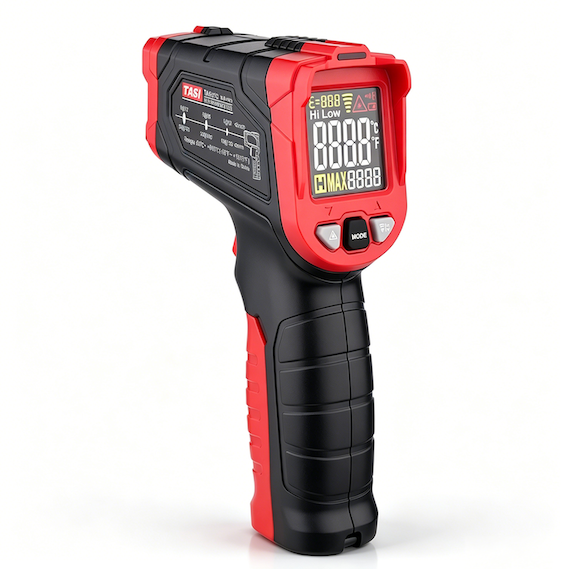
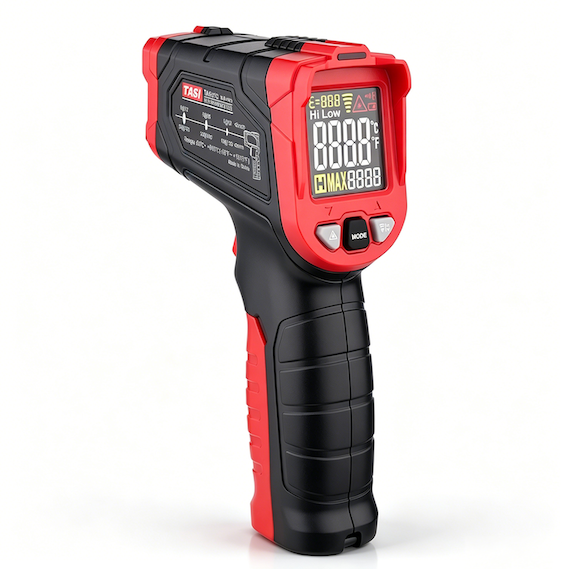
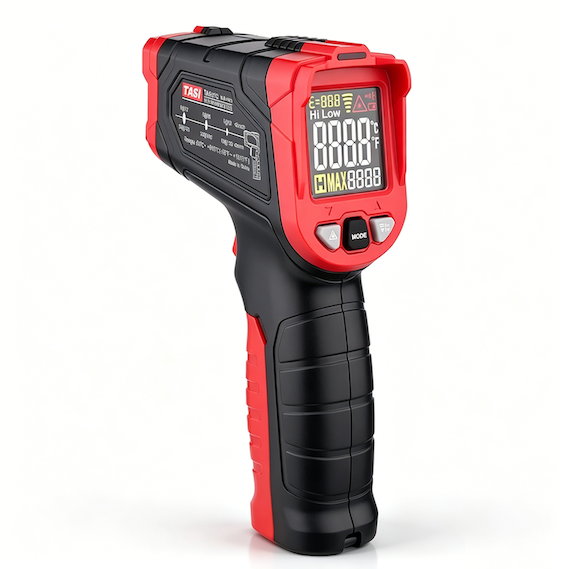
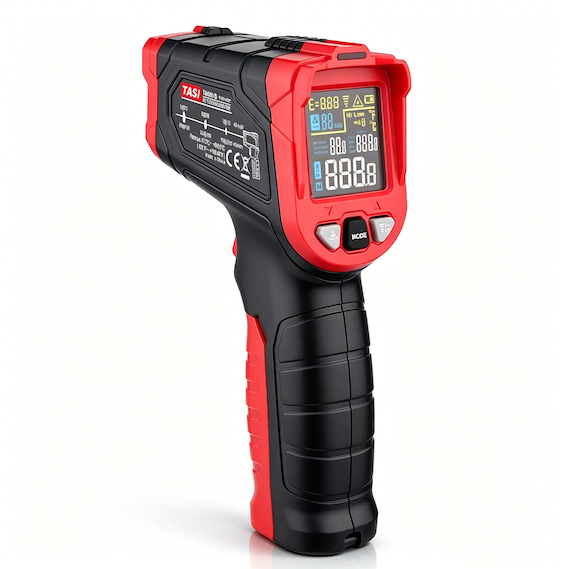
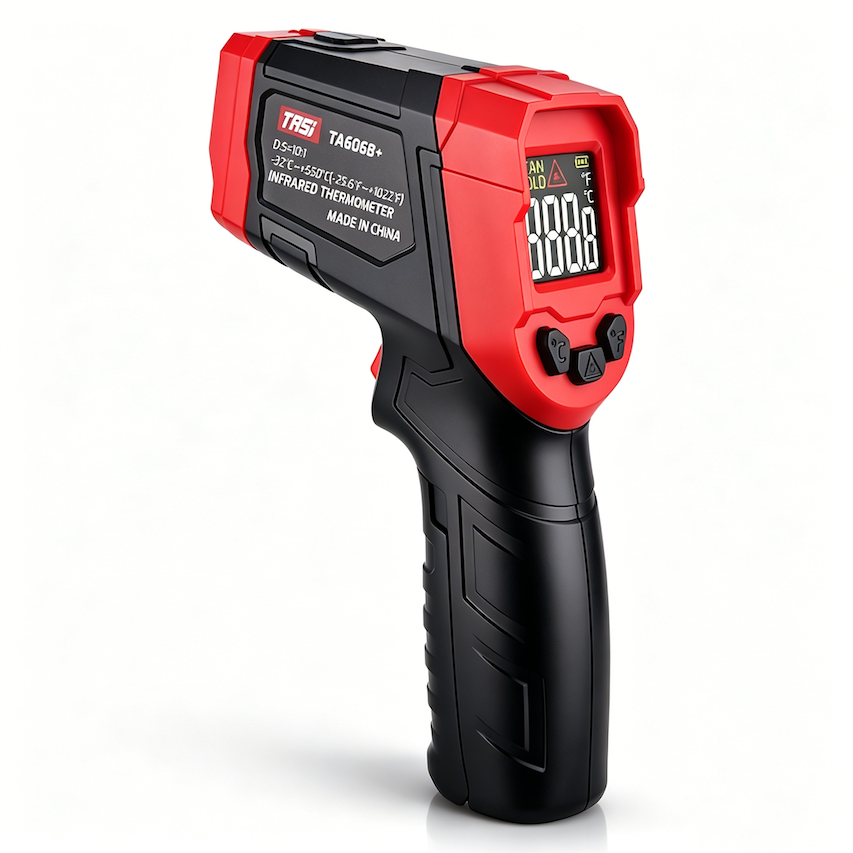
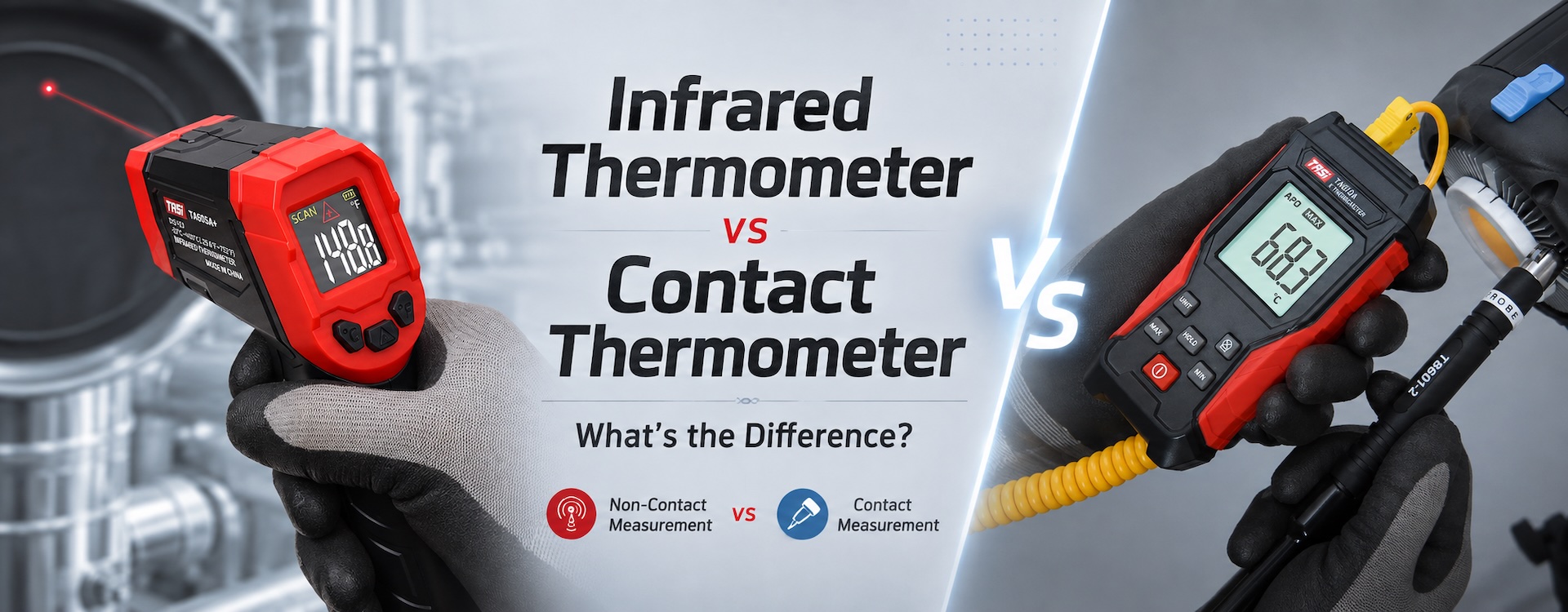
Although both instruments are designed to measure temperature, their working methods are fundamentally different. An infrared thermometer measures temperature without physical contact by detecting infrared radiation emitted from an object, while a contact thermometer requires direct contact between the sensor probe and the measured object to obtain temperature data.
Understanding the differences between these two measurement methods helps users select the right instrument based on measurement conditions, accuracy requirements, and application environments.
Key Points
● Infrared thermometers measure temperature by detecting infrared radiation emitted from an object surface;
● Contact thermometers require direct contact with the target through a temperature sensor probe;
● Infrared thermometers provide fast response, safe operation, and convenient non-contact measurement;
● Contact thermometers usually offer excellent stability and are suitable for precise point temperature measurement;
● The best choice depends on the specific measurement environment and application requirements.
Differences in Measurement Principles
The main difference between infrared thermometers and contact thermometers lies in their measurement principles.
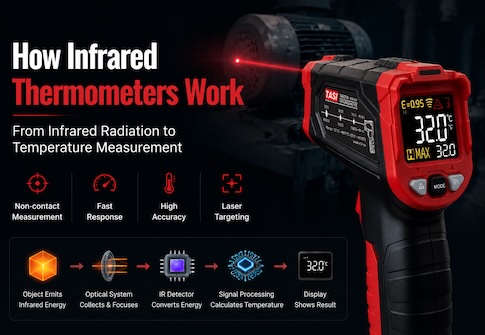
Infrared thermometers work based on the principle that all objects above absolute zero emit infrared radiation. The instrument detects the infrared energy emitted from the target surface through an infrared sensor and calculates the surface temperature based on the detected radiation and the configured emissivity value.
Because measurement is performed without physical contact, infrared thermometers can quickly obtain temperature readings from a distance.
Contact thermometers measure temperature through direct contact between a sensor probe and the measured object. Common sensing elements include thermocouples, thermistors, and resistance temperature detectors (RTDs). The sensor converts temperature changes into electrical signals, which are then processed and displayed as temperature values.
Since the probe must physically contact the target, contact thermometers generally provide stable and reliable measurements under controlled conditions.
Differences in Measurement Methods
Infrared thermometers use a non-contact measurement method.
● No direct contact with the target surface is required;
● Suitable for measuring high-temperature, moving, or difficult-to-access objects;
● The measurement process does not affect the condition of the measured object.
Contact thermometers use a direct-contact measurement method.
● The probe must be placed directly on or inside the measured object;
● The sensor needs sufficient time to reach thermal equilibrium;
● Suitable for applications requiring continuous monitoring or accurate point measurement.
Differences in Response Time
Infrared thermometers usually provide very fast measurement response and can obtain temperature readings within seconds or less, making them ideal for rapid inspection tasks.
For example, maintenance technicians can use infrared thermometers to quickly check motors, electrical cabinets, pipelines, and mechanical equipment to identify abnormal heat conditions.
Contact thermometers require heat transfer between the measured object and the sensor probe. The response time depends on factors such as probe material, size, and contact conditions. Although some advanced contact thermometers provide fast response, they generally require more measurement time compared with infrared thermometers.
Differences in Measurement Accuracy
The accuracy of infrared thermometers can be affected by environmental and application factors.
Important factors include:
● Surface emissivity of the measured object;
● Distance-to-spot ratio (D:S ratio);
● Ambient temperature changes;
● Surface reflection characteristics.
For example, low-emissivity materials such as polished metals may cause measurement errors if the emissivity setting is incorrect.
Because contact thermometers directly measure temperature through the sensor probe, they are less affected by surface characteristics and environmental radiation. Under stable measurement conditions, they usually provide excellent repeatability and measurement stability.
Differences in Applications
Infrared thermometers are especially suitable for fast inspection and situations where direct contact is difficult.
Typical applications include:
● Industrial equipment inspection;
● Electrical system temperature monitoring;
● HVAC system testing;
● Automotive engine and mechanical component inspection;
● Food processing temperature checks;
● High-temperature surface measurement.
Contact thermometers are more suitable for applications requiring accurate measurement at a specific point.
Typical applications include:
● Laboratory temperature measurement;
● Internal food temperature testing;
● Liquid temperature measurement;
● Equipment temperature monitoring;
● Temperature calibration and verification.
Comparison Between Infrared Thermometers and Contact Thermometers
| Comparison Item | Infrared Thermometer | Contact Thermometer |
|---|---|---|
| Measurement Method | Non-contact measurement | Direct-contact measurement |
| Response Speed | Fast response | Relatively slower |
| Safety | Can measure from a distance | Requires access to the target |
| Measurement Object | Surface temperature | Point temperature |
| Moving Targets | Suitable | Generally unsuitable |
| High Temperature Applications | More convenient | Limited by probe temperature range |
| Measurement Stability | Affected by environment | Usually highly stable |
How to Choose the Right Temperature Measurement Tool
Choosing between an infrared thermometer and a contact thermometer depends on the actual application requirements.
If fast inspection, remote measurement, or measurement of hazardous, hot, or moving objects is required, an infrared thermometer is usually the better choice.
For example, infrared thermometers are widely used in electrical maintenance, industrial equipment inspection, and production line monitoring because they improve efficiency and reduce safety risks.
If measuring internal temperature, liquid temperature, or applications requiring high repeatability and stability, a contact thermometer is usually more suitable.
In many professional applications, both technologies can complement each other. Users can first perform rapid screening with an infrared thermometer and then verify critical points using a contact thermometer.
Important Considerations When Using an Infrared Thermometer
● Set the correct emissivity value according to the material being measured;
● Ensure the measurement distance matches the target size and D:S ratio requirements;
● Avoid measuring through glass, steam, or other materials that affect infrared transmission;
● Allow the instrument to adapt to the ambient temperature before measurement;
● Regularly verify instrument performance to maintain measurement reliability.
Important Considerations When Using a Contact Thermometer
● Ensure the probe has sufficient contact with the measured object;
● Prevent damage or contamination of the temperature probe;
● Select the appropriate probe type according to the measurement application;
● Confirm the probe temperature range before high-temperature measurements;
● Perform regular calibration to maintain measurement accuracy.
FAQ
Which is more accurate, an infrared thermometer or a contact thermometer?
Both have their own advantages. Contact thermometers generally provide excellent stability under proper contact conditions, while infrared thermometers can also achieve accurate surface temperature measurement when emissivity and measurement conditions are correctly configured.
Can an infrared thermometer replace a contact thermometer?
Not completely. Infrared thermometers are ideal for fast surface temperature inspection, while contact thermometers are better suited for internal temperature measurement and applications requiring high stability.
Why do infrared thermometer readings vary?
Measurement variations may be caused by incorrect emissivity settings, measurement distance, ambient temperature changes, surface reflection, or improper operation.
Why does a contact thermometer require waiting time?
Because the probe needs time to exchange heat with the measured object and reach thermal equilibrium before providing a stable reading.
Which thermometer is better for industrial inspection?
For equipment inspection and rapid troubleshooting, infrared thermometers provide greater convenience. For precise temperature measurement at fixed locations, contact thermometers are usually more suitable.
Conclusion
Infrared thermometers and contact thermometers are both important temperature measurement instruments, but they are designed for different applications.
Infrared thermometers provide non-contact, fast, and safe temperature measurement, making them ideal for industrial inspection, equipment maintenance, and rapid temperature screening.
Contact thermometers offer excellent stability and are better suited for precise measurements, laboratory testing, internal temperature detection, and calibration applications.
By understanding the differences between these two technologies, users can select the most suitable temperature measurement solution according to their specific requirements and achieve more reliable temperature data.