Introduction
When using a non-contact voltage tester on AC circuits, the tester may sometimes respond several centimeters away from a conductor, while in other situations it must be placed very close to the insulation before an indication appears. The same tester may also behave differently on cables, outlets, or inside distribution panels.
This does not necessarily indicate a fault in the tester.
Non-contact voltage detection generally works by sensing the alternating electric field surrounding an energized conductor. Sensitivity therefore refers primarily to the tester’s ability to detect that electric-field signal. Line voltage, probe distance, insulation thickness, grounding conditions, and nearby energized conductors can all affect the signal reaching the sensor.
Understanding these factors is essential for interpreting NCV indications correctly.
Key Takeaways
● NCV sensitivity mainly depends on the strength of the AC electric field reaching the tester.
● Higher line voltage generally produces a stronger detectable field and may increase detection distance.
● Probe distance, insulation thickness, and insulation material can significantly affect capacitive coupling.
● Conductor arrangement, shielding, grounding, and nearby energized wiring can change the indication.
● The user’s grip and capacitive coupling between the body and ground may affect some tester designs.
● Higher sensitivity does not mean higher measurement accuracy and may increase susceptibility to interference or false indications.
What Is Non-Contact Voltage Detection Sensitivity?
Non-contact voltage testers generally use capacitive coupling to sense the changing electric field surrounding an energized AC conductor.
As the sensing tip approaches a live conductor, extremely small capacitive coupling paths are formed between the conductor, the tester, the user, and the surrounding environment. A high-input-impedance circuit inside the tester detects and processes this weak AC signal. Once the signal exceeds a preset threshold, the tester provides a visual, audible, or vibration indication.
NCV sensitivity can therefore be understood as:
The ability of the tester to respond to relatively weak AC electric-field signals.
A more sensitive tester may detect lower voltages, greater distances, or electric fields attenuated by insulation more readily.
However, NCV detection does not directly measure the conductor’s actual voltage value. Sensitivity should therefore not be confused with measurement accuracy.
Voltage Level of the Circuit Under Test
The circuit voltage is one of the most direct factors affecting NCV response.
Under otherwise similar conditions, a higher AC voltage generally produces a stronger surrounding electric field, making it easier for the tester to detect.
For example, when testing a lower-voltage AC circuit, the sensing tip may need to be placed closer to the conductor. At a higher voltage, the tester may indicate the presence of voltage from a greater distance.
This is why non-contact voltage testers may specify detection ranges such as:
● 12–1000 V AC
● 24–1000 V AC
● 50–1000 V AC
● 90–1000 V AC
A lower specified detection threshold generally requires greater small-signal sensitivity, although actual field detection still depends on the application environment.
Distance Between the Probe and the Energized Conductor
Distance is one of the most noticeable influences on NCV performance.
As the sensing tip moves farther away from an energized conductor, the effective electric-field signal reaching the sensor generally decreases. Once the signal falls below the internal detection threshold, the tester may stop indicating voltage.
A typical response may therefore be:
● No indication when the probe is relatively far away;
● Intermittent indication as the probe approaches;
● Stable indication at a shorter distance.
Detection distance varies between products and can also vary with the circuit being tested.
For this reason, a specific alarm distance should not be considered a fixed value that applies under all conditions.
Insulation Thickness and Material
Because NCV testers normally detect voltage without contacting the metal conductor, the insulation surrounding the conductor directly affects electric-field coupling.
Typical influences include:
● Thicker insulation increases the effective distance between the sensor and conductor;
● Different insulation materials have different dielectric properties;
● Multi-layer sheathed cables may be more difficult to detect than single insulated wires;
● Metallic shielding can substantially reduce or block the external electric field.
Two conductors operating at the same voltage may therefore produce different NCV responses if their insulation structures differ.
Conductor Size, Shape, and Arrangement
The dimensions, surface area, and physical arrangement of conductors also affect electric-field distribution.
For example, the external field around an isolated energized wire can differ significantly from the field around a live conductor located inside a multicore cable.
In a multicore AC cable, line and neutral conductors are positioned close together. Their electric fields can partially interact or cancel outside the cable, making the external NCV signal weaker than that from an isolated line conductor.
This is why the same tester may respond differently when used on:
● Individual wires;
● Power cords;
● Multicore sheathed cables;
● Electrical outlets;
● Terminals.
Position of Line and Neutral Conductors
In normal AC systems, the line conductor is at an alternating potential relative to earth, while the neutral conductor is generally close to earth potential. NCV testers therefore usually respond more strongly to the line conductor.
Inside a multicore cable, however, line and neutral are close together and their fields interact.
The response at the cable surface can vary depending on the probe position, the internal location of the line conductor, and the positions of the neutral and protective-earth conductors.
When identifying a live conductor, it is therefore preferable to test as close as practical to individual wires, terminals, or outlet contacts rather than relying only on an indication taken from the outside of an entire multicore cable.
Probe Position and Orientation
The sensing element of an NCV tester is normally concentrated near the tip or designated detection area. The position and orientation of this area relative to the conductor can affect sensitivity.
When the sensing area is directed toward the energized conductor, coupling is generally stronger. Using the side of the tester body, a more distant section, or a non-sensing area can reduce the response.
The tester should therefore be used according to the manufacturer’s specified sensing area and operating orientation.
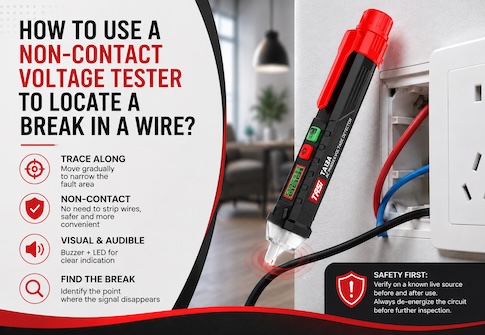
When locating a conductor, the probe can be moved slowly while observing changes in indication intensity, frequency, or status.
Sensitivity Setting of the Tester
Some NCV testers use a fixed sensitivity, while others provide dual or multiple sensitivity levels.
Typical modes may include:
● High sensitivity: suitable for weaker electric fields or lower AC voltages;
● Low sensitivity: useful for stronger fields and for reducing interference from nearby energized wiring.
High sensitivity may increase detection distance, but it can also make the tester more responsive to surrounding conductors and stray fields.
Sensitivity should therefore be selected according to the task rather than simply set to the highest level.
High sensitivity can be useful for initial scanning or locating hidden wiring. Lower sensitivity may be more effective when narrowing down the exact position of a live conductor.
Capacitive Coupling Between the User and Ground
In some tester designs, the detection circuit is influenced by capacitive coupling between the user’s body and ground.
Slight differences in response may therefore occur when:
● The tester is handheld versus placed on an insulated surface;
● The user is standing on a grounded surface versus a highly insulating platform;
● Thick insulating gloves are worn compared with normal handling.
The degree of influence depends on the tester’s internal design.
The instrument should always be held by the manufacturer-specified grip area. Users should not touch unintended areas in an attempt to increase sensitivity.
Grounding and Circuit Configuration
Because electric fields are established relative to the surrounding electrical environment, grounding conditions, power-system configuration, and nearby grounded metalwork can all affect NCV response.
In certain isolated, floating, or heavily shielded systems, the electric field relative to ground may differ substantially from that found in conventional building wiring.
As a result, an energized conductor may produce only a weak externally detectable field.
NCV testers are therefore best used as rapid indicators of the presence of an AC electric field and should not be treated as universal replacements for direct-contact voltage measurement.
Metallic Shielding and Grounded Enclosures
Metal structures can provide substantial electrostatic shielding.
If an energized conductor is located inside:
● Metal conduit;
● A metal distribution enclosure;
● A shielded cable;
● A grounded metal housing;
the external electric field may be greatly reduced.
A tester positioned outside the metal structure may therefore fail to detect the energized conductor inside.
A lack of NCV indication outside a metal enclosure must never be taken as proof that the internal circuit is de-energized.
Electric-Field Interference from Nearby Energized Conductors
A highly sensitive NCV tester may respond not only to the target conductor but also to nearby energized wiring.
Inside a distribution board or densely wired cable bundle, several energized conductors may be positioned close together. The tester may then indicate voltage near a non-energized conductor because of the electric field from an adjacent live conductor.
Possible effects include:
● A wider indication zone;
● Difficulty locating the exact live conductor;
● Multiple adjacent wires appearing energized;
● False interpretation that all nearby conductors are live.
Reducing sensitivity and moving the probe closer to the target conductor can help improve localization.
Induced Voltage and Stray Electric Fields
Capacitive coupling can occur between long conductors routed in parallel.
A conductor that is not directly connected to an AC source may still acquire a small induced potential from nearby energized wiring. This is commonly described as induced or stray voltage.
Because NCV testers use high-input-impedance electric-field sensing, highly sensitive models may respond to such weak fields.
An NCV indication therefore means that an alternating electric field above the tester’s threshold has been detected. It does not necessarily prove that the conductor can deliver normal operating current.
When the actual electrical condition of a circuit must be confirmed, an appropriate contact voltage test should be performed.
Electromagnetic Interference in the Environment
Variable-frequency drives, motors, switching power supplies, transformers, and high-frequency electronic equipment can generate electromagnetic interference.
In complex industrial environments, this interference may affect high-sensitivity detection circuits and produce unstable or unexpected indications.
Typical symptoms include:
● Occasional indications when no obvious live conductor is nearby;
● Indication locations that are inconsistent;
● Stronger responses near specific equipment;
● The effect disappearing after moving away from the interference source.
In electrically noisy environments, NCV results should therefore be interpreted together with the circuit layout and, where necessary, verified using other test equipment.
Detection Frequency Range
Most common NCV testers are designed primarily for power-frequency AC systems, typically 50 Hz or 60 Hz.
Their internal filters and detection circuits are optimized for a specified frequency range.
If the signal frequency differs substantially from the design range, detection sensitivity may change.
When testing variable-frequency outputs, high-frequency equipment, or specialized power systems, the instrument’s specified operating frequency range should be checked.
Battery Condition and Instrument Status
NCV testers rely on electronic sensing, signal amplification, and indication circuits, so battery condition is also important.
When the battery becomes weak, depending on the product, the tester may:
● Display a low-battery indication;
● Fail to power on correctly;
● Produce weaker light or sound indications;
● Show abnormal detection behavior.
Physical damage to the sensing tip, severe contamination, internal faults, or mechanical shock may also affect performance.
Before testing, the instrument should be checked according to the manufacturer’s instructions and verified on a known live source whenever appropriate.
Why Can the Detection Distance Change with the Same Tester?
NCV testers sense the electric field in space rather than directly measuring voltage by conductor contact. The alarm distance therefore depends on the surrounding conditions.
Even at the same nominal voltage, detection distance may vary because of:
● Conductor position;
● Insulation construction;
● Line and neutral arrangement;
● Nearby energized conductors;
● Grounding conditions;
● User handling.
Detection distance should therefore be regarded as an application-dependent response characteristic rather than a fixed physical value.
Is Higher Sensitivity Always Better?
No.
Higher sensitivity can be useful for detecting weaker electric fields, lower-voltage AC circuits, fields attenuated by insulation, or energized conductors from a greater distance.
However, increased sensitivity can also lead to:
● Greater interference from nearby wiring;
● Increased response to stray electric fields;
● Indications from induced voltage;
● A wider detection zone around live conductors.
For example, inside a densely wired panel, high sensitivity may cause several neighboring locations to indicate at the same time, making it difficult to identify the exact live conductor.
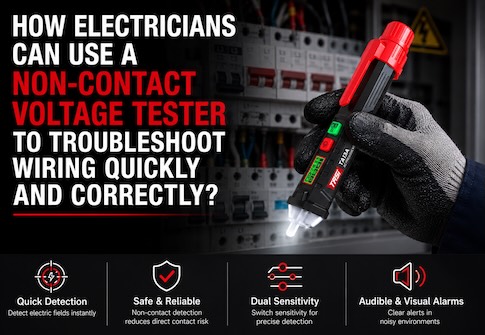
With dual-sensitivity testers, a practical method is to use high sensitivity for initial detection and then switch to low sensitivity to narrow down the source.
How to Improve the Reliability of NCV Detection
Correct operating technique is often more important than simply maximizing sensitivity.
● Verify tester operation on a known live source before testing.
● Position the designated sensing area close to the target conductor.
● After detecting a field at high sensitivity, reduce sensitivity to improve localization where applicable.
● When testing multicore cables, move as close as practical to individual conductors, terminals, or outlet contacts.
● Do not rely solely on NCV results through metal enclosures or shielded cables.
● In densely wired areas, consider the possibility of electric-field coupling from adjacent live conductors.
● For safety-critical verification of de-energization, use an appropriate direct-contact voltage testing method in accordance with applicable procedures.
Does an NCV Indication Always Mean Normal Operating Voltage Is Present?
No.
An NCV tester detects an AC electric field rather than directly measuring the voltage between circuit points.
An indication may result from:
● A normally energized conductor;
● A weak induced voltage;
● Electric-field coupling from nearby live wiring;
● Stray AC electric fields.
Conversely, the absence of an indication does not prove that hazardous voltage is absent in every situation, especially with shielded cables, metallic conduit, unusual grounding systems, or voltages outside the instrument’s specified detection range.
This distinction is fundamental to the correct use of NCV testers.
FAQ
Why does an NCV tester sometimes indicate voltage from relatively far away?
This may occur because the circuit voltage is high, the tester is operating at high sensitivity, or a strong electric field is present nearby. Energized conductors in densely wired areas can also extend the apparent detection zone.
Why can two 220 V or 230 V conductors have different detection distances?
NCV testers detect electric fields rather than voltage directly. Insulation thickness, conductor construction, line-neutral arrangement, surrounding metalwork, and grounding conditions can all change the external electric field.
Does thicker insulation reduce NCV sensitivity?
It generally makes detection more difficult because the effective distance to the energized conductor increases and the insulation changes the coupling conditions. Actual performance also depends on voltage level, insulation material, and tester sensitivity.
When should high-sensitivity mode be used?
It is useful for initial scanning, locating weak electric fields, or detecting lower-voltage AC circuits. In densely wired areas, however, it may increase interference from adjacent conductors.
What is the purpose of low-sensitivity mode?
Low sensitivity helps reject weaker stray fields and interference from nearby wiring, making it useful for narrowing down the location of a specific live conductor.
Why can a multicore cable be harder to detect than an individual live wire?
The line, neutral, and protective-earth conductors are located close together, so their electric fields interact. The outer cable sheath also increases the distance from the sensing probe to the live conductor.
If the tester does not indicate voltage, does that prove the circuit is de-energized?
No. Metallic shielding, unusual grounding conditions, excessive probe distance, voltages below the detection range, or tester malfunction can all result in no indication. Safety-critical absence-of-voltage verification should use an appropriate direct-contact method.
Does a higher CAT rating mean higher NCV sensitivity?
No. CAT ratings describe the transient overvoltage environment and safety category for which an instrument is designed. They do not indicate NCV sensitivity.
Conclusion
Non-contact voltage detection sensitivity is determined by the combined effects of tester design, the circuit under test, and the surrounding environment.
Line voltage, probe distance, insulation thickness, conductor arrangement, line-neutral positioning, metallic shielding, grounding, human-body capacitive coupling, and electromagnetic interference can all affect the strength of the AC electric field reaching the sensor.
NCV performance should therefore not be evaluated solely by detection distance, and higher sensitivity should not automatically be considered better. In many applications, the most useful tester is one that provides an appropriate balance between sensitivity and immunity to interference.
A non-contact voltage tester is well suited to rapid screening and preliminary identification of energized AC wiring. However, because it is fundamentally an electric-field sensing device, safety-critical verification of de-energization should be performed using an appropriate direct-contact voltage testing method and the applicable electrical safety procedure.