Introduction
When installing, maintaining, or troubleshooting electrical systems, determining whether a wire, outlet, or equipment terminal is energized is a common task. Two frequently used tools are the non-contact voltage tester (NCV tester) and the contact voltage tester.
Although both are used for voltage-related checks, they are not the same type of instrument.
A non-contact voltage tester normally does not require access to a bare conductor. The sensing tip is simply brought close to a wire, outlet, or other test location to detect the presence of an alternating electric field. A contact voltage tester, by contrast, requires its probes to make direct electrical contact with conductors or test points. Depending on the instrument, it may also display the actual voltage value.
The two tools should therefore not be viewed simply in terms of which one is “better.” They are designed for different purposes and are often most effective when used together.
Key Takeaways
● A non-contact voltage tester detects the electric field around an AC conductor and does not normally require direct contact with a bare conductor.
● A contact voltage tester requires its probes to make electrical contact with the circuit or test points.
● Non-contact voltage testers are fast and convenient for preliminary screening, identifying possible live conductors, and locating energized wiring.
● Contact voltage testers provide more definitive information, and many instruments can display the actual voltage value.
● NCV detection can be affected by distance, shielding, sensitivity, cable construction, and surrounding electric fields, so it should not be used as the sole means of proving that a circuit is de-energized.
● When the actual voltage must be measured, faults diagnosed, or an absence of voltage verified, an appropriate contact-type test instrument should be used in accordance with the applicable safety procedure.
What Is a Non-Contact Voltage Tester?
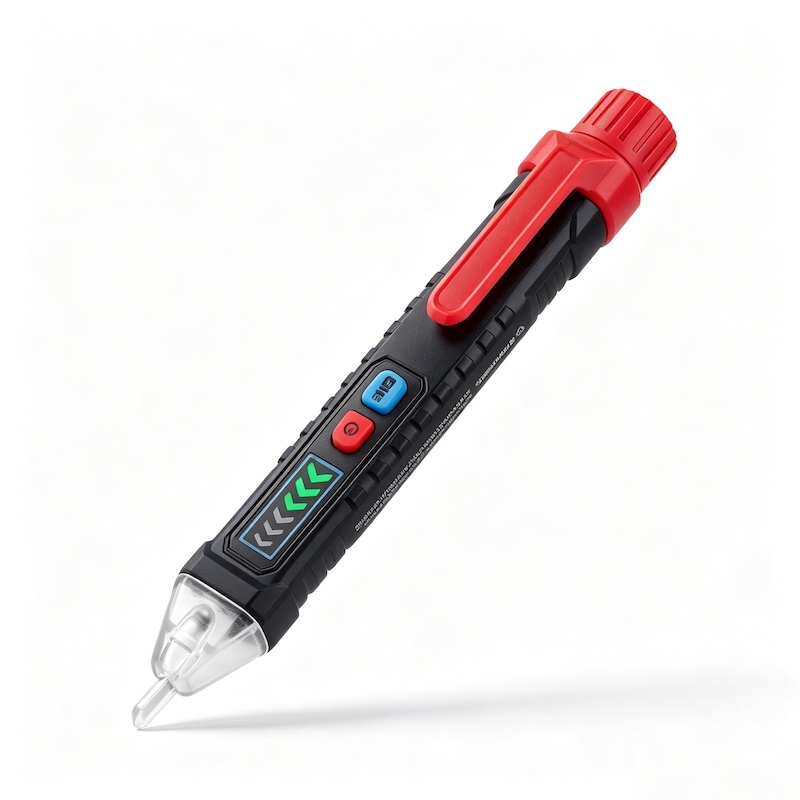
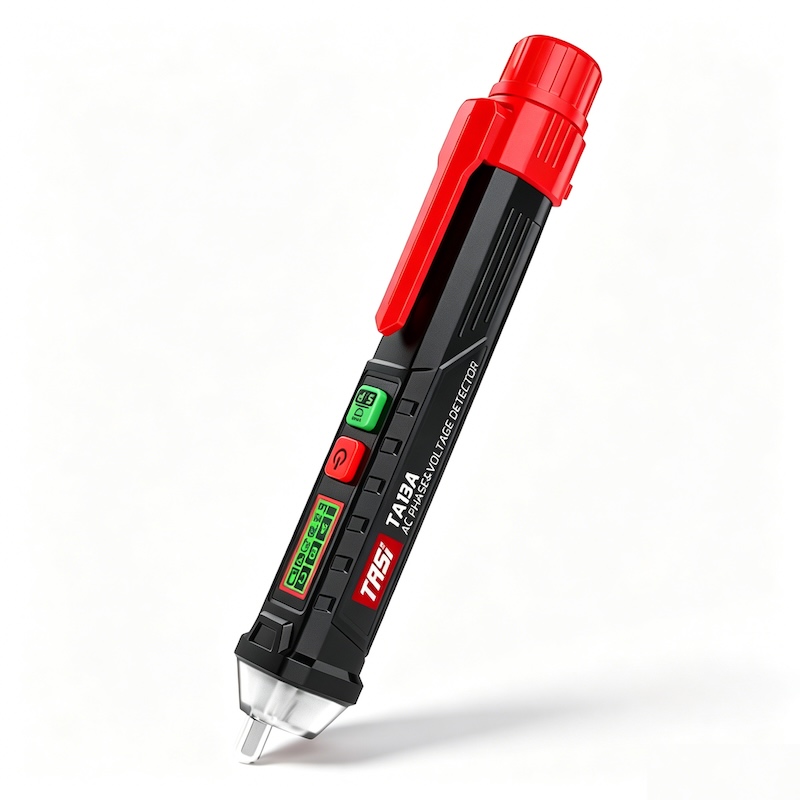
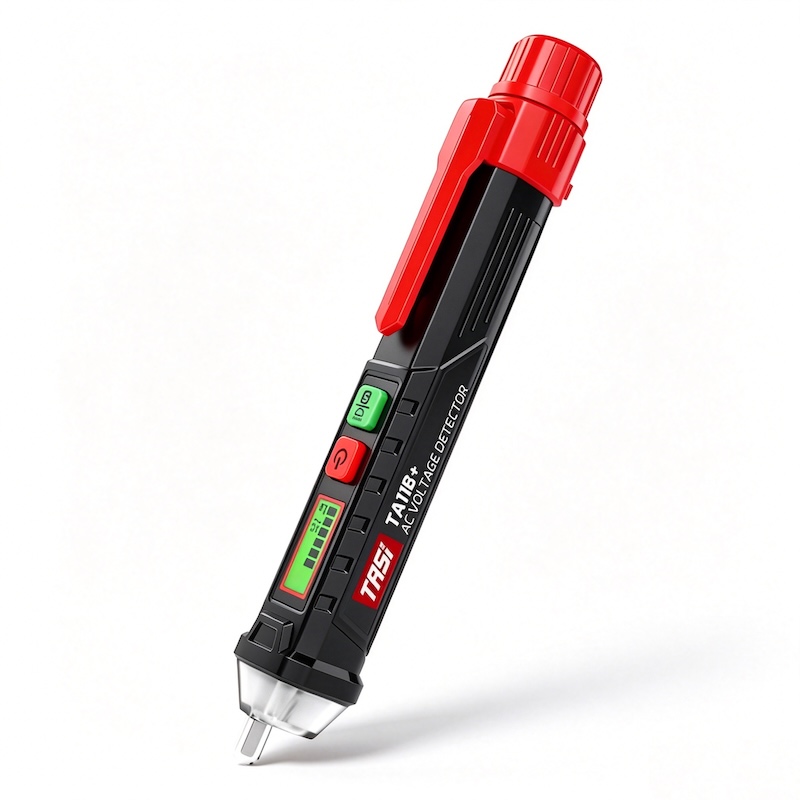
A non-contact voltage tester is a portable electrical test tool that detects AC voltage by sensing an electric field. It is commonly referred to as an NCV tester, non-contact voltage detector, or voltage detection pen.
When AC voltage is present on a conductor, an alternating electric field is produced around it. The sensing circuitry inside an NCV tester detects changes in this field. Once the detected signal exceeds the instrument's threshold, the tester alerts the user through an LED, audible buzzer, vibration, display indication, or a combination of these.
Its main characteristics include:
● No direct contact with a bare metal conductor is normally required.
● Detection can often be performed through standard wire insulation.
● Testing is fast and suitable for preliminary screening.
● Most conventional NCV testers are primarily intended for AC voltage detection.
● The result normally indicates that an electric field has been detected rather than providing an accurate voltage measurement.
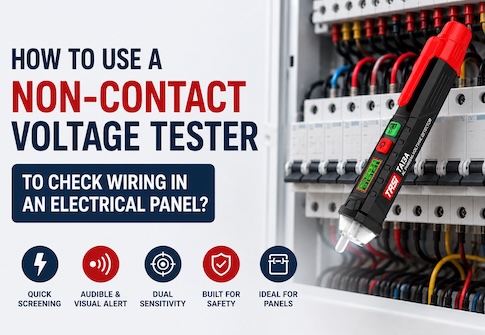
Typical applications include checking outlets, identifying possible live conductors, inspecting wiring around distribution equipment, and quickly locating energized cables.
What Is a Contact Voltage Tester?
A contact voltage tester requires its test terminals or probes to make direct electrical contact with the circuit being tested.
Common examples include two-pole voltage testers, digital multimeters with voltage measurement functions, and other voltage test instruments that use probes to contact conductors directly.
During testing, the probes are normally placed between two points at different electrical potentials, such as:
● Line and neutral;
● Line and protective earth;
● Two phase conductors;
● Positive and negative terminals of a DC supply;
● Two defined points within an electrical circuit.
The instrument measures the potential difference between these points and therefore generally provides more direct electrical information than a non-contact detector.
Depending on the instrument, the result may include:
● Presence or absence of voltage;
● Actual voltage value;
● AC or DC voltage;
● Polarity;
● Other relevant electrical status information.
Contact instruments are therefore better suited to quantitative measurement and more detailed electrical troubleshooting.
How Do Their Operating Principles Differ?
The fundamental difference is that a non-contact voltage tester senses the electric field around a conductor, whereas a contact voltage tester measures the electrical potential difference between actual test points.
An NCV tester operates through capacitive coupling and electric-field sensing. When its tip approaches an energized AC conductor, the changing electric field produces a small signal in the sensing circuit. The instrument amplifies and evaluates this signal and then activates an indication.
No direct metallic connection to the conductor is required.
A contact voltage tester works differently. Its probes must make direct contact with the electrical test points so that the instrument can measure the actual electrical condition between them.
In practical terms, the two tools answer different questions:
● A non-contact voltage tester primarily answers: “Is there a detectable AC electric field in this area?”
● A contact voltage tester more directly answers: “Is there a voltage between these test points, and what is that voltage?”
This difference explains their different levels of certainty, operating methods, and applications.
Main Differences Between Non-Contact and Contact Voltage Testers
| Comparison | Non-Contact Voltage Tester | Contact Voltage Tester |
|---|---|---|
| Test method | Brought close to the conductor | Probes contact the test points directly |
| Basic principle | Detects an AC electric field | Measures potential difference |
| Bare test point required | Normally no | Usually yes |
| Typical test signal | Primarily AC | AC and/or DC depending on instrument |
| Displays actual voltage | Usually no | Often yes |
| Test speed | Very fast | Requires more test setup |
| Preliminary screening | Highly suitable | Possible, but less convenient |
| Quantitative measurement | Not suitable | Suitable |
| Influence from nearby electric fields | Relatively significant | Generally lower |
| Possible induced-field indication | Yes | Less common |
| Typical applications | Live-wire screening, quick checks, line identification | Voltage measurement, troubleshooting, verification |
Actual capabilities depend on the design of the instrument. Some NCV testers, for example, provide high- and low-sensitivity modes, while contact instruments vary significantly in voltage range, accuracy, category rating, and functionality.
Main Advantages of a Non-Contact Voltage Tester
The primary advantages of an NCV tester are speed and convenience.
Because direct contact with a bare conductor is normally unnecessary, the user can often perform a test simply by switching on the instrument and bringing the sensing end close to the area of interest.
Key advantages include:
● Fast testing: Large numbers of wires, outlets, and electrical points can be checked quickly.
● No need to remove insulation: AC electric fields can often be detected through standard cable insulation.
● Useful for locating line conductors: Under suitable conditions, it can assist in distinguishing line from neutral.
● Effective for preliminary checks: It can quickly indicate whether energized wiring may be present before further work begins.
● Portable: NCV testers are typically compact and easy to carry as part of an electrician's everyday toolkit.
These characteristics make them particularly useful for routine electrical maintenance, installation work, and rapid screening.
What Are the Limitations of a Non-Contact Voltage Tester?
The convenience of non-contact detection also comes with limitations.
Because the instrument senses an AC electric field instead of directly measuring voltage between conductors, the result can be affected by several factors, including:
● Thickness of wire insulation;
● Distance between the tester and the conductor;
● Metallic shielding around the cable;
● Voltage level of the circuit;
● Sensitivity of the tester;
● Relative position of line and neutral conductors;
● Electric fields from adjacent energized wiring;
● Capacitive coupling involving the user, ground, and surrounding environment.
Two common situations can result.
The first is voltage is actually present, but the tester does not alarm. Possible causes include metallic shielding, low voltage, excessive sensing distance, or partial cancellation of the electric field due to cable construction.
The second is the target circuit is not normally energized, but the tester still alarms. Nearby energized conductors may produce induced voltage or stray electric fields that are detectable by a high-sensitivity NCV tester.
For this reason, an NCV tester is highly useful for screening, but its indication should not be interpreted as an accurate voltage measurement.
Main Advantages of a Contact Voltage Tester
A contact voltage tester measures the electrical condition directly between test points and can therefore provide more definitive information.
Its main advantages include:
● Ability to confirm whether an actual voltage exists between two test points;
● Ability, on many instruments, to display a numerical voltage value;
● Suitability for further electrical fault diagnosis;
● Ability, depending on the instrument, to measure both AC and DC voltage;
● Generally lower susceptibility to electric fields from nearby wiring;
● Better suitability for measurements requiring quantitative data.
For example, if an outlet is not functioning correctly, an NCV tester may indicate that an electric field is present near the line conductor. A suitable contact instrument can then be used to measure line-to-neutral and line-to-earth voltage and help identify the actual fault condition.
Does Contact Testing Automatically Mean Safer or More Reliable?
Not necessarily.
Contact testing can provide more direct electrical information, but the probes must be brought close to or placed on energized conductors. This generally places greater demands on the test instrument, test method, and operator.
If the tester's rated voltage, measurement category, insulation, or safety design is unsuitable for the electrical environment, the fact that it can display a voltage does not mean it can be used safely.
Before contact testing, users should confirm that:
● The instrument is suitable for the expected voltage range;
● Its CAT measurement category is appropriate for the test location;
● Test leads and probes are in good condition;
● The test procedure complies with the applicable electrical safety requirements;
● The operator has the necessary electrical safety knowledge;
● Appropriate personal protective equipment is used when required.
The distinction between contact and non-contact testing therefore concerns the measurement method, not a simple statement that one is always safer than the other.
When Is a Non-Contact Voltage Tester Most Suitable?
An NCV tester is especially useful when the objective is rapid preliminary screening.
Typical applications include:
● Checking whether AC voltage may be present around a power cable;
● Locating the line conductor in an outlet;
● Checking wiring around switches;
● Screening multiple cables to locate potentially energized conductors;
● Performing a preliminary live check before maintenance;
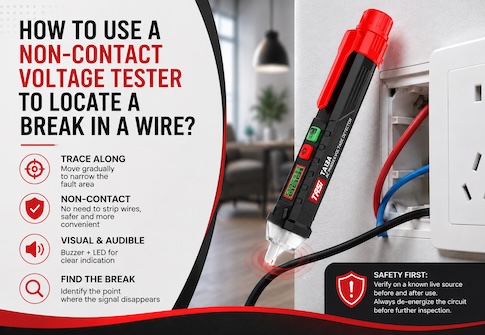
● Tracing a cable to help locate a possible break;
● Checking for an AC electric field around external equipment wiring.
In these situations, the main benefits of NCV testing are speed and the absence of direct conductor contact.
However, if the test result will determine whether a person may safely contact a conductor, further verification should be performed using a test method appropriate to the applicable safety procedure.
When Is a Contact Voltage Tester More Appropriate?
A suitable contact test instrument should normally be used when clear electrical data is required.
Examples include:
● Measuring the actual voltage;
● Distinguishing between AC and DC;
● Confirming whether a potential difference actually exists between two test points;
● Diagnosing line, neutral, or protective-earth faults;
● Verifying an electrical installation after work has been completed;
● Troubleshooting equipment power-supply problems;
● Verifying an absence of voltage before work in accordance with the applicable electrical safety procedure.
These tasks require more than simply knowing whether an electric field is present nearby. They require a clearer understanding of the actual condition of the circuit.
Can the Two Tools Be Used Together?
Yes. In many practical situations, using both tools is an efficient approach.
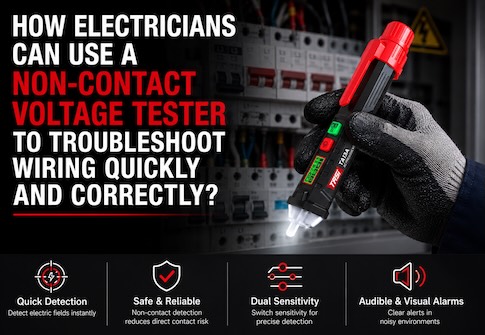
During electrical maintenance, an NCV tester may first be used for quick screening to identify wiring that may be energized and reduce unnecessary direct contact.
If actual voltage, circuit condition, or absence of voltage must then be confirmed, an appropriate contact test instrument can be used.
The principle can be summarized as:
Non-contact testing for rapid detection; contact testing for further confirmation.
Actual work should always follow the applicable electrical safety regulations and workplace procedures. An NCV tester's alarm or lack of alarm should not replace a required voltage-verification procedure.
How Should You Choose Between the Two?
The correct choice depends on the question the test needs to answer rather than on which instrument appears more advanced.
A non-contact voltage tester is particularly convenient when the main requirements are:
● Rapid identification of potentially energized wiring;
● Locating the line conductor in an outlet;
● Preliminary electrical maintenance checks;
● Reducing unnecessary contact with exposed conductors.
A contact voltage tester is more appropriate when the requirements include:
● Measuring actual voltage;
● Identifying AC or DC voltage;
● Diagnosing equipment or circuit faults;
● Confirming voltage between defined test points;
● Performing professional electrical testing and verification.
For electricians, maintenance technicians, and engineers, the two instrument types are generally complementary rather than interchangeable.
What Safety Precautions Should Be Followed?
Regardless of which type of tester is used, the instrument should first be confirmed to be operating correctly and suitable for the electrical environment.
When using a non-contact voltage tester:
● Verify operation on a known energized source before testing.
● After the test, verifying the tester again on a known source can help confirm that it remained operational during the test.
● Do not assume that “no alarm” automatically means the conductor is de-energized.
● Be aware that metallic shielding, cable construction, and sensing distance may reduce detection.
● High-sensitivity modes may respond more readily to neighboring conductors or induced electric fields.
When using a contact test instrument:
● Inspect test leads and probes for damage.
● Do not exceed the instrument's rated input.
● Select a CAT rating appropriate to the measurement environment.
● Keep fingers behind probe guards.
● Avoid contact with exposed conductors.
● High-energy electrical systems should be tested only by appropriately qualified personnel using suitable protective measures.
No voltage test instrument can replace proper electrical safety procedures.
FAQ
Which is more accurate: a non-contact voltage tester or a contact voltage tester?
If the objective is to determine the actual voltage, a contact instrument normally provides more direct and definitive information. An NCV tester detects an AC electric field and is better suited to rapid screening.
If an NCV tester does not alarm, does that mean there is definitely no voltage?
No. Shielding, excessive distance, voltage below the effective detection range, cable construction, and other factors may prevent an alarm. An NCV tester should not be relied upon alone to prove an absence of voltage.
Why can an NCV tester alarm on a circuit that is not normally energized?
Nearby energized conductors can create induced voltage or stray electric fields through capacitive coupling. A high-sensitivity NCV tester may detect these fields.
Can a non-contact voltage tester tell me the exact voltage?
Most standard NCV testers cannot accurately measure the actual voltage. Even if an instrument uses different indication levels to represent field strength, this should not be treated as a precise voltage measurement.
Can a non-contact voltage tester detect DC voltage?
Conventional NCV testers are designed primarily to detect changing AC electric fields. A normal DC source produces a relatively static electric field, so it generally cannot be detected reliably using the conventional NCV principle.
Can an NCV tester replace a multimeter?
No. An NCV tester is designed for rapid voltage screening, while a digital multimeter can provide voltage, resistance, current, and other quantitative measurements. Their functions are different.
Which tool should be used to verify that a circuit is de-energized before maintenance?
An NCV tester can be used as a preliminary checking tool. Where contact with conductors may occur, absence of voltage should be verified using the test equipment and procedure required by the applicable electrical safety rules.
Do home users need both types of tester?
An NCV tester is convenient for simple preliminary checks. A suitable contact instrument is required for actual voltage measurement and more detailed fault diagnosis. Users without appropriate electrical safety knowledge should not perform tests on exposed live conductors.
Conclusion
Non-contact voltage testers and contact voltage testers are both useful electrical test tools, but they operate differently and serve different purposes.
An NCV tester senses an AC electric field without direct contact with a bare conductor. It is fast, convenient, and particularly useful for locating potentially energized wiring, assisting with line identification, and performing preliminary electrical checks.
A contact voltage tester establishes direct electrical contact with the circuit and provides clearer information about the voltage between defined test points. Many instruments can also display the actual voltage, making them more suitable for quantitative measurement, troubleshooting, and verification.
In simple terms:
● For quickly determining whether energized AC wiring may be present nearby, a non-contact voltage tester is convenient.
● For measuring actual voltage or confirming the electrical condition of a circuit, an appropriate contact test instrument should be used.
● For absence-of-voltage verification and safety-critical work, an NCV indication or lack of indication should not be used as the sole basis for the decision.
Understanding the operating principles and limitations of both tester types makes it easier to select the correct instrument for the task while improving test efficiency, reliability, and electrical safety.