Introduction
Sound and noise measurements are widely required in industrial facilities, construction sites, environmental monitoring, equipment maintenance, occupational noise assessment, and acoustic testing. Depending on the measurement objective, the instrument may be a relatively simple sound level meter or a professional sound level analyzer with advanced acoustic analysis capabilities.
Both instruments can measure sound pressure level, but they are designed for different purposes. A basic sound level meter focuses primarily on obtaining a quick indication of the current noise level, while a professional sound level analyzer can provide frequency analysis, statistical evaluation, long-term recording, and other advanced acoustic data.
Instrument selection should therefore not be based solely on measurement range or accuracy. It is equally important to determine what needs to be measured, what data is required, and how the measurement results will be used.
Key Takeaways
● Both basic sound level meters and professional sound level analyzers can measure sound pressure level, but their functional capabilities differ;
● Basic sound level meters are generally suitable for quick on-site measurements, routine inspections, and basic noise assessments;
● Professional sound level analyzers typically provide more advanced frequency analysis, statistical analysis, and data logging functions;
● Requirements for 1/1-octave, 1/3-octave, integrating measurements, or long-term recording are important factors when selecting an instrument;
● For regulatory measurements, occupational noise assessments, or professional acoustic analysis, the instrument should meet the applicable standards and performance requirements;
● More functions do not necessarily make an instrument more suitable—the measurement task should determine the required instrument.
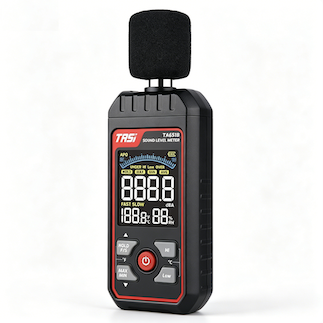
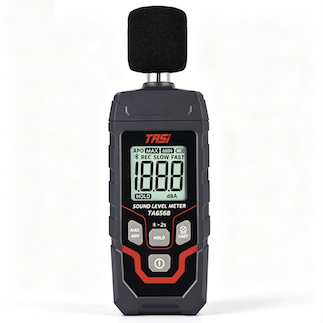
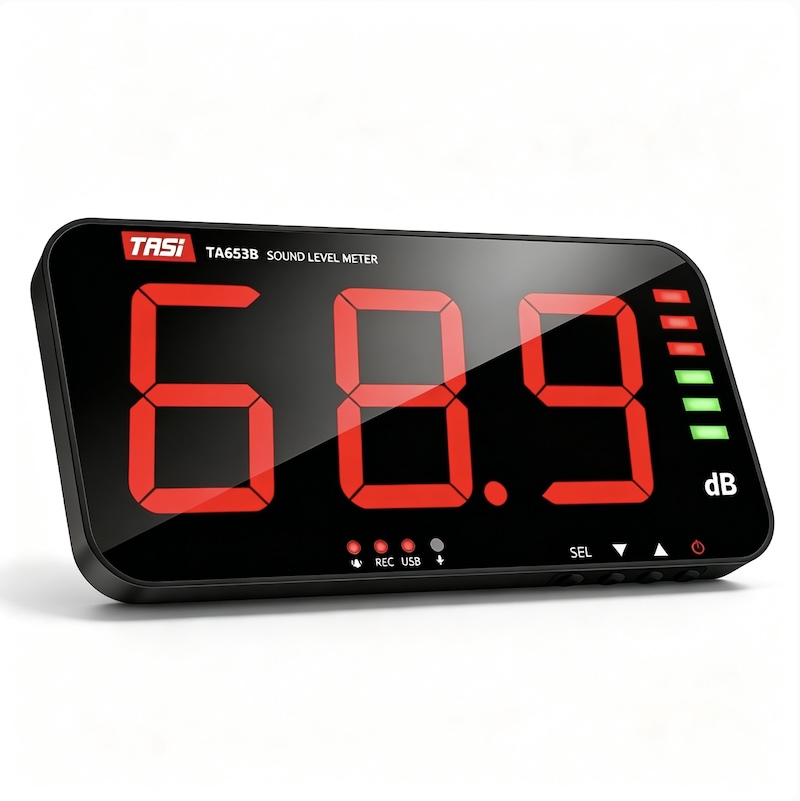
What Is a Basic Sound Level Meter?
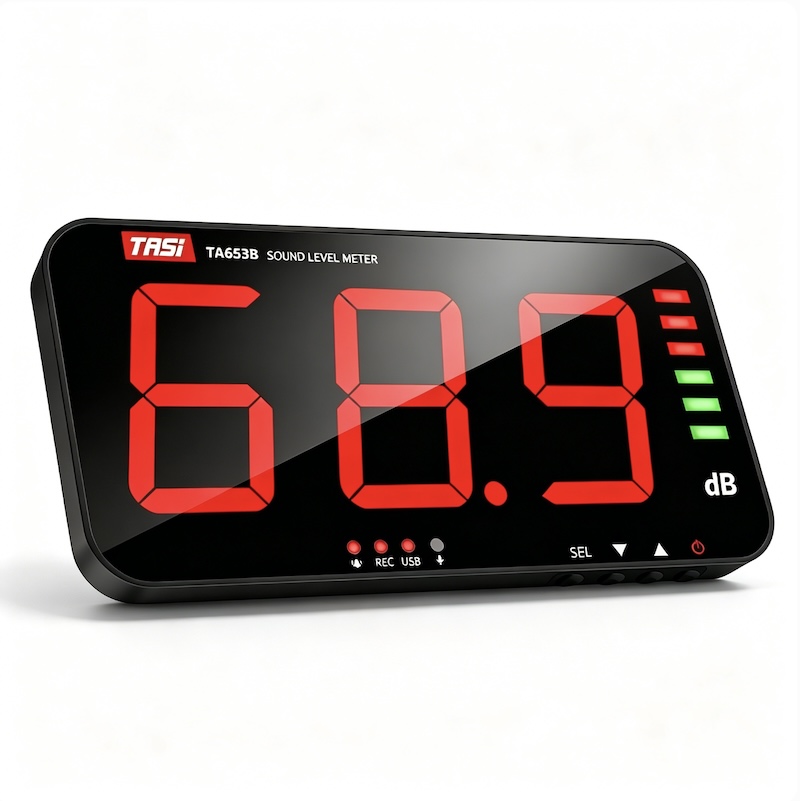
A basic sound level meter is a portable instrument used to measure environmental sound pressure levels. The microphone detects sound and converts acoustic pressure into an electrical signal, which is then processed using frequency weighting, time weighting, and digital signal processing before the measurement result is displayed.
Typical functions include:
● Sound pressure level measurement, usually displayed in dB;
● A-weighting, with some models also supporting C-weighting;
● FAST and SLOW time weighting;
● Maximum, minimum, and current sound level readings;
● Data hold, alarms, backlight, data storage, or Bluetooth connectivity on selected models.
For machinery noise checks, workplace measurements, construction-site inspections, appliance comparisons, and general environmental noise measurements, these instruments are often sufficient for quickly assessing noise levels.
What Is a Professional Sound Level Analyzer?
A professional sound level analyzer does more than measure how loud a sound is. It can also analyze its frequency content, variation over time, and statistical characteristics.
Compared with basic sound level meters, these instruments generally use more advanced signal processing and may provide different acoustic analysis modules depending on the model and configuration.
Typical functions may include:
● A, C, and Z frequency weighting;
● FAST, SLOW, and IMPULSE time weighting;
● Integrating parameters such as equivalent continuous A-weighted sound pressure level, LAeq;
● Maximum, minimum, and peak sound levels;
● 1/1-octave analysis;
● 1/3-octave analysis;
● Statistical sound level analysis;
● Time-history recording;
● Long-term data logging;
● Data export and professional analysis software.
Not every professional sound level analyzer includes all these functions. Actual capabilities depend on the specific instrument, configuration, and applicable measurement standards.
What Is the Main Difference?
The fundamental difference can be summarized as follows: a basic sound level meter primarily tells you how loud the sound is, while a professional sound level analyzer can also help determine what the sound consists of and how it changes.
For example, if approximately 85 dB is measured near an industrial machine and the objective is simply to determine whether the area has a relatively high noise level, a basic sound level meter may provide sufficient information.
However, if the objective is to identify dominant frequencies, investigate machinery-related noise, compare sound energy across frequency bands, or locate the main source of noise for noise-control purposes, an overall sound level alone may not be sufficient.
In these situations, a professional analyzer with frequency analysis capability is more appropriate.
How Do the Measurement Parameters Differ?
Basic sound level meters generally display a limited number of parameters, such as the current sound pressure level, maximum level, and minimum level. This provides a quick overview of the acoustic environment.
Professional sound level analyzers may simultaneously record and calculate parameters such as LAeq, LAFmax, LCpeak, and statistical sound levels.
Equivalent continuous sound level is particularly useful when evaluating noise that changes over time. Real-world noise is rarely constant, and a single instantaneous dB reading may not accurately represent the overall noise exposure during an entire measurement period.
As the measurement objective moves from instantaneous readings to time-based evaluation, the required data-processing capability becomes more advanced.
How Does Frequency Analysis Differ?
Frequency analysis is one of the most important differences between basic sound level meters and professional sound level analyzers.
A basic sound level meter generally uses A- or C-weighting to measure overall sound levels but does not provide detailed sound pressure levels for individual frequency bands.
Professional sound level analyzers may provide 1/1-octave or 1/3-octave analysis, dividing the acoustic signal into different frequency bands.
For example, two machines may both produce an overall level of 80 dB, while one is dominated by low-frequency noise and the other by mid- or high-frequency components. Although the overall levels are similar, their acoustic characteristics, perceived sound, and appropriate noise-control measures can be very different.
Frequency analysis is therefore particularly useful for machinery diagnostics, building acoustics, product acoustic testing, and noise-control engineering.
How Do Data Logging and Analysis Capabilities Differ?
Basic sound level meters generally prioritize portability and immediate readings. Some digital models provide data storage or Bluetooth connectivity, but their analysis capabilities are typically limited.
Professional sound level analyzers place greater emphasis on continuous data acquisition. They may record sound levels over several hours or longer and generate detailed time-history data.
These records can help determine:
● Whether noise levels increase significantly during specific periods;
● How much the sound level changes when a machine starts operating;
● Whether periodic machinery operation produces recurring noise patterns;
● Whether different production stages have significantly different noise levels;
● When short-duration high-noise events occur and how long they last.
This capability is particularly valuable for long-term environmental noise monitoring, industrial noise analysis, and professional acoustic measurements.
Are Professional Instruments Always More Accurate?
It is incorrect to assume that a basic sound level meter is necessarily inaccurate or that a professional analyzer is automatically more accurate.
Measurement performance depends on instrument specifications, applicable standards, microphone characteristics, calibration status, and measurement conditions.
Sound level meters are commonly classified as Class 1 or Class 2 instruments. In general, Class 1 instruments are subject to tighter tolerances for frequency response and other performance characteristics, while Class 2 instruments are commonly used for general field measurements and basic noise assessments.
However, “basic sound level meter” and “professional sound level analyzer” describe instrument functionality and positioning; they do not directly define the accuracy class.
When measurements are intended for regulatory assessment, compliance testing, or professional reports, it is essential to verify compliance with the applicable sound level meter standards and project requirements rather than relying solely on the product name.
How Does Operating Complexity Differ?
Basic sound level meters are generally straightforward to operate. After selecting the appropriate measurement range, frequency weighting, and time weighting, the user can begin measuring, making them suitable for routine inspections and basic acoustic measurements.
Professional sound level analyzers require a deeper understanding of acoustic parameters.
For example:
● Should A, C, or Z weighting be selected?
● Is an instantaneous or equivalent continuous sound level required?
● Is 1/3-octave analysis necessary?
● How long should the measurement period be?
● What data logging interval should be used?
● How should frequency spectra and statistical results be interpreted?
Professional instruments therefore provide more measurement capability but also require greater knowledge of acoustic measurement methods.
How Do Their Applications Differ?
Basic sound level meters are suitable for quick and straightforward field measurements, including:
● Routine factory noise inspections;
● Machinery operating noise checks;
● Noise measurements in offices and commercial environments;
● Basic comparisons of appliances, motors, and tools;
● Construction-site noise checks;
● Educational demonstrations and basic acoustic experiments.
Professional sound level analyzers are more appropriate for advanced or standardized measurements, including:
● Professional environmental noise monitoring;
● Occupational noise assessment;
● Building acoustics;
● Product acoustic performance analysis;
● Industrial machinery noise diagnostics;
● Noise-source frequency analysis;
● Evaluation of noise-control measures;
● Research and professional acoustic engineering.
The final instrument choice should always consider applicable regulations, industry standards, and specific measurement requirements.
Basic Sound Level Meter vs. Professional Sound Level Analyzer
| Comparison | Basic Sound Level Meter | Professional Sound Level Analyzer |
|---|---|---|
| Primary purpose | Quick noise-level measurement | Professional acoustic measurement and analysis |
| Basic SPL measurement | Yes | Yes |
| A/C/Z weighting | Depends on model | Usually more comprehensive |
| FAST/SLOW | Common | Common |
| Integrating parameters such as LAeq | Available on some models | Usually available |
| 1/1-octave analysis | Usually unavailable | Available on selected models |
| 1/3-octave analysis | Usually unavailable | Available on selected models |
| Statistical analysis | Limited | Common on professional models |
| Long-term data logging | Basic or model-dependent | Usually more comprehensive |
| Analysis software | Basic or unavailable | Usually more advanced |
| Operating complexity | Lower | Higher |
| Typical users | Maintenance personnel and general users | Acoustic engineers, professional testing personnel, researchers |
The table describes typical instrument categories rather than every model on the market. Modern digital sound level meters may also provide data logging, Bluetooth connectivity, and app-based analysis. The specifications of the individual instrument should therefore always be checked.
Which Instrument Should You Choose?
The correct choice depends not on which instrument is more advanced, but on which acoustic data the measurement task requires.
If the main objective is to quickly check environmental noise, identify whether machinery has become noticeably louder, compare different areas, or perform routine inspections, a basic digital sound level meter is generally sufficient.
If LAeq, peak levels, statistical sound levels, frequency spectra, or time-history data are required, or if the results will be used for professional acoustic analysis, a professional sound level analyzer with the appropriate functions should be selected.
Before choosing an instrument, consider:
● Do you only need the current dB level, or must noise be evaluated over a defined period?
● Are A, C, or Z frequency weightings required?
● Are FAST, SLOW, or other time weightings required?
● Is LAeq or another integrating parameter required?
● Is 1/1- or 1/3-octave analysis required?
● Is long-term recording and data export necessary?
● Will the measurements be used for regulatory, certification, or formal reporting purposes?
● Does the application specifically require a Class 1 or Class 2 instrument?
Answering these questions will usually make it much easier to determine the appropriate instrument category.
FAQ
Can a basic sound level meter replace a professional sound level analyzer?
For basic sound pressure level measurements and quick field checks, it often can. However, applications requiring frequency analysis, statistical analysis, integrating measurements, or advanced data logging require an instrument with the corresponding capabilities.
Are dB readings from a basic sound level meter useful?
Yes. If the instrument meets the measurement requirements and is used correctly, its readings can be useful for routine noise checks and trend comparisons. Regulatory or professional assessments additionally require consideration of instrument class, calibration, and applicable standards.
When is 1/3-octave analysis required?
It is particularly useful when the objective is to understand how noise is distributed across different frequency ranges, identify dominant noise bands, or develop targeted noise-control measures.
Are Class 1 and Class 2 the same as basic and professional instruments?
No. Class 1 and Class 2 refer to sound level meter performance classifications, while “basic sound level meter” and “professional sound level analyzer” describe instrument functionality. The accuracy class should always be verified from the instrument specifications.
Do I need a professional analyzer to measure machinery noise?
Not necessarily. For routine inspections or comparisons before and after machine operation, a basic sound level meter may be sufficient. Frequency analysis becomes more valuable when identifying noise sources or developing noise-control solutions.
What specifications are most important when choosing a noise measurement instrument?
Consider measurement range, frequency weighting, time weighting, instrument class, frequency range, data logging capability, integrating parameters, and octave-band analysis requirements rather than focusing only on measurement range or display resolution.
Conclusion
Basic sound level meters and professional sound level analyzers are both designed for acoustic measurements, but they serve different purposes.
A basic sound level meter provides a quick indication of sound pressure level and is well suited to routine equipment inspections, environmental checks, and general noise measurements.
A professional sound level analyzer provides additional capabilities such as integrating measurements, frequency analysis, statistical analysis, and time-history recording, making it more suitable for environmental noise monitoring, occupational noise assessment, machinery diagnostics, building acoustics, and research applications.
Instrument selection should therefore be based on the measurement objective, required acoustic parameters, data-analysis requirements, and applicable standards. For straightforward field noise checks, a basic sound level meter is often the more efficient choice; for applications requiring a deeper understanding of noise characteristics, a professional sound level analyzer is more appropriate.