Introduction
In noise measurement, acoustic testing, and machinery noise assessment, three terms frequently appear: sound pressure, sound intensity, and sound power.
Although all three are related to acoustic energy, they describe different physical quantities.
In simple terms:
● Sound pressure describes the pressure fluctuation caused by a sound wave at a specific location.
● Sound intensity describes the rate at which acoustic energy passes through a unit area.
● Sound power describes the total acoustic energy emitted by a sound source per unit time.
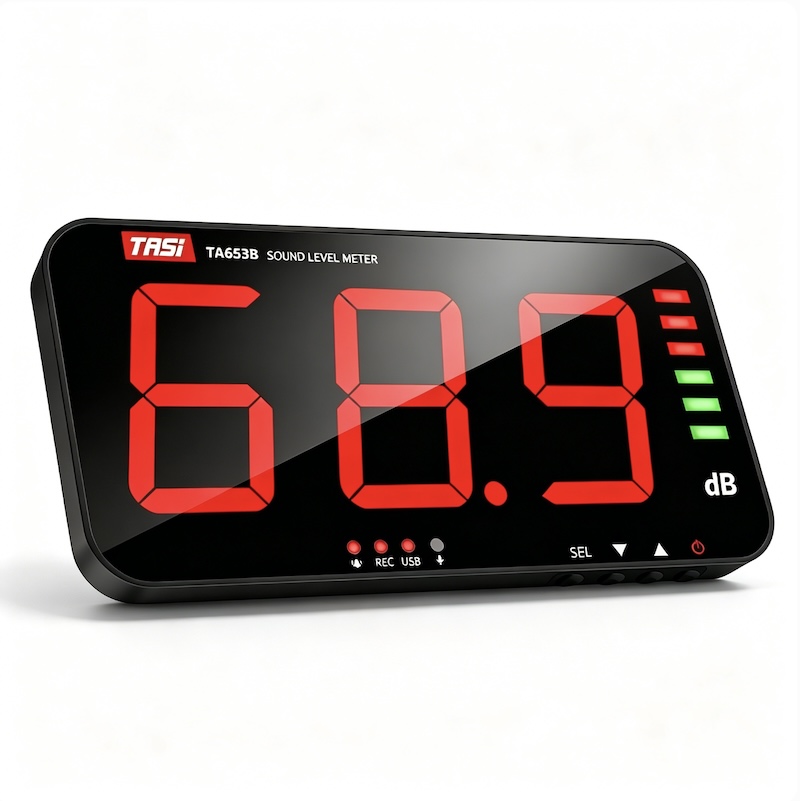
For general noise measurements, sound pressure level is the quantity most commonly measured with a sound level meter. Sound intensity and sound power are more frequently used in engineering acoustics, source identification, and machinery noise evaluation.
Key Points
● Sound pressure is measured in pascals (Pa) and is commonly expressed as sound pressure level in dB SPL.
● Sound intensity is measured in watts per square metre (W/m²) and describes acoustic energy flow through a unit area.
● Sound power is measured in watts (W) and represents the total acoustic energy emitted by a source per unit time.
● Sound pressure and sound intensity depend on measurement position, distance, reflections, and the acoustic environment.
● Sound power characterises the overall acoustic output of a source and is therefore useful for comparing different machines or products.
● A conventional sound level meter primarily measures sound pressure level; a sound pressure level measured at one point cannot simply be treated as a sound power level.
What Is Sound Pressure?
Sound pressure is the small variation in air pressure produced by a sound wave relative to the static atmospheric pressure.
When a loudspeaker, motor, fan, or other sound source vibrates, it creates alternating compression and rarefaction in the surrounding air. These pressure fluctuations are referred to as sound pressure.
Sound pressure is generally represented by the symbol p and is measured in:
Pa (pascal)
Because the range of sound pressures detectable by human hearing is extremely wide, acoustic measurements are usually expressed logarithmically as sound pressure level (SPL) rather than directly in pascals.
Sound pressure level is commonly expressed as:
Lp = 20 log₁₀(p / p₀)
where:
● Lp = sound pressure level in dB;
● p = measured RMS sound pressure;
● p₀ = reference sound pressure, normally 20 μPa in air.
Therefore, readings such as 60 dB, 80 dB, or 100 dB on a sound level meter normally represent the sound pressure level at the measurement position rather than the sound power of the source.
What Is Sound Intensity?
Sound intensity describes the rate of acoustic energy passing through a unit area.
Its SI unit is:
W/m² (watt per square metre)
Sound intensity represents both the magnitude and direction of acoustic energy flow. In strict physical terms, it is therefore a directional quantity.
It can be understood as the amount of acoustic energy passing through an imaginary surface of a defined area every second.
Sound intensity is normally represented by the symbol I and may also be expressed as a sound intensity level:
LI = 10 log₁₀(I / I₀)
where:
● LI = sound intensity level in dB;
● I = sound intensity in W/m²;
● I₀ = reference sound intensity, normally 10⁻¹² W/m².
Under ideal free-field plane-wave conditions, sound pressure and sound intensity are directly related and may be approximated by:
I = p²rms / (ρc)
where ρ is the density of air and c is the speed of sound.
This relationship applies only under appropriate acoustic conditions. In the near field of machinery, in highly reflective rooms, or in complex sound fields, actual sound intensity should not be calculated simply from a single sound pressure measurement.
What Is Sound Power?
Sound power is the total acoustic energy radiated by a sound source per unit time.
Its SI unit is:
W (watt)
For example, when an electric motor operates, it radiates acoustic energy into the surrounding environment. The total rate at which this energy is emitted in all directions represents the sound power of the motor.
Sound power is normally represented by the symbol W and may be expressed as a sound power level:
LW = 10 log₁₀(W / W₀)
where:
● LW = sound power level in dB;
● W = sound power in watts;
● W₀ = reference sound power, normally 10⁻¹² W.
Unlike sound pressure measured at a particular point, sound power characterises the total acoustic output of the source.
For this reason, sound power level is often more useful when comparing the noise performance of fans, motors, compressors, pumps, HVAC equipment, and other machinery.
Main Differences Between Sound Pressure, Sound Intensity, and Sound Power
The three quantities can be distinguished by what they describe, their units, and how strongly they depend on the measurement environment.
| Parameter | Sound Pressure | Sound Intensity | Sound Power |
|---|---|---|---|
| Symbol | p | I | W |
| Basic unit | Pa | W/m² | W |
| Level quantity | Sound pressure level, Lp | Sound intensity level, LI | Sound power level, LW |
| Describes | Pressure fluctuation at a point | Acoustic energy flow per unit area | Total acoustic energy emitted by a source |
| Directional | No | Yes | Usually treated as a total quantity |
| Affected by measurement distance | Yes | Yes | The source power itself does not change simply because measurement distance changes |
| Affected by reflections | Strongly | Measurement may be influenced by the sound field | Source sound power remains a source property, although measurement conditions affect its determination |
| Typical applications | Environmental and occupational noise measurements | Source identification and sound power determination | Machinery and product noise comparison |
The distinction can be summarised as follows:
Sound pressure describes what happens at a measurement point, sound intensity describes how acoustic energy flows through an area, and sound power describes the total acoustic energy generated by the source.
Why Do Sound Level Meters Usually Measure Sound Pressure?
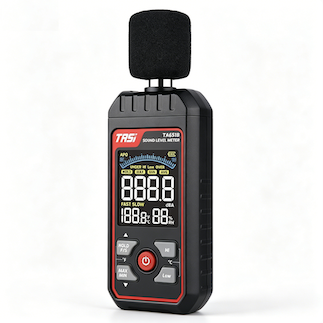
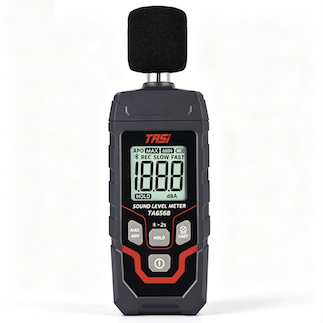
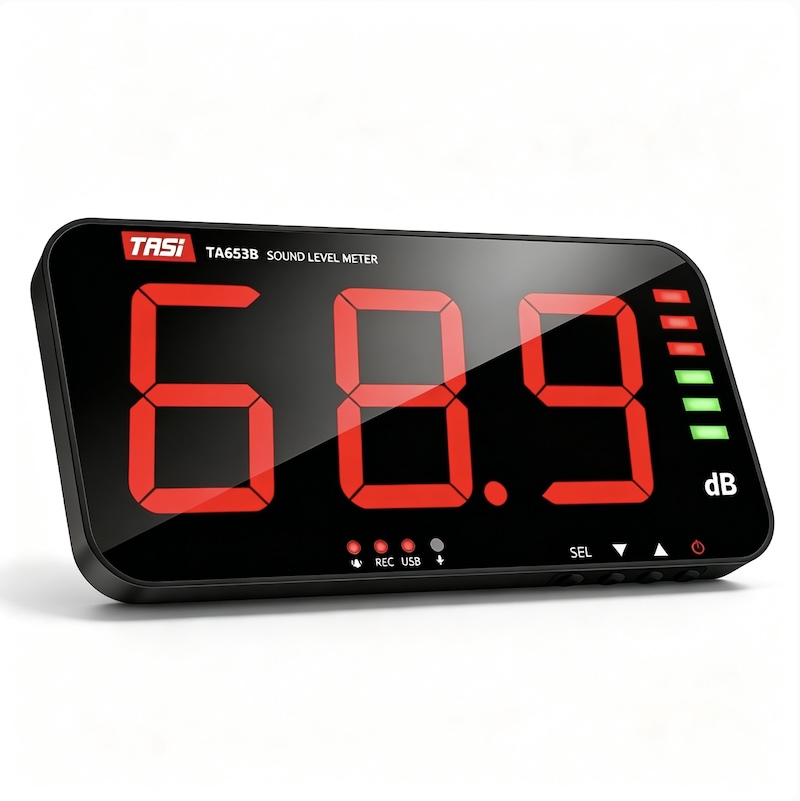
A conventional digital sound level meter uses a microphone that responds primarily to pressure fluctuations in the air.
The microphone converts these fluctuations into an electrical signal. The instrument then applies frequency weighting, time weighting, signal processing, and calculation before displaying the result in decibels.
The principal quantity measured by a conventional sound level meter is therefore:
Sound Pressure Level (SPL)
For example:
● LA indicates an A-weighted sound pressure level;
● LC indicates a C-weighted sound pressure level;
● LAF indicates an A-weighted sound pressure level measured with FAST time weighting.
Consequently, if a sound level meter displays 85 dB(A), this normally refers to the A-weighted sound pressure level at the measurement position, not to the sound power level of the equipment.
Why Does Sound Pressure Change with Distance?
As acoustic energy propagates away from a source, it is distributed over an increasingly large area. Consequently, the acoustic energy per unit area decreases, and the sound pressure at a measurement point generally decreases as well.
For an approximate point source in an ideal free field:
● Sound intensity decreases approximately with the inverse square of distance.
● Each doubling of distance generally reduces the sound pressure level by approximately 6 dB.
For example, under ideal conditions:
1 m: approximately 90 dB
2 m: approximately 84 dB
4 m: approximately 78 dB
In real environments, however, reflections from walls, floors, ceilings, machinery, and other surfaces affect the sound field. Actual measurements therefore do not always follow the 6 dB-per-distance-doubling rule exactly.
Why Does Sound Power Not Decrease Simply Because Measurement Distance Increases?
Sound power represents the total acoustic energy radiated by the source per unit time.
If the operating condition of the source remains unchanged, the total sound power remains essentially unchanged as the sound propagates outward. The energy is simply distributed over a progressively larger area.
In simplified terms:
● The source remains unchanged → total sound power remains essentially constant.
● Distance increases → acoustic energy spreads over a larger area.
● Sound intensity per unit area decreases.
● Sound pressure at a particular location generally decreases.
This is why a noise level measured at a particular distance cannot automatically be regarded as the sound power of the machine.
What Is the Relationship Between Sound Intensity and Sound Power?
Sound power can be determined by integrating sound intensity over a closed measurement surface surrounding the source.
Conceptually:
W = ∫ I · dS
In other words, the acoustic intensity flowing through the entire enclosing surface can be combined to determine the total sound power radiated by the source.
If sound intensity were completely uniform over a measurement surface and perpendicular to that surface, the relationship could be simplified to:
Sound power ≈ Sound intensity × Area
Real machines, however, rarely radiate sound uniformly in every direction. Professional sound power measurements therefore normally require measurements at multiple positions or specialised sound intensity instrumentation rather than a single-point reading.
Sound Pressure Level and Sound Power Level Are Both Expressed in dB. Why Are They Not Directly Comparable?
This is a common source of confusion.
Although both sound pressure level and sound power level use decibels, they represent different physical quantities and use different reference values.
The reference for sound pressure level is:
20 μPa
The reference for sound power level is:
10⁻¹² W
Therefore:
● 80 dB SPL describes a sound pressure level at a particular location.
● 80 dB sound power level describes the acoustic power output of a sound source.
Identical numerical values do not mean that the quantities are physically equivalent.
The sound pressure level produced by the same machine may vary considerably with measurement distance, room characteristics, and reflections, while its sound power level should remain essentially unchanged under the same operating conditions.
Should Machinery Noise Be Evaluated Using Sound Pressure or Sound Power?
The appropriate quantity depends on the purpose of the measurement.
If the objective is to assess the sound actually experienced at a particular location, sound pressure level is generally more relevant. Typical examples include:
● Noise at an operator position;
● Office noise;
● Building environmental noise;
● Machinery noise at a specified distance;
● Occupational noise exposure.
If the objective is to compare the intrinsic acoustic emission of different machines, sound power level is generally more suitable. Typical applications include:
● Comparing the noise emission of different fans;
● Comparing compressor models;
● HVAC equipment noise specifications;
● Machinery acoustic performance testing;
● Product noise specifications.
If the objective is to determine the direction of acoustic energy flow, identify dominant noise sources, or determine sound power using the intensity method, sound intensity measurement is required.
Are the Same Instruments Used for Sound Pressure and Sound Intensity Measurements?
Not usually.
A conventional digital sound level meter uses a single measurement microphone and is primarily designed to measure sound pressure level.
Sound intensity measurements normally require a dedicated sound intensity probe. A common configuration uses two microphones separated by a defined distance and analyses the pressure and pressure gradient to estimate the magnitude and direction of acoustic energy flow.
Therefore:
● Conventional sound level meters primarily measure sound pressure.
● Sound intensity measurement requires specialised intensity instrumentation.
● Sound power is normally determined using defined measurement methods based on sound pressure, sound intensity, or other recognised acoustic techniques.
Why Must the Type of “dB” Be Clearly Specified?
In technical documentation, stating only that “the machine noise is 80 dB” is often insufficient.
The measurement should also identify:
● Whether the value is a sound pressure level or sound power level;
● Which frequency weighting was used;
● The measurement distance;
● The measurement position;
● The time weighting or measurement parameter;
● The acoustic environment;
● The operating condition of the equipment.
For example:
A-weighted sound pressure level of 80 dB(A) measured 1 m from the equipment
is fundamentally different from:
A-weighted sound power level of 80 dB
Clearly defining the acoustic quantity and measurement conditions is essential for meaningful comparison.
FAQ
Q: Are sound pressure and sound intensity the same thing?
No. Sound pressure describes fluctuations in air pressure and is measured in Pa. Sound intensity describes acoustic energy flow per unit area and is measured in W/m². They are directly related under specific free-field conditions, but they are not interchangeable in complex sound fields.
Q: Does a sound level meter measure sound pressure or sound power?
A conventional sound level meter primarily measures sound pressure level. Sound power normally has to be determined using a defined measurement method based on multiple sound pressure measurements or sound intensity measurements.
Q: Does sound power level decrease as distance increases?
No, not simply because the measurement point is farther away. If the operating condition of the source remains unchanged, its total sound power remains essentially constant. Sound pressure and sound intensity at a particular location normally decrease as distance increases.
Q: Can both sound pressure level and sound power level be expressed in dB?
Yes. However, they use different reference quantities and represent different physical parameters, so they must not be treated as the same type of dB value.
Q: Why does the same machine produce different dB readings at different locations?
Sound pressure level is influenced by distance, direction, reflections, background noise, obstacles, and room acoustics.
Q: Which quantity should be used to compare which machine is quieter?
Sound power level is generally more suitable for comparing the total acoustic emission of machines. Sound pressure level is more appropriate when comparing the sound experienced at a specific location.
Summary
Sound pressure, sound intensity, and sound power describe different aspects of acoustic behaviour.
● Sound pressure represents local pressure fluctuations caused by sound waves and is the main quantity measured by conventional sound level meters.
● Sound intensity represents the rate of acoustic energy flow per unit area and also contains directional information.
● Sound power represents the total acoustic energy emitted by a source per unit time and is particularly useful for comparing the intrinsic noise emission of different sound sources.
In practical noise measurement, a decibel value should never be interpreted without knowing which acoustic quantity it represents. Correctly identifying whether the value is a sound pressure level, sound intensity level, or sound power level—and considering measurement distance, frequency weighting, time weighting, and acoustic conditions—is essential for meaningful noise assessment.