Introduction
In industrial plants, construction sites, offices, traffic environments, and environmental noise surveys, it is often necessary to quickly determine the sound level at a specific location. Compared with fixed acoustic monitoring systems, handheld sound level meters are compact and portable, allowing measurements to be taken easily at multiple locations.
A handheld sound level meter uses a microphone to detect sound pressure variations and converts them into electrical signals for processing. The result is typically displayed as a sound pressure level in decibels (dB). Depending on the model, the instrument may also provide A/C frequency weighting, FAST/SLOW time weighting, maximum value hold, data logging, and other measurement functions.
Understanding the characteristics and limitations of handheld sound level meters helps users select the right instrument and obtain more meaningful measurement results.
Key Takeaways
● A handheld sound level meter is a portable instrument designed primarily for on-site sound pressure level measurement.
● It typically consists of a microphone, signal-processing circuitry, a display, and control electronics.
● Common functions include A/C frequency weighting, FAST/SLOW time weighting, MAX hold, and data logging.
● Its portable design makes it suitable for mobile measurements, inspections, and rapid testing at multiple locations.
● Measurement range, accuracy class, frequency response, and data functions can vary significantly between models.
● Measurement position, instrument orientation, time weighting, and calibration status can all affect the final result.
What Is a Handheld Sound Level Meter?
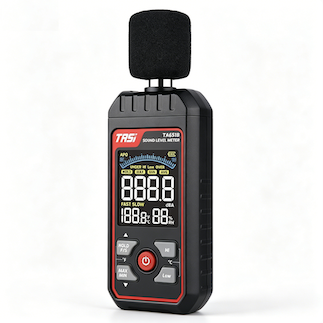
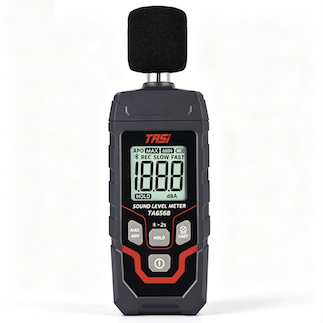
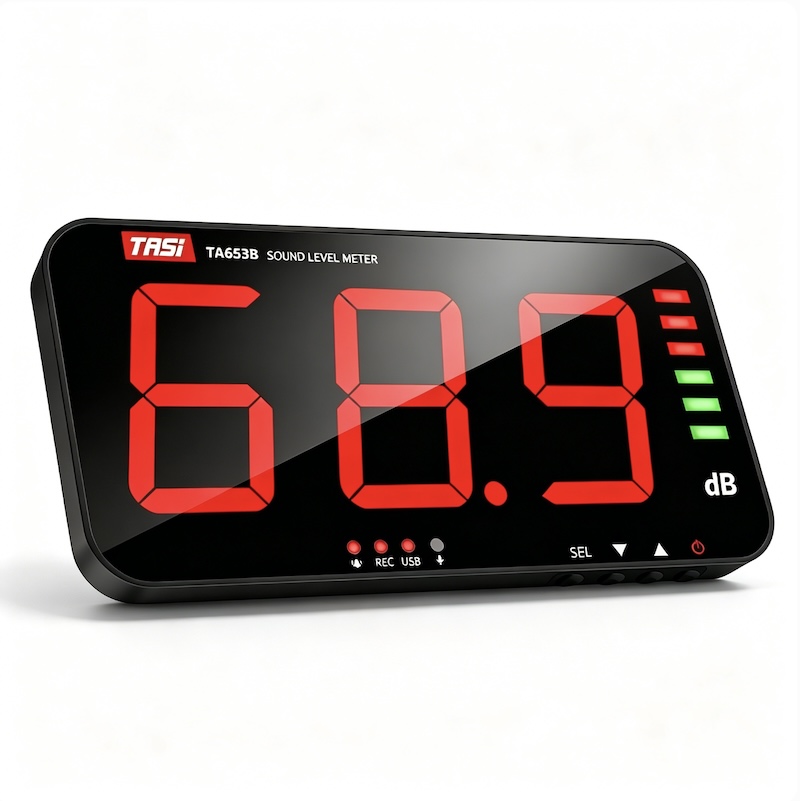
A handheld sound level meter is a portable electronic instrument used to measure sound pressure level. It may also be referred to as a portable sound level meter, digital sound level meter, noise meter, or decibel meter.
As sound travels through air, it creates continuous variations in air pressure. The microphone at the front of the sound level meter detects these pressure variations and converts them into electrical signals. The signals are then amplified, frequency weighted, time weighted, and digitally processed before the resulting sound level is displayed in decibels.
For example, a reading of 65 dBA indicates that the measured sound level has been processed using A-weighting.
The main advantage of a handheld sound level meter is not simply that it can be held in one hand. Its real value is the combination of measurement capability and portability, allowing users to move easily between different locations and perform on-site sound assessments efficiently.
How Does a Handheld Sound Level Meter Work?
The basic measurement process can be summarized as sound detection, signal processing, and result display.
● Sound detection by microphone: The measurement microphone detects variations in acoustic pressure and converts them into an electrical signal.
● Signal amplification and processing: Internal electronics amplify the signal and process it according to the selected frequency weighting and time weighting.
● Sound pressure level calculation: The instrument calculates the sound pressure level from the processed signal.
● Result display: The measured value is shown in dB, dBA, dBC, or another applicable unit or weighting format.
Because sound levels in real environments often fluctuate continuously, a sound level meter does more than capture a single instantaneous sound. It continuously samples and processes acoustic signals according to the selected response settings.
What Are the Main Features of a Handheld Sound Level Meter?
● High portability: Handheld models are generally compact, lightweight, and suitable for one-handed operation, making them practical for inspections and measurements at multiple locations.
● Direct digital readout: The display provides an immediate sound level reading without requiring complex calculations.
● Fast field measurement: Once the instrument is switched on and configured, measurements can usually begin immediately.
● Wide measurement range: Many handheld meters cover sound levels encountered in offices, general environments, industrial facilities, machinery, and traffic applications. The actual range depends on the instrument specification.
● Integrated measurement functions: Depending on the model, functions may include maximum and minimum values, data hold, data logging, and communication interfaces.
● Flexible applications: The same instrument can often be used in factories, offices, buildings, plant rooms, roadsides, and other environments.
What Are A-Weighting and C-Weighting Used For?
Human hearing is not equally sensitive to all frequencies, so sound measurements often use frequency weighting.
A-weighting adjusts the measured signal to approximate the frequency sensitivity of human hearing. Results are normally expressed in dBA. It is widely used for environmental noise, workplace noise, and general sound-level assessment.
C-weighting has a flatter frequency response and retains more low-frequency content. It can be useful when assessing higher sound levels, noise with significant low-frequency components, or certain types of machinery noise.
The appropriate weighting should be selected according to the purpose of the measurement, the applicable procedure, and the acoustic characteristics being evaluated.
What Is the Difference Between FAST and SLOW?
FAST and SLOW are time weightings that determine how quickly the displayed reading responds to changes in sound level.
● FAST: Responds more quickly to changing sound levels and is useful for observing rapidly varying noise.
● SLOW: Provides a more smoothed response, making the displayed reading more stable for relatively steady noise.
FAST and SLOW do not simply mean that the instrument measures “faster” or “slower.” They represent different time-response characteristics. When sound fluctuates, the displayed level may differ depending on the selected time weighting.
What Functions Are Commonly Found on Handheld Sound Level Meters?
The available functions vary by model, but common features may include:
● Real-time sound pressure level measurement;
● A/C frequency weighting;
● FAST/SLOW time weighting;
● MAX value hold;
● MIN value recording;
● Data hold;
● Automatic or manual range selection;
● Backlit display;
● Data storage;
● USB or wireless data transfer;
● High-level or limit alarm.
For general field measurements, basic sound pressure level measurement, A-weighting, and FAST/SLOW time weighting are sufficient for many applications. Where long-term recording, occupational noise assessment, or post-processing is required, data logging and statistical functions should also be considered.
Where Are Handheld Sound Level Meters Used?
One of the main advantages of a handheld sound level meter is the ability to move quickly between different measurement environments.
● Industrial equipment inspection: Measuring noise from motors, fans, compressors, pumps, and production machinery.
● Workplace surveys: Checking sound levels in workshops, plant rooms, and production areas.
● Building environments: Evaluating sound levels in offices, homes, schools, hotels, and similar spaces.
● HVAC inspection: Measuring noise generated by fans, air-conditioning systems, air outlets, and mechanical equipment.
● Traffic and outdoor environments: Measuring road traffic, construction activity, and other outdoor noise sources.
● Equipment maintenance and comparison: Comparing noise levels from the same machine at different times or under different operating conditions.
A general-purpose handheld sound level meter is not automatically suitable for every regulatory, occupational, or professional acoustic measurement. Where a specific measurement procedure or compliance requirement applies, an instrument with the appropriate performance class and technical specifications should be used.
How Does a Handheld Sound Level Meter Differ from a Fixed Noise Monitoring System?
The main differences are measurement method and intended application.
A handheld sound level meter emphasizes portability and flexibility. The operator can take the instrument to different locations and quickly measure multiple points. This makes it particularly useful for inspections, troubleshooting, environmental surveys, and short-term measurements.
A fixed noise monitoring system is installed at a specific location and is generally designed to collect sound data continuously or at scheduled intervals. It is better suited to long-term environmental monitoring, continuous data collection, and remote observation.
If the objective is to determine the sound level at a location at a particular moment, a handheld instrument is usually more convenient. If the goal is to understand how noise changes over hours, days, or longer periods, a continuous monitoring system is generally more appropriate.
How Is a Handheld Sound Level Meter Different from a Smartphone Noise App?
A smartphone noise app can use the phone's built-in microphone to estimate environmental sound levels and may be useful for quick, informal checks. However, smartphones are not primarily designed as acoustic measurement instruments.
Microphone sensitivity, frequency response, automatic gain control, and hardware design differ between phone models. As a result, the same app can produce different readings on different devices.
A dedicated handheld sound level meter uses a purpose-designed measurement microphone and signal-processing system, with specified measurement range, accuracy, frequency response, and time weighting characteristics. It is therefore more suitable when measurement stability, repeatability, and defined technical performance are required.
What Should Be Considered When Using a Handheld Sound Level Meter?
Instrument performance is only one factor affecting measurement quality. Measurement technique is equally important.
● Confirm that the measurement range, frequency weighting, and time weighting are appropriate for the measurement objective.
● Do not cover the microphone with a hand, clothing, or other object.
● Avoid positioning the operator's body too close to the microphone, as reflections may affect the reading.
● During outdoor measurements, consider the effect of wind and use a windscreen where necessary.
● Do not use the instrument outside its specified measurement range.
● Where measurement accuracy is important, verify the calibration status or perform acoustic calibration as required.
● For repeated comparisons, keep the measurement position, distance, orientation, and instrument settings as consistent as possible.
When measuring machinery, it is also advisable to record operating load, rotational speed, operating condition, and measurement distance. Otherwise, measurements taken at different times may not be directly comparable.
How Do You Choose the Right Handheld Sound Level Meter?
The highest measurable decibel value should not be the only selection criterion. The instrument should be chosen according to the intended application.
● Measurement range: Ensure that the expected minimum and maximum sound levels fall within the instrument's specified range.
● Accuracy class: Select the required performance level according to whether the application involves general inspection, engineering measurement, or professional acoustic testing.
● Frequency weighting: A-weighting is commonly required for general environmental measurements; C-weighting may be useful for additional acoustic assessment.
● Time weighting: FAST and SLOW are common basic functions.
● Data functions: For long-term analysis or reporting, consider data storage and export capabilities.
● Operating environment: For outdoor, humid, dusty, or industrial conditions, consider the instrument's environmental suitability.
● Calibration requirements: For measurements requiring higher confidence, check whether the instrument can be conveniently used with an acoustic calibrator.
For general industrial inspections and environmental noise checks, a sound level meter with an appropriate range, practical functions, and straightforward operation is often more useful than an unnecessarily complex instrument.
FAQ
What does a handheld sound level meter measure?
It primarily measures sound pressure level at a specific location, with results typically displayed in dB, dBA, or dBC.
Can a handheld sound level meter measure all types of sound?
It can generally measure sounds that fall within its specified sound-level and frequency ranges. Frequency response, maximum level, and accuracy vary between instruments.
Should environmental noise normally be measured in dBA or dBC?
A-weighting is commonly used for general environmental noise assessment, so results are often expressed in dBA. The correct weighting should still be selected according to the measurement objective and applicable procedure.
Can a handheld sound level meter be held during the entire measurement?
Yes, but the operator's body and arm can reflect or obstruct sound. For more stable or controlled measurements, the instrument may be mounted on a tripod.
Why is a windscreen used for outdoor measurements?
Airflow across the microphone can create additional low-frequency turbulence that may be interpreted as sound. A windscreen helps reduce this effect.
Can a handheld sound level meter replace a noise dosimeter?
Not directly. A handheld sound level meter measures sound levels at a location, while a noise dosimeter is typically worn by a person to assess cumulative personal noise exposure over a defined period.
Conclusion
A handheld sound level meter is a portable, direct, and versatile instrument for measuring sound pressure levels. It detects sound through a microphone, processes the signal using frequency and time weightings, and displays the result in decibels.
Its main advantages are portability, flexible field operation, and the ability to perform rapid measurements at multiple locations. These characteristics make it useful for industrial equipment inspections, workplace surveys, building environments, HVAC systems, and outdoor noise measurements.
Reliable measurements require the correct frequency weighting, time weighting, measurement position, and operating technique. Wind, distance, acoustic reflections, and calibration status should also be considered. For regulatory compliance, occupational noise assessment, or high-accuracy acoustic analysis, the required instrument performance class and measurement specifications should be confirmed in advance.