Introduction
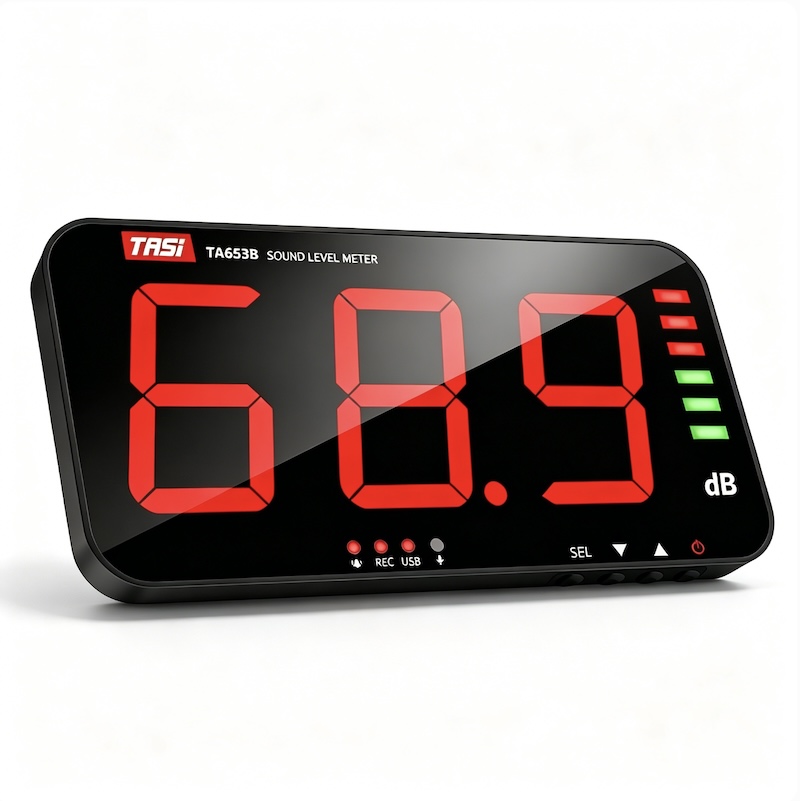
In noise measurement, environmental acoustics, industrial testing, and acoustic analysis, SPL (Sound Pressure Level) is one of the most fundamental parameters. The dB readings displayed by a sound level meter are also commonly related to sound pressure level measurements.
As sound travels through air, it produces small variations in air pressure. These variations are known as sound pressure. Because the range of sound pressures detectable by the human ear is extremely wide, expressing them directly in pascals (Pa) is often impractical. Acoustics therefore uses a logarithmic scale to express sound pressure as a level in decibels (dB).
Understanding SPL provides an essential foundation for interpreting sound level meter readings, A-weighting, C-weighting, FAST/SLOW time weighting, and environmental noise measurements.
Key Points
● SPL stands for Sound Pressure Level and is normally expressed in dB;
● SPL represents measured sound pressure relative to a defined reference sound pressure rather than simply expressing sound in Pa;
● For airborne sound, the standard reference sound pressure is generally 20 µPa;
● SPL uses a logarithmic scale, so dB values cannot be interpreted as ordinary linear values;
● Combining two equal, uncorrelated sound sources typically increases the total sound level by approximately 3 dB rather than doubling the dB value;
● Actual measurement results can also be affected by frequency weighting, time weighting, measurement distance, acoustic reflections, and instrument performance.
What Is Sound Pressure?
Sound pressure is the basic physical quantity behind sound pressure level. When a sound wave propagates through air, it produces small fluctuations in pressure around the ambient atmospheric pressure. These fluctuations caused by sound are referred to as sound pressure.
Sound pressure is expressed in pascals (Pa). In practical acoustic measurements, the root mean square (RMS) sound pressure is generally used rather than an instantaneous pressure peak.
The range of sound pressure detectable by the human ear is extremely large. From sounds close to the threshold of hearing to very intense sounds capable of causing hearing damage, sound pressure can vary by millions of times.
A logarithmic scale is therefore used to convert sound pressure into sound pressure level, making acoustic values easier to express and compare.
What Is Sound Pressure Level (SPL)?
Sound Pressure Level is a logarithmic measure comparing the RMS value of measured sound pressure with a specified reference sound pressure.
The commonly used equation is:
Lp = 20 log₁₀ (p / p₀)
where:
● Lp = sound pressure level, in dB;
● p = measured RMS sound pressure, in Pa;
● p₀ = reference sound pressure;
● log₁₀ = base-10 logarithm.
For airborne sound measurements, the standard reference sound pressure is:
p₀ = 20 µPa = 0.00002 Pa
A sound pressure of 20 µPa is approximately associated with the threshold of hearing around 1 kHz under specified conditions and is therefore used as the standard reference for airborne sound pressure level.
When the measured sound pressure equals 20 µPa:
SPL = 0 dB
Importantly, 0 dB SPL does not mean that no sound exists. It means that the sound pressure is equal to the defined reference sound pressure.
Why Is Sound Pressure Level Expressed in dB?
The human auditory system covers an extremely wide range of sound pressures. Expressing this entire range directly in Pa would result in values that are inconvenient to compare.
For example:
● 20 µPa corresponds to approximately 0 dB SPL;
● 0.02 Pa corresponds to approximately 60 dB SPL;
● 2 Pa corresponds to approximately 100 dB SPL;
● 20 Pa corresponds to approximately 120 dB SPL.
Using decibels compresses this very large range into values that are easier to handle and compare.
The decibel is therefore a logarithmic representation. In the context of SPL, it expresses the logarithmic ratio between a measured sound pressure and the specified reference sound pressure.
How Does a Change in Sound Pressure Affect dB?
Because SPL is calculated logarithmically, changes in sound pressure and changes in dB are not linearly proportional.
For sound pressure amplitude:
● Increasing sound pressure by approximately 1.414 times increases SPL by approximately 3 dB;
● Doubling sound pressure increases SPL by approximately 6 dB;
● Increasing sound pressure by a factor of 10 increases SPL by 20 dB;
● Increasing sound pressure by a factor of 100 increases SPL by 40 dB.
It is important to distinguish between doubling the sound pressure amplitude and combining two equal sound sources.
If the sound pressure amplitude itself doubles, SPL increases by approximately 6 dB. However, when two equal and mutually uncorrelated sound sources operate simultaneously, their average acoustic energies add, and the resulting total level is typically only about 3 dB higher than the level of either source alone.
For this reason, dB values from multiple noise sources cannot simply be added arithmetically.
What Are Typical Sound Pressure Levels?
Actual SPL values depend on measurement distance, acoustic environment, background noise, and other measurement conditions. The following values are approximate examples only.
| Sound or Environment | Typical Sound Pressure Level |
|---|---|
| Approximate threshold of hearing | Approx. 0 dB SPL |
| Very quiet environment | Approx. 20–30 dB SPL |
| Quiet office | Approx. 40–50 dB SPL |
| Normal conversation | Approx. 55–65 dB SPL |
| Near busy road traffic | Approx. 70–85 dB SPL |
| Near some industrial machinery | Approx. 80–100 dB SPL |
| Very intense machinery or sound source | Approx. 100–120 dB SPL |
These values should not be interpreted as regulatory noise limits or occupational exposure criteria. Compliance assessments must follow the applicable regulations, standards, and specified measurement procedures.
How Is SPL Related to a Sound Level Meter?
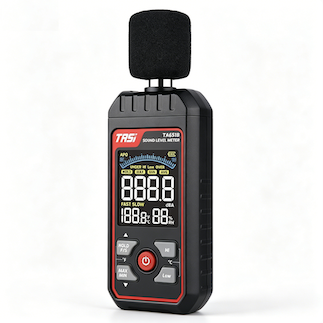
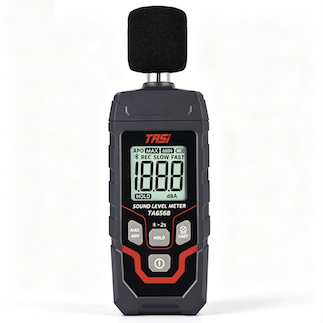
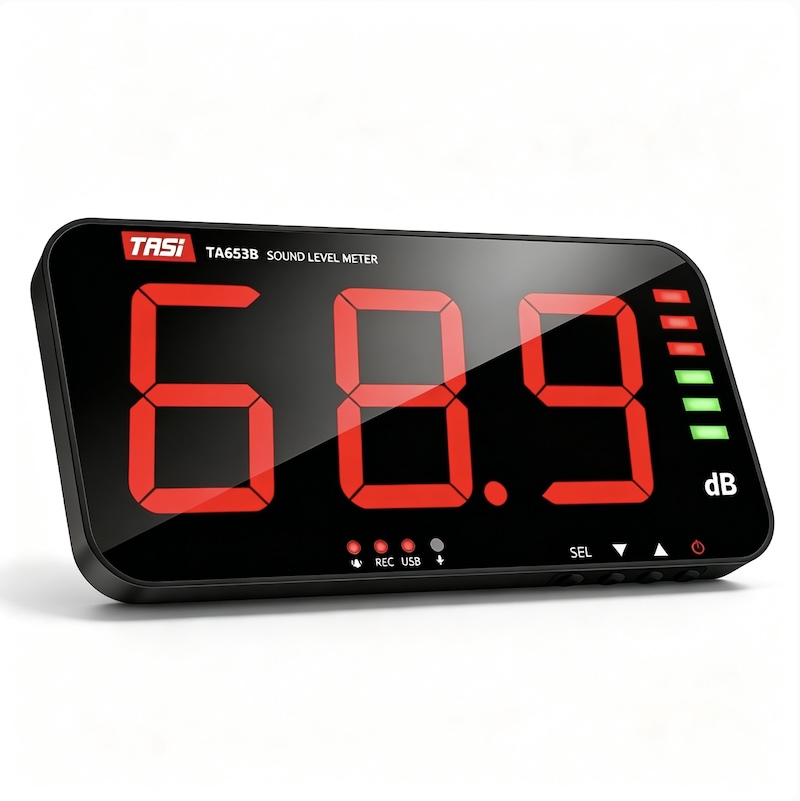
A sound level meter measures acoustic pressure variations and processes the resulting signal to display a sound level in decibels.
The basic measurement process can be represented as:
Sound → Microphone → Electrical Signal → Signal Processing → Frequency/Time Weighting → dB Reading
The microphone converts variations in air pressure into an electrical signal. The instrument then amplifies, filters, processes, and weights this signal before calculating the displayed sound level.
A sound level meter may display different types of readings, for example:
● dB SPL: sound pressure level;
● dB(A): sound level with A-frequency weighting;
● dB(C): sound level with C-frequency weighting;
● FAST: fast time weighting;
● SLOW: slow time weighting.
Therefore, a reading such as “65 dB” alone does not fully describe a professional noise measurement. The frequency weighting, time weighting, measurement position, and other test conditions should also be specified.
What Is the Difference Between SPL, dB, and dB(A)?
These terms are related but do not mean exactly the same thing.
SPL stands for Sound Pressure Level and identifies the acoustic quantity being measured.
dB stands for decibel and is the logarithmic unit used to express SPL and many other ratio-based quantities. Because dB is not exclusive to acoustics, the measured quantity and reference value should be clear in technical applications.
dB(A) indicates a sound level measured using A-frequency weighting. A-weighting applies a standardized frequency response that modifies different frequency components and is widely used for many environmental and human-hearing-related noise assessments.
In short, SPL identifies the acoustic quantity, dB is the unit used to express the level, and dB(A) additionally specifies that A-frequency weighting has been applied.
Why Can SPL Measurements of the Same Sound Source Differ?
Sound pressure level is not necessarily a fixed value for a particular sound source. Measurements of the same equipment can differ significantly depending on test conditions.
● Measurement distance: In an approximate free field, SPL generally decreases as the distance from a point source increases. Under ideal conditions, doubling the distance results in a reduction of approximately 6 dB, although reflections, source dimensions, and room geometry can alter this behavior.
● Measurement direction: Some sound sources are directional, producing different sound levels in different directions.
● Reflections: Walls, floors, ceilings, machinery, and other large objects can reflect sound and change the acoustic field at the measurement position.
● Background noise: When the source level is close to the ambient background level, the meter measures the combined sound field, which can significantly affect the reading.
● Frequency weighting: A-, C-, and other frequency weightings respond differently to different frequencies.
● Time weighting: FAST and SLOW respond at different rates to variations in sound level, which can produce different displayed readings for fluctuating noise.
● Instrument performance: Microphone frequency response, dynamic range, linear operating range, instrument class, and calibration condition can all affect the measurement.
When comparing SPL measurements, the measurement position, distance, instrument settings, and acoustic conditions should therefore be kept consistent.
What Should Be Considered When Measuring SPL?
Reliable and repeatable sound measurements require consistent measurement conditions.
● Select the appropriate frequency weighting, such as A or C, according to the measurement objective;
● Select FAST or SLOW time weighting according to the characteristics of the sound;
● Position the microphone at the specified location, height, orientation, and distance from the sound source;
● Minimize unnecessary acoustic shielding and reflections caused by the operator, walls, or large objects;
● Check the instrument range, microphone condition, and battery status before measurement;
● For measurements requiring higher accuracy, use an acoustic calibrator to perform pre- and post-measurement checks as required;
● Record measurement distance, environmental conditions, frequency weighting, time weighting, and measurement time for comparison and traceability;
● For regulatory compliance, occupational noise, or formal testing, follow the applicable standards regarding instrument class and measurement procedure.
FAQ
What is the unit of SPL?
Sound pressure level is normally expressed in decibels (dB). For airborne sound, 20 µPa is generally used as the reference sound pressure.
Does 0 dB SPL mean complete silence?
No. 0 dB SPL means that the measured sound pressure equals the reference pressure of 20 µPa. It does not mean zero sound pressure.
How much does SPL increase when sound pressure doubles?
If the sound pressure amplitude doubles, SPL increases by approximately 6 dB.
Do two identical noise sources double the dB level?
No. For two equal and uncorrelated sound sources, the combined sound level is normally approximately 3 dB higher than either source alone. For example, two independent 70 dB sources produce a combined level of approximately 73 dB, not 140 dB.
Are SPL and dB(A) the same?
Not exactly. SPL refers to sound pressure level, while dB(A) specifically indicates that A-frequency weighting has been applied. Professional measurement records should specify the weighting and relevant measurement conditions.
Why does SPL change with measurement distance?
Sound pressure generally decreases as sound propagates away from its source. In an approximate free field, doubling the distance from a point source typically reduces SPL by about 6 dB. Actual results may differ because of reflections, source directivity, and environmental conditions.
Conclusion
Sound Pressure Level (SPL) is one of the fundamental quantities in acoustic measurement. It expresses measured sound pressure relative to a defined reference pressure and is normally stated in decibels. For airborne sound, 20 µPa is generally used as the reference pressure.
Understanding the logarithmic nature of SPL is essential: doubling sound pressure amplitude increases SPL by approximately 6 dB, while combining two equal, uncorrelated sound sources typically increases the total level by only about 3 dB.
In practical noise measurement, SPL also depends on measurement distance, acoustic conditions, frequency weighting, time weighting, and instrument performance. A professional measurement should therefore document not only the dB value but also the measurement position, instrument settings, and relevant test conditions.