Introduction
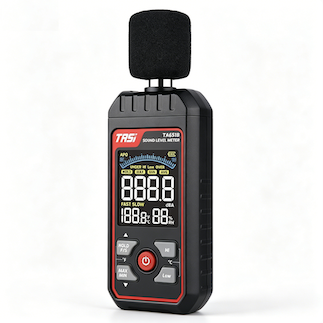
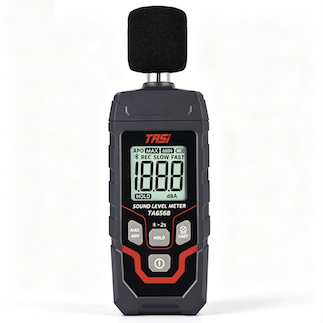
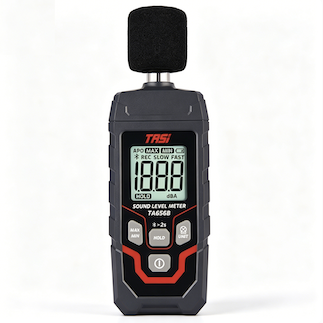
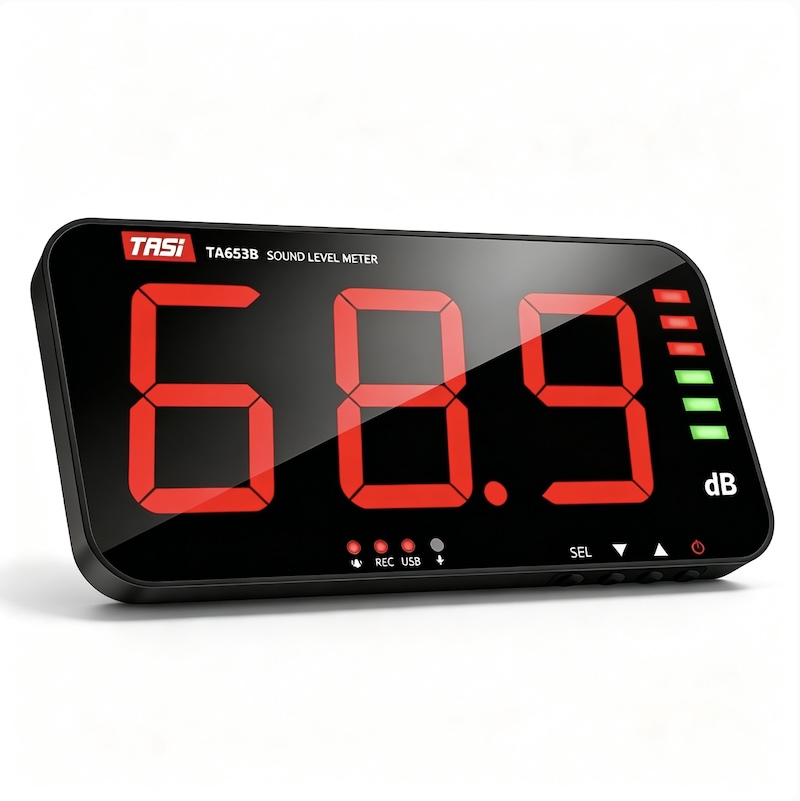
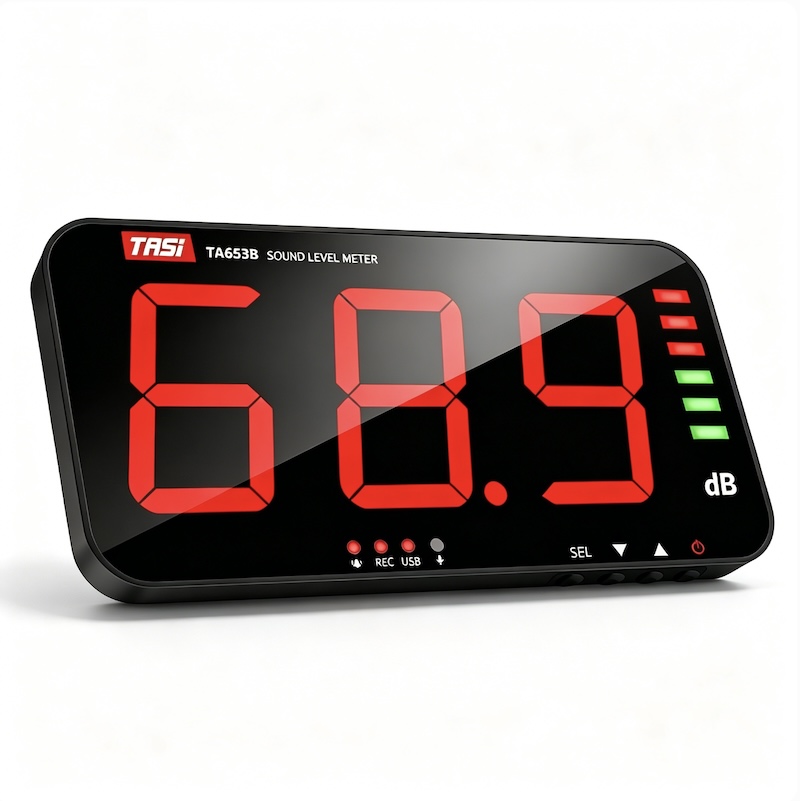
A digital sound level meter, also commonly referred to as a noise meter or decibel meter, is an instrument used to measure sound pressure level. Modern digital models often provide much more than a real-time decibel reading. Depending on the instrument, additional functions may include frequency weighting, time weighting, maximum value recording, data hold, data logging and communication.
Each function serves a different measurement purpose. A-weighting is widely used for general environmental and occupational noise measurements, while FAST and SLOW time weighting determine how quickly the displayed value responds to changes in sound level. Data logging is particularly useful when noise needs to be evaluated over an extended period.
Understanding these functions helps users operate a sound level meter correctly and choose an instrument based on actual measurement requirements rather than measurement range or price alone.
Key Points
● Sound pressure level measurement is the basic function of a digital sound level meter, with results commonly displayed in dB, dBA or dBC.
● A/C frequency weighting is used to evaluate sounds with different frequency characteristics.
● FAST/SLOW time weighting determines how quickly the meter responds to changes in sound level.
● MAX/MIN and Data Hold functions make it easier to capture fluctuating noise and retain measurement readings.
● Some models also support data logging, alarm thresholds, USB or Bluetooth communication.
● More functions do not necessarily mean a better instrument; the correct choice depends on the application.
Sound Level Measurement
Sound level measurement is the core function of a digital sound level meter. The microphone detects sound-pressure fluctuations in the air, and the instrument processes this signal and converts it into a decibel value displayed on the screen.
Common display formats include:
● dB: a general expression of sound level.
● dBA: sound level measured using A-frequency weighting.
● dBC: sound level measured using C-frequency weighting.
Measurement ranges vary between instruments. Many general-purpose digital sound level meters, for example, cover approximately 30 to 130 dB, although the actual range must always be confirmed from the product specifications.
For many basic applications, real-time sound level measurement is the most important function.
Frequency Weighting
Human hearing does not respond equally to all sound frequencies. For this reason, sound level measurements often apply frequency weighting to modify the measured signal according to a defined frequency response.
Common frequency weightings include:
● A-weighting: Attenuates low and very high frequencies significantly and approximates the frequency sensitivity of human hearing under many common sound-level conditions. Results are typically expressed in dBA.
● C-weighting: Has a flatter frequency response and retains substantially more low-frequency content than A-weighting. It is often used for higher sound levels, low-frequency-dominant noise or comparison between different weighting methods.
● Z-weighting: Provides an approximately flat, unweighted frequency response and is mainly found on professional sound level meters and acoustic analysis instruments.
Basic digital sound level meters usually provide at least A-weighting, while some models support both A and C weighting.
FAST and SLOW Time Weighting
Sound levels in real environments are rarely constant. Machinery, traffic, human activity and equipment start-up or shutdown can all cause rapid variations.
To provide an appropriate response to these changes, digital sound level meters commonly offer FAST and SLOW time weighting.
● FAST: Uses a time constant of approximately 125 ms and responds relatively quickly to changes in sound level, making short-term variations easier to observe.
● SLOW: Uses a time constant of approximately 1 second and produces a more stable display, making it suitable for relatively steady or continuously varying noise.
For fluctuating machinery noise, FAST can make short-term changes easier to see. SLOW is useful when a steadier, easier-to-read indication is preferred.
FAST and SLOW change the meter's time response; they should not be regarded simply as different accuracy settings.
Maximum and Minimum Functions
MAX/MIN functions are widely used in digital measurement instruments.
● MAX: Records the highest sound level observed during a measurement period.
● MIN: Records the lowest sound level observed during a measurement period.
When sound levels fluctuate, it may be difficult to identify the highest reading by watching the display continuously. MAX allows the user to capture the highest displayed level during the measurement period.
For example, when checking motors, fans, compressors or production equipment, MAX can help identify higher sound levels occurring during operation.
However, the MAX reading on a basic sound level meter is not necessarily the same as a true acoustic peak sound pressure level. Applications requiring Peak measurement should use an instrument specifically designed to provide that parameter.
Data Hold
Data Hold is commonly identified by a HOLD key.
When activated, the current displayed value is temporarily frozen on the screen, even if the surrounding sound level changes.
This function is useful when:
● The meter is positioned where the display cannot be read easily during measurement.
● A reading at a particular moment needs to be recorded.
● Measurement results must be entered manually into an inspection record.
● The instrument needs to be moved before the displayed value can be read.
Data Hold does not stop the surrounding sound from changing. It simply freezes a displayed reading.
Measurement Range and Over-Range Indication
Depending on the product design, a digital sound level meter may use automatic ranging or allow the user to select between multiple measurement ranges.
Auto-ranging instruments automatically select a suitable range according to the current sound level, simplifying operation. Manual-ranging models allow the user to select the appropriate range for the expected measurement environment.
If the actual sound level exceeds the available range, the meter may display an indication such as “OVER”. Some instruments also indicate when the signal falls below the usable range.
An over-range indication should not be interpreted as an actual sound-level value. The selected range and the instrument's maximum measuring capability should be checked instead.
Backlight and Auto Power-Off
Digital sound level meters often include convenience features that improve field usability.
● LCD backlight: Improves readability in machine rooms, underground areas, nighttime conditions or other poorly illuminated environments.
● Auto power-off: Automatically switches the instrument off after a period of inactivity to reduce battery consumption.
● Low-battery indication: Alerts the user when the battery needs replacement or charging.
These features do not directly affect acoustic performance, but they can significantly improve practical operation.
Alarm Function
Some digital sound level meters provide an alarm or threshold indication function.
After a sound-level threshold has been set, the instrument may provide a visual, audible or display indication when the measured level reaches or exceeds that threshold.
Typical applications include:
● Quickly checking whether a location exceeds a predefined sound level.
● Noise inspections in production areas.
● Supporting observation of machinery operating conditions.
● Monitoring environmental sound-level thresholds.
An instrument's user-defined alarm threshold is not automatically equivalent to a regulatory or occupational noise exposure limit. Formal compliance or occupational noise assessments require the applicable measurement procedure, exposure duration and relevant regulations or standards to be considered.
Data Logging
Basic digital sound level meters are primarily designed for real-time readings, whereas data-logging models can automatically store measurements at specified intervals.
Continuous recording can be used to observe sound-level variation over time, for example:
● Noise changes throughout the operating cycle of a machine.
● Sound-level variation in a workshop during different periods.
● Noise during start-up, stable operation and shutdown of HVAC equipment.
● Environmental noise trends over an extended period.
Compared with a single decibel reading, continuous data provides substantially more information for subsequent analysis.
Logging capacity, sampling interval and recorded parameters vary considerably between instruments and should therefore be checked during product selection.
USB, Bluetooth and Data Communication
Some digital sound level meters can connect to a computer, smartphone or data acquisition system via USB, Bluetooth or another communication interface.
Depending on the instrument and software, users may be able to:
● View readings in real time.
● Download stored data.
● Plot sound-level trends.
● Export measurement records.
● Perform long-term data analysis.
● View meter readings remotely.
These functions are not essential for quick on-site measurements, but they can be particularly useful for equipment maintenance, laboratory testing, environmental monitoring and applications requiring retained measurement records.
Equivalent Continuous Sound Level and Other Advanced Functions
Some professional or integrating sound level meters provide measurement parameters that are not normally available on basic instruments, including equivalent continuous sound level, Leq, and other time-integrated acoustic parameters.
Leq represents the constant sound level that would contain the same acoustic energy as the varying noise measured over a specified period. It is therefore an important parameter in environmental noise assessment and occupational noise evaluation.
It is useful to distinguish between different instrument categories:
● A basic digital sound level meter is primarily intended for real-time sound-level measurement and quick field checks.
● A data-logging sound level meter can continuously store changes in sound level.
● An integrating sound level meter can calculate Leq and other time-integrated parameters.
● A professional sound level analyzer may also provide frequency-spectrum analysis and other advanced acoustic functions.
Product selection should therefore start by determining whether the application only requires a current decibel reading or a formal long-term noise assessment.
Calibration-Related Functions
To maintain confidence in measurement results, sound level meters normally require acoustic calibration or verification.
Depending on the instrument design, calibration adjustment may be built into the meter, or the instrument may be checked using an external acoustic calibrator.
A typical procedure involves fitting a suitable sound calibrator to the microphone. The calibrator produces a stable reference sound pressure level, allowing the user to verify whether the meter reading is within the acceptable tolerance.
For routine trend checks, calibration requirements may be relatively straightforward. Occupational, environmental, laboratory or formal measurement applications usually require calibration and instrument management in accordance with the applicable measurement procedure.
Are More Functions Always Better?
Not necessarily.
For basic equipment inspection or environmental sound-level checks, a digital sound level meter with A-weighting, FAST/SLOW, MAX and HOLD functions may already be sufficient.
For recording sound levels throughout a full working day, data-logging capacity and sampling settings become more important. If measurements need to be transferred to a computer or smartphone, USB or Bluetooth connectivity may be required. For occupational noise exposure assessment or professional environmental noise analysis, Leq, integrating measurement capability, instrument class and applicable measurement requirements become more important.
The best sound level meter is therefore the one whose functions match the actual application, rather than simply the model with the largest number of features.
FAQ
What is the most basic function of a digital sound level meter?
Its primary function is to measure sound pressure level and display the result in decibels. Most general-purpose models also provide A-weighting, FAST/SLOW time weighting and functions such as MAX or HOLD.
What is the difference between A-weighting and C-weighting?
A-weighting attenuates low frequencies more strongly and more closely reflects human hearing sensitivity under many common sound-level conditions. C-weighting has a flatter response and retains more low-frequency content.
Is FAST more accurate than SLOW?
No. FAST and SLOW have different time-response characteristics. The appropriate setting depends on the type of sound and the measurement objective.
Can the MAX function measure an instantaneous peak?
Not necessarily. MAX on a basic sound level meter usually records the highest reading under the selected frequency and time weighting. It is not the same as a dedicated Peak acoustic parameter.
What is the difference between Data Hold and data logging?
Data Hold freezes one displayed reading. Data logging automatically stores multiple measurements over a period of time or at specified intervals.
Can an ordinary digital sound level meter measure Leq?
Not all models can. Leq normally requires integrating sound-level measurement capability and should be specifically listed in the product specifications.
Does Bluetooth improve measurement accuracy?
No. Bluetooth is primarily used for data display, transmission and storage. It does not directly improve the accuracy of the microphone or acoustic measurement system.
Conclusion
The core function of a digital sound level meter is to convert sound-pressure fluctuations into readable decibel values. Modern instruments may additionally provide A/C frequency weighting, FAST/SLOW time weighting, MAX/MIN, HOLD, alarms, backlighting, data logging and USB or Bluetooth communication.
Each function addresses a different measurement need. Frequency weighting determines how sound at different frequencies is evaluated, time weighting determines how the instrument responds to changes in level, MAX/MIN and HOLD improve field usability, while data logging and communication functions support longer-term monitoring and analysis.
When selecting a digital sound level meter, the required functions should therefore be determined according to the measurement object, data-recording requirements and whether professional noise assessment is involved.