Introduction
Many smartphone apps are marketed as “decibel meters,” “noise meters,” or “sound level meters.” Once opened, they use the phone’s built-in microphone to capture sound and display values such as 45 dB, 70 dB, or 90 dB.
So, are smartphone noise measurement apps actually accurate?
The answer is: they can provide a useful estimate of everyday noise levels, but they generally cannot replace a professional sound level meter.
The reliability of a smartphone-based measurement depends not only on the app itself, but also on microphone characteristics, operating-system audio processing, frequency response, measurable sound pressure range, and calibration.
Key Points
● Smartphone noise measurement apps can be useful for estimating general environmental noise levels.
● Results may vary between different smartphone brands and models.
● Built-in smartphone microphones are primarily designed for calls and audio recording, not calibrated sound-level measurement.
● Measurement errors are more likely at high sound pressure levels, low or high frequencies, and in complex noise environments.
● Calibration can improve the usefulness of some apps, but it does not automatically make a smartphone equivalent to a professional sound level meter.
● Occupational noise assessment, environmental noise measurement, equipment testing, and formal records should normally be performed with a professional sound level meter.
How Does a Smartphone Noise Measurement App Work?
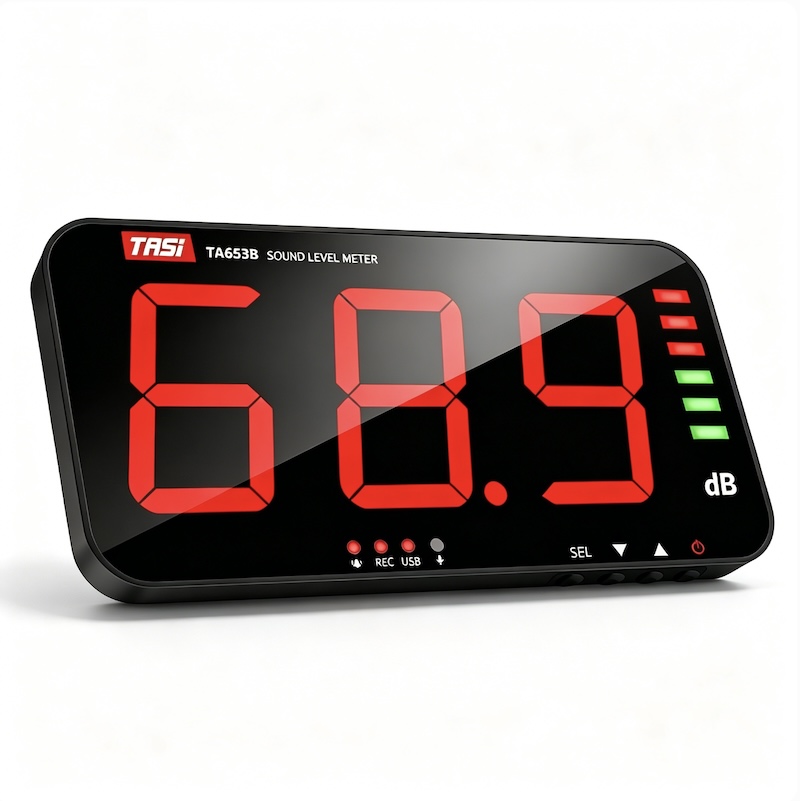
The basic operating principle is similar in some respects to that of a digital sound level meter.
The smartphone’s built-in microphone converts acoustic pressure variations into electrical signals. The phone’s audio system then digitizes and processes those signals, while the app calculates and displays an estimated sound pressure level.
Depending on the application, additional functions may include:
● Real-time decibel readings;
● Maximum and minimum values;
● Average noise levels;
● Waveform or trend displays;
● A-weighting or other measurement settings;
● Measurement logging and data storage.
From a functional perspective, smartphones are therefore capable of capturing sound and calculating approximate decibel values.
However, the ability to display a decibel reading does not mean that the complete measurement system provides the same performance as a purpose-designed and calibrated sound level meter.
Why Can Different Smartphones Show Different Decibel Readings?
One of the main reasons is that smartphones use different microphones and audio-processing systems.
Built-in microphones are primarily designed for voice calls, video recording, speech recognition, and general audio capture. Manufacturers typically prioritize voice intelligibility, compact size, power consumption, and recording quality rather than precision sound-level measurement.
As a result, two smartphones running the same noise measurement app may show different values when exposed to the same sound at the same location.
Possible causes include:
● Different microphone sensitivities;
● Different microphone frequency responses;
● Different internal gain settings;
● Different operating-system audio processing;
● Automatic gain control or noise-reduction processing;
● Microphone opening location and interference from protective cases.
For this reason, the accuracy of a noise measurement system cannot be judged by the app alone.
How Does the Smartphone Microphone Affect Noise Measurement?
Professional sound level meters normally use measurement microphones specifically designed for acoustic measurements, together with suitable signal processing, frequency weighting, and time weighting.
A smartphone microphone has a different design objective.
At normal speech levels, for example, a smartphone microphone may provide good audio capture. At very high sound pressure levels, however, the microphone or audio input circuitry may reach its operating limit and begin to saturate or clip.
If this happens, the actual sound level may continue increasing while the value reported by the app no longer increases correctly.
Similar limitations may appear when measuring:
● Very low ambient noise;
● High-level industrial noise;
● Strong low-frequency noise;
● High-frequency sound;
● Impulsive or rapidly changing sound;
● Very high sound pressure levels.
A smartphone app that performs reasonably well under normal indoor conditions therefore may not provide the same reliability in an industrial or high-noise environment.
Does the App Itself Affect the Measurement Result?
Yes.
In addition to smartphone hardware, the app’s measurement algorithms and settings also influence the result.
Different apps may use different sampling methods, averaging algorithms, frequency weightings, and signal-processing techniques. Some provide A-weighting and FAST or SLOW time weighting, while others display only a software-calculated decibel value.
If an app does not clearly specify its weighting method, time response, or calibration procedure, its readings should generally be treated as indicative rather than as professional measurement data.
When evaluating a smartphone noise app, it is therefore important to consider not only the appearance of its interface, but also the measurement method and whether calibration is supported.
Does Calibration Make a Smartphone App More Accurate?
Appropriate calibration can usually improve the usefulness of a smartphone noise measurement app.
For example, a smartphone can be compared with a properly functioning, calibrated professional sound level meter in a reasonably stable acoustic environment. If the app provides a calibration adjustment, a correction can then be applied.
This can reduce a fixed offset associated with a particular smartphone and app combination.
However, single-point calibration does not solve every measurement limitation.
A smartphone that agrees with a professional instrument at one sound level may not maintain the same agreement at other frequencies, other sound pressure levels, or under complex acoustic conditions.
Calibration therefore improves the reference value of the app, but it should not be interpreted as converting the smartphone into a professional sound level meter.
Can an External Microphone Improve Smartphone Noise Measurement?
In some applications, a dedicated calibrated external measurement microphone can significantly improve the performance of a smartphone-based measurement system.
Compared with a standard built-in smartphone microphone, a suitable external microphone may provide better-defined frequency response, sensitivity, and sound pressure range.
When the external microphone, software, and calibration procedure are designed to work together as a measurement system, the resulting measurements can be considerably more reliable than those obtained from the phone’s internal microphone alone.
However, if results are required for regulatory assessment, occupational safety, professional reports, or formal acceptance testing, the complete measurement system must still be verified as suitable for the relevant measurement requirements.
When Are Smartphone Noise Apps Useful?
For everyday applications where formal measurement accuracy is not required, smartphone apps can be very convenient.
Typical uses include:
● Estimating whether a room is relatively quiet or noisy;
● Comparing noise levels between two office areas;
● Observing noise changes before and after operating a household appliance;
● Obtaining a general indication of traffic noise;
● Comparing environmental noise at different times;
● Performing an initial noise survey before using professional equipment.
In these situations, the primary question is often “approximately how loud is it?” or “has the noise level increased significantly?” rather than obtaining a tightly controlled measurement value.
For this purpose, a smartphone app can be a useful screening tool.
When Should You Not Rely Only on a Smartphone App?
A smartphone app should not normally be the only measurement method when the results will be used for safety decisions, professional analysis, acceptance testing, or formal reports.
Examples include:
● Occupational noise exposure assessment;
● Industrial machinery noise testing;
● Environmental noise assessment;
● Product noise performance testing;
● Building acoustics measurements;
● Formal verification before and after noise-control measures;
● Measurements that require traceable records;
● Tests with specified accuracy, frequency weighting, or time weighting requirements.
These applications generally require a professional sound level meter with defined specifications, acoustic calibration capability, and performance appropriate to the intended measurement.
What Is the Difference Between a Smartphone App and a Professional Sound Level Meter?
The main difference is not simply that one is a smartphone and the other is a dedicated instrument. The complete measurement systems are designed for different purposes.
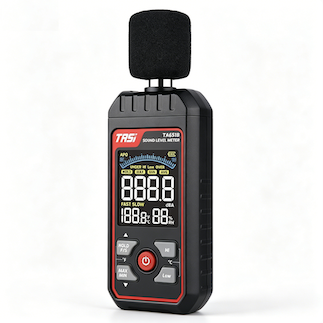
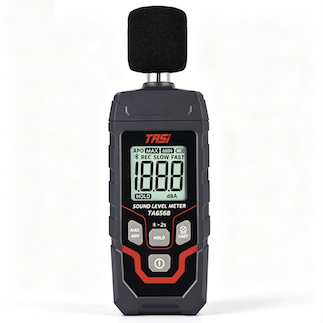
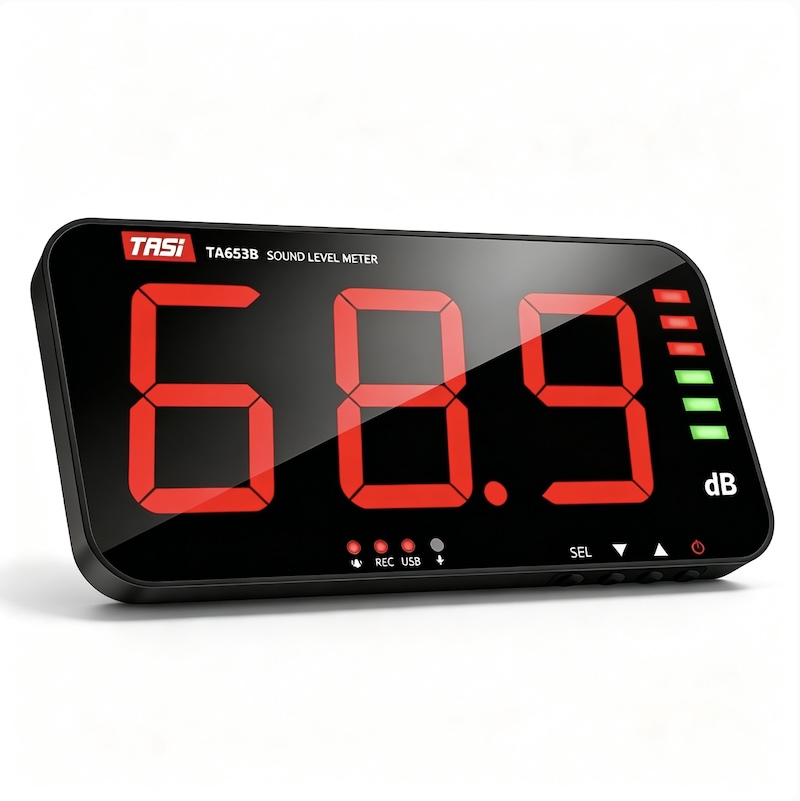
A professional sound level meter typically specifies:
● Measurement range;
● Measurement accuracy;
● Frequency range;
● Frequency weighting;
● Time weighting;
● Microphone performance;
● Linear operating range;
● Calibration method;
● Applicable environmental conditions.
Professional measurements can also use an acoustic calibrator to verify the instrument’s response before and after measurements.
Smartphone apps offer advantages in cost, convenience, and portability, but the hardware varies considerably between devices. They are therefore better suited to quick checks and preliminary assessments than to replacing a professional sound measurement instrument.
How Can You Make Smartphone Noise Measurements More Useful?
For everyday measurements, several practices can help reduce obvious errors.
● Use an app that supports manual calibration;
● Use the same smartphone for before-and-after comparisons;
● Do not cover the microphone opening;
● Check whether the phone case obstructs the microphone;
● Keep the phone position and orientation consistent;
● Avoid rubbing the phone or touching the area around the microphone during measurement;
● Do not assume the app remains accurate at very high industrial noise levels;
● Where possible, compare or calibrate the app against a professional sound level meter;
● Use a professional sound level meter when greater measurement reliability is required.
When the objective is to compare whether a machine is quieter after maintenance, keeping the smartphone, distance, position, and surrounding conditions consistent is often more useful than focusing excessively on one absolute decibel value.
FAQ
Are the decibel readings shown by smartphone noise apps real?
The readings are normally calculated from sound signals captured by the smartphone microphone, so they are not arbitrary values. However, their accuracy depends on the phone hardware, app algorithms, and calibration status, and they should generally be treated as reference values.
Can a smartphone noise app differ significantly from a professional sound level meter?
It depends. Some smartphones, after appropriate calibration and within a moderate sound-level range, may produce readings reasonably close to a professional instrument. However, the deviation may change with frequency, sound pressure level, and measurement conditions.
Why does the same app give different results on two phones?
Different smartphones may use microphones with different sensitivity, frequency response, audio circuitry, and system-level signal processing. The same app can therefore produce different readings on different devices.
Can a smartphone measure noise above 100 dB?
Whether it can do so reliably depends on the maximum sound pressure level that the microphone and audio input system can handle. If the hardware saturates or clips, the app may still display a value, but that value may no longer represent the actual sound pressure level accurately.
Can a smartphone app be used to check factory noise?
It can be used for preliminary screening and trend observation. For occupational noise assessment, machinery noise testing, or formal measurement records, a professional sound level meter should be used.
Can a smartphone app replace a Class 1 or Class 2 sound level meter?
Generally, no. Class 1 and Class 2 sound level meters are designed to meet defined performance requirements. Standard smartphone microphones and audio systems are not normally designed or verified as complete professional sound-level measurement systems.
Is a smartphone app still useful if I already have a professional sound level meter?
Yes. A smartphone app can be convenient for quick checks and preliminary screening, while a professional sound level meter is more appropriate when defined measurement performance, calibration capability, and reliable measurement data are required.
Conclusion
Smartphone noise measurement apps are not necessarily inaccurate. They can provide useful estimates of environmental sound levels and are convenient for everyday comparisons and trend monitoring.
However, a smartphone is not designed primarily as a professional sound-level measurement instrument. Microphone characteristics, frequency response, audio processing, measurement range, app algorithms, and calibration can all affect the result.
If the goal is simply to understand approximately how noisy an environment is, a smartphone app can be a practical reference tool. If the measurement is related to occupational safety, environmental assessment, industrial equipment testing, product testing, or formal reporting, a calibrated professional sound level meter should be used.
Understanding the intended role of each tool helps ensure that the measurement method matches the application and reduces the risk of making decisions based on an unreliable single decibel value.