Introduction
Mechanical equipment generates sound during operation due to motor rotation, gear meshing, bearing friction, airflow, structural vibration, compressed air, and other sources. In industrial production and maintenance, this noise is relevant not only to the working environment but also as a supplementary indicator of equipment condition.
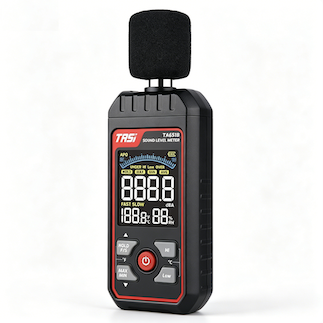
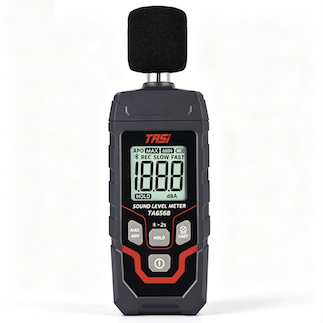
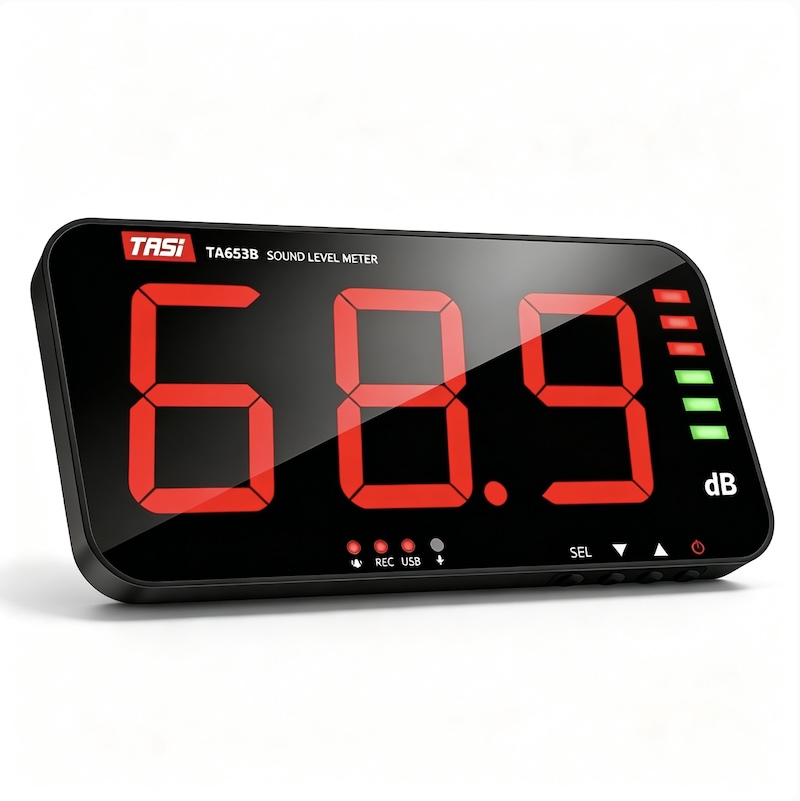
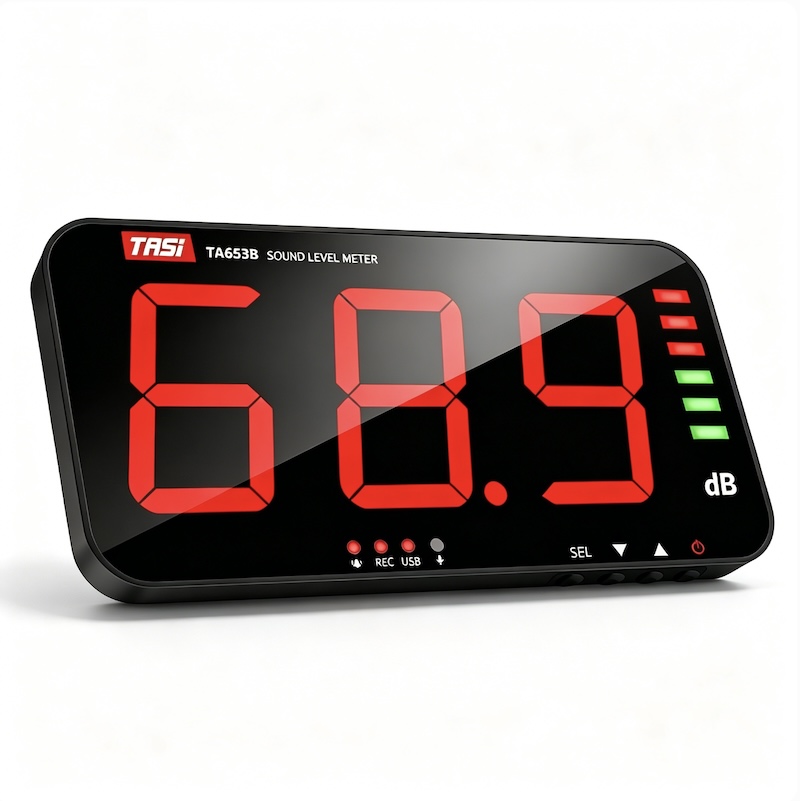
A sound level meter can quickly measure the sound pressure level around operating machinery. When measurements are repeated at the same location, distance, and operating condition, changes in machinery noise can be compared over time.
Noise measurements can help identify abnormal trends, but a single decibel reading cannot determine a specific mechanical fault. Reliable condition assessment normally requires noise data to be considered together with vibration, temperature, rotational speed, electrical current, and maintenance records.
Key Points
● Sound level meters can be used to assess noise from motors, fans, pumps, compressors, gearboxes, production machinery, and other equipment.
● Before measurement, verify the instrument condition and select suitable A-weighting and FAST or SLOW time weighting.
● Measurement position, distance, and equipment operating conditions should remain as consistent as possible.
● A single maximum value does not represent the complete noise condition of a machine; stable readings and repeated measurements should also be considered.
● For long-term equipment monitoring, trends measured under consistent conditions are generally more useful than isolated absolute readings.
● A significant increase in noise should be investigated together with vibration, temperature, and mechanical condition rather than being treated as proof of a specific fault.
Why Measure Machinery Noise?
A certain amount of noise is normal when machinery operates. However, wear, looseness, lubrication problems, or changes in operating conditions may alter the acoustic behavior of the equipment. Machinery noise measurement therefore has several practical uses in industrial maintenance.
● Evaluate surrounding noise levels: Determine the sound pressure level produced during operation and provide basic information for workplace noise assessment.
● Identify changes in operating condition: A sustained increase in noise under comparable operating conditions may indicate a change in machine condition.
● Compare similar equipment: Machines of the same type or units on different production lines can be compared under equivalent measurement conditions.
● Support preventive maintenance: Periodic noise records can reveal long-term changes in equipment behavior.
● Verify maintenance results: Measurements taken before and after lubrication, tightening, bearing replacement, or other maintenance can be compared.
Machinery noise monitoring is particularly useful when combined with vibration measurement, infrared temperature inspection, and electrical measurements.
What Types of Machinery Can Be Measured?
A sound level meter can be used with many types of industrial machinery. Any operating equipment that produces airborne sound can be assessed by measuring the sound pressure level around it.
● Electric motors and motor-driven systems;
● Fans, blowers, and ventilation equipment;
● Water pumps, circulation pumps, and hydraulic pumps;
● Air compressors and vacuum pumps;
● Gearboxes and speed reducers;
● Generators;
● Machine tools and processing equipment;
● Conveyors and drive systems;
● Stamping, cutting, and packaging machinery;
● HVAC equipment;
● Other rotating or reciprocating machinery.
Normal noise levels vary considerably between equipment types. A single fixed decibel value should therefore not be used to judge all machinery. For condition monitoring, establishing a historical baseline for each machine is usually more meaningful.
What Should Be Prepared Before Measurement?
Before testing, confirm that both the sound level meter and the machine are in conditions suitable for measurement.
● Check the sound level meter: Make sure the battery is sufficient, the microphone is clean and undamaged, and the instrument operates normally.
● Check the measurement range: Verify that the expected noise level falls within the instrument's usable range.
● Confirm operating conditions: Record load, rotational speed, operating mode, and other parameters that may influence noise.
● Define the measurement location: Establish the microphone position, distance, direction, and height in advance to support repeatable measurements.
● Reduce environmental interference: Where possible, minimize the influence of nearby machinery, conversations, vehicles, airflow, and impact noise.
● Perform acoustic calibration when required: For measurements requiring higher data reliability, use an acoustic calibrator according to the instrument manufacturer's procedure before and, where appropriate, after measurement.
When comparing measurements over time, use the same instrument, settings, and measurement procedure whenever possible.
How Should the Sound Level Meter Be Set?
Digital sound level meters commonly provide frequency weighting and time weighting settings. These settings affect how the instrument responds to sound and should be selected according to the measurement objective.
● A-weighting, dB(A): Suitable for many workplace and general machinery-noise assessments because its frequency response approximates human hearing sensitivity.
● FAST: Responds more quickly to changing sound levels and is useful for observing fluctuating or rapidly changing machinery noise.
● SLOW: Produces a steadier display and is useful for relatively stable continuous machinery noise.
● MAX function: Records the maximum sound level during the measurement period and can help capture short-duration high-noise events.
● Data logging: If available, continuous recording can be used to analyze changes in machinery noise over time.
For routine machinery inspections, A-weighting is commonly a practical starting point, with FAST or SLOW selected according to the behavior of the sound.
How Should Measurement Points Be Selected?
Measurement-point selection is an important part of machinery noise testing. Even on the same machine, sound pressure levels can differ significantly between locations.
● Select a position that represents the noise being evaluated rather than simply placing the microphone as close to the machine as possible.
● Maintain a suitable microphone-to-machine distance and record it for future repeat measurements.
● Avoid placing the microphone directly against the machine housing, where structural vibration and highly localized sources may distort the intended airborne-noise measurement.
● Avoid positioning the microphone unnecessarily close to walls, large metal panels, or other highly reflective surfaces.
● For large machinery, establish several fixed points near major sources such as the motor end, drive end, gearbox, or fan section.
● When evaluating operator exposure near a machine, measurements may also be taken close to the normal working position.
For periodic inspections, marking fixed measurement points can greatly improve consistency between measurement rounds.
How to Measure Machinery Noise with a Sound Level Meter
Once the instrument and measurement points have been prepared, testing can follow a consistent procedure.
● Bring the machine to the required operating condition: Allow it to run at the normal speed, load, or operating mode that needs to be evaluated.
● Switch on and configure the sound level meter: Select the appropriate frequency weighting, time weighting, and measurement range.
● Position the microphone correctly: Follow the instrument instructions and avoid blocking the sound path with the operator's body or other objects.
● Maintain a fixed position: Avoid unnecessary movement during measurement, as changes in distance and direction can alter the reading.
● Allow the reading to stabilize: For continuously operating machinery, observe the sound level for a suitable period before recording representative values.
● Record the data: Note the sound level, equipment ID, measurement position, distance, load, rotational speed, and measurement time.
● Repeat the measurement: Repeat readings at the same point and, where appropriate, measure several predefined locations.
● Compare with historical results: Compare current readings with previous measurements taken under comparable operating conditions.
For machines with cyclical sound patterns, avoid relying on a single instantaneous value. Observe one or more complete operating cycles whenever practical.
How Can Abnormal Machinery Noise Be Identified?
A fixed dB value alone is usually not enough to determine whether machinery noise is abnormal. Equipment type, power, speed, load, mechanical design, installation, and surrounding conditions all influence the measured level.
A more useful approach is to establish a baseline during normal operation and monitor changes over time.
For example, if a machine consistently produces similar readings at a fixed position, distance, and load, but later measurements repeatedly show a clear increase under the same conditions, further investigation may be justified.
In addition to overall level, observe whether:
● A previously stable operating sound changes noticeably;
● New knocking, rubbing, squealing, or periodic sounds appear;
● Noise at a specific area becomes significantly higher than previous records;
● Noise continues to increase while load remains similar;
● Increased noise occurs together with higher vibration or temperature;
● Sound levels change significantly before and after maintenance.
These observations do not confirm a specific failure, but they can provide useful indications for further inspection.
What Noise Changes May Be Associated with Common Mechanical Problems?
Different mechanical conditions may alter the sound characteristics of a machine. However, a general-purpose sound level meter normally cannot identify a specific fault by itself, so the following should be treated as maintenance indicators rather than fault diagnoses.
● Bearing condition changes: May be accompanied by increased friction noise, continuous abnormal sound, or a change in overall noise level.
● Loose mechanical components: May produce periodic impacts, knocking, or irregular sound.
● Gear wear or meshing problems: May change the characteristic sound produced by a gearbox.
● Insufficient lubrication: Certain rotating or sliding components may become noticeably noisier.
● Mechanical imbalance or installation problems: These may produce both increased vibration and noise.
● Fan blade or airflow problems: May increase aerodynamic noise or generate periodic sound fluctuations.
When the source of abnormal noise must be identified, noise measurement should be supplemented by vibration analysis, frequency analysis, temperature inspection, or direct mechanical examination.
How to Improve Measurement Consistency
For machinery condition monitoring, obtaining one accurate reading is not enough. Measurements made at different times must also be comparable.
● Use the same measurement position each time;
● Maintain the same microphone-to-machine distance;
● Use the same instrument settings;
● Measure at similar load and rotational speed;
● Keep background conditions as similar as practical;
● Use a comparable observation period at each point;
● Record operating parameters and maintenance status;
● Use a standardized data-recording format.
For example, if the first measurement is taken 1 m from the machine and the next at 0.3 m, the readings may differ significantly even when the machine itself has not changed. Consistency in the measurement method is therefore essential for trend monitoring.
What Factors Can Affect Measurement Results?
Industrial environments often contain multiple sound sources, so the measured result may not come entirely from the machine under test.
● Nearby machinery: Motors, fans, and production equipment can increase background noise.
● Measurement distance: Changes in the distance between the source and microphone affect sound pressure level.
● Walls and large structures: Reflections can increase or alter readings at certain positions.
● Operating condition: Noise may differ under no-load, partial-load, and full-load conditions.
● Rotational speed: Speed changes can significantly affect noise from rotating machinery.
● Airflow: Strong airflow directly across the microphone can interfere with measurement.
● Personnel activity: Conversations, footsteps, and tool impacts can create short-duration disturbances.
● Measurement position: Different directions and heights around a machine may produce different sound levels.
Recording measurement conditions together with sound-level data significantly improves the reliability of later comparisons.
How Can Noise Measurement Support Preventive Maintenance?
An isolated noise measurement provides limited information. Greater value can be obtained by incorporating sound-level measurements into routine machinery inspections.
For critical equipment, records can include equipment identification, measurement point, distance, operating load, sound level, and date.
As data accumulates, measurements can be compared over weeks, months, or longer periods.
Stable readings generally indicate that the machine's acoustic condition has not changed significantly. A persistent increase under equivalent operating conditions can trigger further inspection.
This approach does not replace specialized condition-monitoring techniques, but it is quick, easy to implement, and useful as a supplementary method within a machinery maintenance program.
Important Precautions When Measuring Machinery Noise
● Do not diagnose a machine based only on one maximum sound-level reading.
● Do not apply the same fixed sound-level threshold to all types of machinery.
● When comparing historical data, verify that measurement position, distance, and operating conditions are consistent.
● In high-noise areas, use appropriate hearing protection and follow site safety requirements.
● Do not move close to rotating shafts, fans, belts, gears, or other hazardous moving components simply to obtain a reading.
● Protect the microphone from strong airflow, oil contamination, water droplets, and mechanical impact.
● For formal acoustic assessments, select an appropriate sound level meter and calibration procedure according to the applicable measurement requirements.
● Noise measurement can support the detection of condition changes, but it does not replace professional mechanical fault diagnosis.
FAQ
Can a sound level meter directly determine whether a machine has failed?
● No. A sound level meter measures sound pressure level and can help identify changes in acoustic behavior, but it cannot independently diagnose bearing failure, gear wear, mechanical imbalance, or other specific faults. Additional vibration, temperature, and mechanical inspections may be required.
Should FAST or SLOW be used for machinery noise?
● SLOW is useful when the sound is relatively stable because it produces an easier-to-read display. FAST is more suitable for rapidly changing or fluctuating noise. The correct setting ultimately depends on the measurement objective and applicable procedure.
How many times should machinery noise be measured?
● There is no single number suitable for every machine. Repeat measurements at the same point can be used to confirm stability, while larger machines may require several predefined measurement locations.
Does louder machinery always indicate a more serious fault?
● No. Different machines have different normal noise characteristics. Changes in the same machine under comparable conditions and long-term trends are generally more meaningful than absolute sound level alone.
Can the sound level meter be placed directly against the machine housing?
● This is generally not recommended for airborne-noise measurement. A sound level meter microphone is intended to measure sound pressure in air. Direct contact with the housing can introduce structural vibration effects. A suitable vibration instrument should be used when mechanical vibration needs to be measured.
Why are different decibel readings obtained around the same machine?
● Machinery often contains several sound sources, and the result is also affected by distance, direction, machine structure, and nearby reflecting surfaces. Different sound levels at different measurement points are therefore normal, which is why fixed measurement locations are important.
Does an increase of a few decibels always indicate a problem?
● Not necessarily. First confirm that load, rotational speed, measurement distance, background noise, and instrument settings are comparable. If repeated measurements under the same conditions show a sustained increase, further inspection is more appropriate.
Conclusion
Using a sound level meter to measure machinery noise is a fast and practical supplementary method for industrial inspection and equipment maintenance. By selecting suitable instrument settings, establishing fixed measurement points, and maintaining consistent distances and operating conditions, comparable sound-level data can be obtained.
For machinery condition monitoring, an isolated decibel value is usually less informative than a consistent measurement method and long-term trend data. When sustained increases, unusual sounds, or significant local changes are detected under comparable operating conditions, the equipment should be further evaluated using vibration, temperature, electrical measurements, and mechanical inspection.
A structured machinery-noise measurement program can therefore support workplace noise assessment, preventive maintenance, abnormal-condition screening, and verification of maintenance results.