Introduction
Industrial operations generate sound from motors, fans, compressors, pumps, stamping machines, machine tools, conveyors, pneumatic systems, and many other types of equipment. When multiple machines operate simultaneously, the resulting acoustic environment may include continuous, intermittent, and impulsive noise.
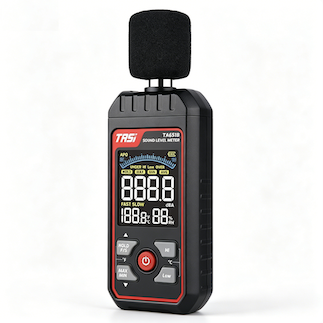
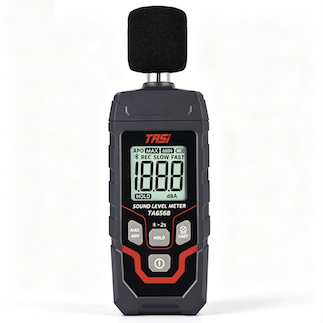
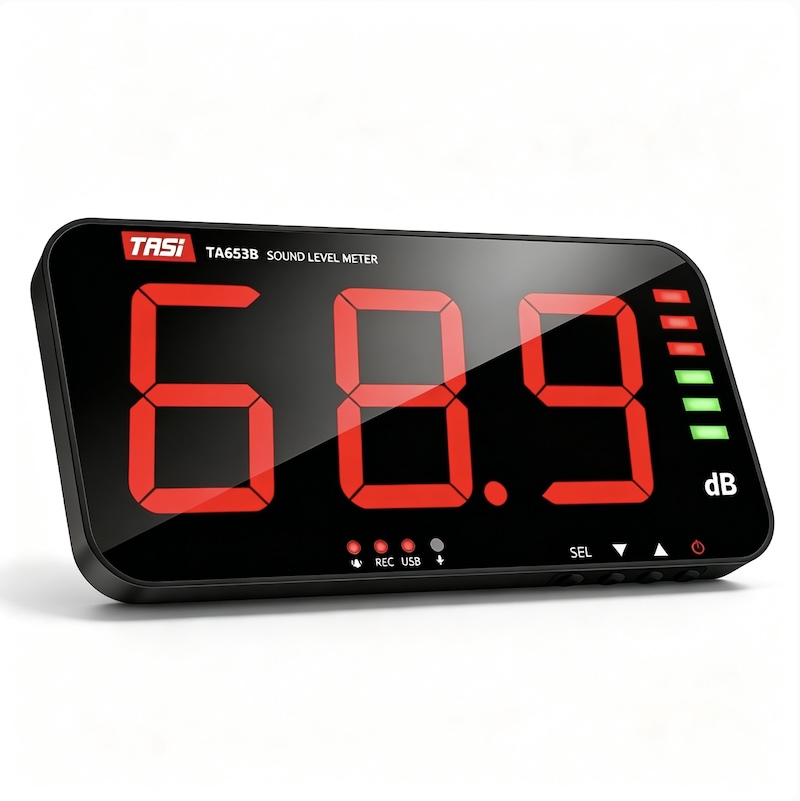
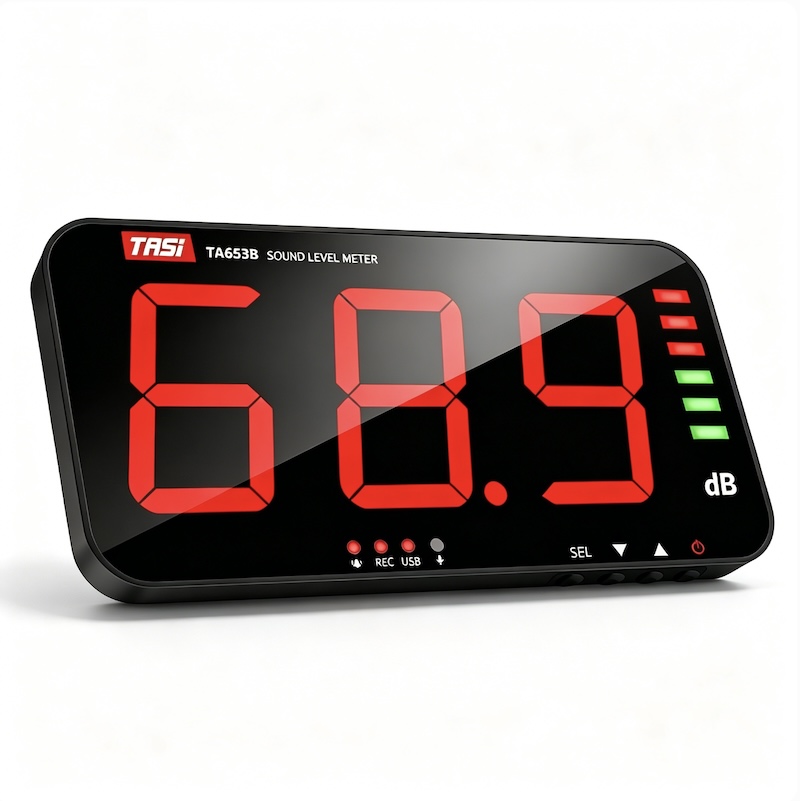
A sound level meter, sometimes referred to as a decibel meter, is a commonly used acoustic measurement instrument in industrial environments. It uses a microphone to capture sound and converts the signal into sound pressure level data, normally displayed in decibels (dB) or as frequency-weighted values such as dBA.
In industrial production, a sound level meter does more than indicate how loud an area is. It can also support machinery inspections, production-line checks, workplace noise surveys, abnormal-noise investigation, and verification of noise-reduction measures.
Key Takeaways
● Sound level meters can be used to measure noise from machinery, production lines, and industrial work areas.
● Periodic measurements taken under consistent conditions can help identify abnormal changes in equipment noise.
● Industrial noise measurement may require attention not only to instantaneous levels but also to settings such as A-weighting and FAST/SLOW time weighting.
● Measurement distance, microphone position, machine operating condition, and the surrounding environment can all affect results.
● Where measurements are used for occupational noise exposure assessment, regulatory compliance, or formal testing, the instrument class and measurement procedure should meet the applicable requirements.
Why Measure Noise in Industrial Production?
Industrial machinery produces noise through mechanical vibration, airflow, friction, impact, high-speed rotation, and other physical processes.
In practice, industrial noise measurements are carried out for several purposes.
● Understanding workplace noise levels: Measurements provide baseline data for workshops, production lines, areas around machinery, and specific operator positions.
● Checking machinery operating condition: Worn bearings, abnormal gear meshing, loose components, friction, or other mechanical problems may alter the sound produced by a machine.
● Supporting abnormal-noise investigation: When a new or unusual sound appears, measurements taken at different locations can help narrow down the likely source.
● Assessing work-area noise: Measurements near operator positions can provide useful information for further occupational noise exposure assessment.
● Verifying noise-control measures: Measurements before and after installing acoustic enclosures, silencers, vibration isolation, or changing equipment layout can help evaluate improvement.
Noise measurement is therefore relevant both to industrial environmental management and as a supporting tool for equipment inspection and maintenance.
Machinery Noise Measurement
Machinery is one of the most common noise sources in industrial facilities. Motors, pumps, fans, air compressors, gearboxes, stamping machines, cutting equipment, and CNC machine tools normally produce characteristic and relatively stable sound patterns when operating correctly.
A sound level meter can be used at defined measurement points around a machine to record its operating noise.
For example, if a machine consistently produces similar sound levels at the same speed, load, distance, and measurement position, a sustained increase in future readings may justify further inspection.
Possible causes of increased or altered machinery noise include:
● Bearing wear;
● Abnormal gear meshing;
● Loose mechanical components;
● Excessive structural vibration;
● Damaged or unbalanced fan blades;
● Motor abnormalities;
● Insufficient lubrication;
● Internal friction or impact.
A sound level meter measures acoustic level and cannot by itself identify a specific mechanical fault. Equipment diagnosis should normally combine acoustic observations with vibration analysis, temperature measurements, electrical tests, and maintenance records.
Production-Line Noise Inspection
Modern production lines may contain many machines, making detailed inspection of every unit time-consuming. Periodic sound-level checks can provide a rapid overview of acoustic changes across different areas.
Typical fixed measurement points may include:
● Raw-material handling areas;
● Motors and drive systems;
● Processing equipment;
● Conveyor systems;
● Fans and exhaust equipment;
● Packaging areas;
● Main operator positions.
For trend analysis, each inspection should use the same measurement location, distance, instrument settings, and, as far as practical, similar machine operating conditions.
Over time, this creates comparable historical data. If the noise level in a particular area is normally stable but increases noticeably during a later inspection, nearby equipment can be prioritized for further investigation.
This approach is useful for routine condition checks, although a change in noise level should be treated as an indication rather than direct proof of equipment failure.
Workplace Noise Measurement
Employees in factories, machining workshops, metal-processing facilities, assembly areas, and other industrial environments may be exposed to elevated noise levels for extended periods.
Sound level meters can be used to measure sound levels at locations such as:
● Operator workstations;
● Areas beside production machines;
● Equipment control stations;
● Workshop walkways;
● Maintenance areas;
● Locations where several machines operate simultaneously.
A-frequency weighting is commonly used for measurements intended to approximate human hearing response and for many occupational noise applications, with results expressed in dBA.
However, an important distinction must be made between area sound-level measurement and personal noise exposure assessment.
A conventional sound level meter primarily represents the noise at a specific location and time. Where cumulative exposure over an entire work shift must be assessed, an integrating sound level meter, personal noise dosimeter, or another appropriate occupational noise assessment method may be required.
A single instantaneous dBA reading therefore should not be used on its own to determine an employee's full-shift noise exposure.
Investigating Abnormal Noise Sources
Industrial environments often contain multiple simultaneous noise sources. When operators hear an unusual sound, identifying its origin by hearing alone may be difficult.
A sound level meter can assist by comparing readings at different locations.
For example, where several similar motors, pumps, or fans operate side by side, measurements can be taken at approximately equal distances from each unit. If one machine produces a significantly higher level than comparable units, it can be prioritized for inspection.
During this process:
● Keep the measurement distance as consistent as possible;
● Use the same frequency and time weighting;
● Maintain similar machine loading conditions;
● Avoid shielding the microphone with the operator's body;
● Consider background noise from nearby equipment.
A sound level meter can help narrow down the likely source, but where several machines are close together, reflections are significant, or background noise is high, overall sound-level readings alone may not clearly distinguish individual sources.
Noise Measurement for Fans, Compressors, and Ventilation Systems
Fans, air compressors, exhaust systems, and industrial ventilation equipment often produce substantial continuous noise.
Typical sources include:
● Motors;
● Fans or impellers;
● High-velocity airflow;
● Duct vibration;
● Mechanical joints;
● Compressed-air discharge;
● Air inlets and outlets.
Measurements can be taken near the equipment, along ductwork, and at employee work positions to understand how noise levels vary throughout the area.
When evaluating a repair, replacement component, silencer, or other noise-control measure, before-and-after measurements should be made under comparable operating conditions and with the same measurement location and instrument settings.
Comparing Noise Before and After Installation or Maintenance
After a new machine is installed, an initial noise measurement can be recorded together with its operating conditions, measurement position, distance, and equipment identification.
This information can serve as a baseline for future maintenance.
When the machine is measured again after a period of service:
● A generally stable level suggests that its acoustic condition has not changed significantly;
● A sustained increase may justify investigation of wear, looseness, or other abnormalities;
● A reduction after maintenance can provide supporting evidence of improvement;
● An increase after component replacement may indicate the need to verify installation or operating condition.
A baseline-and-trending approach usually provides greater maintenance value than isolated one-time measurements.
How to Use a Sound Level Meter Correctly in Industrial Environments
Industrial environments are acoustically complex. To obtain meaningful and comparable results, measurement conditions should be kept as consistent as possible.
● Confirm the measurement range: Make sure the expected noise level falls within the meter's effective operating range.
● Select the appropriate frequency weighting: Many meters provide A-weighting, while professional models may also provide C- or Z-weighting. Selection should be based on the measurement objective.
● Select the time weighting: FAST is useful for observing rapidly changing sound, while SLOW provides a steadier indication for fluctuating levels. The choice should reflect the measurement purpose and applicable procedure.
● Maintain a consistent distance: Where machines or historical readings are being compared, keep the measurement distance as consistent as possible.
● Avoid shielding the microphone: The operator's body, walls, and large machinery can influence sound propagation and measured level.
● Use a windscreen when necessary: Air movement from fans, outlets, or outdoor conditions can act directly on the microphone and introduce additional noise.
● Record operating conditions: Machine speed, load, and production status should be documented because measurements taken under different operating conditions may not be directly comparable.
Factors That Affect Industrial Noise Measurements
The same machine will not necessarily produce exactly the same reading every time. Many factors can influence sound-level measurements.
● Distance between the measurement point and sound source;
● Microphone orientation;
● Reflections from walls, floors, and large machinery;
● Background noise from other equipment;
● Machine speed and load;
● Airflow and wind;
● Operator position;
● Instrument accuracy and calibration status;
● FAST or SLOW time weighting;
● A-, C-, or other frequency weighting.
For trend analysis, maintaining consistent measurement conditions is often more important than comparing two isolated numbers.
What Type of Sound Level Meter Is Suitable for Industrial Use?
Requirements vary depending on the application.
For routine equipment checks, environmental surveys, and production-floor inspections, useful features may include:
● An appropriate sound-level measurement range;
● A-frequency weighting;
● FAST/SLOW time weighting;
● MAX hold;
● A clear, easy-to-read display;
● Portable and convenient operation.
For longer-term analysis, data logging, USB communication, or wireless data transmission may also be useful.
For regulatory compliance, occupational hygiene assessment, laboratory testing, or other formal acoustic measurements, the sound level meter should meet the required performance class and be used according to the applicable calibration and measurement procedure.
Why Calibration Matters in Industrial Noise Measurement
Over time, microphones, electronic components, handling, and environmental conditions may affect the performance of a measurement system. Where measurement accuracy is important, calibration status must therefore be considered.
Before and after field measurements, an acoustic calibrator may be used according to the relevant procedure to verify that the sound level meter is responding correctly.
Periodic calibration should also be arranged according to instrument usage, manufacturer recommendations, internal quality procedures, and applicable measurement requirements.
If a meter is dropped, subjected to significant impact, exposed to severe environmental conditions, or begins producing unusual results, its condition should be checked rather than waiting for the next scheduled calibration.
How to Maintain Industrial Noise Measurement Records
For maintenance or production management, recording only a single dB value is usually insufficient.
A useful measurement record may include:
● Date and time;
● Measurement area;
● Machine name or identification number;
● Measurement position;
● Approximate distance from the sound source;
● Operating condition and load;
● Frequency weighting;
● Time weighting;
● Measured or maximum level;
● Environmental conditions;
● Instrument model;
● Notes on unusual conditions.
A standardized recording method improves comparison between different dates, machines, and production shifts and can gradually build a useful noise-trend database.
The Value of Sound Level Meters in Industrial Production
The value of a sound level meter is not simply that it displays a decibel value. More importantly, it converts workplace sound into data that can be recorded, compared, and analyzed.
Industrial applications include:
● Machinery noise checks;
● Routine production-line inspection;
● Initial investigation of abnormal noise;
● Before-and-after maintenance comparison;
● Work-area noise surveys;
● Verification of noise-control measures;
● Long-term industrial noise trend recording.
When sound-level data are considered together with operating parameters, maintenance records, vibration measurements, and temperature data, they can provide greater value for condition monitoring and preventive maintenance.
FAQ
Can a sound level meter directly determine whether a machine has failed?
No. An abnormal sound level can indicate a change in equipment condition, but it cannot identify a specific fault by itself. Vibration, temperature, electrical measurements, and mechanical inspection may also be required.
Should industrial noise be measured in dB or dBA?
They are not identical terms. dB is the general unit used for logarithmic level values, while dBA indicates a sound level measured using A-frequency weighting. dBA is commonly used for workplace and many general industrial noise measurements, depending on the purpose.
Why does the same machine produce different readings at different times?
Possible reasons include machine load, speed, measurement distance, reflections, nearby equipment, and instrument settings. Consistent measurement conditions are therefore essential for meaningful trend comparisons.
Can a standard sound level meter be used in a very noisy factory?
The first requirement is that the meter's measurement range covers the actual sound level. A general-purpose meter may be suitable for routine inspection, while formal occupational or compliance assessments may require a meter of an appropriate performance class and a defined measurement procedure.
How far should the meter be from a machine?
There is no single distance suitable for every application. The distance depends on the measurement objective, machine size, source characteristics, and applicable procedure. For long-term trend comparison, using a defined and repeatable measurement position is especially important.
Can a sound level meter be used to compare noise before and after maintenance?
Yes. For meaningful comparison, machine load, speed, measurement position, distance, and instrument settings should be kept as similar as possible.
Conclusion
Sound level meters are widely used in industrial production for machinery noise measurement, production-line inspection, abnormal-noise investigation, workplace noise surveys, and evaluation of maintenance and noise-control measures.
For routine industrial applications, the greatest value often comes not from a single decibel reading but from consistent measurement and long-term comparison. Establishing fixed measurement points, standardized methods, and operating-condition records allows sound-level data to become a useful part of equipment maintenance and workplace management.
A sound level meter remains an acoustic measurement instrument rather than a complete diagnostic system. Mechanical fault diagnosis, personal occupational noise exposure assessment, and regulatory compliance testing should therefore use appropriate additional methods, instruments, and measurement procedures where required.