Introduction
When selecting an instrument for sound measurement, terms such as “noise meter,” “decibel meter,” and “sound level meter” are often used interchangeably. This can lead to a common question: are a noise meter and a decibel meter actually different instruments?
In most general-purpose applications, noise meter and decibel meter refer to the same basic type of instrument used to measure sound pressure level, with the result normally displayed in decibels (dB). The main difference is usually terminology rather than the fundamental measurement principle.
However, instruments sold under either name can vary significantly in measurement accuracy, frequency weighting, time weighting, data logging capability, and compliance with applicable sound level meter standards. The product name alone therefore does not indicate its professional measurement capability.
Key Points
● In most general applications, noise meters and decibel meters refer to the same type of sound-measuring instrument.
● “Decibel meter” is a common descriptive term that emphasizes measurement results expressed in decibels.
● “Noise meter” emphasizes noise or environmental sound measurement and is widely used as a commercial product term.
● In professional acoustics, sound level meter (SLM) is the more technically established term.
● Instrument performance should be evaluated by measurement range, accuracy, frequency weighting, time weighting, and applicable instrument classification or standards rather than by product name alone.
What Is a Noise Meter?
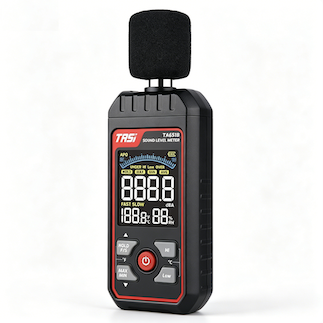
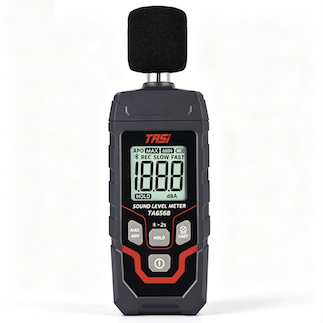
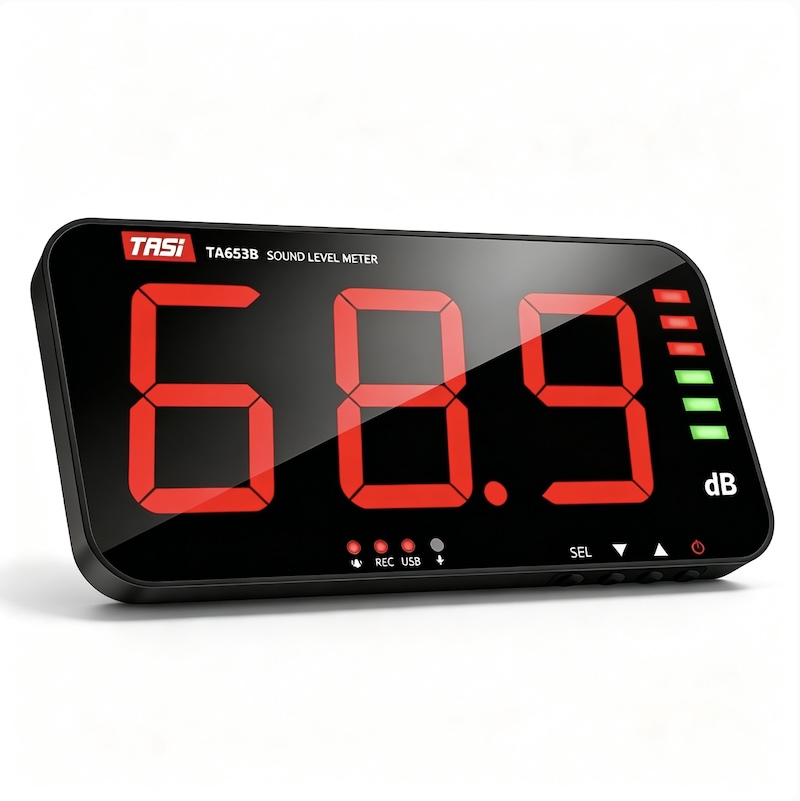
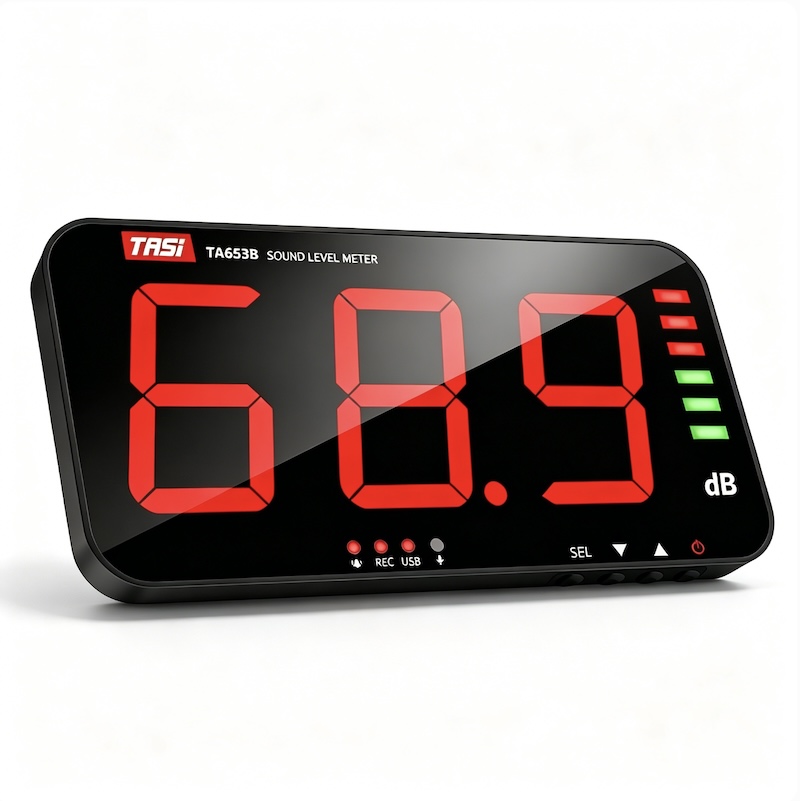
A noise meter is an electronic instrument used to measure the sound pressure level of environmental or equipment noise. A microphone detects changes in acoustic pressure, and the instrument converts, processes, and calculates the signal before displaying the result in decibels.
A typical digital noise meter provides a direct sound level reading such as 55 dB, 75 dB, or 95 dB. Depending on the model, it may also provide A/C frequency weighting, FAST/SLOW time weighting, maximum and minimum level functions, data hold, and data logging.
Noise meters are commonly used for environmental noise checks, machinery noise measurements, offices, schools, construction sites, HVAC systems, and general industrial maintenance.
What Is a Decibel Meter?
“Decibel meter” is generally a descriptive rather than strictly technical term.
Because these instruments normally display sound level readings in decibels (dB), they are often marketed or referred to as decibel meters or dB meters.
For example, an instrument with a measurement range of 30 to 130 dB may be described as a:
● Noise meter
● Decibel meter
● dB meter
● Digital sound level meter
● Sound level tester
These names may refer to very similar, or even identical, types of instruments.
For this reason, the product name alone should not be used to determine measurement capability. The technical specifications should always be checked.
What Is the Main Difference Between a Noise Meter and a Decibel Meter?
In general market usage, there is no strict technical boundary between the two terms. The difference is mainly one of naming convention.
| Comparison | Noise Meter | Decibel Meter |
|---|---|---|
| Typical meaning | Instrument for measuring environmental or equipment noise | Instrument for measuring and displaying sound level in dB |
| Measurement result | Normally displayed in dB | Normally displayed in dB |
| Basic principle | Microphone detects acoustic pressure for electronic processing | Usually the same |
| Typical applications | Environmental, industrial, workplace, equipment noise | General sound and noise measurements |
| Naming emphasis | Application-oriented term | Measurement-unit-oriented term |
| Indicates professional class? | Not necessarily | Not necessarily |
Therefore, two instruments labeled respectively as a “noise meter” and a “decibel meter” cannot be assumed to differ in accuracy or performance simply because of their names.
Their actual specifications must be compared.
How Are Noise Meters, Decibel Meters, and Sound Level Meters Related?
Compared with “noise meter” and “decibel meter,” sound level meter (SLM) is the more established technical term used in professional acoustics.
In a broad sense, many digital noise meters and decibel meters are sound level measuring instruments. In professional applications, however, the term sound level meter more often implies defined technical characteristics such as frequency response, frequency weighting, time weighting, measurement accuracy, and compliance with applicable sound level meter requirements.
A simple way to understand the terminology is:
● Decibel meter: a common descriptive term emphasizing results in dB;
● Noise meter: an application-oriented term emphasizing noise measurement;
● Sound level meter: the more formal technical term used in professional acoustics.
These terms can overlap in commercial product descriptions, so they should not be used alone to determine instrument grade.
Why Is a dB Reading Alone Not Enough to Define Instrument Performance?
Decibel is a unit used to express sound level. It does not indicate the measurement quality of the instrument itself.
Two instruments may both display dB values while differing considerably in performance. A basic meter may be designed primarily for quick sound level checks, whereas a professional sound level meter may provide tighter tolerances and more clearly defined acoustic performance.
Important specifications include:
● Measurement range: the minimum and maximum sound levels the instrument can measure.
● Accuracy: the permitted measurement uncertainty or tolerance under specified conditions.
● Frequency weighting: commonly A and C weighting; A-weighting is widely used for general environmental and noise measurements.
● Time weighting: commonly FAST and SLOW, used to observe sound levels with different response characteristics.
● Dynamic range: affects the instrument’s ability to process different sound levels effectively.
● Data functions: such as MAX, MIN, data hold, data logging, or communication functions.
● Instrument class or applicable standard: particularly important for professional measurements.
Being able to “measure decibels” is therefore only a basic capability and does not by itself mean that an instrument is suitable for professional noise assessment.
Which Type Is Suitable for General Measurements?
For general environmental checks, equipment noise comparisons, or quick field measurements, a standard digital noise meter or decibel meter is often sufficient.
Typical applications include:
● Checking sound levels in offices or classrooms;
● Comparing noise from different machines;
● Checking operational noise from fans, motors, or HVAC equipment;
● Identifying noticeable changes in sound level;
● Performing general environmental noise checks.
For these applications, measurement range, accuracy, A-weighting, FAST/SLOW response, and MAX functions are usually the most relevant specifications.
When Should a Professional Sound Level Meter Be Used?
If measurement results are required for formal occupational noise assessment, environmental noise evaluation, engineering testing, laboratory research, or other applications governed by defined measurement procedures, an instrument should not be selected merely because it can display dB values.
A professional sound level meter should be selected according to the relevant measurement requirements, including instrument performance, frequency weighting, time weighting, and calibration capability.
For formal reports or long-term noise assessment, instrument performance, calibration status, measurement position, measurement duration, and test procedure can all affect the validity of the results.
Should You Choose by Product Name or by Specifications?
Specifications and application requirements should be the primary selection criteria.
Before purchasing, consider the following:
● What sound level range needs to be measured?
● Is A-frequency weighting required?
● Are FAST and SLOW time weightings needed?
● Is maximum or minimum value recording required?
● Is data logging, USB, or wireless communication needed?
● Are the results only for reference, or for professional evaluation?
● Is a specific instrument class or compliance requirement necessary?
If the technical specifications meet the intended application, the instrument may be suitable regardless of whether it is marketed as a noise meter, decibel meter, or sound level meter.
FAQ
Are a noise meter and a decibel meter the same thing?
In most general applications and commercial product descriptions, they can be considered the same type of sound measurement instrument. Both typically use a microphone to detect sound pressure and display the result in dB.
Why are some instruments called noise meters and others decibel meters?
The difference is mainly terminology. “Noise meter” emphasizes the noise measurement application, while “decibel meter” emphasizes the unit in which the result is displayed.
Is a decibel meter the same as a sound level meter?
Broadly, both measure sound levels. However, “sound level meter” is the more technically established term and, in professional applications, may imply more clearly defined performance requirements.
Is a more expensive noise meter always more accurate?
Not necessarily. Price may also reflect data logging, connectivity, accessories, brand positioning, or additional functions. Accuracy should be evaluated from the published specifications, instrument class, frequency response, and other relevant parameters.
Can a smartphone decibel app replace a noise meter?
A smartphone app may be useful for approximate checks and trend observations, but microphone characteristics, device processing, and calibration vary between phones. For reliable measurements, a dedicated sound measuring instrument with specified performance is preferable.
Can a standard noise meter be used for occupational noise assessment?
It may be useful for preliminary screening or general reference measurements. Formal occupational noise assessment should use an appropriate professional instrument and measurement procedure that meet the applicable requirements.
Conclusion
Noise meters and decibel meters are not two instrument categories separated by a strict technical definition. In most general applications, both terms describe instruments that measure sound pressure level and display the result in decibels.
Rather than focusing on whether a product is called a “noise meter” or “decibel meter,” it is more important to evaluate its measurement range, accuracy, frequency weighting, time weighting, data functions, and instrument performance classification.
A standard digital noise meter is generally suitable for routine environmental and equipment noise checks. For occupational noise assessment, environmental noise monitoring, engineering testing, or laboratory measurements, a suitable professional sound level meter should be selected according to the applicable measurement requirements.