Introduction
Traditional contact-type voltage testing usually requires a probe to touch an exposed conductor. A non-contact voltage tester (NCV), however, can indicate the possible presence of AC voltage simply by being brought close to a wire, outlet, or other energized component.
This does not mean that the tester measures voltage directly through insulation. Instead, it detects the alternating electric field produced around an AC-energized conductor. A sensing electrode and highly sensitive electronic circuitry inside the tester respond to changes in that field.
It is therefore important to distinguish between two functions: an NCV tester can help determine whether AC voltage may be present nearby, but it normally cannot measure the actual voltage value in the same way as a digital multimeter.
Key Takeaways
● A non-contact voltage tester primarily detects the alternating electric field around an AC-energized conductor.
● Even when insulation separates the tester from the conductor, a small signal can be transferred through capacitive coupling.
● High-input-impedance, high-sensitivity electronics detect and process the induced signal.
● Detection distance is affected by voltage level, insulation thickness, conductor configuration, environment, and tester sensitivity.
● NCV is generally intended for AC voltage detection and should not automatically be assumed to detect DC voltage.
● NCV is useful for rapid screening, but it does not replace a multimeter or other suitable instrument for accurate voltage measurement or formal verification of a de-energized circuit.
What Is a Non-Contact Voltage Tester?
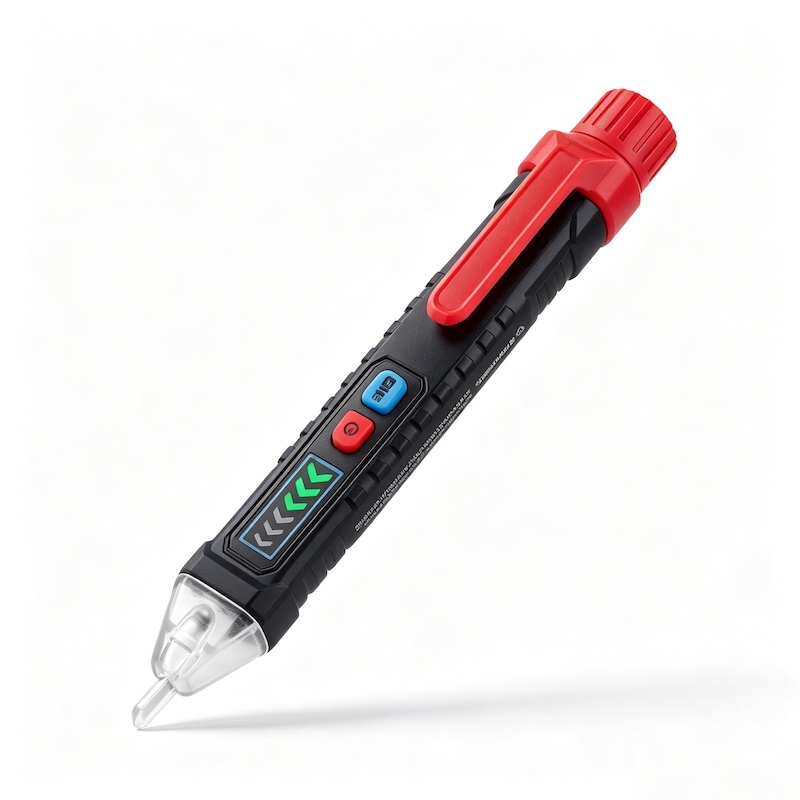
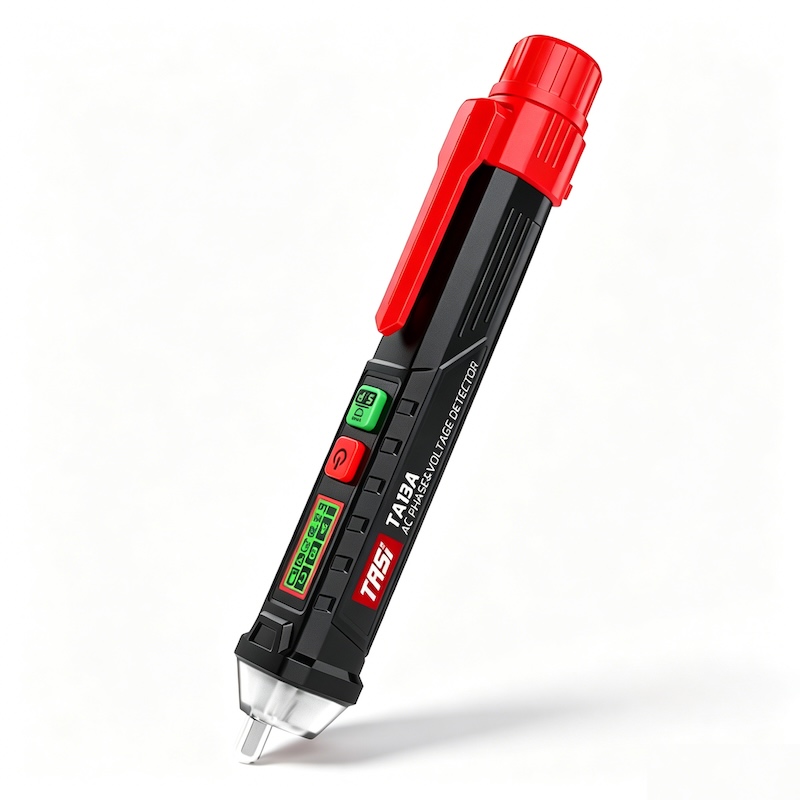
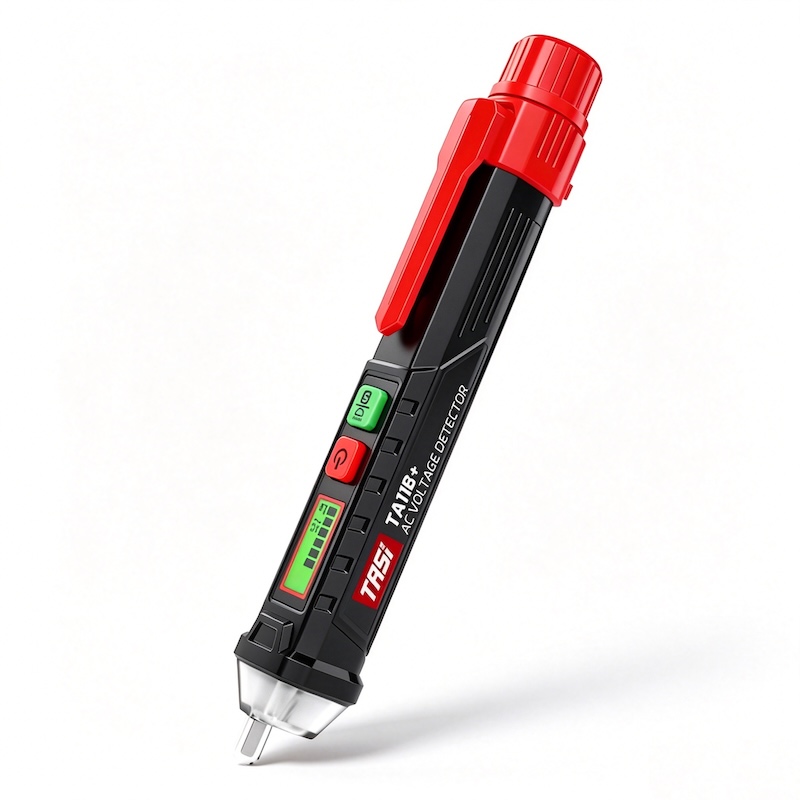
A non-contact voltage tester is a portable electrical test instrument designed to quickly indicate whether AC voltage may be present around wires, cables, outlets, switches, and other electrical components.
Unlike contact-type testing, an NCV tester normally does not require its sensing tip to touch exposed metal. When the sensing end is brought close to an energized location, the instrument may provide an indication through an LED, audible buzzer, display, or vibration.
Because the insulation usually does not need to be removed and direct contact with exposed live metal is unnecessary, NCV testers are convenient for preliminary circuit checks, identifying line conductors, troubleshooting wiring, pre-maintenance inspections, and assisting with locating certain cable faults.
Why Is There an Electric Field Around an Energized Conductor?
When a voltage exists between a conductor and a reference potential, an electric field is established around the conductor.
With AC voltage, such as mains-frequency electricity, the magnitude and polarity of the voltage change continuously over time. The surrounding electric field therefore also changes continuously.
PVC, rubber, and other insulating materials are designed to restrict conductive current. They do not necessarily eliminate the external electric field completely.
As a non-contact voltage tester approaches an AC-energized wire, its internal sensing electrode can respond to this changing field and develop a very small electrical signal.
This is the physical basis that allows NCV detection to work through ordinary wire insulation.
How Does Capacitive Coupling Allow the Tester to Sense Voltage?
One of the key principles behind non-contact voltage detection is capacitive coupling.
Two conductive objects positioned close to each other and separated by an insulating material can form a very small effective capacitance.
In a typical NCV application:
● The energized conductor acts as one electrode.
● The sensing electrode inside the tester acts as the second electrode.
● Air, plastic insulation, and other non-conductive materials form the dielectric between them.
Together, these elements create a very small coupling capacitance.
As the AC voltage on the conductor changes, a tiny alternating signal can be coupled into the sensing electrode. Although this signal is extremely small, modern NCV testers use high-input-impedance and high-sensitivity electronics that can detect it.
The tester is therefore not drawing current directly from the conductor to measure it. Instead, it detects a small signal produced by capacitive coupling with the alternating electric field.
Why Can the User’s Body Affect NCV Detection?
In many non-contact voltage tester designs, the user and the surrounding environment also contribute to the reference coupling path.
When the tester is held in the hand, the human body has a small distributed capacitance to the floor, nearby structures, and the surrounding environment. This allows the energized conductor, tester, user, and environment to form a very weak AC coupling path.
This does not mean that a significant current normally flows through the user. The coupling current is extremely small and serves as part of the reference condition used by the sensing circuit.
For this reason, very thick insulating gloves, highly isolated surroundings, or different ways of holding the tester can influence sensitivity in some situations.
The degree to which detection depends on the user varies between different NCV circuit designs.
How Does the Tester Decide That Voltage Is Present?
A typical non-contact voltage tester contains a sensing electrode, high-impedance input stage, signal amplification circuitry, decision circuitry, and an audible or visual indication system.
The basic detection sequence can be summarized as follows:
● The sensing tip approaches an AC-energized conductor.
● The alternating electric field produces a small signal at the sensing electrode through capacitive coupling.
● A high-impedance input circuit receives the signal.
● Amplification and filtering stages process the relevant AC component.
● The control circuit determines whether the signal exceeds a defined threshold.
● If the trigger condition is reached, the LED, buzzer, display, or other indicator is activated.
Some testers use a fixed sensitivity level, while others provide high- and low-sensitivity modes. Certain models also vary the buzzer frequency, indicator intensity, or display according to the detected field strength.
An NCV indication is therefore the result of an electronic circuit determining that the sensed signal has exceeded its detection threshold.
Why Can NCV Work Through Wire Insulation?
Electrical insulation prevents normal conductive current from passing directly through the wire covering, but it does not completely eliminate the low-frequency electric field around an AC conductor.
As a result, an NCV tester can often detect an energized conductor through ordinary PVC or rubber insulation.
The insulation does, however, affect coupling strength. In general, the closer the tester is to the conductor, the stronger the capacitive coupling and the easier the signal is to detect.
Thick insulation, deeply buried conductors, metallic shielding, or excessive distance can reduce the field at the tester to a level below its detection threshold.
“Non-contact” therefore means that the sensing tip does not need to make direct electrical contact with exposed metal. It does not mean that the tester can detect voltage from any distance or through every material.
Why Does Detection Distance Vary?
The sensing distance of a non-contact voltage tester is not fixed. It depends on several interacting factors.
● Voltage level: Under otherwise similar conditions, a higher AC voltage generally produces a stronger electric field and is easier to detect.
● Tester sensitivity: High-sensitivity modes can detect weaker fields but may also respond more readily to nearby energized circuits.
● Distance from the conductor: Capacitive coupling generally decreases as the sensing tip moves farther away.
● Insulation thickness: Thick cable jackets, conduit, or insulating structures can reduce the detectable field.
● Conductor configuration: Single conductors, multicore cables, twisted conductors, and shielded cables produce different external field distributions.
● Nearby energized wiring: Multiple energized conductors can influence the signal detected by the tester.
● User and environmental conditions: Holding method, grounding conditions, humidity, and nearby metal structures can affect the coupling path.
For this reason, NCV response should be interpreted as an indication that AC voltage may be present nearby, not as a method for estimating voltage from sensing distance.
Why Do NCV Testers Primarily Detect AC Voltage?
Non-contact voltage testers rely mainly on a changing electric field, which makes them particularly suitable for AC voltage detection.
Because AC voltage continuously varies with time, it creates a changing electric field that can produce a detectable signal through capacitive coupling.
Once a stable DC voltage has been established, its electric field does not continue changing periodically in the same way. Conventional NCV circuitry therefore cannot generally detect steady DC voltage using the same principle.
For this reason, specifications describing “non-contact voltage detection” normally refer to AC voltage unless the manufacturer explicitly states otherwise.
DC voltage should be tested using a digital multimeter or another instrument specifically designed for the required DC measurement.
Why Can an NCV Tester Indicate Voltage on an Apparently Disconnected Wire?
Because NCV testers can be highly sensitive, they may respond to induced voltage or electric fields from nearby energized conductors.
For example, a disconnected conductor running in parallel with an energized wire over a significant distance can become capacitively coupled to it. This may create an induced or so-called phantom voltage on the disconnected conductor.
A high-sensitivity NCV tester may respond to this field.
Other energized wiring, switching power supplies, electrical equipment, and dense cable installations can also affect the local electric field.
An NCV alarm therefore means that the instrument has detected an AC electric-field signal above its threshold. By itself, it does not necessarily prove that the conductor can supply normal load current.
If the actual circuit voltage must be confirmed, an appropriate contact measurement should be performed with a multimeter or other suitable test instrument.
Why Can Shielded Cables Be Difficult to Detect?
If an energized conductor is surrounded by a continuous conductive shield that is properly referenced or grounded, the external electric field can be substantially reduced.
As a result, an NCV tester may detect little or no field outside the cable even though the internal conductor is energized.
Similar limitations may occur with metal conduit, grounded metal enclosures, and equipment with effective electrical shielding.
A non-contact voltage tester should therefore not be regarded as capable of detecting energized conductors through every type of material or enclosure.
Can a Non-Contact Voltage Tester Measure the Exact Voltage?
Most NCV testers cannot provide an accurate voltage value in the same way as a digital multimeter.
Their main purpose is to detect the presence of an electric field or provide an approximate voltage-range indication rather than measure a defined potential difference between two test points.
Some models use different LED colors, buzzer rates, or display indications to represent signal strength. However, the signal is influenced not only by voltage but also by distance, insulation, conductor geometry, the user, environmental conditions, and sensitivity settings.
A faster buzzer or stronger indication therefore does not provide a reliable way to determine whether the circuit is, for example, 120 V, 230 V, or another exact value.
Where an actual voltage value is required, a digital multimeter, voltmeter, or another suitable measurement instrument should be used.
What Is a Non-Contact Voltage Tester Suitable For?
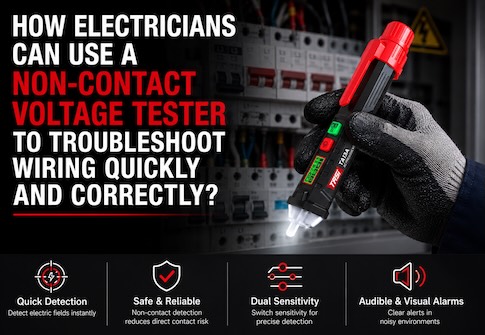
Because NCV testing is fast and generally does not require exposed metal, it is useful for preliminary electrical inspection and troubleshooting.
Typical applications include:
● Quickly checking whether AC voltage may be present around outlets, switches, or wiring.
● Assisting with identification of line conductors.
● Checking extension cords, power cables, and equipment wiring.
● Performing a preliminary live-voltage check before maintenance.
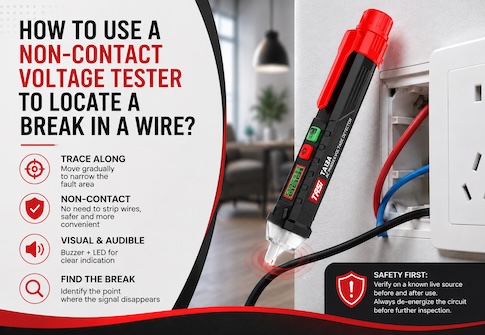
● Moving the tester along a conductor to assist in locating certain wiring breaks.
● Rapid circuit screening during electrical installation, maintenance, and troubleshooting.
However, safety and measurement requirements vary by application. When a task involves formal verification of a de-energized condition or other safety-critical work, a single NCV indication should not be the only basis for the decision.
Why Should NCV Not Be the Only Method Used to Verify a De-Energized Circuit?
A non-contact voltage tester is a screening tool, and its response can be affected by distance, sensitivity, cable construction, shielding, and environmental electric fields.
Even when voltage is present, the detected signal may be weak in situations such as:
● The conductor is relatively far from the sensing tip.
● The insulation or surrounding structure is thick.
● The cable is shielded.
● The tester battery is low.
● The tester is malfunctioning.
● The voltage is below the specified detection range.
● Environmental or holding conditions reduce the coupling path.
For electrical work involving personal safety, an NCV tester should therefore be used as an auxiliary tool rather than as the sole means of confirming absence of voltage.
Applicable electrical safety procedures and suitable test instruments should be used to verify circuit condition.
How Should a Non-Contact Voltage Tester Be Used Correctly?
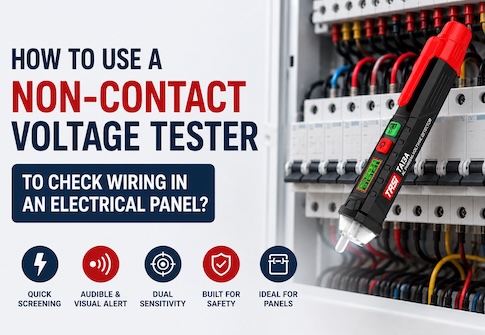
Before use, inspect the tester body and sensing tip, check battery condition, and confirm that the intended AC voltage falls within the specified detection range.
Before testing an unknown circuit, verify the tester on a known live AC source to confirm that the audible and visual indicators are functioning.
Bring the sensing end gradually toward the wire, outlet, or electrical component under test. Direct contact with exposed metal is normally unnecessary. If the tester provides high- and low-sensitivity modes, select the appropriate setting according to the wiring density and surrounding environment.
For safety-related verification, it is good practice to check the tester again on a known live source after the test. This helps confirm that the instrument remained functional during the inspection.
FAQ
Why can an NCV tester detect voltage through plastic insulation?
Plastic insulation restricts conductive current but does not completely eliminate the alternating electric field around an AC-energized conductor. The tester can sense this changing field through capacitive coupling.
Does an NCV tester detect voltage or an electric field?
From an operating-principle perspective, it mainly detects the alternating electric field produced by AC voltage and uses the resulting signal to determine whether AC voltage may be present nearby. It does not directly measure the potential difference between two defined test points.
Can a non-contact voltage tester detect DC voltage?
Standard NCV functions are primarily designed for AC voltage detection. Because steady DC does not produce the same continuously changing electric field, conventional NCV testers should not be assumed to detect DC reliably.
Why can a disconnected wire still trigger an NCV tester?
Capacitive coupling from adjacent energized conductors can create an induced or phantom voltage on a disconnected wire. A sensitive NCV tester may respond to this field.
Does a stronger NCV indication mean a higher voltage?
Not necessarily. Signal strength is also affected by distance, insulation, conductor arrangement, the user, environment, and tester sensitivity. The indication should not be used to determine an exact voltage value.
Why might an energized wire inside metal conduit not be detected?
Metal structures can shield the electric field produced by the conductor, significantly reducing the field available outside the enclosure for NCV detection.
Can an NCV tester replace a multimeter?
No. NCV is intended for rapid AC voltage screening, while a multimeter can measure defined electrical quantities such as voltage, resistance, and current when used correctly.
Can an NCV tester alone be used to confirm that a circuit is de-energized?
It should not be the sole method for safety-critical confirmation. Appropriate electrical safety procedures and suitable test instruments should be used to verify circuit status.
Summary
A non-contact voltage tester can detect voltage without touching exposed metal because an AC-energized conductor produces a continuously changing electric field.
When the tester approaches the conductor, a very small capacitive coupling is created between the conductor and the sensing electrode. This produces a weak alternating signal inside the tester. High-input-impedance electronic circuitry detects, amplifies, and evaluates the signal, then activates an LED, buzzer, or other indicator when the trigger threshold is reached.
An NCV tester is therefore fundamentally an AC electric-field sensing device. Its main advantages are speed, convenience, and the ability to perform preliminary checks without direct contact with an exposed conductor.
However, detection is influenced by distance, insulation, shielding, voltage level, environment, and tester sensitivity. Accurate voltage measurement and safety-critical verification of a de-energized circuit still require a suitable multimeter or other appropriate test instrument.