Introduction
When two infrared thermometers are used to measure the same object, their readings may not be exactly identical. For example, one instrument may display 82.3°C while the other shows 84.0°C.
This does not necessarily mean that one of the thermometers is faulty. Infrared temperature measurement depends not only on the actual surface temperature of the target, but also on emissivity, measurement area, distance, viewing angle, reflected background radiation, and the accuracy characteristics of the instrument.
For this reason, the condition of the thermometers should not be judged from a single difference in displayed temperature. First confirm that both instruments are being used under the same and appropriate measurement conditions.
Key Points
● A small difference between two infrared thermometer readings is not necessarily abnormal.
● Different emissivity settings are a common cause of different measurement results.
● Different D:S ratios (Distance-to-Spot Ratios) mean that the two instruments may measure different surface areas.
● Measurement distance, viewing angle, target surface condition, and reflected background radiation can all affect infrared temperature readings.
● Different thermometer models may have different accuracy specifications, spectral response ranges, response times, and calibration conditions.
● When comparing two instruments, use the same emissivity, distance, angle, measurement point, and environmental conditions.
Why Can the Same Object Produce Different Temperature Readings?
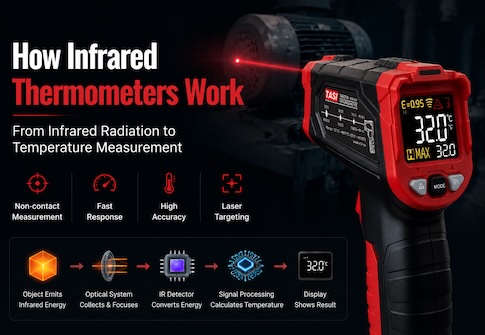
An infrared thermometer does not directly read the internal temperature of an object. It detects infrared radiation from the target surface and converts the detected radiation into a temperature value according to the instrument settings and internal calculation method.
Therefore, even when the same object is being measured, different radiation conditions at the detector can produce different displayed temperatures.
This effect is especially noticeable with metals, glossy surfaces, small targets, surfaces with non-uniform temperature distribution, and measurements made in complex thermal environments.
Different Emissivity Settings Directly Affect the Result
Emissivity is one of the most important parameters in infrared temperature measurement.
If both infrared thermometers allow emissivity adjustment, but one is set to 0.95 and the other to a different value, they may produce different readings even when aimed at exactly the same location.
This is particularly important for low-emissivity materials such as:
● Polished stainless steel;
● Aluminum;
● Copper;
● Chrome-plated surfaces;
● Other shiny metal surfaces.
Before comparing two instruments, check that their emissivity settings are identical and appropriate for the material being measured.
If either thermometer uses a fixed emissivity value, confirm whether the fixed emissivity values of the two instruments are the same.
The Two Instruments May Not Be Measuring the Same Area
An infrared thermometer does not measure only the laser point. It measures infrared radiation from a circular or approximately circular area on the target surface.
The size of this area depends on the instrument's D ratio (Distance-to-Spot Ratio) and the measurement distance.
For example, two thermometers may have different D ratios:
● The first thermometer has a D:S ratio of 12:1;
● The second thermometer has a D:S ratio of 50:1.
Even if both thermometers are positioned at the same distance from the target, the areas they measure can be significantly different.
If the target surface has a temperature gradient, such as a hot center and cooler surrounding area, the two instruments may display different temperatures because they are receiving radiation from different measurement areas.
Therefore, although both instruments may appear to be aimed at the same point, their actual infrared measurement areas may not be identical.
Different Measurement Distances Can Also Affect the Result
As the distance between an infrared thermometer and the target increases, the measurement spot generally becomes larger.
If the target is relatively small and the measurement spot extends beyond its boundaries, the thermometer will also receive infrared radiation from the surrounding background.
For example, when measuring a hot pipe next to a cooler wall from too great a distance, the instrument may receive radiation from:
● The hot pipe;
● The surrounding wall;
● Other background areas.
The displayed value may therefore represent the combined influence of several areas rather than the actual surface temperature of the pipe alone.
If the two instruments have different D:S ratios, this effect can become even more significant.
Different Viewing Angles Can Change the Reading
Infrared temperature measurements should generally be made as close to perpendicular to the target surface as practical.
At a large viewing angle, both the shape and coverage of the measurement spot can change. The reflective characteristics of the target surface may also affect the result.
This is particularly relevant when measuring shiny metals. A small change in instrument angle may cause reflected infrared radiation from nearby sources to enter the detector, including:
● People;
● Lighting fixtures;
● Heating equipment;
● Ceilings;
● Nearby hot objects.
Therefore, two thermometers aimed at the same target from different angles may display different temperatures.
The Target Surface May Not Have a Uniform Temperature
Measuring the “same object” does not mean that every point on its surface has the same temperature.
Many real-world targets have significant temperature gradients, including:
● Different areas of a motor housing;
● Pipe joints;
● The center and edges of a heating plate;
● Electronic components;
● Areas near mechanical bearings.
If two infrared thermometers are aimed only a few millimeters or centimeters apart, they may still be measuring areas with different temperatures.
The smaller the target and the greater the temperature variation across its surface, the more noticeable this effect can be.
For comparison testing, a fixed measurement point should therefore be defined rather than simply specifying the same object.
The Instruments May Have Different Accuracy Specifications
Every measuring instrument has a specified measurement uncertainty or allowable error.
Two infrared thermometers may differ in:
● Measurement accuracy;
● Temperature range;
● Display resolution;
● Repeatability;
● Spectral response range;
● Response time;
● Ambient temperature compensation.
Even if both instruments are operating correctly, their displayed values are not required to be exactly identical.
When comparing readings, check the accuracy specifications in each instrument's technical documentation instead of expecting the same displayed value.
If the difference is consistent with the specified accuracy limits of both instruments, the difference alone does not indicate that either thermometer is faulty.
Ambient Conditions and Reflected Background Radiation Can Also Cause Differences
An infrared thermometer detects radiation emitted by the target, but reflected radiation from the surrounding environment can also influence the measurement.
This is particularly important for low-emissivity surfaces.
When measuring a shiny stainless-steel surface, for example, the result may be influenced by infrared radiation from nearby:
● Hot equipment;
● Furnaces or heaters;
● Sunlight;
● Lighting fixtures;
● Operators.
If the two thermometers are positioned differently or used at different viewing angles, they may receive different amounts of reflected background radiation and therefore produce different readings.
Check the Optics and Calibration Condition
Dust, oil, condensation, or other contamination on the infrared optical system may reduce or alter the amount of infrared energy reaching the detector.
Two instruments that have been used for different periods may also differ in maintenance or calibration condition.
Before performing a formal comparison, check:
● Whether the infrared optics are clean;
● Whether the battery condition is normal;
● Whether the instrument has been dropped or subjected to impact;
● Whether it has been stored or used for long periods in high-temperature or high-humidity environments;
● Whether the recommended calibration or inspection interval has been exceeded.
If an instrument has suffered significant mechanical shock, or if a large and consistent systematic difference remains between the two thermometers, further verification or calibration using an appropriate reference source is recommended.
How Should Two Infrared Thermometers Be Compared Correctly?
To determine whether the difference between two instruments is reasonable, the comparison conditions should be controlled as closely as possible.
Recommended practice includes:
● Use the same stable target with a uniform surface temperature;
● Set both instruments to the same appropriate emissivity;
● Keep the measurement distance as similar as possible;
● Measure at an angle as close to perpendicular to the surface as practical;
● Aim at exactly the same surface location;
● Ensure the target is significantly larger than the measurement spot of both instruments;
● Avoid reflected radiation from sunlight, heaters, or other strong heat sources;
● Allow the target temperature to stabilize before comparison;
● Take several measurements instead of relying on a single reading.
For a more rigorous accuracy assessment, use a reference radiation source or blackbody calibrator with a known temperature and suitable emissivity characteristics rather than an arbitrary everyday object.
Why Should One Infrared Thermometer Not Be Used as the “Standard” for the Other?
Both ordinary infrared thermometers have their own measurement errors, so the reading from one instrument should not automatically be treated as the true temperature.
For example, if one thermometer reads 100°C and the other reads 102°C, those two values alone do not establish which instrument is correct.
To determine the actual measurement error, each thermometer should be compared against a reference source or reference system with a traceable temperature value.
Comparing two infrared thermometers is useful for identifying obvious inconsistencies, but it is not a substitute for formal accuracy verification or calibration.
FAQ
Is a difference of 1–2°C between two infrared thermometers normal?
It cannot be determined from the temperature difference alone. The measured temperature, the accuracy specifications of both thermometers, and the actual test conditions must all be considered. If the difference is consistent with the specified accuracy limits of both instruments, it does not necessarily indicate a fault.
Why do the two thermometers agree more closely on black surfaces but differ more on metal?
Many black, non-metallic surfaces have relatively high emissivity and are generally less affected by reflected background radiation. Shiny metals often have low emissivity and high reflectivity, making the result much more sensitive to emissivity settings and reflected radiation.
Why are the readings different even when both laser points are aimed at the same location?
The laser is primarily an aiming aid and does not define the actual measurement area. The true measurement area is determined by the optical system, D:S ratio, and measurement distance. Two laser points can therefore overlap while the actual measurement spots remain different.
How can I determine which infrared thermometer is more accurate?
This cannot be determined reliably by comparing the two instruments with each other. A more appropriate method is to test them against a reference radiation source with a known temperature, stable thermal field, and suitable radiative characteristics, while also considering each instrument's accuracy specification.
Do the thermometers need repair if they consistently differ by a large amount?
First rule out emissivity settings, measurement distance, viewing angle, target size, reflected background radiation, and contamination of the optics. If a significant and consistent deviation remains under controlled conditions or when tested against an appropriate reference radiation source, professional inspection or calibration is recommended.
Summary
Different readings from two infrared thermometers measuring the same object are common in practical applications. The difference may originate from the instruments themselves or from the measurement conditions.
Emissivity settings, D:S ratio, measurement distance, viewing angle, surface temperature distribution, reflected background radiation, instrument accuracy, and calibration condition can all influence the displayed result.
A difference between two readings should therefore not automatically be interpreted as an instrument fault. Comparison tests should be performed under consistent conditions and evaluated against the accuracy specifications of both thermometers.
If the actual measurement accuracy of an infrared thermometer needs to be verified, an appropriate reference radiation source or professional calibration system should be used rather than another handheld infrared thermometer as the reference.