Introduction
When selecting an infrared thermometer, temperature range and measurement accuracy are usually among the first specifications to be compared. An instrument with a wider range may appear more versatile, while another model with a narrower range may offer better accuracy within the temperatures actually encountered in daily use.
In practice, neither “the wider the range, the better” nor “the highest stated accuracy is always best” is a reliable selection rule. What matters is whether the instrument performs appropriately at the actual measurement temperatures, on the target material, at the required distance, and under the expected operating conditions.
For most industrial maintenance, HVAC, electrical inspection, and equipment troubleshooting applications, reliable accuracy within the primary operating range is often more important than an unnecessarily extreme temperature span.
Key Takeaways
● The temperature range should first cover the actual application range; wider is not automatically better.
● Accuracy must be checked for the relevant temperature interval rather than compared as a single headline value.
● A wide temperature range and high accuracy are not mutually exclusive, but accuracy may vary across different parts of the range.
● If most measurements fall within a relatively narrow temperature band, prioritize accuracy and repeatability in that band.
● High-temperature, low-temperature, or widely varying applications require greater attention to range and segmented accuracy specifications.
● Infrared measurement results are also affected by emissivity, D:S ratio, target size, ambient temperature, and surface condition.
Does a Wider Temperature Range Mean a Better Infrared Thermometer?
Not necessarily.
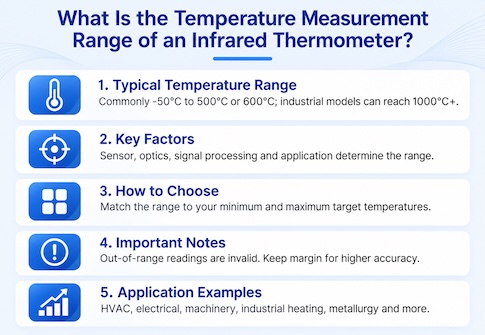
The temperature range defines the approximate lower and upper limits within which the instrument is designed to measure. One infrared thermometer may be intended for routine industrial maintenance, while another may be designed for furnaces, high-temperature machinery, or distant hot targets.
A wider range increases application flexibility, but if the user normally measures only from several tens to a few hundred degrees Celsius, the additional extremely low or high temperature capability may provide little practical benefit.
Before selecting an instrument, determine:
● The temperatures measured most frequently;
● The normal minimum and maximum operating temperatures;
● Whether occasional temperature peaks may occur;
● Whether additional range margin is required.
For example, if the highest expected target temperature is around 300°C, this does not automatically mean that an instrument rated above 1000°C is required. A model with suitable margin above the expected maximum and good accuracy within the main operating range may be the more appropriate choice.
Why Can’t Temperature Range and Accuracy Be Compared Using Only One Number?
Infrared thermometer accuracy is usually not identical across the entire specified temperature range.
Technical specifications often define different accuracy values for different temperature intervals. Accuracy may be expressed as a fixed temperature error, a percentage of reading, or a combination of both depending on the range.
This means that an infrared thermometer with a very wide temperature range does not necessarily maintain the same measurement uncertainty from its minimum to maximum limit.
When comparing products, do not focus only on:
● Which model has the higher maximum temperature;
● Which model shows the smallest headline accuracy figure.
Instead, check the accuracy specification for the temperature interval in which the instrument will actually be used.
If most measurements are between 50 and 200°C, performance within that range is generally more relevant than whether the instrument can measure 800°C, 1000°C, or more.
Why Can a Wide Temperature Range Increase Measurement Design Complexity?
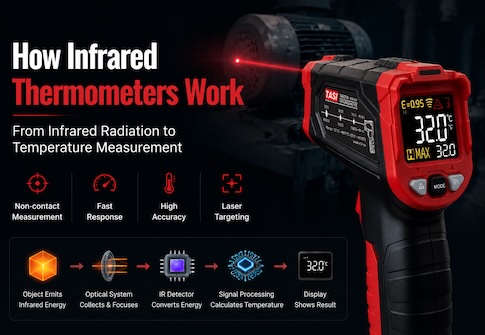
Infrared thermometers determine temperature by detecting infrared radiation emitted from the target surface. Radiation levels can differ significantly between low- and high-temperature targets, requiring the sensor, optics, analog circuitry, calibration, and signal-processing algorithms to work together across a wide dynamic range.
When one instrument is expected to cover both relatively low temperatures and very high temperatures, system design, compensation, and calibration become more demanding.
This does not mean that a wide-range instrument must have poor accuracy.
Modern infrared thermometers can combine a broad range with strong measurement performance through appropriate sensor design, multi-point or segmented calibration, and compensation algorithms. The important point is that a wider range should not be assumed to provide better accuracy across the entire range.
Always refer to the manufacturer’s complete specification.
When Should Accuracy Take Priority?
If the application operates within a relatively stable temperature range and the readings are used for comparison, diagnosis, or process evaluation, accuracy within the main operating range deserves greater attention.
Typical applications include:
● HVAC equipment inspection;
● Temperature-rise checks on electrical cabinets, terminals, and distribution equipment;
● Maintenance of motors, bearings, pumps, and other machinery;
● Product quality inspection and process-temperature comparison;
● Repeated measurements in laboratories and R&D;
● Trending temperature differences between locations.
These applications often do not require extreme temperature capability but benefit from stable repeat measurements and dependable performance within the normal operating range.
In addition to accuracy, check repeatability, resolution, and specified operating conditions.
Resolution must not be confused with accuracy. An instrument displaying 0.1°C increments does not necessarily have an accuracy of ±0.1°C.
When Should a Wide Temperature Range Take Priority?
Temperature range becomes more important when one instrument must cover several temperature levels or when target temperatures vary substantially.
Examples include:
● Industrial equipment inspection across different temperature zones;
● Furnaces, ovens, and high-temperature processing equipment;
● Metalworking and other high-temperature processes;
● Temperature checks on different parts of machinery;
● Production lines involving several materials or process stages;
● Maintenance teams that need one instrument for multiple types of equipment.
In these situations, ensure that the instrument covers all required temperatures with appropriate margin.
However, the accuracy within the primary operating zones should still be verified. There is little value in selecting an unnecessarily high maximum temperature solely because the specification appears more impressive.
Why Can Measurements Still Be Inaccurate Even with a High-Accuracy Instrument?
Infrared thermometry is a non-contact method for measuring surface temperature. Instrument accuracy is only one factor affecting the final result.
Even a high-accuracy infrared thermometer can produce significant errors if the measurement method is inappropriate.
Common factors include:
● Emissivity setting: Polished metals, stainless steel, aluminum, copper, and other low-emissivity or highly reflective surfaces can cause large errors.
● Incorrect D:S ratio: If the distance is too great, the measurement spot may extend beyond the target.
● Target too small: The instrument measures infrared radiation over an area, not simply at the laser point.
● Ambient temperature changes: An instrument moved quickly from a cold environment into a warm one may require time to reach thermal equilibrium.
● Steam, smoke, dust, or oil mist: These can attenuate or interfere with infrared radiation from the target.
● Reflected background radiation: Reflective surfaces may reflect infrared energy from nearby heat sources.
Therefore, product selection should not be based solely on temperature range and stated accuracy.
Why Should D:S Be Considered Together with Temperature Range?
The D:S ratio, or Distance-to-Spot ratio, determines the approximate size of the measurement area at a given distance.
When measuring a small, hot target from a greater distance, an adequate temperature range alone is not enough. If the D:S ratio is insufficient, the measurement area may include both the target and its surroundings, causing the displayed value to differ from the actual target surface temperature.
High-temperature applications should therefore consider:
● Whether the temperature range is sufficient;
● The physical size of the target;
● The required measurement distance;
● Whether the D:S ratio ensures that the target fully covers the measurement area.
For distant, small, or high-temperature targets, a higher D:S ratio may be more useful than simply choosing a wider temperature range.
How Should You Choose Between Temperature Range and Accuracy?
A practical approach is to define the primary operating temperature range first.
For example, if an application normally involves temperatures from 80 to 350°C, with occasional peaks up to 450°C, first choose a model that can safely cover 450°C with reasonable margin. Then compare the available instruments based on their accuracy within the main 80–350°C range.
A suitable selection sequence is:
● Determine the actual minimum and maximum temperatures;
● Allow reasonable margin for temperature fluctuations;
● Check accuracy in the primary operating range;
● Compare repeatability and resolution;
● Select the appropriate D:S ratio according to target size and measurement distance;
● Confirm whether adjustable emissivity is required for the materials involved;
● Finally compare response time, alarms, MAX/MIN, data logging, and other functions.
This approach is generally more effective than simply choosing the model with the widest range or the smallest headline accuracy value.
Should You Choose a Wider Range for Future Applications?
Some additional range can be useful, but excessive range should not be selected solely for hypothetical future requirements.
If high-temperature equipment may realistically be added in the future, additional range can improve instrument versatility. However, if current and foreseeable applications remain concentrated in low- to medium-temperature conditions, performance in those ranges should remain the priority.
For industrial maintenance teams, it may also be more effective to use different instruments for different tasks: a medium-range, high-accuracy model for routine inspections and a dedicated wide-range or high-D:S model for high-temperature equipment.
This can be more practical than expecting one instrument to cover every possible application.
Which Specifications Should Be Compared?
In addition to temperature range and accuracy, compare:
● Temperature range;
● Accuracy within different temperature intervals;
● Repeatability;
● Resolution;
● D:S ratio;
● Emissivity range and adjustability;
● Response time;
● Operating ambient temperature;
● Spectral response;
● MAX/MIN, data hold, high/low alarms, and other functions.
The most suitable infrared thermometer is the one whose overall specifications match the application—not necessarily the one with the most extreme individual specification.
FAQ
● Does a wider temperature range make an infrared thermometer more professional?
Not necessarily. A wider range increases temperature coverage, but overall capability also depends on accuracy, repeatability, D:S ratio, emissivity adjustment, environmental performance, and system design.
● Is a high-accuracy infrared thermometer always better than a wide-range model?
No. If the target temperature exceeds the instrument’s range, its stated accuracy is irrelevant. First ensure adequate temperature coverage, then compare accuracy within the primary operating range.
● How much temperature-range margin should be allowed?
This depends on equipment fluctuations, operating conditions, and possible temperature peaks. The normal maximum temperature should not routinely sit very close to the instrument’s upper limit, but excessive unused range is also unnecessary.
● Does 0.1°C resolution mean ±0.1°C accuracy?
No. Resolution is the smallest displayed increment, while accuracy describes the possible difference between the indicated value and the true value.
● If two infrared thermometers have the same temperature range, what should be compared next?
Compare accuracy within the working range, repeatability, D:S ratio, emissivity adjustment, response time, and operating environment. D:S is especially important for small or distant targets.
● For high-temperature measurement, should range or accuracy come first?
First ensure that the range covers the highest expected target temperature. Then evaluate accuracy in the high-temperature region, D:S ratio, and target emissivity characteristics. Maximum temperature alone is not sufficient for selection.
Summary
A wide temperature range and high accuracy are not a simple either-or choice, and an infrared thermometer should not be evaluated solely by its maximum temperature or a single accuracy figure.
A practical principle is: first ensure that the temperature range covers the application, then focus on measurement accuracy within the primary operating range.
For applications with relatively stable temperatures and a need for reliable comparison or trend analysis, accuracy, repeatability, and consistency deserve greater emphasis. For applications involving large temperature variations, high-temperature equipment, or multiple measurement tasks, temperature range becomes more important.
D:S ratio, target size, emissivity, measurement distance, and environmental conditions must also be considered. Only when these parameters match the actual application can the specified performance of an infrared thermometer translate into reliable measurement results.