Introduction
Laser tachometers and photo tachometers are widely used for non-contact rotational speed measurement on motors, fans, shafts, pulleys, and other rotating machinery. Since both instruments typically detect periodic changes in reflected light from a rotating target and convert these signals into RPM, the two terms are sometimes treated as if they described completely different technologies.
In practice, they are closely related.
From a measurement principle perspective, a laser tachometer is generally a type of photoelectric tachometer. The term “laser” mainly describes the emitted light source and beam characteristics, while “photoelectric” describes the broader method of transmitting light, receiving the reflected optical signal, and electronically processing that signal to determine rotational speed.
For this reason, the most useful comparison is not simply “laser versus photoelectric,” but rather how the instruments differ in light source, beam characteristics, aiming, measuring distance, and application conditions.
Key Takeaways
● A laser tachometer is generally one implementation of a photo tachometer rather than a completely separate measurement technology.
● Both are commonly used for non-contact rotational speed measurement by detecting periodic reflected-light signals from a rotating object.
● Laser tachometers use a narrow, directional laser beam, making them easier to aim at small or relatively distant targets.
● Other photo tachometers may use LEDs, infrared emitters, or other optical sources depending on their design.
● Measurement accuracy cannot be judged simply by whether an instrument is described as “laser” or “photoelectric.” Sensor performance, signal processing, target condition, measuring distance, and instrument design are also important.
● In reflective measurement applications, reflective tape helps create a strong and repeatable optical signal.
What Is a Laser Tachometer?
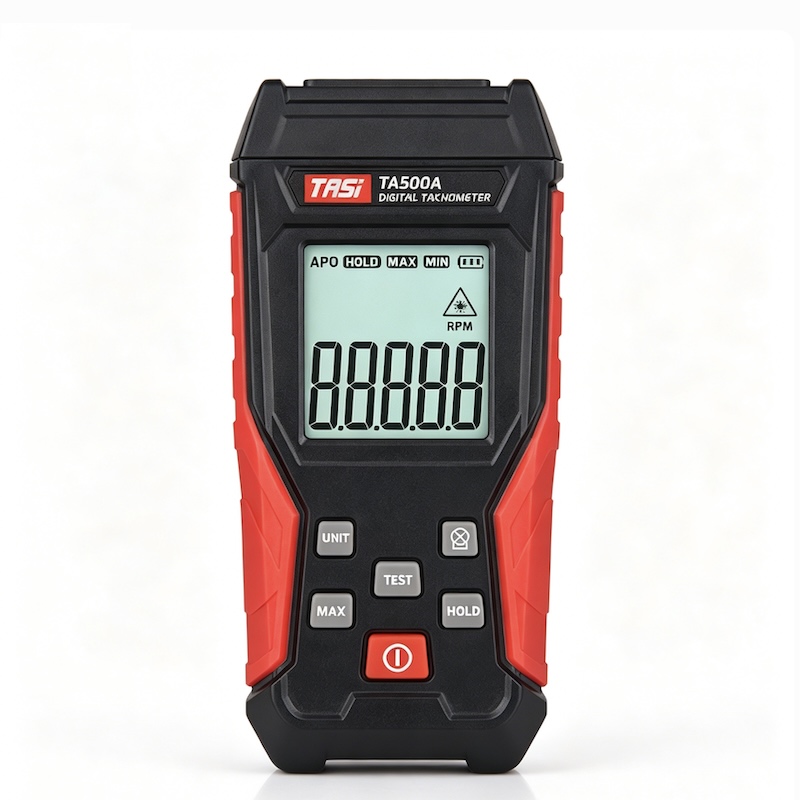
A laser tachometer is a non-contact rotational speed measuring instrument that uses a laser light source together with a photoelectric receiver.
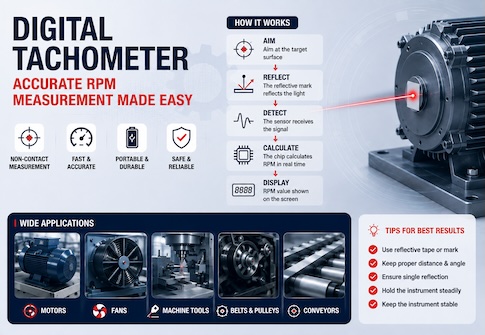
During measurement, a reflective mark—typically a piece of reflective tape—is placed on the rotating shaft, disc, or other target. The tachometer directs a laser beam toward the rotating surface. Each time the reflective mark passes through the beam, the amount of reflected light changes significantly.
The optical receiver detects this periodic change and converts it into an electrical pulse. The instrument then determines rotational speed from the number and frequency of the pulses and displays the result in RPM, or revolutions per minute.
When one effective reflective mark is used, one detected pulse generally corresponds to one revolution.
The laser itself does not change the fundamental RPM calculation method. Its main advantage is that it provides a concentrated, directional beam that makes the measuring point easier to identify and aim.
What Is a Photo Tachometer?
A photo tachometer uses an optical emitter, a photoelectric receiver, and electronic signal-processing circuitry to detect repeating rotational cycles and calculate rotational speed.
“Photo tachometer” is a broader technical term. Depending on the instrument design, the emitted light source may be a visible LED, infrared emitter, or laser.
A typical measurement sequence is:
● The instrument emits light toward the rotating target.
● Reflective and non-reflective areas produce different return signals.
● The optical receiver detects the periodic variation in reflected light.
● The optical signal is converted into electrical pulses.
● The instrument calculates rotational speed from the pulse frequency.
● The result is displayed in RPM.
A photo tachometer that uses a laser as its optical source may therefore also be described as a laser photo tachometer.
This explains why terms such as “Laser Tachometer,” “Photo Tachometer,” and “Laser Photo Tachometer” may all appear in product documentation.
Main Differences Between Laser and Photo Tachometers
The most important differences usually relate to the emitted light source and the practical characteristics that result from it, rather than the RPM calculation principle itself.
● Light source: A laser tachometer specifically uses a laser. A broader photo tachometer may use an LED, infrared emitter, laser, or another optical source.
● Beam concentration: Laser beams are highly directional and typically remain relatively concentrated, which is useful when measuring small rotating targets.
● Aiming: A visible laser spot allows the operator to see where the instrument is measuring, making alignment easier on shafts, small pulleys, and targets located at some distance.
● Measuring distance: Depending on instrument design, laser tachometers are often better suited to measurements performed from a greater distance. The usable range of LED or infrared photo tachometers depends on emitter power, receiver sensitivity, and optical design.
● Application format: Handheld non-contact tachometers often use lasers to simplify field measurement, while fixed industrial speed-monitoring systems may use dedicated photoelectric or infrared sensors.
● Visibility: A visible laser directly indicates the measurement point, while infrared light cannot normally be seen by the operator.
These are general characteristics. Actual measuring range, accuracy, resolution, and operating distance should always be confirmed from the specifications of the individual instrument.
Do They Use the Same Operating Principle?
For typical reflective RPM measurement, their fundamental operating principles are very similar.
The process can be summarized as:
Light emission → Target reflection → Optical detection → Pulse generation → Frequency calculation → RPM
If a rotating shaft has one reflective mark, that mark periodically passes through the instrument's optical detection area. Each valid reflection produces a signal that represents one rotational cycle.
The key factor is therefore not simply whether the light source is a laser or another optical source, but whether the instrument can reliably distinguish each periodic optical event.
Is a Laser Tachometer Always More Accurate?
No.
A laser source does not automatically provide higher rotational speed accuracy. Its main advantages are beam directionality, a concentrated measuring spot, and easier aiming.
Actual accuracy is influenced by factors such as:
● Instrument accuracy specification and resolution;
● Sensitivity of the optical receiver;
● Internal signal-processing performance;
● Contrast between the reflective mark and surrounding surface;
● Whether the target is within the specified measuring distance;
● Stability of beam alignment;
● Vibration or axial movement of the rotating object;
● Interference from ambient light.
When comparing tachometers, measurement range, basic accuracy, resolution, effective operating distance, and application conditions are more meaningful than the word “laser” alone.
Do Both Types Require Reflective Tape?
For common reflective laser tachometers and reflective photo tachometers, reflective tape is generally recommended.
The tape creates a controlled high-reflectivity area that contrasts strongly with the surrounding surface. Each time the mark passes through the optical detection area, the receiver can identify a clear and repeatable signal.
Some rotating components may already have sufficient natural contrast between bright and dark or reflective and non-reflective areas. In such cases, certain instruments may produce a reading without added reflective tape.
However, measurement stability can then depend on material, surface colour, gloss, angle, and ambient lighting. For reliable and repeatable measurements, suitable reflective tape is normally the preferred approach.
Typical Applications
Laser tachometers are particularly suitable for handheld measurements where accurate aiming or a certain stand-off distance is required, including:
● Motor shaft speed measurement;
● Fan and impeller testing;
● Pulley speed measurement;
● Machine-tool spindle inspection;
● Pump maintenance;
● Industrial equipment troubleshooting;
● High-speed rotating parts that should not be contacted directly.
Photoelectric speed measurement has a broader range of implementations and can also be integrated into fixed or automated systems, including:
● Production-line rotating mechanisms;
● Motor speed monitoring;
● Conveyor speed feedback;
● Laboratory test equipment;
● Automated control and monitoring systems.
For portable field work, a visible laser often improves aiming convenience. For industrial monitoring systems as a whole, photoelectric speed sensing covers a wider range of sensor configurations.
How to Choose Between Them
When selecting a handheld non-contact tachometer, it is usually more useful to evaluate actual measurement performance than to focus only on whether the product is labelled “laser” or “photoelectric.”
Key parameters include:
● Measurement range: Confirm that the minimum and maximum RPM values cover the intended equipment.
● Accuracy: Select a suitable accuracy level according to maintenance, commissioning, or testing requirements.
● Resolution: Higher resolution can be important when measuring low speeds or small speed variations.
● Effective measuring distance: If the rotating part cannot be approached closely, check the specified optical operating distance.
● Target size: A concentrated and easy-to-aim beam is useful for small shafts, pulleys, and confined measurement points.
● Operating environment: Strong ambient light, dust, vibration, and surface condition may affect optical detection.
● Additional functions: Depending on the application, functions such as MAX/MIN, data hold, or memory may be useful.
For routine handheld inspection of motors, fans, shafts, and pulleys, a non-contact tachometer with visible laser aiming is often particularly convenient.
Common Misconceptions
● Misconception: Laser tachometers and photo tachometers use completely different technologies.
In most cases, laser tachometers also use a photoelectric receiver to detect reflected signals and can therefore be considered one type of photo tachometer.
● Misconception: A laser automatically means higher accuracy.
A laser mainly improves beam directionality and aiming. Overall measurement accuracy depends on the complete instrument design and measurement conditions.
● Misconception: Pointing the laser at any rotating surface will produce an RPM reading.
The instrument must detect a stable periodic change in reflected light. A uniformly reflective surface may not generate sufficient signal contrast.
● Misconception: A longer measuring distance is always better.
Every instrument has an effective operating range. Excessive distance, incorrect aiming, or insufficient reflected signal can cause unstable readings or measurement failure.
FAQ
Is a laser tachometer a non-contact tachometer?
Yes. A typical laser tachometer determines rotational speed optically without contacting the rotating shaft.
Is a laser tachometer a type of photo tachometer?
Generally, yes. The laser provides the emitted light, while a photoelectric sensor receives the reflected signal.
Why are some instruments called photo tachometers and others laser tachometers?
The terminology reflects different emphasis. “Photo tachometer” describes the optical detection principle, while “laser tachometer” highlights the use of a laser light source and aiming beam.
Can a laser tachometer work without reflective tape?
Some targets with sufficient natural optical contrast may produce a usable signal, but reflective tape normally provides more stable and repeatable measurements.
Can a laser tachometer measure from a long distance?
The maximum usable distance depends on the specific optical system, emitter, receiver sensitivity, and reflective target. The manufacturer's specified operating distance should always be followed.
How is a laser tachometer different from a contact tachometer?
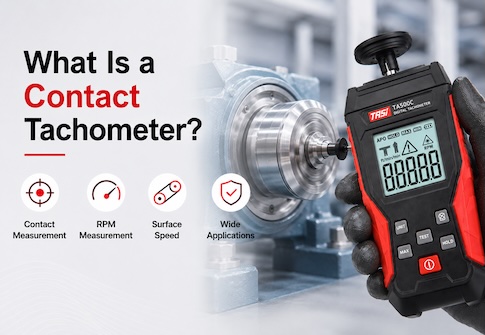
A laser tachometer measures rotational speed optically without physical contact. A contact tachometer requires a measuring tip or wheel to touch the rotating shaft or moving surface.
Conclusion
Laser tachometers and photo tachometers are not completely separate technologies. In broad technical terms, a laser tachometer is generally a type of photo tachometer that uses a laser as its emitted light source.
Both determine RPM by detecting periodic optical signals generated by a rotating target. Compared with photoelectric systems using conventional LEDs or infrared emitters, laser-based instruments generally provide a more concentrated beam, clearer aiming, and greater convenience for handheld measurements.
When selecting an instrument, the most important considerations are measurement range, accuracy, resolution, effective measuring distance, target size, and operating environment—not simply whether the product is described as “laser” or “photoelectric.”