Introduction
When using an infrared thermometer, the display may occasionally show “OL” instead of a numerical temperature reading. For users encountering this indication for the first time, it can easily be mistaken for an instrument failure.
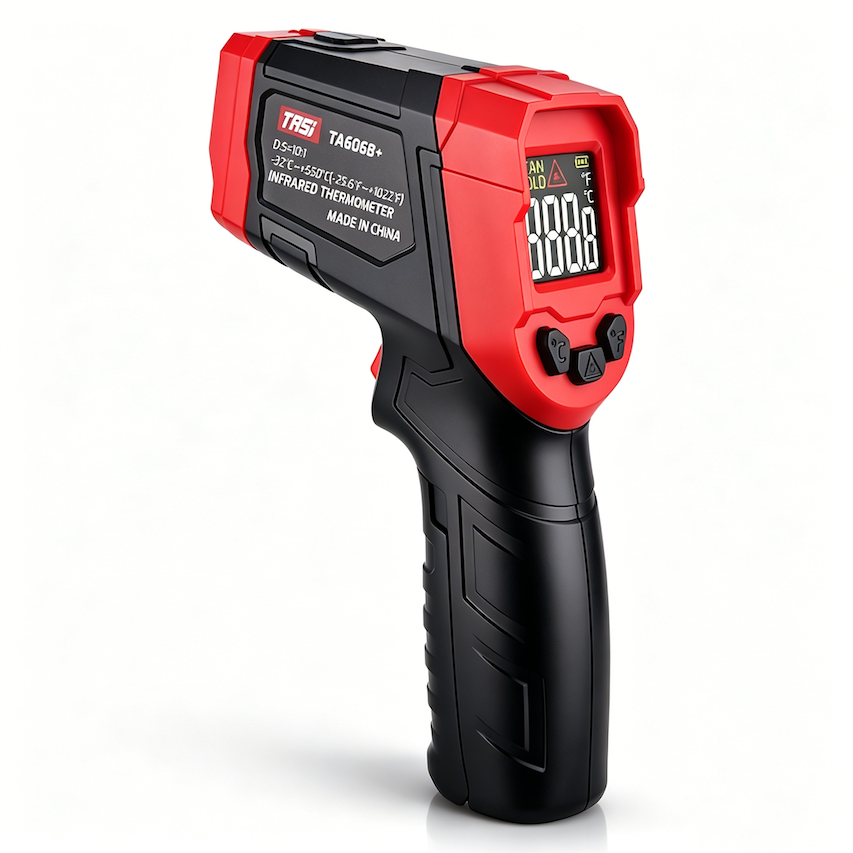
In most infrared thermometers, OL is associated with a measurement that falls outside the instrument’s allowable measurement range. For example, if the target surface temperature exceeds the thermometer’s maximum range or falls below its minimum range, the instrument may be unable to provide a valid numerical reading and display OL instead.
However, display logic varies between models. The indication should therefore be interpreted together with the product manual, specified measurement range, and actual measurement conditions.
Key Points
● OL usually indicates that the measured temperature or detected signal is outside the range the infrared thermometer can process normally.
● A target temperature that is too high or too low is one of the most common causes.
● OL does not necessarily mean that the thermometer is faulty.
● First check the specified temperature range and determine whether the target may be outside that range.
● If OL continues to appear when measuring normal room-temperature objects, further checks of the lens, battery, ambient conditions, or instrument may be necessary.
● The exact meaning of OL may vary slightly by manufacturer and model, so the relevant product manual should always be consulted.
What Does OL Usually Mean on an Infrared Thermometer?
OL can generally be understood as an “over-limit” or out-of-range indication, meaning that the current measurement is outside the range the instrument can measure or display correctly.
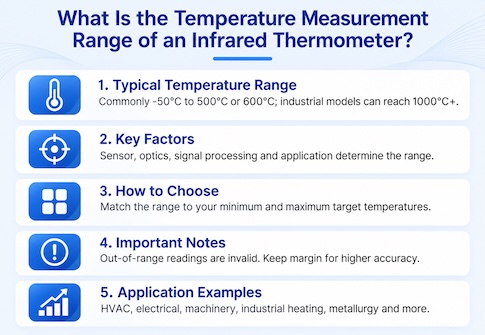
For example, if an infrared thermometer has a specified measurement range of -50°C to 550°C and the actual target temperature is significantly above 550°C, the instrument cannot provide a valid temperature within its designed range and may display OL instead of a numerical value.
Similarly, some instruments may also display OL when the measured value falls below the minimum temperature limit. Other models may use LO or another symbol for this condition.
Therefore, when OL appears, the first question should not be whether the thermometer is damaged, but whether the current measurement conditions are outside the instrument’s normal operating range.
Why Does OL Appear When the Target Temperature Is Too High?
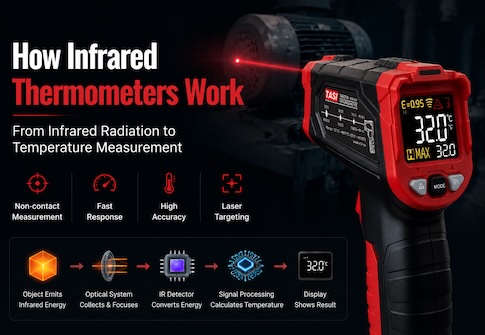
Every infrared thermometer has a specified temperature measurement range. Its infrared detector, optical system, signal-processing electronics, and calibration are designed for operation within that range.
When the infrared radiation received from the target exceeds the level the instrument can process reliably, the thermometer can no longer calculate a temperature within its specified performance range and may display OL.
For example:
● The thermometer has a maximum range of 550°C, while the target may be approximately 700°C.
● A general-purpose infrared thermometer is used on a high-temperature furnace, molten metal, or a very hot heating element.
● The temperature of a rapidly heating component rises beyond the thermometer’s upper limit.
In these situations, OL is a normal over-range indication. Repeated measurements will not produce a valid result. A thermometer with a higher and more appropriate measurement range should be used.
Can a Temperature That Is Too Low Also Cause OL?
Yes.
Infrared thermometers have both upper and lower measurement limits. If the target surface temperature falls below the lowest temperature the instrument can measure reliably, the thermometer may also be unable to calculate a valid result.
Different products handle this condition differently. Some models may display LO, while others may use OL, a negative over-range symbol, or another error indication.
Therefore, when measuring refrigeration equipment, cold-storage systems, low-temperature piping, cryogenic containers, or other cold targets, the thermometer’s minimum measurement temperature should also be checked.
What Should Be Checked First When OL Appears?
When OL appears, the following checks are recommended:
● Check the measurement range. Refer to the thermometer label, manual, or technical specifications to confirm its minimum and maximum measurable temperatures.
● Estimate the target temperature. When measuring furnaces, heating elements, exhaust components, or other hot targets, first consider whether the temperature may exceed the instrument’s upper limit.
● Test a normal-temperature target. Measure a wall, sheet of paper, cardboard, or another high-emissivity object near room temperature and check whether a normal reading returns.
● Inspect the infrared lens. Make sure the lens is not severely contaminated or obstructed by dirt, moisture, dust, or foreign material.
● Check the battery. A weak battery may cause abnormal operation. Replace the battery if necessary and test again.
● Check the operating environment. If the thermometer has just been moved between significantly different temperatures, allow it to stabilize before measurement.
If the thermometer measures room-temperature objects normally but displays OL only on specific hot or cold targets, the instrument itself is usually functioning and the target temperature is more likely outside its range.
How Can You Tell Whether OL Means Over-Range or an Instrument Fault?
A simple method is to test an object whose temperature is known to be well within the normal measurement range.
In a typical indoor environment, measure paper, cardboard, a wall, or another non-reflective surface. If the thermometer displays a normal reading close to room temperature but shows OL on a hot object, the indication is most likely caused by an over-range condition.
If OL appears regardless of what is being measured, further investigation is required.
● Check whether the ambient temperature exceeds the instrument’s specified operating range.
● Inspect the infrared lens for heavy contamination or condensation.
● Check whether the battery is weak.
● Determine whether the instrument has been dropped, subjected to severe impact, or exposed to water.
● Consider whether there may be an internal detector, optical, or electronic fault.
If OL continues after basic operating conditions have been verified, the instrument should not be relied on for formal measurements until the issue has been resolved according to the product manual or through technical support.
What Is the Difference Between OL, HI, and LO?
Infrared thermometers do not all use the same display conventions, so OL, HI, and LO do not have a completely universal meaning across all models.
In general:
● HI usually indicates that the measured temperature is above the instrument’s upper limit.
● LO usually indicates that the measured temperature is below the lower limit.
● OL usually indicates an over-range condition, a value outside the valid measurement range, or an invalid measurable result.
Some instruments use only one or two of these indications. Therefore, the display characters should not be interpreted as a definitive fault diagnosis without reference to the specific model.
The most reliable approach is to compare the indication with the model’s measurement range and the error-message definitions in its operating manual.
Can Measuring from Too Far Away Cause OL?
Usually, excessive distance is more likely to cause an oversized measurement spot and greater influence from the surrounding background rather than directly causing OL.
Infrared thermometers have a defined distance-to-spot ratio, or D:S ratio. As the measurement distance increases, the area from which the instrument receives infrared radiation also increases. If the target is smaller than the measurement spot, radiation from surrounding surfaces may be included, causing measurement error.
However, if the resulting combined signal falls outside the range the instrument can process normally, some models may display an abnormal indication.
For this reason, when OL appears, temperature range should be checked first, but measurement distance and target size should also comply with the thermometer’s D:S requirements.
Can Incorrect Emissivity Settings Cause OL?
Incorrect emissivity settings are more likely to cause temperature error than directly cause an OL indication.
However, when measuring high-temperature, low-emissivity, or highly reflective surfaces, a significant mismatch between the emissivity setting and the actual target surface may produce a substantial calculation error. If the true or calculated temperature is already close to the instrument’s upper or lower measurement limit, the result may move outside the valid range.
Emissivity settings and reflected background radiation therefore require particular attention when measuring metals, polished surfaces, and other low-emissivity materials.
For highly reflective metallic targets, adjusting emissivity alone may not completely solve the measurement problem. An appropriate measurement method is also required.
Can Ambient Temperature Cause OL?
Yes, but it is important to distinguish between the temperature of the target and the ambient temperature surrounding the infrared thermometer itself.
An infrared thermometer normally specifies both a target measurement range and an allowable operating ambient temperature range. The fact that an instrument can measure a target at several hundred degrees Celsius does not mean that the thermometer itself can operate in an environment at that temperature.
If the instrument is exposed to excessive heat, extreme cold, or a rapid ambient temperature change, the internal infrared detector and temperature-compensation system may not operate correctly, potentially resulting in abnormal readings or error indications.
For example, after moving an instrument from a cold outdoor environment into a warm indoor environment, its internal temperature may require time to stabilize and condensation may form on the lens. The thermometer should be allowed to reach environmental equilibrium before accurate measurements are taken.
Can You Continue Measuring a High-Temperature Target When OL Is Displayed?
An OL indication should not be treated as a valid temperature measurement.
Once the instrument indicates that the measurement is outside its capability, its specified accuracy can no longer be guaranteed, even if the actual temperature is only slightly above the upper measurement limit.
If the target routinely exceeds the maximum temperature range of the existing thermometer, a model with an appropriate higher range should be selected rather than attempting to estimate the temperature using an over-range instrument.
Although infrared temperature measurement is non-contact, the instrument must still be kept within a safe working distance and its permitted ambient operating temperature. High-temperature locations may also involve intense thermal radiation, hot air, flames, or other hazards, so applicable site safety procedures should be followed.
FAQ
Does OL mean the infrared thermometer is broken?
Not necessarily. One of the most common causes of OL is a target temperature outside the thermometer’s valid measurement range. If normal readings return when measuring room-temperature objects, the instrument is unlikely to have an obvious fault.
Does OL always mean the temperature is too high?
No. It often indicates an over-range condition, but some models may also display OL when the temperature is too low or when a valid measurement cannot be obtained. Refer to the model-specific manual.
What should I do if my infrared thermometer always displays OL?
Test a non-reflective object at room temperature first, then check the battery, lens, and ambient operating conditions. If OL appears for all targets, further instrument inspection may be necessary.
Can replacing the battery fix OL?
It may help if the indication is caused by low battery voltage or unstable power. It will not solve the problem if the target temperature is genuinely outside the instrument’s measurement range.
Can I estimate the actual temperature after the instrument exceeds its range?
This is not recommended. Once the measurement falls outside the specified range, the instrument cannot guarantee a valid reading or stated accuracy. Use an infrared thermometer with a suitable range.
Are OL and LO the same?
Not necessarily. Some instruments use LO for values below the lower measurement limit and OL for a general over-range condition. Display definitions vary by model.
Is it normal for OL to appear when measuring ordinary objects?
Normally, no. If OL persists when measuring walls, paper, or other room-temperature objects under normal operating conditions, check the battery, lens, environmental conditions, and possible instrument damage.
Conclusion
When an infrared thermometer displays OL, the most common meaning is that the current measurement is outside the instrument’s valid measurement or display range. A target temperature above the upper limit is a common cause, although some models may also use OL for temperatures below the lower limit or other out-of-range conditions.
The first step is to confirm the thermometer’s specified measurement range and then test a non-reflective object at normal room temperature. The battery, infrared lens, and operating environment should also be checked.
If OL appears only when measuring certain high- or low-temperature targets, the most likely cause is an unsuitable measurement range. If OL remains on normal-temperature targets, further troubleshooting may be required. Because error-code definitions vary between infrared thermometer models, the operating manual for the specific instrument should always be treated as the final reference.