Introduction
Infrared thermometers rely on battery power to operate the infrared detector, signal-processing circuitry, display, laser aiming module, and other internal components. This raises a common question: does measurement accuracy gradually decrease as the battery becomes discharged?
In general, a properly designed infrared thermometer should not immediately develop significant measurement errors simply because the battery is no longer fully charged. Most instruments incorporate voltage regulation and low-battery detection, allowing normal measurement performance to be maintained while the supply voltage remains within the specified operating range.
However, if the battery voltage continues to fall and approaches the instrument's minimum operating voltage, overall operating stability may be affected. For this reason, the battery should be replaced promptly when the low-battery indicator appears.
Key Points
● A partially discharged battery does not necessarily cause an infrared thermometer to become inaccurate immediately.
● Properly designed instruments generally use voltage regulation and low-battery detection to maintain normal operation within a specified voltage range.
● If battery voltage becomes too low, unstable readings, abnormal response, a dim display, automatic shutdown, or measurement failure may occur.
● A weaker laser does not necessarily mean that temperature accuracy has decreased, because the laser is normally used for aiming rather than temperature sensing.
● Replacing the battery when a low-battery warning appears is a simple way to maintain reliable measurements.
Why Does an Infrared Thermometer Need a Stable Battery Voltage?
An infrared thermometer does more than simply power a temperature sensor directly from the battery. A complete measurement typically depends on several electronic systems working together, including the infrared detector, analog amplification circuitry, analog-to-digital conversion, microprocessor, ambient-temperature compensation circuitry, and display system.
These circuits require a reasonably stable operating voltage.
As long as battery voltage remains within the instrument's permitted operating range, the internal voltage-regulation circuitry can normally provide a stable supply. As a result, the measurement value should not change in direct proportion to the gradual decrease in battery voltage.
If battery voltage falls below the level required for proper electronic operation, however, some circuits may no longer function within their intended operating conditions, potentially reducing the overall stability of the instrument.
Does Low Battery Power Always Make Measurements Inaccurate?
No.
In an infrared thermometer with properly designed power management, the instrument may continue to measure normally before the low-battery warning appears and even for some time after the warning is first displayed.
It is therefore incorrect to assume that if a battery has only half of its capacity remaining, measurement accuracy is also reduced by half.
In practice, the instrument normally maintains its specified performance while the supply voltage remains within its operating range. Once battery voltage reaches a defined threshold, a low-battery warning is displayed. If the instrument continues to be used and voltage decreases further, the likelihood of unstable operation increases.
Because power-management design and minimum operating voltage vary between models, the exact behavior can differ from one infrared thermometer to another.
What Can Happen When Battery Voltage Becomes Too Low?
When the battery is close to being fully discharged, one or more of the following symptoms may occur:
● A low-battery icon or battery warning appears on the display;
● The LCD becomes faint, flickers, or displays information incorrectly;
● Temperature readings refresh abnormally;
● Readings become less stable during continuous measurement;
● Buttons respond slowly or certain functions fail to operate;
● Display backlight brightness decreases;
● The laser aiming point becomes dim or cannot be activated;
● The instrument shuts down automatically or fails to power on;
● At extremely low supply voltage, the measurement system may no longer operate correctly.
Well-designed instruments often use a low-battery warning, function limitation, or automatic shutdown to prevent prolonged operation under severely undervoltage conditions.
Does a Dim Laser Mean the Temperature Measurement Is Already Inaccurate?
Not necessarily.
The laser on an infrared thermometer is normally used to assist with aiming. It is generally not the infrared source used to determine the target temperature.
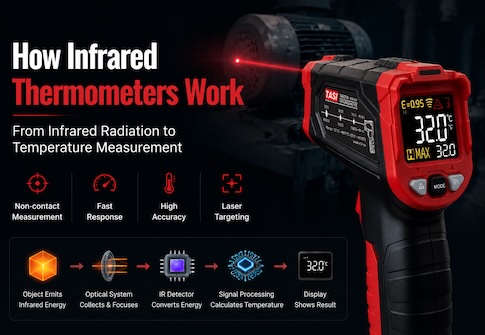
The target itself emits infrared radiation. The thermometer's optical system receives this radiation, and the infrared detector and electronic circuitry use it to calculate the surface temperature.
Therefore, a reduction in laser brightness caused by a weak battery does not, by itself, prove that the temperature reading is inaccurate.
However, a noticeably weaker laser can indicate that battery voltage has become low. If this occurs together with a low-battery warning, abnormal display behavior, or unstable readings, the battery should be replaced immediately.
Why Can Readings Still Appear Normal When the Battery Is Low?
This is normal.
The internal measurement circuitry of an infrared thermometer is generally not powered directly by the continuously decreasing raw battery voltage. Instead, power-management and voltage-regulation circuits are commonly used to provide a more stable operating supply.
As long as battery voltage remains above the minimum level required by the instrument, the measurement electronics may continue to operate normally. The temperature reading can therefore appear unchanged compared with readings obtained using a new battery.
The important factor is whether the battery is approaching the instrument's minimum operating voltage, rather than simply how long the battery has been in use.
For this reason, the instrument's low-battery indicator is generally more useful than estimating battery condition based only on operating time.
Can the Instrument Still Be Used After the Low-Battery Warning Appears?
The instrument may continue to operate for a short time, but continued use is not recommended when measurement reliability is important.
A low-battery warning normally indicates that the battery is approaching the range in which replacement is recommended. Even if the readings still appear normal, there is no guarantee that the instrument will maintain the same operating condition as battery voltage continues to fall.
In industrial maintenance, electrical inspection, HVAC diagnostics, equipment temperature inspection, and similar applications where readings may be used to identify abnormal heating or equipment faults, the battery should be replaced promptly after the warning appears.
Why Is It Recommended to Measure Again After Replacing the Battery?
If measurements were previously taken while the battery was clearly low, repeating the measurement with a new battery helps eliminate abnormal power supply as a possible source of error.
When replacing the battery:
● Use the battery type specified in the instrument manual;
● Do not mix batteries of different brands, capacities, or states of charge;
● Verify correct battery polarity;
● If the instrument will not be used for an extended period, follow the manufacturer's instructions regarding battery storage or removal to reduce the risk of leakage;
● If readings remain abnormal after replacing the battery, check emissivity settings, measurement distance, target size, ambient conditions, and target surface characteristics.
Battery condition is only one of several factors that can affect infrared temperature measurement.
How Can You Tell Whether Abnormal Readings Are Caused by the Battery?
First check whether the instrument is showing other clear signs of low battery power.
If the low-battery icon is displayed together with fluctuating readings, abnormal display behavior, or unstable functions, replace the battery with a suitable new one and repeat the measurement under the same conditions.
If the readings become stable again, the original abnormal behavior may have been related to insufficient supply voltage.
If the problem remains after replacing the battery, check other common causes:
● Is the target smaller than the actual measurement spot?
● Is the measurement distance too long?
● Is the emissivity setting appropriate for the target material?
● Are you measuring a low-emissivity, highly reflective surface such as aluminium, copper, or stainless steel?
● Is the lens contaminated by dust, dirt, or condensation?
● Has the instrument just been moved between environments with a large temperature difference?
● Is there glass, steam, smoke, or another interfering medium in the measurement path?
These factors are often more likely to cause significant infrared measurement errors than an ordinary reduction in battery charge.
FAQ
Does a low-battery warning mean that every temperature reading is already incorrect?
No. A low-battery warning generally indicates that the battery is approaching the recommended replacement level. It does not mean that every current measurement is already incorrect. However, replacing the battery promptly helps maintain measurement stability and reliability.
Will a weak battery make the measured temperature read too high or too low?
There is no fixed direction of error. Severe undervoltage is more likely to cause unstable operation, abnormal readings, or complete measurement failure than a consistent high or low temperature bias.
Does a weaker laser affect temperature measurement?
The laser normally serves only as an aiming aid and does not directly measure infrared temperature. A weaker laser therefore does not necessarily mean that temperature accuracy has decreased. It may, however, indicate low battery voltage.
Can installing a new battery improve the accuracy of an infrared thermometer?
If the existing battery is still within the normal operating voltage range, installing a new battery will not normally improve the instrument's specified accuracy. If the previous battery was severely discharged, replacing it can restore normal and stable operation.
Why are the readings still inaccurate after replacing the battery?
Infrared temperature measurement is also affected by emissivity, measurement distance, spot size, surface reflectivity, ambient temperature, lens condition, and other factors. Replacing the battery only eliminates insufficient power supply as one possible cause.
Conclusion
Low battery power does not mean that the measurement accuracy of an infrared thermometer will decrease continuously or linearly as the battery discharges. While the supply voltage remains within the normal operating range, internal voltage regulation and power-management circuitry generally allow the measurement system to operate normally.
The main concern is severe battery depletion. If battery voltage approaches or falls below the instrument's minimum operating requirement, abnormal display behavior, unstable readings, slow response, function failure, or automatic shutdown may occur.
When the low-battery warning appears, particularly in industrial inspection and equipment maintenance applications where reliable temperature data is important, the battery should be replaced promptly and the measurement repeated when necessary. This helps minimize the potential influence of power-supply conditions on measurement reliability.